Dexak 50
Poland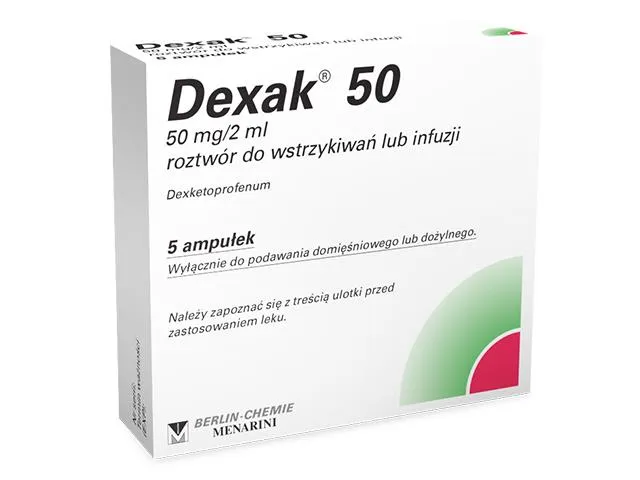
Table of Contents
Package leaflet: Information for the user
Warning! Keep the leaflet! Information on the immediate packaging in a foreign language.
Dexak 50 (Tador Inject)
50 mg/2 ml
solution for injection/infusion
Dexketoprofen
Dexak 50 and Tador Inject are different trade names for the same medicine.
Please read the entire leaflet carefully before using the medicine, as it contains
important information for the patient.
- Keep this leaflet, as you may need to read it again.
- If you have any questions, please consult your doctor or pharmacist.
- This medicine has been prescribed for a specific individual. Do not pass it on to others. The medicine may harm someone else, even if their symptoms are similar.
- If the patient experiences any adverse effects, including any adverse effects not listed in this leaflet, inform a doctor or pharmacist. See section 4.
Table of contents of the leaflet:
- What Dexak 50 is and what it is used for
- Important information before using Dexak 50
- How to use Dexak 50
- Possible side effects
- How to store Dexak 50
- Contents of the pack and other information
1. What Dexak 50 is and what it is used for
Dexak 50 is an analgesic medicine belonging to a group of medicines called non-steroidal anti-inflammatory drugs (NSAIDs).
It is used for symptomatic treatment of moderate to severe acute pain when oral administration is not appropriate, e.g. postoperative pain, pain associated with renal colic, and lumbosacral pain.
2. Important information before using Dexak 50
When not to use Dexak 50:
- If the patient is allergic to dexketoprofen or to any of the other components of this medicine (listed in section 6);
- If the patient is allergic to acetylsalicylic acid or to other non-steroidal anti-inflammatory drugs (NSAIDs);
- If the patient has asthma or has previously experienced asthma attacks, acute allergic rhinitis (short-term inflammation of the nasal lining), nasal polyps (nasal swellings caused by allergy), urticaria (blistering rash), angioedema (swelling of the face, eyes, lips, tongue or throat, or breathing difficulties), or wheezing after taking acetylsalicylic acid or another NSAID;
- If the patient has previously experienced photosensitivity reactions: photoallergic or phototoxic reactions (particularly redness and/or blisters on skin exposed to sunlight) while taking ketoprofen (a non-steroidal anti-inflammatory drug) or fibrates (medicines used to lower blood lipid levels);
- If the patient has a peptic ulcer of the stomach and/or duodenum or gastrointestinal bleeding, or if they have previously experienced gastrointestinal bleeding, ulceration, or perforation;
- If the patient has certain chronic gastrointestinal disorders (e.g. indigestion, heartburn);
- If the patient currently has or has previously had gastrointestinal bleeding or perforation due to the use of painkillers from the NSAID group;
- If the patient has inflammatory bowel diseases (Crohn's disease or ulcerative colitis);
- If the patient has severe heart failure, moderate or severe renal failure, or severe hepatic failure;
- If the patient has a tendency to excessive bleeding or coagulation disorders;
- If the patient is severely dehydrated (excessive fluid loss from the body) due to vomiting, diarrhoea, or inadequate fluid intake;
- If the patient is in the third trimester of pregnancy or is breastfeeding.
Warnings and precautions
Before starting treatment with Dexak 50, discuss with your doctor or pharmacist:
- If the patient has previously had chronic inflammatory bowel diseases (ulcerative colitis, Crohn's disease);
- If the patient has or has previously had other stomach or intestinal disorders;
- If the patient is taking other medicines that increase the risk of gastric or duodenal ulceration or bleeding, e.g. oral corticosteroids, certain antidepressants (SSRIs, such as serotonin reuptake inhibitors), anticoagulant drugs such as acetylsalicylic acid, or anticoagulants such as warfarin. In such cases, consult your doctor before taking this medicine, as they may decide to prescribe an additional protective medicine (e.g. misoprostol or drugs that inhibit gastric acid production);
- If the patient has heart problems, has had a stroke, or is suspected of being at risk for these conditions (e.g. due to high blood pressure, diabetes, high cholesterol levels, or smoking). In such cases, consult your doctor before using Dexak 50. Taking medicines such as Dexak 50 may be associated with a small increased risk of heart attack ("myocardial infarction") or stroke. This risk increases with long-term use of high doses. Do not use higher doses or longer treatment duration than recommended;
- If the patient is elderly: there is an increased risk of adverse effects (see section 4). In such cases, contact your doctor immediately;
- If the patient has allergies or has previously experienced allergy-related problems;
- If the patient has kidney, liver, or heart dysfunction (hypertension and/or heart failure), fluid retention, or if any of these conditions have occurred previously;
- In patients receiving diuretic therapy or in patients with reduced hydration and decreased blood volume due to excessive fluid loss (e.g. frequent urination, diarrhoea, or vomiting);
- In women experiencing fertility problems or undergoing fertility investigations (Dexak 50 may impair female fertility and is not recommended for women planning pregnancy or undergoing infertility treatment);
- In women during the first and second trimesters of pregnancy;
- If the patient has blood cell or bone marrow disorders;
- If the patient has systemic lupus erythematosus or mixed connective tissue disease (immune system disorders affecting connective tissue);
- If the patient has an infection – see below under the section titled "Infections";
- If the patient has asthma, chronic rhinitis, chronic sinusitis, and/or nasal polyps, the risk of allergy to acetylsalicylic acid and/or NSAIDs is higher than in the general population. Taking this medicine may trigger asthma attacks or bronchospasm, particularly in patients allergic to acetylsalicylic acid and/or NSAIDs.
Infections
Dexak 50 may mask symptoms of infection such as fever and pain. Therefore, Dexak 50 may delay appropriate treatment of infection and consequently increase the risk of complications. This has been observed in bacterial pneumonia and bacterial skin infections associated with chickenpox. If the patient takes this medicine during an infection and symptoms persist or worsen, consult a doctor immediately.
Avoid using this medicine during chickenpox.
Children and adolescents
The use of this medicine in children and adolescents has not been studied. The safety and efficacy have not been established, and therefore Dexak 50 should not be used in children and adolescents.
Dexak 50 and other medicines
Inform your doctor about all medicines currently or recently taken, as well as any medicines you plan to take.
Some medicines should not be used together with Dexak 50, while others may require dose adjustments when taken concurrently with Dexak 50. Always inform your doctor, dentist, or pharmacist if you are taking any of the following medicines together with Dexak 50:
- Concomitant use not recommended:
- Acetylsalicylic acid, corticosteroids, or other anti-inflammatory drugs.
- Warfarin, heparin, or other anticoagulant drugs.
- Lithium used to treat certain mood disorders.
- Methotrexate (an anticancer or immunosuppressive drug) used in high doses of 15 mg per week.
- Hydantoin derivatives and phenytoin used to treat epilepsy.
- Sulfamethoxazole used to treat bacterial infections.
- Concomitant use requiring caution:
- ACE inhibitors, diuretics, beta-blockers, and angiotensin II antagonists used to treat high blood pressure and heart diseases.
- Pentoxifylline and oxpentifylline used to treat ulcers in chronic venous insufficiency.
- Zidovudine used to treat viral infections.
- Aminoglycoside antibiotics used to treat bacterial infections.
- Sulfonylurea derivatives (chlorpropamide and glibenclamide) used to treat diabetes.
- Methotrexate used in low doses, below 15 mg per week.
- Concomitant use requiring special consideration:
- Quinolone antibiotics (e.g. ciprofloxacin, levofloxacin) used to treat bacterial infections.
- Cyclosporine and tacrolimus used to treat immune system disorders and in transplant patients.
- Streptokinase and other thrombolytic or fibrinolytic drugs (used to dissolve blood clots).
- Probenecid used to treat gout.
- Digoxin used to treat chronic heart failure.
- Mifepristone used as an abortion-inducing agent (to terminate pregnancy).
- Selective serotonin reuptake inhibitors (SSRIs) used as antidepressants.
- Antiplatelet drugs used to reduce platelet aggregation and blood clot formation.
- Beta-blockers used to treat high blood pressure and heart diseases.
- Tenofovir, deferasirox, pemetrexed.
If you have any doubts about taking Dexak 50, consult your doctor or pharmacist.
Pregnancy, breastfeeding, and effect on fertility
Dexak 50 should not be used during the last three months of pregnancy or during breastfeeding.
If the patient is pregnant, breastfeeding, suspects she may be pregnant, or is planning to become pregnant, she should consult a doctor, as using Dexak 50 in these circumstances may be inappropriate.
Pregnant women or women planning pregnancy should avoid using this medicine. Use of the medicine at any stage of pregnancy must be strictly under medical supervision.
Dexak 50 is not recommended for women planning pregnancy or undergoing fertility investigations.
Information on the potential effect on fertility is also provided in section 2, "Warnings and precautions".
Driving and operating machinery
Dexak 50 may cause dizziness and fatigue and therefore may have a minor or slight influence on the ability to drive vehicles or operate machinery. If such symptoms occur, do not drive or operate mechanical equipment until symptoms resolve. If in doubt, consult your doctor.
Dexak 50 contains ethanol and sodium
Each ampoule of Dexak 50 contains 12.35% ethanol (alcohol) by volume, i.e. up to 200 mg per dose, equivalent to 5 ml of beer or 2.08 ml of wine per dose. This may be harmful in individuals with alcohol-related illness.
This should be taken into account in pregnant women, breastfeeding women, children, and high-risk groups such as patients with liver disease or epilepsy.
This medicine contains less than 1 mmol of sodium (23 mg) per dose unit, meaning it can be considered "sodium-free".
3. How to use Dexak 50
This medicine should always be taken according to the instructions given by your doctor or pharmacist. If you have any doubts, consult your doctor or pharmacist.
Use the lowest effective dose for the shortest duration necessary to relieve symptoms. If, during an infection, its symptoms (such as fever and pain) persist or worsen, consult your doctor immediately (see section 2).
Your doctor will inform you about the appropriate dose of Dexak 50, which will depend on the type, severity, and duration of your symptoms. The recommended dose is 50 mg of dexketoprofen (1 ampoule of Dexak 50) every 8 to 12 hours. If necessary, the dose may be repeated after 6 hours. Do not exceed the maximum daily dose of 150 mg of dexketoprofen (3 ampoules of Dexak 50).
Dexak 50 is intended for short-term use only and should be used solely during the acute pain phase (no longer than 2 days). Your doctor will switch to oral pain medication as soon as possible.
In elderly patients with renal impairment and in patients with kidney or liver disorders, the dose should not exceed 50 mg of Dexak 50 per day (equivalent to 1 ampoule).
Method of administration:
This medicine may be administered intramuscularly (injected into the muscle) or intravenously (injected into the vein). A detailed description of intravenous administration is provided in section 7.
When administering Dexak 50 intramuscularly, the solution should be injected immediately after opening the ampoule, by slow deep intramuscular injection. Only clear, colourless solutions should be used.
Children and adolescents
Do not use in children and adolescents under 18 years of age.
Use of a higher than recommended dose of Dexak 50
If you suspect an overdose, inform your doctor or pharmacist immediately or go to the nearest hospital emergency department. Remember to bring the medicine packaging or patient leaflet with you.
Missed dose of Dexak 50
Do not use a double dose to make up for a missed dose. The next dose should be administered according to the prescribed dosing schedule (see section 3 "How to use Dexak 50").
If you have any further doubts regarding the use of this medicine, consult your doctor or pharmacist.
4. Possible adverse reactions
Like all medicines, this medicine can cause adverse reactions, although not everyone will experience them.
The possible adverse reactions are listed below and grouped according to their likelihood of occurrence.
Common adverse reactions (may affect up to 1 in 10 people):
Nausea and (or) vomiting, pain at injection site, reactions at injection site such as inflammation, bruising or bleeding.
Uncommon adverse reactions (may affect up to 1 in 100 people):
Vomiting blood, hypotension, fever, blurred vision, vertigo (vestibular origin), drowsiness, sleep disturbances, headache, anaemia, abdominal pain, constipation, dyspepsia, diarrhoea, dryness of oral mucosa, facial flushing, rash, skin inflammation, itching, increased sweating, fatigue, pain, feeling of cold.
Rare adverse reactions (may affect up to 1 in 1,000 people):
Peptic ulcer, gastrointestinal bleeding or perforation of gastric ulcer, hypertension, fainting, reduced respiratory rate, superficial thrombophlebitis (inflammation of surface veins due to blood clot), arrhythmia (extra beats), rapid heartbeat, limb oedema, throat swelling, abnormal sensations, feeling of increased body temperature and tremors, tinnitus (ringing in the ears), itchy rash, jaundice, acne, back pain, kidney area pain, increased frequency of urination, menstrual disorders, benign prostatic hyperplasia, muscle stiffness, joint stiffness, muscle cramps, abnormal liver function tests (blood tests), high blood sugar levels (hyperglycaemia), low blood sugar levels (hypoglycaemia), elevated levels of certain fats in the blood (hypertriglyceridaemia), increased excretion in urine of so-called ketone bodies (ketonuria) or protein (proteinuria), liver cell damage (hepatitis), acute kidney failure.
Very rare adverse reactions (may affect up to 1 in 10,000 people):
Anaphylactic reactions (acute hypersensitivity reactions which may lead to anaphylactic shock), skin, lip, eye and genital ulceration (Stevens-Johnson syndrome and Lyell's syndrome), facial swelling or swelling of lips and throat (angioedema), shortness of breath caused by bronchial muscle spasm (bronchospasm), shortness of breath, pancreatitis, skin hypersensitivity reactions and photosensitivity, kidney damage, decreased white blood cell count (neutropenia), decreased platelet count (thrombocytopenia).
Patients should inform their doctor if they experience any gastrointestinal adverse reactions (e.g. stomach pain, heartburn or bleeding) at the beginning of treatment, especially if they have previously experienced similar adverse reactions due to long-term use of anti-inflammatory drugs, particularly in elderly patients.
If a skin rash or any mucosal lesion (e.g. inside the mouth) or any allergic symptoms occur, patients should immediately consult a doctor, who will promptly discontinue treatment with Dexak 50.
During administration of non-steroidal anti-inflammatory drugs, fluid retention and oedema (particularly of ankles and legs), increased blood pressure and heart failure may occur.
Use of medicines such as Dexak 50 may be associated with a small increased risk of myocardial infarction ("heart attack") or cerebrovascular events (stroke).
In patients with systemic lupus erythematosus or mixed connective tissue disease (immunological disorders affecting connective tissue), administration of anti-inflammatory drugs may rarely cause fever, headache and neck stiffness.
The most frequently observed adverse reactions involved gastrointestinal disturbances. Particularly in elderly patients, gastric or duodenal ulcer, perforation or gastrointestinal bleeding may occur, in some cases with fatal outcome.
After administration of the medicine, the following were observed: nausea, vomiting, diarrhoea, bloating, constipation, dyspepsia, lower abdominal pain, tarry stools, haematemesis, ulcerative stomatitis, exacerbation of colitis and Crohn's disease. Gastritis was observed less frequently.
As with other NSAIDs, aseptic meningitis may occur, particularly in patients with systemic lupus erythematosus or mixed connective tissue disease, and haematological reactions (purpura, aplastic anaemia, haemolytic anaemia, rarely agranulocytosis and bone marrow dysfunction) may occur.
Patients should immediately inform their doctor if signs of infection occur or if their condition worsens during treatment with Dexak 50.
Reporting of adverse reactions
If any adverse reactions occur, including any not listed in this leaflet, patients should inform their doctor or pharmacist. Adverse reactions can be reported directly to the Department for Monitoring Adverse Drug Reactions of the Office for Registration of Medicinal Products, Medical Devices and Biocidal Products
Al. Jerozolimskie 181C
02-222 Warsaw
Phone: +48 22 49 21 301
Fax: +48 22 49 21 309
Website: https://smz.ezdrowie.gov.pl
Reporting adverse reactions helps to provide more information on the safety of the medicine.
5. How to store Dexak 50
Keep this medicine out of sight and reach of children!
Do not use this medicine after the expiry date stated on the cardboard box and on the ampoule.
The expiry date refers to the last day of the stated month.
Store ampoules in the original packaging to protect from light.
Do not use this medicine if the solution is not clear and colourless or if visible signs of contamination are present (e.g. particles).
Dexak 50 solution for injection/infusion is for single use only and should be used immediately after opening.
Any unused solution must be discarded (see section "Disposal" below).
Medicines must not be disposed of via the sewage system or in household waste. Ask your pharmacist how to dispose of medicines no longer required and how to handle used needles and syringes. This will help protect the environment.
6. Contents of the packaging and other information
What Dexak 50 contains
- The active substance is dexketoprofen (as dexketoprofen trometamol). Each ampoule contains 50 mg of dexketoprofen.
- Other ingredients are: alcohol (ethanol 96%, see section 2, Dexak 50 contains ethanol and sodium), sodium chloride, sodium hydroxide, and water for injections.
What Dexak 50 looks like and contents of the pack
Dexak 50 is a solution for injection/infusion. The pack contains 5 ampoules made of brown type I glass,
in a cardboard box, each containing 2 ml of clear, colourless solution.
For more detailed information, please contact the marketing authorisation holder or the parallel importer.
Marketing authorisation holder in Romania, country of export:
Menarini International Operations Luxembourg S.A.
1, Avenue De La Gare, L-1611 Luxembourg, Luxembourg
Manufacturer:
A. Menarini Manufacturing Logistics and Services S.R.L.
Via Sette Santi 3, 50131 Florence, Italy
Alfasigma S.p.A.
Via Enrico Fermi, 1, 65020 Alanno (Pescara), Italy
Parallel importer:
Aga Kommerz spol. s r.o.
Frydecka 2006
737 01 Czesky Těšín
Czech Republic
Repackaged in:
Pharma Innovations Sp. z o.o.
ul. Jagiellońska 76
03-301 Warsaw
CEFEA Sp. z o.o. Sp. komandytowa
ul. Działkowa 56
02-234 Warsaw
Wytwórnia Euceryny Laboratorium Farmaceutyczne COEL S.J. E.Z.M. KONSTANTY
ul. Wł. Żeleńskiego 45
31-353 Kraków
Medezin Sp. z o.o.
ul. Zbąszyńska 3
91-342 Łódź
Marketing authorisation number in Romania, country of export: 11193/2018/01
Parallel import authorisation number: 160/22
This medicinal product is authorised for sale in the European Economic Area under the following trade names:
Spain (RMS), Belgium, Finland, France, Italy, Luxembourg, Portugal: Ketesse
Cyprus, Greece: Nosatel
Austria, Czech Republic: Dexoket
Estonia, Latvia, Lithuania: Dolmen
Germany: Sympal
Hungary: Ketodex forte
Ireland, Malta: Keral
Poland: Dexak 50
Slovakia: Dexadol
Slovenia: Menadex
Netherlands: Stadium
[Trademark information reserved]
7. Information intended for healthcare professionals only
Intravenous administration:
Intravenous infusion ("drip"): dilute the contents of 1 ampoule (2 ml) of Dexak 50 in 30 ml to 100 ml of sodium chloride solution, 5% glucose solution, or Ringer's solution. The diluted solution should be administered as a slow intravenous infusion over a period of 10 to 30 minutes. The solution must always be protected from daylight.
Intravenous bolus (injection into a vein): if necessary, the contents of 1 ampoule (2 ml) of Dexak 50 may be administered as a slow intravenous bolus over no less than 15 seconds.
Due to the ethanol content, Dexak 50 must not be administered directly into the spinal canal (intrathecally or epidurally).
Instructions for handling the medicinal product:
When administering Dexak 50 as an intravenous bolus, the solution should be injected immediately after withdrawal from the tinted ampoule.
When administering as an intravenous infusion, the solution must be diluted under aseptic conditions and protected from daylight.
Only clear, colourless solutions should be used.
Compatibility information:
Dexak 50 has been shown to be compatible when mixed in small volumes (e.g. in a syringe) with injectable solutions of heparin, lidocaine, morphine, and theophylline.
The solution for injection, when diluted as indicated, is a clear solution.
Dexak 50 diluted in a volume of 100 ml of normal saline or glucose solution is compatible with the following injectable solutions: dopamine, heparin, hydroxyzine, lidocaine, morphine, pethidine, and theophylline.
No adsorption of the active substance has been observed when diluted solutions of Dexak 50 were stored in plastic bags or administration devices made of ethylene vinyl acetate (EVA), cellulose propionate (CP), low-density polyethylene (LDPE), or polyvinyl chloride (PVC).