Detritin
Poland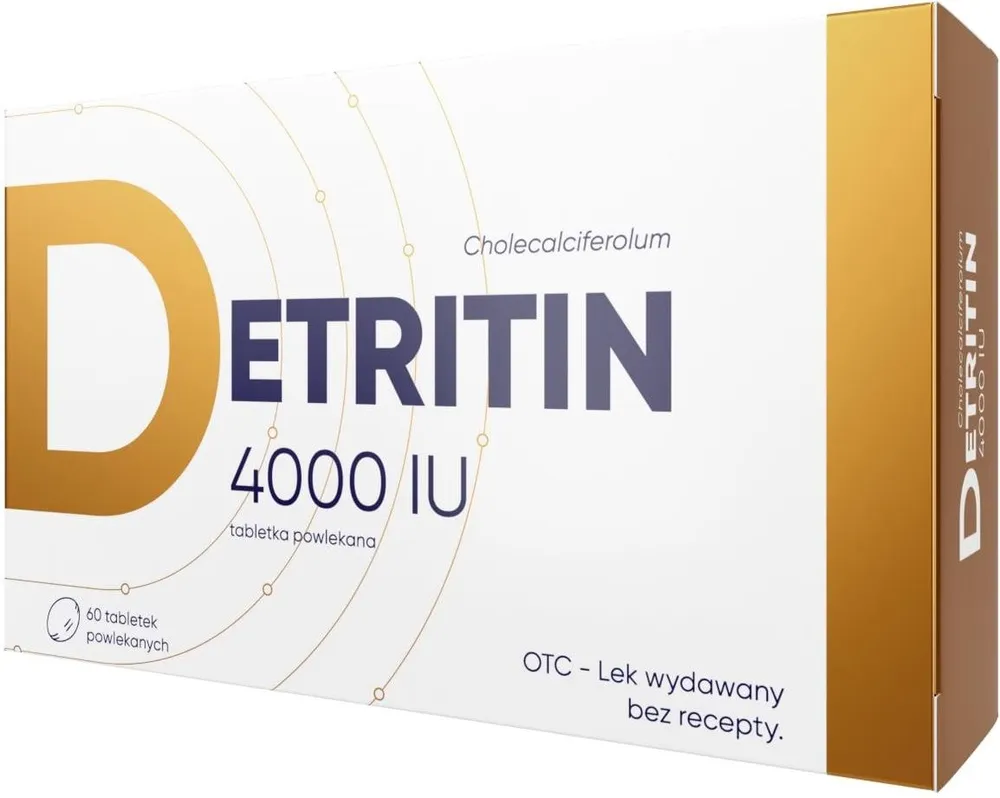
Table of Contents
Patient Information Leaflet
DETRITIN, 4000 IU, coated tablets
Cholecalciferolum
Please read all of this leaflet carefully before taking this medicine, because it contains
important information for you.
You should always take this medicine exactly as described in this patient leaflet or as your
doctor or pharmacist has instructed.
- Keep this leaflet so that you can read it again if necessary.
- If you need advice or further information, please consult your pharmacist.
- If you experience any side effects, including any not listed in this leaflet, tell your doctor or pharmacist. See section 4.
- If you do not feel better or if you feel worse, you should contact your doctor.
Table of contents
- What Detritin is and what it is used for
- What you need to know before taking Detritin
- How to take Detritin
- Possible side effects
- How to store Detritin
- Contents of the pack and other information
1. What Detritin is and what it is used for
Detritin is a medicine containing cholecalciferol (vitamin D3) as the active substance, in a dose of
4000 IU (international units) in each coated tablet. Vitamin D3 is involved in many metabolic processes, and its deficiency may negatively affect health and physical well-being. Vitamin D3 supports calcium and phosphorus metabolism in the body and ensures adequate bone mineralization.
Vitamin D is produced in the skin under the influence of sunlight and is also supplied to the body through food. Vitamin D deficiency may occur when diet and lifestyle (insufficient exposure to sunlight) do not provide enough vitamin D, or when the requirement for vitamin D is increased.
Detritin is indicated for the prevention of vitamin D deficiency and conditions resulting from vitamin D deficiency in adults with obesity [body mass index (BMI) ≥ 30].
2. Important information before taking medicine D
When not to take medicine D:
- if the patient is allergic to the active substance or any of the other ingredients of this medicine (listed in section 6),
- in case of elevated calcium levels in the blood (hypercalcemia),
- in case of increased calcium excretion in urine (hypercalciuria),
- in case of elevated vitamin D levels in the blood (hypervitaminosis D),
- if the patient has diseases and (or) conditions leading to hypercalcemia and (or) hypercalciuria,
- if the patient has kidney stones (nephrolithiasis),
- if the patient has severe renal function impairment (glomerular filtration rate < 30 mL/min/1.73 m²),
- in case of pseudohypoparathyroidism (vitamin D requirement may be reduced due to periods of normal sensitivity to this vitamin, leading to overdose). In this case, vitamin D derivatives that are easier to control are available.
- in children and adolescents under 18 years of age. In this case, less potent vitamin D derivatives are available.
- in pregnant and breastfeeding women. In this case, less potent vitamin D derivatives are available.
Warnings and precautions
Before starting to take medicine D, discuss it with your doctor or pharmacist.
During long-term use of this medicine, serum calcium levels, urinary calcium excretion, and kidney function (by measuring serum creatinine concentration) should be monitored. This is particularly important in elderly patients, patients concurrently taking cardiac glycosides or diuretics, in patients with hyperphosphatemia (increased phosphate levels in blood), and in patients at increased risk of kidney stones.
Symptoms that may indicate vitamin D excess in the body include:
- malaise, lethargy, and weakness, hyperexcitability,
- nausea and vomiting, abdominal pain, loss of appetite, constipation,
- excessive thirst,
- increased urination,
- headache, eye pain, and skin pain,
- skin itching.
If any of these symptoms occur, consult your doctor.
In patients with severe renal insufficiency, vitamin D in the form of cholecalciferol is not adequately metabolized, and alternative vitamin D derivatives should be used.
Before starting to take medicine D, consult your doctor if:
- the patient suffers from pseudohypoparathyroidism (a genetic metabolic disorder);
- the patient suffers from sarcoidosis (an immune system disorder characterized by the formation of small inflammatory nodules);
- the patient is immobilized and has osteoporosis (a metabolic bone disease characterized by decreased bone mineral density and weakened bones);
- the patient is taking other products containing vitamin D (see section: Medicine D and other medicines);
- the patient has kidney function disorders;
- the patient is being treated with cardiac glycosides or diuretics;
- vitamin D treatment is long-term (over 3 months), as in such cases the doctor should monitor serum and urinary calcium levels and assess kidney function by measuring blood creatinine concentration.
Children and adolescents
Medicine D is contraindicated in children and adolescents under 18 years of age.
In this case, less potent vitamin D derivatives are available.
Medicine D and other medicines
Inform your doctor or pharmacist about all medicines the patient is currently taking or has recently taken, as well as any medicines the patient plans to take.
Do not take other medicines, dietary supplements, or food products containing vitamin D (cholecalciferol) simultaneously with medicine D without medical supervision.
Antacids containing aluminum (used in the treatment of gastric hyperacidity), when taken together with medicine D, may increase aluminum levels in blood, increasing the risk of aluminum toxicity to bones.
Antacids containing magnesium, when used concomitantly with medicine D, may increase magnesium levels in blood.
Some antiepileptic, sedative, or hypnotic drugs (containing phenytoin or barbiturates), when used simultaneously with medicine D, may reduce its effectiveness.
Some diuretics may lead to hypercalcemia (increased calcium levels) caused by reduced renal calcium excretion. During long-term treatment, serum and urinary calcium levels should be monitored.
Concomitant use of glucocorticosteroids (synthetic corticosteroid hormones) may counteract the effect of medicine D.
Medicine D may enhance the effect and toxicity of cardiac glycosides, increasing the risk of cardiac arrhythmias. In such cases, the doctor should monitor serum and urinary calcium levels and perform periodic ECG examinations.
Do not take calcitonin, etidronate, or pamidronate simultaneously with medicine D (medicines used in the treatment of elevated serum calcium), as vitamin D may act antagonistically to them.
Rifampicin and isoniazid (medicines used in the treatment of tuberculosis) may reduce the effectiveness of medicine D.
Medicines causing fat malabsorption, e.g., orlistat, liquid paraffin, or cholestyramine, may reduce vitamin D absorption in the gastrointestinal tract.
The cytotoxic drug actinomycin and imidazole antifungal agents impair vitamin D3 activity by inhibiting the enzymatic conversion of 25-hydroxyvitamin D by renal 1-hydroxylase.
Pregnancy and breastfeeding
If the patient is pregnant or breastfeeding, suspects she may be pregnant, or is planning to become pregnant, she should consult her doctor or pharmacist before using this medicine.
Pregnancy
Medicine D is contraindicated for use in pregnant women.
Breastfeeding
Medicine D is contraindicated for use in breastfeeding women.
Driving and operating machinery
Medicine D does not affect the ability to drive motor vehicles or operate machinery.
Medicine D contains sucrose. If the patient has previously been diagnosed with intolerance to certain sugars, the patient should consult a doctor before taking this medicine.
Medicine D contains sodium. The medicine contains less than 1 mmol (23 mg) of sodium per coated tablet, meaning the medicine is considered "sodium-free".
3. How to take medicine D
This medicine should always be taken exactly as described in this patient leaflet or as directed by a
physician or pharmacist. If in doubt, consult your physician or pharmacist.
Do not use this medicine long-term (beyond 3 months) or in higher doses than recommended without
medical supervision.
Dosage
Prophylaxis of vitamin D deficiency and conditions resulting from vitamin D deficiency in adults
with obesity
The usual recommended dose is 4000 IU daily, from October to April, or throughout the year if
adequate cutaneous synthesis of vitamin D cannot be ensured during summer months.
Do not use this medicine for longer than recommended or in higher doses, and do not simultaneously
use other medicines, dietary supplements, or foodstuffs containing vitamin D (cholecalciferol), calcitriol,
or other vitamin D metabolites or analogues without consulting a physician. Your doctor may recommend
measuring serum 25(OH)D concentration.
Method of administration
The tablet should be taken with sufficient amount of water.
Patients with renal function impairment
Do not use this medicine in patients with impaired renal function without medical supervision.
Patients with hepatic function impairment
No special dosage recommendations.
Children and adolescents under 18 years of age
Medicine D is contraindicated in children and adolescents under 18 years of age.
Overdose of medicine D
In case of administration of a higher than recommended dose, contact your physician. The physician
will decide on appropriate treatment.
Symptoms of overdose: nausea, vomiting, diarrhoea followed by constipation, loss of appetite, fatigue,
headache, muscle pain, joint pain, muscle weakness, drowsiness, azotemia (increased concentration
of nitrogen compounds in blood), excessive thirst, polyuria, and dehydration. With markedly elevated
serum calcium levels, cardiac arrhythmias, renal failure, psychoses, and even coma may occur.
Missed dose of medicine D
Do not take a double dose to make up for a missed tablet.
If you have any further questions concerning use of this medicine, consult your physician or pharmacist.
4. Possible adverse reactions
Like all medicines, this medicine can cause adverse reactions, although not everyone will experience them.
Adverse reactions occurring uncommonly (with a frequency of 1 to 10 per 1,000 patients):
- Hypercalcaemia (excessively high calcium levels in the blood) – symptoms include: nausea, vomiting, loss of appetite, constipation, stomach pain, bone pain, excessive thirst, increased need to urinate, muscle weakness, drowsiness and confusion;
- Hypercalciuria (excessively high calcium levels in the urine).
Adverse reactions occurring rarely (with a frequency of 1 to 10 per 10,000 patients):
- Itching;
- Rash;
- Urticaria.
Adverse reactions with unknown frequency (cannot be estimated from available data):
- Constipation;
- Bloating;
- Nausea;
- Abdominal pain;
- Diarrhoea.
Reporting of adverse reactions
If any adverse reactions occur, including any adverse reactions not listed in this leaflet, patients should inform their doctor or pharmacist. Adverse reactions can be reported directly to the Department of Monitoring Adverse Reactions to Medicinal Products, Office for Registration of Medicinal Products, Medical Devices and Biocidal Products, Al. Jerozolimskie 181 C, 02-222 Warsaw, Tel.: +48 22 49 21 301, Fax: +48 22 49 21 309, Website: https://smz.ezdrowie.gov.pl
Adverse reactions can also be reported to the marketing authorization holder.
Reporting adverse reactions helps to provide more information on the safety of the medicine.
5. How to store medicine D
Keep this medicine out of the sight and reach of children.
Do not store above 25°C. Store in the original packaging to protect from light.
Do not use this medicine after the expiry date stated on the carton after: Expiry (EXP). The expiry date refers to the last day of the stated month.
Medicines must not be disposed of via wastewater or household waste. Ask your pharmacist how to dispose of medicines no longer required. This will help protect the environment.
6. Contents of the pack and other information
What the medicine contains D
- The active substance is cholecalciferol. Each coated tablet contains 40 mg of cholecalciferol (in powder form), equivalent to 0.100 mg (4000 IU) of cholecalciferol (vitamin D3). Cholecalciferol, powder composition: cholecalciferol, sodium ascorbate, all-rac-α-tocopherol, modified corn starch, sucrose, medium-chain triglycerides, colloidal anhydrous silica.
The other ingredients are:
Tablet core:
Microcrystalline cellulose (Type 102)
Sodium croscarmellose
Magnesium stearate
Tablet coating: AquaPolish P white 014.95 MS
Hypromellose 15 mPa·s
Hypromellose 6 mPa·s
Titanium dioxide (E 171)
Talc
Medium-chain triglycerides
Hydroxypropylcellulose 100 mPa·s
What Detritin D looks like and contents of the pack
White or almost white, round, biconvex coated tablets with a diameter of approximately 10 mm.
PVC/PVDC/Aluminium blister packs in cardboard boxes.
Pack sizes: 15, 30, 60, 90 or 120 coated tablets.
Marketing Authorisation Holder and Manufacturer
Natur Produkt Pharma Sp. z o.o.,
ul. Podstoczysko 30
07-300 Ostrów Mazowiecka
Tel.: +48 29 644 29 00