Decristol forte
Poland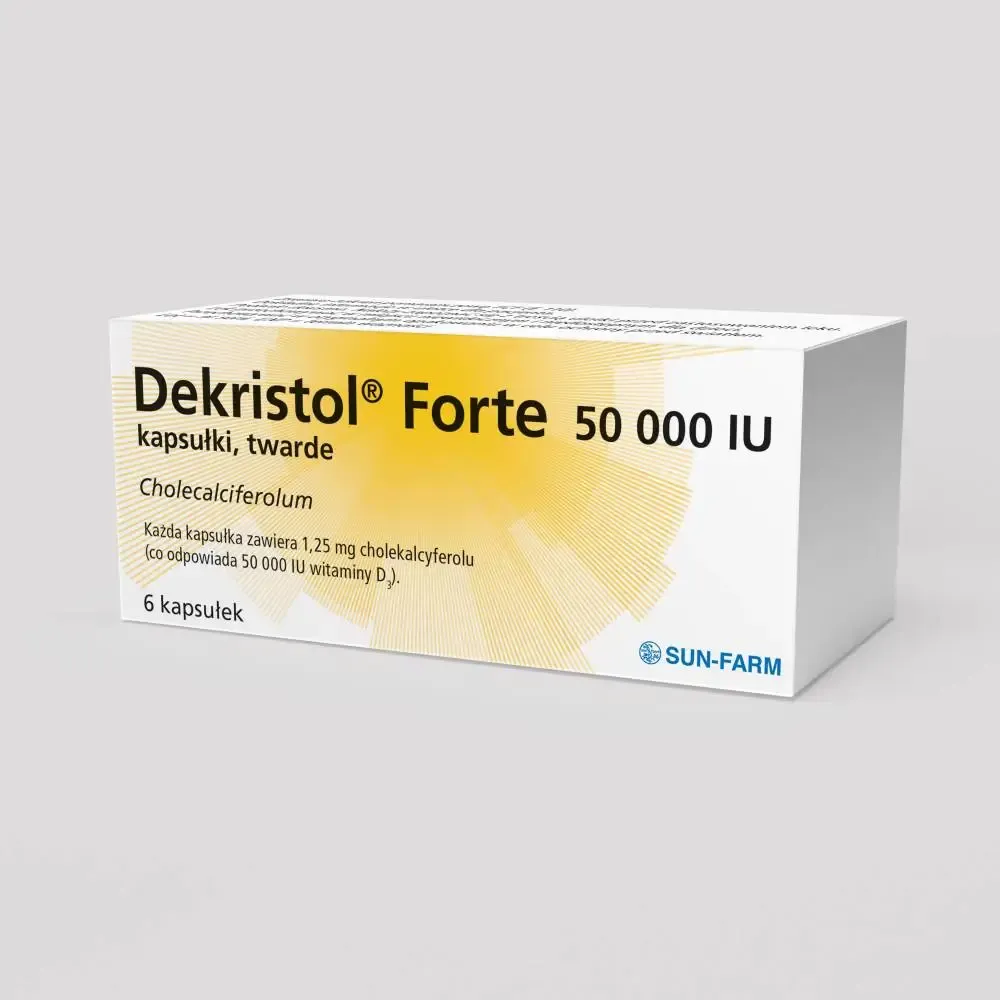
Table of Contents
Package leaflet: information for the patient
Dekristol Forte, 50,000 IU, hard capsules
Cholecalciferolum
Please read the entire leaflet carefully before using this medicine, because it contains
important information for the patient.
- Keep this leaflet so that you can read it again if necessary.
- If you have any questions, please consult your doctor or pharmacist.
- This medicine has been prescribed for a specific individual. Do not pass it on to others. The medicine may harm another person, even if their symptoms are the same.
- If you experience any adverse reactions, including any adverse reactions not listed in this leaflet, inform your doctor or pharmacist. See section 4.
Leaflet contents
- What Dekristol Forte is and what it is used for
- Important information before taking Dekristol Forte
- How to take Dekristol Forte
- Possible side effects
- How to store Dekristol Forte
- Contents of the pack and other information
1. What Dekristol Forte is and what it is used for
Dekristol Forte contains vitamin D (also known as cholecalciferol), which is used to regulate
calcium absorption and metabolism, as well as bone mineralization.
Dekristol Forte is used for the treatment of vitamin D deficiency and for the prevention of
vitamin D deficiency in adult patients at high risk.
2. Important information before taking Dekristol Forte
When not to use Dekristol Forte:
- if the patient is allergic to cholecalciferol, tartrazine FCF (E 110), or any of the other ingredients of this medicine (listed in section 6);
- if the patient has hypercalcaemia (high calcium levels in the blood);
- if the patient has hypercalciuria (high calcium levels in the urine);
- if the patient has been diagnosed with hypervitaminosis D (excess vitamin D in the blood);
- if the patient has pseudohypoparathyroidism (a disorder affecting parathyroid hormone balance);
- if the patient has kidney stones or severe renal insufficiency.
Warnings and precautions
Before starting treatment with Dekristol Forte, consult your doctor or pharmacist:
- if the patient is prone to developing calcium-containing kidney stones;
- if the patient has kidney disorders and the kidneys do not properly excrete calcium and phosphates. The doctor should monitor the effect of treatment on calcium-phosphate metabolism;
- if the patient is taking diuretics (benzothiadiazine derivatives) or is immobilized, as there is then a risk of hypercalcaemia (high calcium levels in the blood) and hypercalciuria (high calcium levels in the urine);
- if the patient suffers from sarcoidosis (a disease affecting connective tissue in the lungs, skin, and joints), as there is a risk of increased conversion of vitamin D into its active form. In such cases, the doctor should monitor calcium levels in blood and urine;
1/6
- if the patient has pseudohypoparathyroidism (a disorder affecting parathyroid hormone balance);
- if the patient is taking other medicines containing vitamin D (e.g. multivitamin preparations) or certain types of food containing vitamin D.
When Dekristol Forte is used at doses exceeding 1,000 IU (international units) of vitamin D per day, the doctor should monitor calcium levels in blood and urine and check kidney function. Monitoring is particularly important in elderly patients and in patients concurrently taking cardiac glycosides (medicines stimulating heart muscle function) or diuretics (medicines increasing urine production). If elevated calcium levels in blood (hypercalcaemia) or urine (hypercalciuria), or other signs of kidney dysfunction occur, the dose should be reduced or treatment discontinued.
Children and adolescents
Dekristol Forte is not recommended for use in children and adolescents under 18 years of age.
Dekristol Forte and other medicines
Tell your doctor or pharmacist about all medicines the patient is currently taking or has recently taken, as well as any medicines the patient plans to take.
The effect of Dekristol Forte may be reduced by concomitant use of:
- phenytoin (a medicine used to treat epilepsy) or barbiturates (medicines used to treat epilepsy, sleep disorders, and for anaesthesia);
- glucocorticosteroids (medicines used to treat certain allergic diseases and inflammatory conditions);
- rifampicin and isoniazid (medicines used to treat tuberculosis);
- cholestyramine (a medicine used to lower elevated cholesterol levels), laxatives containing liquid paraffin;
- orlistat (a medicine used to treat obesity);
- actinomycin (a medicine used to treat cancer);
- imidazole derivatives (antifungal medicines).
The effect of Dekristol Forte or the risk of adverse effects may be increased by concomitant use of:
- metabolites or analogues of vitamin D (e.g. calcitriol): concomitant use with Dekristol Forte should be avoided;
- diuretics (e.g. thiazide diuretics): reduced excretion of calcium by the kidneys may lead to increased calcium levels in blood (hypercalcaemia). Therefore, during long-term treatment, calcium levels in blood and urine should be systematically monitored.
Concomitant use of Dekristol Forte increases the risk of adverse effects of:
- cardiac glycosides (medicines used to stimulate heart muscle function): the risk of cardiac arrhythmias may increase due to elevated calcium levels in blood during vitamin D treatment. In such cases, the treating physician should perform ECG examinations and monitor calcium levels in blood and urine as well as drug concentration in blood.
Dekristol Forte with food and drink
Dekristol Forte should preferably be taken with food and drink.
Pregnancy and breastfeeding
If the patient is pregnant or breastfeeding, suspects she may be pregnant, or plans to become pregnant, she should consult her doctor before using this medicine.
Pregnancy
2/6
The recommended daily dose of vitamin D during pregnancy is 400 IU; however, in women with vitamin D deficiency, higher doses (up to 2,000 IU/day) may be necessary. During pregnancy, women should follow their doctor's advice, as individual needs may vary depending on the severity of the condition and response to treatment.
High-dose vitamin D treatment is not recommended during pregnancy.
Excessive vitamin D intake should be avoided during pregnancy, as prolonged hypercalcaemia may lead to delayed physical and mental development and heart and eye disorders in the child.
Breastfeeding
Vitamin D and its metabolites pass into human milk. High-dose vitamin D treatment is not recommended during breastfeeding.
Fertility
There are no data on the effect of cholecalciferol on fertility. No adverse effect of normal, physiologically occurring vitamin D concentrations on fertility is expected.
Driving and operating machinery
Dekristol Forte has no effect or negligible effect on the ability to drive and operate machinery.
Dekristol Forte contains tartrazine FCF (E 110)
This medicine may cause allergic reactions.
3. How to use Dekristol Forte
This medicine should always be used as directed by a doctor or pharmacist. If in doubt,
consult a doctor or pharmacist.
This medicine should be taken orally. The capsules should be swallowed whole with an adequate
amount of water, preferably with the main meal of the day.
Use in adults
Prophylaxis of vitamin D deficiency: 1 capsule (50,000 IU) every 2 months. In high-risk patient groups (see below), the dose may be increased to 1 capsule per month.
Treatment of vitamin D deficiency: 1 capsule (50,000 IU) weekly for 6–8 weeks, followed by
maintenance therapy (which may require 1,400–2,000 IU/day, i.e., 1 capsule per month).
Three to four months after starting maintenance therapy, serum vitamin D levels should be measured to confirm that the desired level has been achieved.
National guidelines for the treatment and prevention of vitamin D deficiency may also be followed.
Certain populations are at high risk of vitamin D deficiency and may require higher doses and monitoring of serum vitamin D concentration. These include:
- individuals residing in closed institutions or hospitalized patients,
- individuals with dark skin pigmentation,
- individuals with limited effective sun exposure due to protective clothing or use of sunscreen,
- obese individuals,
- patients under observation for osteoporosis,
- individuals taking certain medications (e.g., anticonvulsants, glucocorticosteroids),
- patients with malabsorption disorders, including inflammatory bowel disease and celiac disease,
- individuals recently treated for vitamin D deficiency and requiring maintenance therapy.
Use in children and adolescents
Dekristol Forte is not recommended for use in children and adolescents under 18 years of age.
How to take the medicine
The capsules should be swallowed whole with an adequate amount of water, preferably with the main meal of the day.
To remove the capsule from the blister pack:
- press only on the edge of the capsule to push it through the foil;
- do not press on the center of the capsule, as this may cause it to break.

Overdose of Dekristol Forte
If more than the recommended dose has been taken, consult a doctor immediately.
Symptoms of overdose are nonspecific and may include thirst, nausea, vomiting, initial diarrhea followed by constipation, loss of appetite, fatigue, headache, muscle and joint pain, muscle weakness, persistent drowsiness, disturbances in consciousness, arrhythmia (irregular heartbeat), azotemia (high blood nitrogen levels), increased thirst, increased urination, and, in the final stage, dehydration.
Additional symptoms of vitamin D overdose may be explained by the treating physician.
If necessary, the doctor will initiate appropriate measures.
There is no known specific antidote.
Missed dose of Dekristol Forte
Do not take a double dose to make up for a missed dose.
Stopping Dekristol Forte prematurely
If treatment is stopped earlier than recommended, symptoms may return or worsen.
If you have any further questions about the use of this medicine, consult your doctor or pharmacist.
4. Possible adverse reactions
Like all medicines, this medicine can cause adverse reactions, although not everyone experiences them.
You should stop taking Dekristol Forte and immediately contact your doctor if symptoms of a severe allergic reaction occur, such as:
- swelling of the face, lips, tongue or throat;
- difficulty swallowing;
- hives and breathing difficulties.
The following adverse reactions may occur:
4/6
Uncommon (may affect up to 1 in 100 patients):
hypercalcaemia (high calcium levels in the blood) and hypercalciuria (high calcium levels in the urine)
Rare (may affect up to 1 in 1,000 patients):
itching, rash or hives.
Frequency not known (cannot be estimated from available data):
gastrointestinal disturbances (constipation, bloating, nausea, abdominal pain or diarrhoea).
Orange Yellow FCF (E 110) may cause allergic reactions.
Reporting of adverse reactions
If any adverse reactions occur, including any adverse reactions not listed in this leaflet, inform your doctor or pharmacist. Adverse reactions can be reported directly to the Department of Monitoring Adverse Drug Reactions of the Office for Registration of Medicinal Products, Medical Devices and Biocidal Products:
Al. Jerozolimskie 181C
02-222 Warsaw
Phone: +48 22 49 21 301
Fax: +48 22 49 21 309
Website: https://smz.ezdrowie.gov.pl
Adverse reactions can also be reported to the marketing authorization holder.
Reporting adverse reactions helps provide more information on the safety of this medicine.
5. How to store Dekristol Forte
Keep this medicine out of sight and reach of children.
Store in the original packaging to protect from light.
No special temperature storage requirements.
Do not use this medicine after the expiry date stated on the carton and blister after:
"EXP". The expiry date refers to the last day of the stated month.
Medicines must not be disposed of via wastewater. Ask your pharmacist how to dispose of medicines no longer required. These measures help protect the environment.
6. Contents of the pack and other information
What Dekristol Forte contains
- The active substance is cholecalciferol. Each hard capsule contains 1.25 mg of cholecalciferol (equivalent to 50,000 IU of vitamin D).
- Other components are: medium-chain triglycerides, gelatin, colloidal anhydrous silica, titanium dioxide (E 171), quinoline yellow (E 104), butylhydroxytoluene (E 321), and orange-yellow FCF (E 110).
5/6
What Dekristol Forte looks like and contents of the pack
Dekristol Forte is a hard gelatin capsule with an opaque orange body and a yellow cap, filled with a colourless to slightly yellow oily liquid. The capsules have a colourless band.
Dekristol Forte is available in PVC/PVDC/Aluminium blisters, packed in a cardboard box containing 6, 8, 10, 12, 15, 20, 30, 35 or 40 capsules.
Not all pack sizes may be marketed.
Marketing Authorisation Holder
SUN-FARM Sp. z o.o.
ul. Dolna 21
05-092 Łomianki
tel. +48 22 350 66 69
Manufacturer
mibe GmbH Arzneimittel
Münchener Straße 15
06796 Brehna
Germany
SUN-FARM Sp. z o.o.
ul. Dolna 21
05-092 Łomianki
6/6