Dasergin
Poland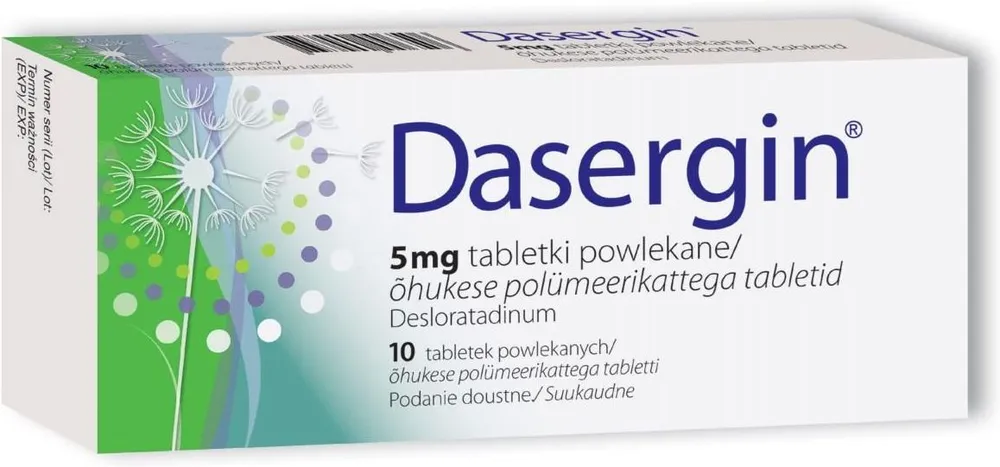
Table of Contents
Package leaflet: Information for the patient
Dasergin, 5 mg, coated tablets
Desloratadine
Please read all of this leaflet carefully before taking this medicine, because it contains
important information for you.
This medicine should always be used exactly as described in this patient leaflet or as directed by
your doctor or pharmacist.
- Keep this leaflet, as you may need to read it again.
- If you need advice or further information, please consult your pharmacist.
- If you experience any adverse reactions, including any possible side effects not listed in this leaflet, inform your doctor or pharmacist. See section 4.
- If there is no improvement after 3 days, or if you feel worse, contact your doctor.
Table of contents
- What Dasergin is and what it is used for
- Important information before taking Dasergin
- How to take Dasergin
- Possible side effects
- How to store Dasergin
- Contents of the pack and other information
1. What Dasergin is and what it is used for
What Dasergin is
Dasergin contains desloratadine, which is an antihistamine medicine.
How Dasergin works
Dasergin is an antiallergic medicine that does not cause drowsiness. It helps control allergic reactions and their symptoms.
When Dasergin should be used
Dasergin relieves symptoms associated with allergic rhinitis (inflammation of the nasal mucosa caused by allergy, for example hay fever or dust mite allergy) in adults and adolescents aged 12 years and older. Symptoms include: sneezing, watery or itchy nose, itchy palate, as well as itchy, red or watery eyes.
Dasergin is also used to relieve symptoms associated with urticaria (a skin condition caused by allergy). Symptoms of this condition include: skin itching and hives.
Relief from these symptoms lasts throughout the day, helping patients return to normal daily activities and achieve normal sleep.
If there is no improvement after 3 days, or if you feel worse, contact your doctor.
2. Important information before using Dasergin
When not to use Dasergin
- if the patient is allergic to desloratadine or any of the other ingredients of this medicine (listed in section 6), or to loratadine.
Warnings and precautions
Before starting to take Dasergin, discuss this with your doctor or pharmacist:
- if the patient has kidney function disorders.
- if the patient has a history or family history of seizures.
Children and adolescents
Dasergin should not be given to children under 12 years of age.
Dasergin and other medicines
No interactions between Dasergin and other medicines are known.
Tell your doctor or pharmacist if the patient is taking, has recently taken, or might take any other medicines.
Taking Dasergin with food, drink and alcohol
Dasergin may be taken with or without food.
Caution is advised when taking Dasergin with alcohol.
Pregnancy, breastfeeding and fertility
If the patient is pregnant, breastfeeding, suspects she may be pregnant, or is planning to have a child, she should consult her doctor or pharmacist before using this medicine.
Use of Dasergin is not recommended during pregnancy or breastfeeding.
Fertility
There are no available data on the effect on fertility in men and women.
Driving and operating machinery
This medicine is not expected to affect the ability to drive or operate machinery when used at the recommended dose. Although drowsiness does not occur in most people, it is recommended to refrain from activities requiring mental alertness, such as driving or operating machinery, until the patient knows how he or she reacts to this medicine.
Dasergin contains lactose and sodium
If the patient has been previously diagnosed with intolerance to certain sugars, he or she should consult a doctor before taking this medicine.
The medicine contains less than 1 mmol (23 mg) of sodium per tablet; therefore, it is considered "sodium-free".
3. How to use Dasergin
This medicine should always be used as described in the patient leaflet. In case of doubt, consult your
doctor or pharmacist.
Adults and adolescents aged 12 years and older
The recommended dose is one tablet once daily, taken with water, with or without food.
This medicine is intended for oral use.
The tablet should be swallowed whole.
The duration of treatment with Dasergin will be determined by the doctor after establishing the type of allergic rhinitis affecting the patient.
If the patient has intermittent allergic rhinitis (symptoms occurring for less than 4 days per week or for less than 4 weeks), the doctor will recommend a treatment regimen based on the previous course of the disease.
If the patient has persistent allergic rhinitis (symptoms occurring for 4 or more days per week and for more than 4 weeks), the doctor may recommend longer-term use of the medicine.
In urticaria, the duration of treatment may vary between individual patients. Therefore, the patient should follow the doctor's instructions.
If there is no improvement after 3 days or if the patient feels worse, consult a doctor. Do not use Dasergin for longer than 10 days without consulting a doctor.
Taking more Dasergin than recommended
Dasergin should only be taken as prescribed. Accidental overdose should not lead to severe adverse effects. However, if a dose higher than recommended has been taken, inform your doctor or pharmacist immediately.
Missed dose of Dasergin
If a dose has been missed, take it as soon as possible, then return to the regular dosing schedule.
Do not take a double dose to make up for a missed dose.
If you have any further doubts about the use of this medicine, consult your doctor or pharmacist.
4. Possible adverse reactions
Like any medicine, this medicine may cause side effects, although not everyone will experience them.
Since desloratadine has been marketed, very rare cases of severe allergic reactions (difficulty breathing, wheezing, itching, hives, and swelling) have been reported. If any of these severe adverse reactions occur, you should stop taking the medicine immediately and consult a doctor without delay.
In clinical trials in adult patients, adverse reactions were almost the same as with placebo (tablet without active ingredient). However, fatigue, dry mouth, and headache were reported more frequently than with placebo. In adolescents, headache was the most commonly reported adverse reaction.
The following adverse reactions have been reported in clinical trials with desloratadine:
Frequent (may occur in up to 1 in 10 people):
- fatigue,
- dry mouth,
- headache.
Adults
After desloratadine has been marketed, the following adverse reactions have been reported:
Very rare (may occur in up to 1 in 10,000 people):
- severe allergic reactions,
- rash,
- palpitations and irregular heartbeat,
- rapid heartbeat,
- abdominal pain,
- nausea,
- vomiting,
- stomach upset,
- diarrhoea,
- dizziness,
- drowsiness,
- insomnia,
- muscle pain,
- hallucinations,
- seizures,
- restlessness with increased motor activity,
- hepatitis,
- abnormal liver function test results.
Frequency unknown: frequency cannot be estimated from available data
- unusual weakness,
- yellowing of the skin and/or eyes,
- increased skin sensitivity to sunlight, even on cloudy days and to UV (ultraviolet) radiation, for example UV radiation in sunbeds,
- changes in heart rhythm,
- unusual behaviour,
- aggressive behaviour,
- increased appetite,
- weight gain.
Children
Frequency unknown: frequency cannot be estimated from available data
- slow heartbeat,
- change in heart rhythm,
- unusual behaviour,
- aggressive behaviour.
Reporting of adverse reactions
If any adverse reactions occur, including any not listed in this leaflet, you should inform your doctor or pharmacist. Adverse reactions can be reported directly to the Department for Monitoring of Adverse Drug Reactions, Office for Registration of Medicinal Products, Medical Devices and Biocidal Products
Al. Jerozolimskie 181 C
02-222 Warsaw
Tel.: + 48 22 49 21 301
Fax: + 48 22 49 21 309
e-mail: [email protected]
Adverse reactions may also be reported to the marketing authorization holder.
Reporting adverse reactions allows further collection of information on the safety of the medicine.
5. How to store Dasergin
Keep this medicine out of sight and reach of children.
Do not use this medicine after the expiry date stated on the packaging (carton and
blister pack) following EXP. The expiry date refers to the last day of the stated month.
Store in the original packaging to protect from moisture.
Medicines must not be disposed of via wastewater or household waste. Ask your
pharmacist how to dispose of medicines no longer in use. Such measures will help
protect the environment.
6. Contents of the pack and other information
What Dasergin contains
- The active substance is desloratadine. Each coated tablet contains 5 mg of desloratadine.
- The other ingredients are: microcrystalline cellulose, hypromellose, hydrochloric acid (for pH adjustment), sodium hydroxide (for pH adjustment), maize starch, lactose monohydrate, and talc in the tablet core; and hypromellose, macrogol 400, lactose monohydrate, titanium dioxide (E171), and indigo carmine (E132) in the tablet coating (see section 2, "Dasergin contains lactose and sodium").
What Dasergin looks like and contents of the pack
Light blue, round, film-coated tablets with bevelled edges (diameter: 6.5 mm, thickness: 2.3–3.5 mm).
Dasergin is available in cardboard boxes containing blisters of 10 film-coated tablets.
Marketing Authorisation Holder and Manufacturer
KRKA, d.d., Novo mesto, Šmarješka cesta 6, 8501 Novo mesto, Slovenia
For further information on product names in other European Economic Area countries, please contact the local representative of the Marketing Authorisation Holder:
KRKA-POLSKA Sp. z o.o.
Równoległa 5 Street
02-235 Warsaw, Poland
Tel. 22 57 37 500