Cusicrom 4%
Poland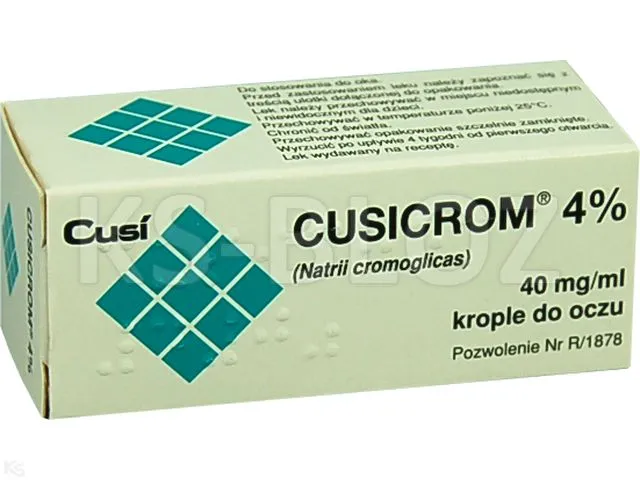
Table of Contents
Patient Information Leaflet
Cusicrom 4%, 40 mg/ml, eye drops, solution
Sodium cromoglicate
Please read all of this leaflet carefully before using the medicine, because it contains
important information for the patient.
- Keep this leaflet, as you may need to read it again.
- If you have any doubts, please consult your doctor or pharmacist.
- This medicine has been prescribed for a specific individual. Do not share it with others. This medicine may harm other people, even if their symptoms are the same.
- If the patient experiences any adverse reactions, including any not listed in this leaflet, they should inform their doctor or pharmacist. See section 4.
Table of contents
- What Cusicrom 4% is and what it is used for
- Important information before using Cusicrom 4%
- How to use Cusicrom 4%
- Possible side effects
- How to store Cusicrom 4%
- Contents of the pack and other information
1. What Cusicrom 4% is and what it is used for
Cusicrom 4% is indicated for the treatment of allergic eye diseases such as: seasonal
and perennial allergic conjunctivitis, vernal keratoconjunctivitis, allergic (atopic) keratitis,
and allergies associated with contact lens wear.
It is an anti-allergic medicine that prevents the release of histamine and other biologically active substances involved in allergic reactions. Due to the action of sodium cromoglicate, it prevents allergic reactions mediated by substances released from mast cells.
Cusicrom 4% is an eye drop formulation containing the active substance sodium cromoglicate at a concentration of 40 mg per 1 ml of drops.
2. Important information before using Cusicrom 4%
When not to use Cusicrom 4%
- if the patient is allergic to sodium cromoglicate or any of the other ingredients of this medicine (listed in section 6).
Warnings and precautions
Before starting treatment with Cusicrom 4%, discuss this with your doctor or pharmacist.
- For ocular use only.
Children and adolescents
The use of Cusicrom 4% is not recommended in children under 4 years of age due to lack of safety data in this age group.
Cusicrom 4% and other medicines
Tell your doctor or pharmacist about all medicines the patient is currently taking, has recently taken, or plans to take.
No adverse interactions have been reported between topically applied sodium cromoglicate and other medicines.
If the patient is using other eye drops or ointments , at least a 5-minute interval should be maintained between the administration of each product. Eye ointments should be used last.
Pregnancy, breastfeeding and fertility
If the patient is pregnant or breastfeeding, suspects she may be pregnant, or is planning to have a baby, she should consult her doctor or pharmacist before using this medicine.
There are no data on whether sodium cromoglicate passes into human milk. Since many medicines are excreted in human milk, caution should be exercised when administering this medicine to breastfeeding women.
It is unknown whether sodium cromoglicate affects fertility in humans.
Driving and operating machinery
Cusicrom 4% has no effect or has a negligible effect on the ability to drive and operate machinery.
After using Cusicrom 4%, blurred vision may occur for a short period of time. Do not drive or operate machinery until normal vision is restored.
Cusicrom 4% contains benzalkonium chloride
If the patient wears contact lenses:
- during treatment of ocular inflammatory conditions, wearing contact lenses (rigid or soft) is not recommended
- however, if contact lenses are used, they should be removed before instilling Cusicrom 4% eye drops and not reinserted until at least 15 minutes after administration. The preservative (benzalkonium chloride) contained in Cusicrom 4% may cause eye irritation and is known to cause discoloration of soft contact lenses.
3. How to use Cusicrom 4%
This medicine should always be used as directed by a doctor or pharmacist. If in doubt,
consult a doctor or pharmacist.
Dosage
The following dosage regimen is most commonly used:
The usual dose of Cusicrom 4% is one or two drops into the eye or eyes, four to
six times daily, at regular intervals.
The number of daily doses and duration of treatment may be adjusted according to the evaluation criteria
established by the physician.
A symptomatic response to treatment usually occurs within a few days of using the medicine, but sometimes
treatment may need to be continued for up to 6 weeks.
The duration of treatment is determined by the doctor.
Cusicrom 4% is intended exclusively for ophthalmic use.
Use in children
Cusicrom 4% is not recommended for children under 4 years of age due to lack of
data on safety and efficacy in this age group.
Method of administration
- Prepare the medicine bottle and a mirror.
- Wash your hands.
- Holding the bottle, unscrew the cap. If the safety collar is loose after removing the cap, discard it before using the medicine.
- Hold the bottle upside down, gripping it between the thumb and middle finger.
- Tilt the head backward. Gently pull down the lower eyelid with a clean finger to form a "pocket" between the eyelid and the eyeball; the drop should be instilled into this pocket.
- Bring the dropper tip close to the eye. A mirror may be used to assist.
- Do not touch the dropper tip to the eye, eyelid, surrounding areas, or any other surface. Failure to follow this instruction may result in contamination of the drops. Using contaminated drops may lead to serious eye infections and even loss of vision.
- Gently press the bottom of the bottle to release a single drop of the medicine.
- Do not squeeze the bottle; it is designed so that light pressure on the bottom is sufficient to release a drop. If the drop does not enter the eye, repeat the instillation procedure.
- After instilling the drop, gently close the eye and press with a finger on the inner corner of the eye near the nose. This helps prevent the medicine from draining into the systemic circulation.
- If drops are to be administered to both eyes, repeat the steps described above for the second eye.
- Immediately after use, tightly replace the cap on the bottle.
Use of more than the recommended dose of Cusicrom 4%
In case of overdose, excess medicine can be rinsed from the eye with lukewarm water. Do not administer
additional drops until the next scheduled dose at the usual time.
Missed dose of Cusicrom 4%
If a patient forgets to use Cusicrom 4%, they should continue treatment with the next dose according to the
prescribed schedule. If it is almost time for the next dose, the missed dose should be skipped and treatment
continued as prescribed. Do not use a double dose to make up for a missed dose.
If you have any further doubts about the use of this medicine, consult your doctor or pharmacist.
4. Possible adverse reactions
Like any medicine, this medicine can cause adverse reactions, although not everyone experiences them.
The following adverse reactions have been observed during the use of Cusicrom 4%:
- Common adverse reactions (may occur in up to 1 in 10 patients):
- Eye disorders: eye discomfort.
- Uncommon adverse reactions (may occur in up to 1 in 100 patients):
- Eye disorders: eye discharge, eye pruritus, eye sensory disturbances, increased lacrimation, eye hyperemia.
Additional adverse reactions have been reported after marketing authorization of the medicine. The frequency of occurrence of these reactions is unknown.
- Eye disorders: eye irritation.
Reporting of adverse reactions
If any adverse reactions occur, including any adverse reactions not listed in this leaflet, inform a doctor or pharmacist. Adverse reactions can be reported directly to the Department of Monitoring Adverse Reactions of Medicinal Products, Office for Registration of Medicinal Products, Medical Devices and Biocidal Products,
Al. Jerozolimskie 181C
02-222 Warsaw
Phone: +48 22 49 21 301
Fax: +48 22 49 21 309
Website: https://smz.ezdrowie.gov.pl
Adverse reactions can also be reported to the marketing authorization holder.
Reporting adverse reactions allows the collection of further information on the safety of the medicine.
5. How to store Cusicrom 4% medicine
Keep this medicine out of sight and reach of children.
To prevent contamination, the bottle should be discarded four weeks after first opening.
The date of opening the bottle should be recorded in the space below.
Opened:
Store below 25°C. Protect from light.
Keep the container tightly closed.
Do not use this medicine after the expiry date stated on the packaging after: EXP.
The expiry date refers to the last day of the stated month.
Medicines must not be disposed of via wastewater or household waste. Ask your pharmacist how to dispose of medicines no longer required. This will help protect the environment.
6. Contents of the pack and other information
What Cusicrom 4% contains
- The active substance is disodium cromoglycate. 1 ml of solution contains 40 mg of disodium cromoglycate.
- The other ingredients are: benzalkonium chloride, polysorbate 80, disodium edetate dihydrate, purified water.
What Cusicrom 4% looks like and contents of the pack
Cusicrom 4% is a liquid supplied in a 10 ml plastic bottle with a safety cap.
The cardboard pack contains 1 bottle with a capacity of 10 ml.
Marketing Authorisation Holder
Novartis Poland Sp. z o.o.
ul. Marynarska 15
02-674 Warszawa
tel. +48 22 37 54 888
Importer/Manufacturer
Novartis Pharma GmbH
Roonstrasse 25
90429 Nürnberg
Germany
Siegfried El Masnou, S.A.
Camil Fabra 58
08320 El Masnou
Barcelona
Spain
Novartis Farmaceutica S.A.
Gran Via de les Corts Catalanes, 764
08013 Barcelona
Spain