Cusi erythromycin 0.5%
Poland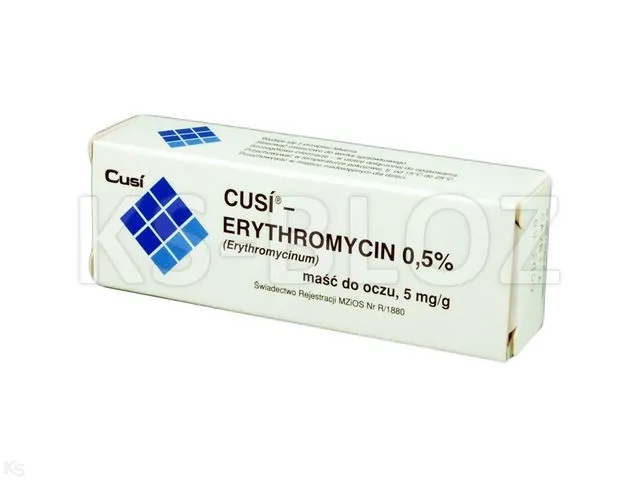
Table of Contents
- Package leaflet: Information for the user
- 1. What Cusi Erythromycin 0.5% is and what it is used for
- 2. Important information before using the medicine Cusi Erythromycin 0.5%
- 3. How to use Cusi Erythromycin 0.5%
- 4. Possible adverse reactions
- 5. How to store Cusi Erythromycin 0.5%
- 6. Contents of the pack and other information
Package leaflet: Information for the user
Warning! Keep this leaflet. The information on the immediate packaging is in a foreign language.
Cusi Erythromycin 0.5% (Oftalmolosa Cusí Eritromicina)
5 mg/g, eye ointment
Erythromycinum
Cusi Erythromycin 0.5% and Oftalmolosa Cusí Eritromicina are different trade names for the
same medicinal product.
Please read this leaflet carefully before using the medicine, as it contains important
information for the patient.
- Keep this leaflet, so that you can read it again if necessary.
- If you have any questions, please consult your doctor or pharmacist.
- This medicine has been prescribed for a specific individual. Do not pass it on to others. The medicine may harm another person, even if their symptoms are the same.
- If you experience any adverse reactions, including any not listed in this leaflet, inform your doctor, pharmacist, or nurse. See section 4.
Table of contents of the leaflet
- What Cusi Erythromycin 0.5% is and what it is used for
- Important information before using Cusi Erythromycin 0.5%
- How to use Cusi Erythromycin 0.5%
- Possible side effects
- How to store Cusi Erythromycin 0.5%
- Contents of the pack and other information
1. What Cusi Erythromycin 0.5% is and what it is used for
Cusi Erythromycin 0.5% is a sterile eye ointment. It contains the active substance erythromycin at a concentration of 5 mg per 1 g of ointment. Erythromycin belongs to a group of medicines called antibiotics. It acts as a bactericide. The medicine is indicated for the treatment of eye and ocular adnexa infections caused by bacteria sensitive to erythromycin. It may also be used for the prevention of certain eye infections in newborns.
2. Important information before using the medicine Cusi Erythromycin 0.5%
When not to use Cusi Erythromycin 0.5%
- if the patient is allergic to erythromycin or to any of the other components of this medicine (listed in section 6).
Warnings and precautions
Before starting treatment with Cusi Erythromycin 0.5%, discuss it with your doctor or
pharmacist.
- Cusi Erythromycin 0.5% should be used for the eyes only.
- After each use, the tube must be closed tightly.
- If the patient uses Cusi Erythromycin 0.5% for a prolonged period, bacteria or fungi resistant to erythromycin may develop.
Children
There are no special recommendations regarding the use of this medicine in children.
The medicine is used for prophylaxis of ophthalmia neonatorum in newborns. In such cases, it should be administered as a single dose (see section 3: Dosage).
Page 1 of 4
Cusi Erythromycin 0.5% and other medicines
Tell your doctor or pharmacist about all medicines the patient is currently taking or has recently taken, as well as any medicines planned for future use.
To date, there have been no reports of other medicines used concomitantly with Cusi Erythromycin 0.5% causing worsening of existing or emergence of new adverse effects.
Pregnancy, breastfeeding and fertility
If the patient is pregnant or breastfeeding, suspects she may be pregnant, or is planning to have a baby, she should consult her doctor or pharmacist before using this medicine.
The use of this medicine in pregnant or breastfeeding women should be evaluated by a doctor.
Consult your doctor before use.
Driving and using machines
Ophthalmic ointments may cause blurred vision and therefore should not be used when the patient intends to drive or operate machinery.
Transient blurred vision or other visual disturbances may affect the ability to drive and operate machinery. If blurred vision occurs after instillation, wait until vision clears before driving or operating machinery.
3. How to use Cusi Erythromycin 0.5%
This medicine should always be used exactly as prescribed by the doctor. In case of doubt, consult
your doctor or pharmacist.
Dosage
The following dosage regimen is most commonly used:
Adults:
In superficial eye infections – once daily or more frequently, depending on the
severity of the infection.
To achieve complete cure of the infection, the medicine should be used regularly throughout the
entire treatment period prescribed by the doctor, even if symptoms of infection subside earlier.
Stopping treatment too early may result in recurrence of symptoms. Do not skip any doses.
If there is no improvement within a few days of using the medicine, consult your doctor.
For newborns, for prophylaxis of ophthalmia neonatorum:
Administer the medicine once only.
If you feel that the effect of the medicine is too strong or too weak, consult your doctor.
Method of administration
Wash your hands thoroughly before applying the medicine.
Administration into the eye:
Tilt the head backwards and, using one hand, gently pull down the skin below the lower eyelid.
Pull the lower eyelid away from the eye to create a small pocket between the eyelid and the eye.
Remove the cap and squeeze a small amount of ointment, approximately the size of a grain of rice,
from the tube into this pocket.
Gently close the eye. Do not blink. Keep the eye closed for about 1-2 minutes to allow the medicine
to be absorbed.
If a small amount of ointment does not enter the eye, repeat the procedure to ensure proper
administration.
External application around the eye:
If crusts are present, soften them with warm water and carefully remove them, then apply the
ointment directly from the tube to the affected area.
Page 2 of 4
After each use, close the tube tightly and store it out of sight and reach of children.
Caution: to avoid contamination of the medicine, avoid contact of the tube tip with any surface,
including the surface of the eye.
Keep the tube tightly closed.
The medicine should be used by only one person.
Dispose of the medicine after completion of treatment.
If the patient is using other eye drops or eye ointments, wait at least 5 minutes between
administration of each medicine. Eye ointments should be used last.
Use of more than the recommended dose of Cusi Erythromycin 0.5%
In case of overdose, excess medicine can be rinsed from the eye with lukewarm water. Do not
administer additional medicine to the eye until the next scheduled dose time.
Missed dose of Cusi Erythromycin 0.5%
If the patient forgets to use Cusi Erythromycin 0.5%, treatment should be continued by applying the
next dose according to the prescribed schedule. If it is almost time for the next dose, skip the missed
dose and continue treatment according to the prescribed dosage regimen. Do not use a double dose
to make up for a missed dose.
Stopping use of Cusi Erythromycin 0.5%
Avoid stopping treatment prematurely. See section 3 – Dosage.
If you have any further questions about the use of this medicine, consult your doctor or pharmacist.
4. Possible adverse reactions
Like all medicines, this medicine can cause adverse reactions, although not everyone will experience them.
The following adverse reactions have been observed during the use of Cusi Erythromycin 0.5%.
The frequency of these reactions is unknown (cannot be estimated from the available data).
- General adverse reactions: hypersensitivity (allergy).
Reporting of adverse reactions
If any adverse reactions occur, including any adverse reactions not listed in this leaflet, inform your doctor, pharmacist or nurse. Adverse reactions can also be reported directly to the Department of Monitoring Adverse Drug Reactions at the Office for Registration of Medicinal Products, Medical Devices and Biocidal Products:
Al. Jerozolimskie 181C, 02-222 Warsaw, tel.: +48 22 49 21 301, fax: +48 22 49 21 309, website:
https://smz.ezdrowie.gov.pl
Reporting adverse reactions helps to provide more information on the safety of this medicine.
5. How to store Cusi Erythromycin 0.5%
Keep this medicine out of sight and reach of children.
Do not store above 25°C.
Do not use this medicine after the expiry date stated on the container.
The expiry date refers to the last day of the stated month.
Shelf-life after first opening of the tube: 4 weeks.
Page 3 of 4
Medicines must not be disposed of via wastewater or household waste. Ask your pharmacist how to dispose of medicines no longer required. Such measures help protect the environment.
6. Contents of the pack and other information
What Cusi Erythromycin 0.5% contains
- The active substance is erythromycin. 1 g of ointment contains 5 mg of erythromycin.
- The other ingredients are: cholesterol, liquid paraffin, white soft paraffin.
What Cusi Erythromycin 0.5% looks like and contents of the pack
An aluminium tube containing 3.5 g of ointment, in a cardboard box.
For further information, please contact the responsible party or the parallel importer.
Responsible party in Spain, country of export:
NTC S.r.l., Via Luigi Razza 3, 20124 Milan, Italy
Manufacturer:
Siegfried El Masnou, S.A., C/ Camil Fabra 58, 08320 El Masnou – Barcelona, Spain
Parallel importer:
Delfarma Sp. z o.o., ul. Św. Teresy od Dzieciątka Jezus 111, 91-222 Łódź
Repackaged in:
Delfarma Sp. z o.o., ul. Św. Teresy od Dzieciątka Jezus 111, 91-222 Łódź
Authorisation number in Spain, country of export: 653528.8
Parallel import authorisation number: 142/23
Page 4 of 4