Clodivac
Poland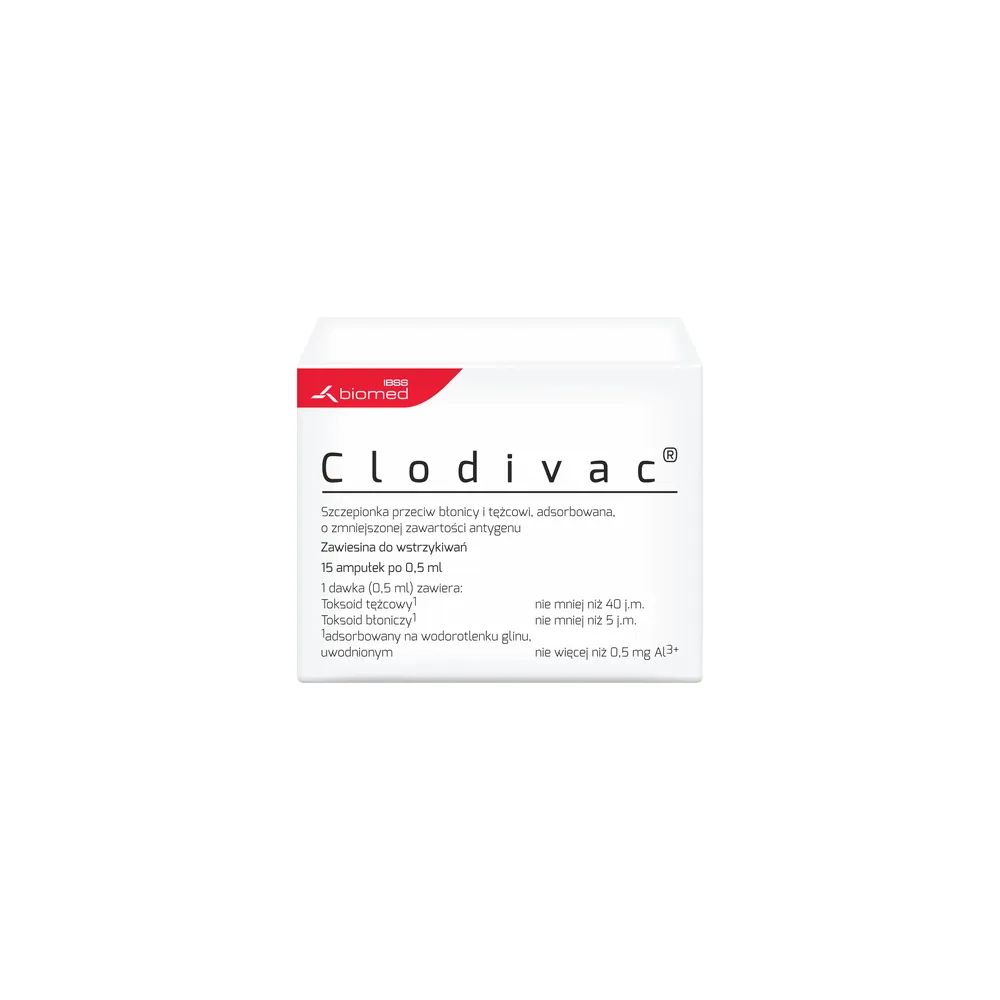
Table of Contents
- Package leaflet: Information for the user
- 1. What Clodivac vaccine is and what it is used for
- 2. Important information before administration of Clodivac vaccine
- 3. How to use the Clodivac vaccine
- 4. Possible adverse reactions
- 5. How to store the Clodivac vaccine
- 6. Contents of the pack and other information
- Information intended exclusively for healthcare professionals
Package leaflet: Information for the user
Clodivac, suspension for injection
Vaccine against tetanus and diphtheria, adsorbed, with reduced antigen content
Not less than 40 I.U. of tetanus toxoid and not less than 5 I.U. of diphtheria toxoid/0.5 ml;
1 dose (0.5 ml)
Please read all of this leaflet carefully before the vaccine is administered, because it
contains important information for you.
- Keep this leaflet. You may need to read it again.
- If you have any further questions, ask your doctor, pharmacist, or nurse.
- This vaccine has been prescribed for a specific individual. Do not pass it on to others.
- If you experience any adverse reactions, including any not listed in this leaflet, inform your doctor, pharmacist, or nurse. See section 4.
Table of contents of the leaflet
- What Clodivac vaccine is and what it is used for
- What you need to know before receiving Clodivac
- How to use Clodivac
- Possible side effects
- How to store Clodivac
- Contents of the pack and other information
1. What Clodivac vaccine is and what it is used for
Clodivac is a vaccine that protects against two diseases: tetanus and diphtheria, caused by Clostridium tetani and Corynebacterium diphtheriae. The active substances of the vaccine are tetanus and diphtheria toxoids (non-infectious components derived from bacteria). After administration, the vaccine stimulates the body to produce antibodies that protect against these diseases.
The vaccine is intended for active immunization of children who have completed their 7th year of life, adolescents, and adults against tetanus and diphtheria.
Primary vaccination
- Individuals who have completed their 7th year of life and have not received primary vaccination against diphtheria and tetanus (i.e., the mandatory vaccination according to the National Immunization Program).
Booster vaccination
- Children who have completed their 7th year of life and did not receive a booster dose of DTPa in the 6th year of life (in cases of contraindications to pertussis vaccination),
- Adolescents at 14 and 19 years of age,
- Adults who have completed the full primary vaccination series against tetanus and diphtheria (booster dose every 10 years).
Tetanus vaccination in injured persons
Clodivac vaccine may be administered following injury, according to the National Immunization Program.
A protective level of immunity against infection is achieved after administration of all doses of the vaccine according to the National Immunization Program, which provides detailed information on these vaccinations.
Clinical studies have confirmed both the safety and high efficacy of Clodivac vaccine.
2. Important information before administration of Clodivac vaccine
When not to use Clodivac vaccine:
- if the patient is allergic to diphtheria and (or) tetanus toxoids or to any of the other components of this vaccine (listed in section 6). Symptoms of allergy may include: itchy rash, difficulty breathing, swelling of the face and tongue;
- if the patient has an acute illness with fever. A mild infection such as a cold should not be a reason to delay vaccination, but the doctor should be informed about it first;
- if the patient has a chronic disease in an active phase of exacerbation. In such cases, vaccination should be postponed until the exacerbation has resolved;
- if the patient previously developed a low platelet count causing an increased risk of bleeding and bruising, or if neurological disorders occurred after prior administration of any diphtheria and (or) tetanus-containing vaccine.
If there are any contraindications to vaccination with Clodivac, the doctor should assess the risk of administering the vaccine against the risk of contracting the infection.
Warnings and precautions
Before starting vaccination with Clodivac, discuss with a doctor or nurse if any adverse reactions described in section 4 occurred after a previous dose of the vaccine, or if any other concerning reactions were observed.
Vaccination should be preceded by a medical examination and a medical history review regarding the patient's general health status and previously administered and documented vaccinations. This procedure helps predict the risk of adverse reactions following vaccination.
For safety reasons, remain under medical observation for 30 minutes after vaccination.
Clodivac vaccine and other medicines
Clodivac vaccine may be administered simultaneously with other vaccines as indicated in the National Immunization Program, as well as with immunoglobulins if clinically necessary.
Different vaccines and immunoglobulins administered at the same time should be injected at separate injection sites using separate syringes and needles.
In patients receiving immunosuppressive treatment (which suppresses the immune system) or in those with immune deficiencies, the immune response to the vaccine may be reduced. In such cases, the doctor may decide to delay vaccination until the end of therapy and may recommend measuring antibody levels after vaccination.
Inform the doctor about all medicines currently used, recently taken, or planned to be taken by the patient.
Pregnancy and breastfeeding
Guidelines regarding recommended vaccinations during pregnancy are provided in the National Immunization Program.
Breastfeeding is not a contraindication to vaccination.
If the patient is pregnant or breastfeeding, suspects she might be pregnant, or is planning to become pregnant, she should consult a doctor before receiving this vaccine.
Driving and operating machinery
The vaccine has no effect or has a negligible effect on the ability to drive and operate machinery.
3. How to use the Clodivac vaccine
The Clodivac vaccine will be administered by a nurse or doctor as a deep subcutaneous injection. The vaccine must never be given intravenously.
Dosage for primary and booster vaccination
Primary vaccination
The primary vaccination consists of three doses of the vaccine:
- two doses of the vaccine given 4 weeks apart (primary vaccination)
- the third dose of the vaccine given 6–12 months after the second dose (booster vaccination).
Booster vaccination
One dose of the vaccine:
- children who have completed their 7th year of life and have not received a Tdap booster dose at the age of 6 (in cases where pertussis vaccination is contraindicated)
- adolescents at 14 years of age (second booster dose)
- adolescents at 19 years of age (third booster dose)
- adults who have completed the primary vaccination series, every 10 years.
Dosage in case of injury
In case of injury, the decision on administering the vaccine and the dosage regimen will be made by a physician.
Detailed information can be found at the end of this leaflet in the section “Information intended exclusively for healthcare professionals.”
Use during pregnancy
Guidelines regarding recommended vaccinations are presented in the National Immunization Programme.
Administration of a higher than recommended dose of Clodivac vaccine
Overdose is unlikely because the packaging contains a single dose.
In case of doubt, consult your doctor.
Interrupting the use of Clodivac vaccine
If you have any further questions about the use of this vaccine, consult your doctor, pharmacist, or nurse.
4. Possible adverse reactions
Like any vaccine, this vaccine may cause adverse reactions, although they do not occur in
everyone.
Very common (occur in more than 1 in 10 patients):
general adverse reactions: fever, feeling unwell
reactions at the injection site: reaction, pain
Frequency unknown (frequency cannot be determined from available data):
- decreased platelet count, leading to increased risk of bleeding and bruising
- enlarged, painful local lymph nodes
- allergic reactions (including generalized or local rash, itching, facial swelling, and laryngeal spasm), up to and including anaphylactic shock
- disorders of the central and peripheral nervous system
- headache, dizziness
- febrile seizures
- fainting, loss of consciousness, reduced muscle tone
- limb weakness following vaccination, which may indicate paralysis or brachial plexus inflammation
- Guillain-Barré syndrome (polyneuritis that may present with sensory disturbances, muscle weakness, and limb paralysis)
- gastrointestinal disorders (nausea, vomiting, abdominal pain)
- limited joint mobility, pain, swelling, and warmth in the limb where the vaccine was administered
- muscle pain
- kidney failure
- systemic reaction: fever, chills, excessive sweating, malaise. These symptoms occur very rarely and usually resolve within 24–48 hours
- local reaction: redness, painful swelling, and itching at the injection site. Itchy lymphatic infiltration may also occur. Such reactions are most common in individuals who have been vaccinated multiple times. Subcutaneous nodules (granulomas) may develop, sometimes progressing to aseptic abscesses (1:100,000). Granulomas that do not resolve within 6 weeks may result from hypersensitivity to aluminum.
Reporting of adverse reactions
If any adverse reactions occur, including any adverse reactions not listed
in this leaflet, inform a doctor, pharmacist, or nurse. Adverse reactions
can be reported directly to the Department of Monitoring Adverse Drug Reactions of the Office for Registration of Medicinal Products, Medical Devices and Biocidal Products, Al. Jerozolimskie 181C, 02-222 Warsaw, phone: +48 22 49-21-301, fax: +48 22 49-21-309,
website: https://smz.ezdrowie.gov.pl .
Adverse reactions can also be reported to the responsible entity.
Reporting adverse reactions helps to gather more information on the safety of the medicinal product.
5. How to store the Clodivac vaccine
Store upright in a refrigerator (2°C - 8°C).
Do not freeze; if frozen, the vaccine must be destroyed.
Keep vials in the outer packaging to protect from light.
Store the vaccine out of sight and reach of children.
Do not use this vaccine after the expiry date stated on the carton.
The expiry date refers to the last day of the stated month.
Medicines must not be disposed of via wastewater or household waste. Ask your pharmacist how to dispose of medicines no longer required. Such measures will help protect the environment.
6. Contents of the pack and other information
What Clodivac vaccine contains
The active substances in the vaccine are:
Tetanus toxoid not less than 40 IU
Diphtheria toxoid not less than 5 IU
adsorbed on aluminium hydroxide, hydrated, containing not more than 0.5 milligrams of Al
Other vaccine components are: sodium chloride and water for injections.
What Clodivac vaccine looks like and contents of the pack
After shaking, the vaccine is a white or almost white, homogeneous suspension in glass vials.
During storage, a white sediment forms at the bottom of the vial, with a clear supernatant (liquid) above it.
The pack contains 1 or 15 vials.
Not all pack sizes may be available on the market.
Marketing Authorisation Holder and Manufacturer
Institute of Serum and Vaccine Biotechnology BIOMED Joint Stock Company
Al. Sosnowa 8
30-224 Kraków
Tel.: +48 12 37 69 200
E-mail: [email protected]
Information intended exclusively for healthcare professionals
Administration of Clodivac vaccine
Shake well before use to obtain a homogeneous suspension.
Visually inspect the vaccine for any foreign particles and (or) changes in appearance.
Do not use the vaccine if any changes are observed.
Measure a 0.5 mL dose and administer deep subcutaneously.
The deltoid muscle is recommended as the injection site.
Do not administer intravenously!
Ensure that the needle has not entered a blood vessel.
Warning: Due to the risk of anaphylactic shock associated with vaccine administration, the vaccination room must be equipped with a standard anaphylaxis kit.
If there are contraindications to administering the diphtheria vaccine, administer only the tetanus vaccine (T).
Clodivac vaccine may be administered following injury—guidelines for specific tetanus prophylaxis in injured persons are provided in the National Immunization Program.
To improve traceability of biological medicinal products, clearly record the name and batch number of the administered product.