Clindamycin-mip 600
Poland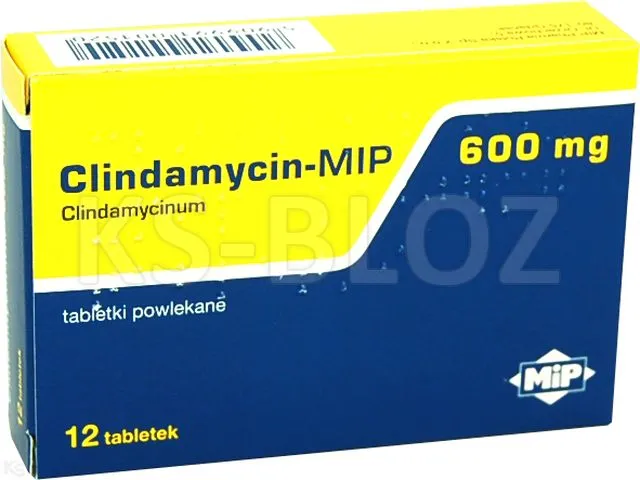
Table of Contents
Package leaflet: Information for the patient
Clindamycin-MIP 300, 300 mg, coated tablets
Clindamycin-MIP 600, 600 mg, coated tablets
Clindamycinum
Please read carefully the entire leaflet before using the medicine, as it contains
important information for the patient.
- Keep this leaflet, as you may need to read it again.
- If you have any further questions, please consult your doctor or pharmacist.
- This medicine has been prescribed for a specific individual. Do not pass it on to others. The medicine may harm other people, even if their symptoms are the same.
- If you experience any adverse reactions, including those not listed in this leaflet, inform your doctor or pharmacist. See section 4.
Table of contents of the leaflet:
- What is Clindamycin-MIP and what is it used for
- Important information before taking Clindamycin-MIP
- How to take Clindamycin-MIP
- Possible side effects
- How to store Clindamycin-MIP
- Contents of the pack and other information
1. What is Clindamycin-MIP and what is it used for
Clindamycin-MIP is available as coated tablets containing clindamycin hydrochloride. It is
an antibiotic – a semisynthetic derivative of lincomycin, belonging to the lincosamide group, which
does not resemble other antibiotics. Depending on the microorganism's sensitivity and the
antibiotic concentration, clindamycin may act either bacteriostatically or bactericidally.
Clindamycin is active against the following microorganisms: staphylococci (Staphylococcus aureus, Staphylococcus epidermidis), Streptococcus pneumoniae (partial resistance to clindamycin has been detected in penicillin-resistant pneumococci), Streptococcus pyogenes group A, Streptococcus viridans, Bacteroides spp., Fusobacterium spp., Actinomycetes spp., Peptococcus spp., Peptostreptococcus spp., Propionibacterium, Mycoplasma hominis.
Susceptibility of Clostridium spp. varies; some species are resistant to clindamycin.
Secondary resistance develops rarely.
Resistant strains include Enterococcus spp. (E. faecalis, E. faecium), Neisseria spp. (e.g. N. gonorrhoeae, N. meningitidis), Haemophilus spp., Escherichia coli, Klebsiella, Enterobacter, Serratia, Proteus spp., Pseudomonas, Salmonella, Shigella, and Nocardia.
Complete cross-resistance between clindamycin and lincomycin occurs in pathogens, and partial cross-resistance exists between clindamycin and erythromycin.
Indications for use
Bacterial infections caused by strains sensitive to clindamycin:
- Bone and joint infections;
- Ear, nose, and throat infections;
- Dental and periapical osteomyelitis of the jaw;
- Lower respiratory tract infections;
- Intra-abdominal infections;
- Pelvic and female genital tract infections;
- Skin and soft tissue infections;
- Toxoplasmosis.
In cases of severe infection, intravenous administration of the drug is recommended instead of oral.
2. Important information before using Clindamycin-MIP
When not to use Clindamycin-MIP
- if the patient is allergic to clindamycin or lincomycin (due to cross-allergy), or to any of the other ingredients of this medicine (listed in section 6).
Warnings and precautions
Before starting treatment with Clindamycin-MIP, discuss the following with your doctor:
- if you have liver function disorders;
- if you have neuromuscular conduction disorders (e.g. myasthenia gravis or Parkinson's disease);
- if you have previously suffered from gastrointestinal diseases (e.g. previous colitis).
You should consult your doctor even if the above warnings refer to conditions that occurred in the past.
During long-term (longer than 3 weeks) treatment, periodic monitoring of blood count, liver and kidney function is recommended.
Severe kidney function disorders may occur. Inform your doctor about all concomitantly used medicines and any existing kidney problems. If the patient experiences reduced urine output or fluid retention causing swelling of the legs, ankles or feet, shortness of breath or nausea, contact your doctor immediately.
Prolonged and repeated use of clindamycin may lead to infection and overgrowth of resistant bacteria or yeasts, particularly affecting the skin or mucous membranes.
If diarrhoea occurs during treatment, especially if severe or persistent, the patient should consult a doctor. It may be a symptom of pseudomembranous colitis caused by toxins produced by excessive growth of Clostridium difficile bacteria in the intestine. The doctor will recommend appropriate treatment – in milder cases discontinuation of Clindamycin-MIP may be sufficient; in more severe cases, an effective antibiotic or chemotherapeutic agent may be required, and symptomatic treatment if necessary. Medicines that inhibit intestinal peristalsis are contraindicated.
In case of anaphylactic shock, discontinue the drug and provide appropriate medical support (e.g. adrenomimetics, antihistamines, corticosteroids or, if necessary, controlled ventilation).
Clindamycin can usually be used in patients allergic to penicillin. Allergic reactions to clindamycin in penicillin-allergic patients (so-called cross-allergy) generally do not occur due to structural differences between the two substances. However, in isolated cases, anaphylaxis has been observed during clindamycin treatment in patients with penicillin allergy. A patient allergic to penicillin should inform the doctor before starting clindamycin treatment.
Clindamycin should not be used in the treatment of acute viral respiratory tract infections.
Clindamycin does not achieve therapeutic concentrations in cerebrospinal fluid; therefore, Clindamycin-MIP tablets should not be used in the treatment of meningitis.
Children
Coated tablets are unsuitable for use in children under 5–6 years of age who may have difficulty swallowing the medicine. When administering clindamycin in tablet form to children, accurate dosing is often not achievable.
Patients with renal and/or hepatic impairment
In patients with moderate to severe liver impairment, the serum half-life of clindamycin is prolonged. If clindamycin is administered every 8 hours, dose reduction is usually not necessary. In patients with severe liver impairment, serum drug concentration should be monitored – depending on the results, dose reduction or extended dosing intervals may be required.
In patients with renal impairment, the half-life is prolonged. Dose reduction is not necessary in mild or moderate renal impairment. However, in patients with severe renal impairment or anuria, serum drug concentration should be monitored – depending on the results, dose reduction or extension of the dosing interval from 8 to 12 hours may be required.
Patients undergoing haemodialysis
Haemodialysis does not remove clindamycin from the blood; therefore, additional doses before or after dialysis are not required.
Clindamycin-MIP and other medicines
Inform your doctor about all medicines currently or recently used, as well as any medicines you plan to take.
Clindamycin should not be used concomitantly with macrolide antibiotics (e.g. erythromycin) due to antagonistic effects observed in vitro.
Microorganisms resistant to lincomycin are also resistant to clindamycin (so-called cross-resistance).
Clindamycin has neuromuscular blocking properties, which may enhance the effects of muscle relaxants (e.g. ether, tubocurarine, pancuronium bromide). Therefore, during surgery using such agents, unexpected life-threatening situations may occur.
Patients receiving clindamycin together with anticoagulant medication (warfarin or similar drugs) may have an increased tendency to bleed. The doctor may decide to perform regular blood tests to monitor blood clotting.
Pregnancy and breastfeeding
If the patient is pregnant or breastfeeding, suspects she may be pregnant, or is planning to have a baby, she should consult her doctor or pharmacist before using this medicine.
Human studies have not revealed teratogenic effects of the drug. However, the benefit-risk ratio of using clindamycin during pregnancy and breastfeeding should be carefully evaluated.
Clindamycin passes into breast milk. In a breastfed newborn, hypersensitivity, diarrhoea or yeast infection may occur.
Driving and operating machinery
Clindamycin-MIP has no effect or negligible effect on the ability to drive vehicles and operate machinery.
3. How to use Clindamycin-MIP
This medicine should always be taken exactly as directed by your doctor or pharmacist. If in doubt,
consult your doctor or pharmacist.
Children
Depending on the severity and location of infection, children over 5 years of age should receive between 8 mg
and 25 mg of clindamycin per kilogram of body weight.
The daily dose should be divided into 3 or 4 divided doses.
Coated tablets are not suitable for use in children under 5–6 years of age who may have difficulty swallowing
the medicine. When administering clindamycin in tablet form to children, it is often not possible to achieve
precise dosing.
Adults
Depending on the severity and location of infection, adults and adolescents over 14 years of age should receive
between 600 mg and 1,800 mg of clindamycin per day. The daily dose should be divided into 3 or 4 doses.
If a dose lower than 1,200 mg per day is required, or in children under 14 years of age, a medicine with a lower
content of active substance should be used.
Method of administration
Clindamycin-MIP coated tablets should be swallowed whole, without chewing, with an adequate amount of
fluid (e.g. one glass of water). The medicine may be taken independently of meals.
Clindamycin-MIP should be taken regularly, at the same time each time.
Your doctor will advise you on how long you should take Clindamycin-MIP. Do not stop treatment early, as this
may render the treatment ineffective.
Taking more Clindamycin-MIP than recommended
Symptoms of overdose and toxicity with clindamycin are not known. In case of oral overdose (coated tablets),
gastric lavage is recommended. Clindamycin cannot be removed from the blood by hemodialysis or peritoneal
dialysis. No specific antidote is known.
If you take more medicine than recommended, seek immediate advice from your doctor or pharmacist.
Missing a dose of Clindamycin-MIP
Occasionally missing a single dose usually does not cause any adverse effects. Continue treatment as before.
Do not take a double dose to make up for a missed dose. However, remember that Clindamycin-MIP works
effectively only when taken regularly.
Stopping Clindamycin-MIP treatment
If you have any further doubts regarding the use of this medicine, consult your doctor or pharmacist.
4. Possible adverse reactions
Like all medicines, this medicine can cause adverse reactions, although not everyone will experience them.
You should inform the doctor immediately if the patient experiences:
- fluid retention causing swelling of the ankles, feet or legs, breathlessness or nausea
Adverse reactions occurring not very frequently (in 1 to 10 per 1000 patients):
- abdominal pain, nausea, vomiting or mild diarrhoea. All these symptoms are dose-dependent and resolve during or after treatment. Oesophagitis, glossitis or stomatitis may also occur.
Adverse reactions occurring rarely (in 1 to 10 per 10,000 patients):
- acneiform rash, pruritus and urticaria;
- thrombocytopenia (reduced platelet count), leukopenia (reduced white blood cell count), eosinophilia (increased number of acidophilic granulocytes), neutropenia (reduced number of neutrophil granulocytes) or granulocytopenia (reduced number of granulocytes);
- transient slight increase in serum aminotransferase activity;
- neuromuscular blockade.
Adverse reactions occurring very rarely (less than 1 in 10,000 patients):
- pseudomembranous colitis;
- oedema (Quincke's oedema, joint oedema), drug fever, erythema multiforme (e.g. Stevens-Johnson syndrome), Lyell's syndrome and anaphylactic shock. These reactions may occur after the first dose of the medicine;
- transient cholestatic hepatitis;
- pruritus, desquamative and bullous dermatitis;
- vaginitis;
- polyarthritis;
- taste and smell disturbances.
Reporting of adverse reactions
If any adverse reactions occur, including any adverse reactions not listed
in this leaflet, tell your doctor or pharmacist. Adverse reactions can
be reported directly to the Department of Monitoring of Adverse Drug Reactions of the Office for Registration of Medicinal Products, Medical Devices and Biocidal Products,
Al. Jerozolimskie 181C, 02-222 Warsaw,
Tel.: +48 22 49 21 301
Fax: +48 22 49 21 309
Website: https://smz.ezdrowie.gov.pl.
Adverse reactions can also be reported to the marketing authorization holder.
Reporting adverse reactions helps to provide more information on the safety of the medicine.
5. How to store Clindamycin-MIP 300
Keep the medicine out of the sight and reach of children.
Do not use this medicine after the expiry date stated on the carton after "Expiry date". The expiry date refers to the last day of the stated month.
Store below 30°C.
Do not use this medicine if you notice that the tablets have clearly discoloured to a yellow-brown colour.
Medicines must not be disposed of via wastewater or household waste. Ask your pharmacist how to dispose of medicines no longer required. Such measures help protect the environment.
6. Contents of the package and other information
What Clindamycin-MIP contains
- The active substance is clindamycin. One Clindamycin MIP 300 coated tablet contains 300 mg of clindamycin (Clindamycinum) in the form of 344 mg clindamycin hydrochloride. One Clindamycin MIP 600 coated tablet contains 600 mg of clindamycin (Clindamycinum) in the form of 688 mg clindamycin hydrochloride.
- Other ingredients are: microcrystalline cellulose, mannitol, talc, colloidal anhydrous silica, magnesium stearate, crospovidone, Eudragit E 12.5%, titanium dioxide (E 171), magnesium stearate, polyethylene glycol.
What Clindamycin-MIP looks like and contents of the pack
Clindamycin MIP 300: white, round, biconvex coated tablets.
Clindamycin MIP 600: white, elongated coated tablets with a score line.
Pack sizes of Clindamycin-MIP 300 contain 6, 12, 16 or 30 coated tablets.
Pack sizes of Clindamycin-MIP 600 contain 6, 12, 16, 30 or 32 coated tablets.
Not all pack sizes may be marketed.
Marketing Authorisation Holder and Manufacturer
Marketing Authorisation Holder
MIP Pharma Polska Sp. z o.o.
Orzechowa 5
80-175 Gdańsk
Tel.: 58 303 93 62
Fax: 58 322 16 13
e-mail: [email protected]
Manufacturer
Chephasaar, Chemisch-pharmazeutische Fabrik GmbH
Mühlstrasse 50
D-66386 St. Ingbert
Germany