Clatra
PolandTable of Contents
Patient Information Leaflet
Warning! Keep this leaflet! Information on the immediate packaging in a foreign language.
Clatra (Bysabel)
6 mg/ml, eye drops, solution
Bilastinum
Clatra and Bysabel are different trade names for the same medicine.
Please read the entire leaflet before using the medicine, as it contains important information
for the patient.
- Keep this leaflet for future reference.
- Consult your doctor or pharmacist if you have any further questions.
- This medicine has been prescribed for a specific individual. Do not pass it on to others. The medicine may harm another person, even if their symptoms are the same.
- If the patient experiences any adverse reactions, including those not listed in this leaflet, inform the doctor or pharmacist. See section 4.
Table of contents:
- What Clatra is and what it is used for
- What you need to know before using Clatra
- How to use Clatra
- Possible side effects
- How to store Clatra
- Contents of the pack and other information
1. What Clatra is and what it is used for
Clatra contains the active substance bilastine, which belongs to a group of medicines called antihistamines.
Antihistamines work by preventing the effects of a substance called histamine, which the body produces during an allergic reaction.
This medicine is used for symptomatic treatment of eye disorders associated with seasonal allergic conjunctivitis in adults and children aged 2 years and older.
This medicine is also used for symptomatic treatment of eye disorders caused by allergy to substances such as house dust mites or animal dander (perennial allergic conjunctivitis) in adults and children aged 2 years and older.
2. Important information before using Clatra
When not to use Clatra
- if the patient is allergic to bilastine or any of the other ingredients of this medicine (listed in section 6).
Warnings and precautions
Before starting treatment with Clatra, consult a doctor or pharmacist. If the patient experiences any adverse reactions during treatment such as eye irritation, pain, redness or worsening of vision, or if the patient's condition worsens, treatment may need to be discontinued.
After instilling the anti-allergic eye drops Clatra into the conjunctival sac, visual acuity may be temporarily blurred for a few minutes due to the formation of streaks.
If the patient experiences symptoms of inflammation, including allergic conjunctivitis, they should consult their ophthalmologist whether they can continue wearing contact lenses despite these symptoms.
Children and adolescents
Clatra is indicated for use in adults and children aged 2 years and older.
This medicine should not be given to children under 2 years of age, as its safety and efficacy have not been established in this population.
Clatra and other medicines
Inform the doctor or pharmacist about all medicines the patient is currently taking or has recently taken, as well as any medicines the patient plans to take.
When using other topical eye medications simultaneously, a 5-minute interval should be maintained between the administration of each medicine. Ointments for the eyes should be administered last.
Pregnancy, breastfeeding and fertility
Clatra may be used during pregnancy and breastfeeding. If the patient is pregnant or breastfeeding, suspects she may be pregnant, or is planning to have a child, she should consult a doctor or pharmacist before using this medicine.
Driving and operating machinery
Transient blurred vision or other visual disturbances affecting the ability to drive and operate machinery may occur after using this medicine. The patient should wait until vision clears before driving or operating machinery.
Contact lenses
This medicine does not alter the properties of contact lenses. Wearing contact lenses may be continued after using the medicine.
Contact lenses should be removed before applying the medicine and reinserted no sooner than 15 minutes after administration of the medicine.
3. How to use Clatra
This medicine should always be used as directed by a doctor or pharmacist. If in doubt,
consult a doctor or pharmacist.
The recommended dose for adults and children aged 2 years and older is one drop in each eye once daily.
This medicine may be used for up to 8 weeks. The treating doctor will determine, based on the patient's condition, how long Clatra should be used.
For ophthalmic use only.
Method of administration
- Always wash your hands before administering this medicine and dry them with a clean towel.
- If there is dried discharge on the eyelid, gently clean it by wiping the closed eyelid from the inner to the outer corner using a cotton swab moistened with warm water.
- Open the bottle and avoid touching the eye or any other surface with the dropper tip.
- The drops and dropper must be kept clean.
- Tilt your head backward or lie down and look upward (Figure 1). Gently pull down the lower eyelid with a finger (Figure 2).
- Look upward and instill one drop into the eye.
- Release the lower eyelid and keep the eye closed for a few moments to spread the drop over the eye surface (Figure 3).
- If necessary, repeat the above steps for the other eye.
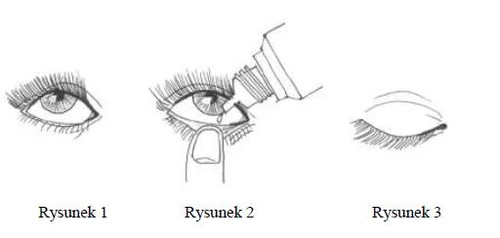
To avoid contamination during use, do not let the dropper tip touch any surfaces (eyelids, eye area, or other surfaces). After use, wipe the dropper tip with a clean tissue to remove any residual liquid.
Use of more Clatra than recommended
The eyes may be rinsed with warm water.
Missed dose of Clatra
Do not use a double dose to make up for a missed dose.
If a dose is missed, administer the missed dose as soon as possible, then return to the regular dosing schedule.
Stopping Clatra
If possible, treatment with this medicine should be continued regularly until symptoms resolve. If Clatra is discontinued during exposure to allergen(s), a recurrence of typical allergy symptoms should be expected.
If you have any further questions about the use of this medicine, consult your doctor or pharmacist.
4. Possible adverse reactions
Like all medicines, this medicinal product may cause adverse reactions, although not everyone experiences them.
The adverse reactions listed below have been reported.
Not common (occurring in fewer than 1 in 100 people):
Taste disturbances, headache.
Dry eye syndrome, eye discharge, eye irritation, increased lacrimation, eye discomfort.
If any of the above adverse reactions occur, use of this medicine should be discontinued and immediate medical advice should be sought. Adverse reactions are usually mild and resolve quickly in all cases. Therefore, no special precautions are required.
Reporting of adverse reactions
If any adverse effects occur, including any adverse effects not listed in this leaflet, inform your doctor or pharmacist. Adverse reactions can be reported directly to the Department of Monitoring Adverse Drug Reactions of the Office for Registration of Medicinal Products, Medical Devices and Biocidal Products, Al. Jerozolimskie 181 C, 02-222 Warsaw, phone: +48 22 49 21 301, fax: +48 22 49 21 309, website: https://smz.ezdrowie.gov.pl.
Reporting adverse reactions enables further information on the safety of the medicine to be collected.
5. How to store Clatra
Keep the medicine out of the sight and reach of children.
Do not use the medicine after the expiry date stated on the container.
The expiry date refers to the last day of the stated month.
No special storage conditions are required.
After first opening the bottle: do not use this medicine for more than 2 months after first opening.
Medicines must not be disposed of via wastewater or household waste. Ask your pharmacist how to dispose of medicines no longer required. These measures will help protect the environment.
6. Contents of the packaging and other information
What Clatra contains
- The active substance is bilastine 6 mg/ml. One drop contains 0.2 mg of bilastine.
- The other ingredients are: hydroxypropylbetadex, methylcellulose, sodium hyaluronate, glycerol (E 422), sodium hydroxide 1N (for pH adjustment), water for injections.
What Clatra looks like and contents of the pack
Clatra is a clear, colourless eye drop solution in a multidose container made of LDPE, with a dropper made of HDPE and a cap with a tamper-evident seal, packed in a cardboard box.
Pack size: 1 bottle containing 5 ml
For more detailed information, please contact the marketing authorisation holder or the parallel importer.
Marketing Authorisation Holder in Italy, the country of export:
Menarini International Operations Luxembourg S.A.
1, Avenue de la Gare
L-1611 Luxembourg
Luxembourg
Manufacturer:
FAMAR Healthcare Services Madrid S.A.U
Avenida de Leganés, 62 - 28923 Alcorcón
Madrid, Spain
Parallel Importer:
InPharm Sp. z o.o.
ul. Strumykowa 28/11
03-138 Warsaw
Poland
Repackaged by:
InPharm Sp. z o.o. Services sp. k.
ul. Chełmżyńska 249
04-458 Warsaw
Poland
Marketing Authorisation Number in Italy, the country of export: 041044114
Parallel Import Authorisation Number: 25/26
This product is authorised for sale in the European Economic Area (EEA) under the following names:
Austria: Olisir 6 mg/ml Augentropfen, Lösung
Belgium: Bellozal 6 mg/ml eye drops, solution
Croatia: Nixar 6 mg/ml kapi za oko, otopina
Cyprus: Bilaz 6mg/ml οφθαλμικές σταγόνες
Czech Republic: Xados
Estonia: Opexa
France: Bilaska 6 mg/ml collyre en solution
Germany: Bilaxten 6 mg/ml Augentropfen, Lösung
Greece: Bilaz
Hungary: Lendin 6 mg/ml szemcsepp
Ireland: Drynol 6 mg/ml eye drops, solution
Italy: Bysabel 6 mg/ml collirio, soluzione
Latvia: Opexa 6 mg/ml acu pilieni, šķīdums
Lithuania: Opexa 6 mg/ml akių lašai, tirpalas
Luxembourg: Bellozal 6 mg/ml eye drops, solution
Malta: Gosall 6 mg/ml eye drops, solution
Poland: Clatra
Portugal: Lergonix 6 mg/ml colírio, solução
Romania: Borenar 6 mg/ml picături oftalmice, soluţie
Slovakia: Omarit 6 mg/ml očné roztokové kvapky
Slovenia: Bilador 6 mg/ml kapljice za oko, raztopina
Spain: Ibis 6 mg/ml colirio en solución