Claritin allergy
Poland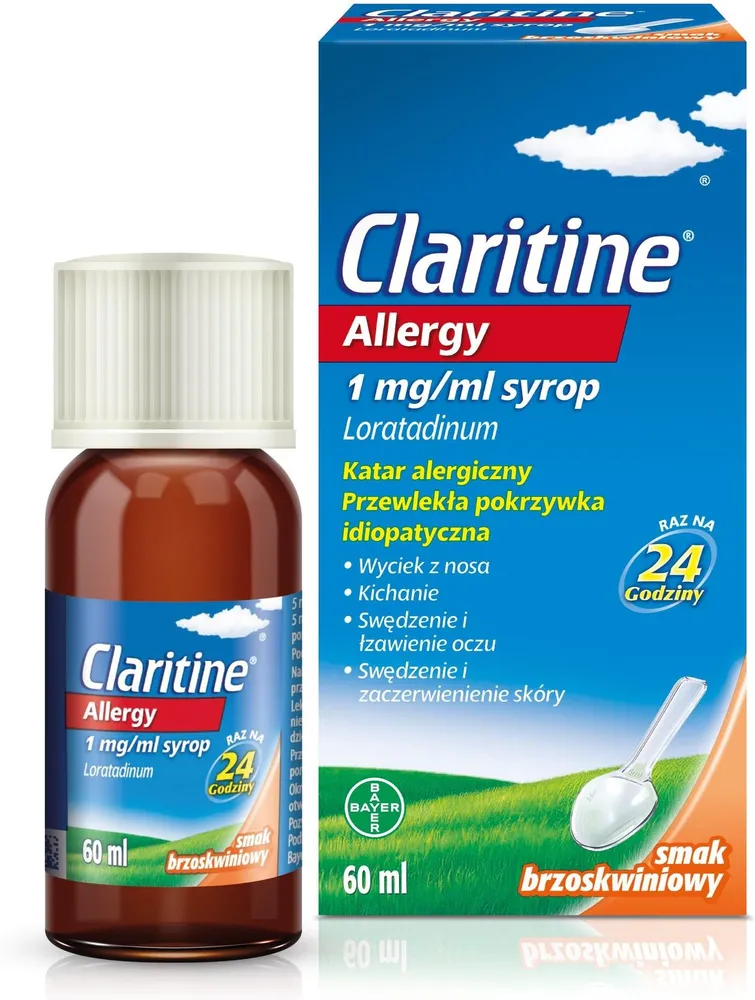
Table of Contents
Patient Information Leaflet
CLARITINE ALLERGY, 1 mg/ml, syrup
Loratadine
Please read the following information carefully before using this medicine, as it contains
important information for the patient.
This medicine should always be used exactly as described in this patient leaflet or as directed by
your doctor or pharmacist.
- Keep this leaflet for future reference.
- If you need advice or further information, consult your pharmacist.
- If you experience any side effects, including any possible side effects not listed in this leaflet, inform your doctor or pharmacist. See section 4.
- If there is no improvement after 3 days, or if you feel worse, consult your doctor.
Table of Contents
- What Claritine Allergy is and what it is used for
- What you need to know before taking Claritine Allergy
- How to take Claritine Allergy
- Possible side effects
- How to store Claritine Allergy
- Contents of the pack and other information
1. What Claritine Allergy is and what it is used for
Claritine Allergy belongs to a group of medicines called antihistamines. These medicines reduce allergy symptoms by blocking the effects of a substance called histamine, which is produced in the body.
Claritine Allergy relieves symptoms of allergic rhinitis such as sneezing, itching, watery nasal discharge, and itchy, burning eyes.
The medicine may also be used to relieve symptoms of chronic idiopathic urticaria (itching, skin redness).
Therapeutic effects providing relief from these symptoms last throughout the day, helping patients return to normal daily activities and achieve normal sleep.
If there is no improvement after 3 days, or if you feel worse, consult your doctor.
Claritine Allergy may only be used by individuals diagnosed by a doctor with allergic rhinitis and chronic idiopathic urticaria, and only according to the doctor's instructions.
2. Important information before using Claritine Allergy
When not to use Claritine Allergy:
- if the patient is allergic to loratadine or any of the other ingredients of this medicine (listed in section 6).
Warnings and precautions
Before starting to use Claritine Allergy, please discuss this with your doctor or pharmacist:
- if the patient has liver function disorders (see section 3. How to use Claritine Allergy).
Skin tests
Claritine Allergy should be discontinued approximately 48 hours before planned skin testing, as antihistamines may cause false-negative results (they may reduce or completely suppress the skin reaction which would normally be positive).
Claritine Allergy and other medicines
Adverse effects may be intensified when Claritine Allergy is used concomitantly with medicines affecting the activity of certain liver enzymes responsible for drug metabolism. However, in clinical studies, no increase in adverse effects was observed during concomitant use of loratadine with drugs affecting these enzymes.
Concomitant administration of loratadine with ketoconazole, erythromycin, or cimetidine increases plasma concentrations of loratadine, but without clinical consequences. Concomitant use of loratadine with drugs affecting hepatic metabolism should be performed under medical supervision.
Inform your doctor or pharmacist about all medicines currently used or recently used, as well as any medicines the patient intends to use, including those available without a prescription.
Taking Claritine Allergy with food, drink and alcohol
This medicine may be taken regardless of meals.
When taken together with alcohol, Claritine Allergy does not enhance its effects to a degree detectable by psychomotor tests.
Pregnancy, breastfeeding and fertility
If the patient is pregnant or breastfeeding, suspects she may be pregnant, or is planning to have a child, she should consult her doctor or pharmacist before using this medicine.
As a precautionary measure, use of Claritine Allergy during pregnancy is not recommended.
Loratadine passes into breast milk; therefore, use of this medicine is not recommended during breastfeeding.
There are no data available regarding fertility in men and women.
Driving and operating machinery
In clinical studies, loratadine had no effect or only negligible effect on the ability to drive and operate machinery. However, in some individuals, somnolence has very rarely occurred, which may impair the ability to drive and operate machinery.
Claritine Allergy contains maltitol liquid, crystallized liquid sorbitol, propylene glycol, sodium benzoate
The medicine contains 2.5 mg of sodium benzoate in 5 ml of syrup, equivalent to 0.5 mg/ml.
The medicine contains 250 mg of propylene glycol in 5 ml of syrup, equivalent to 50 mg/ml.
The medicine contains less than 1 mmol (23 mg) of sodium in 5 ml of syrup, meaning the medicine is considered "sodium-free".
The medicine contains 1 g of sorbitol in 5 ml of syrup, equivalent to 200 mg/ml.
Sorbitol is a source of fructose. If intolerance to certain sugars has previously been diagnosed in the patient (or their child), or if hereditary fructose intolerance, a rare genetic disorder in which the patient's body cannot break down fructose, has been diagnosed, the patient should consult a doctor before taking the medicine or giving it to a child.
3. How to use Claritine Allergy
This medicine should always be used exactly as described in this patient leaflet or as directed by a doctor or pharmacist. If in doubt, consult a doctor or pharmacist.
Recommended dose
Adults and children over 12 years of age:
10 ml of syrup once daily. The medicine can be taken independently of meals. It is not necessary to drink water or other fluids after taking the syrup.
Children aged 6 to 12 years – dosage depends on body weight:
Body weight greater than 30 kg:
10 ml of syrup once daily. The medicine can be taken independently of meals. It is not necessary to drink water or other fluids after taking the syrup.
Body weight 30 kg or less:
Claritine Allergy is not recommended.
Patients with severe hepatic impairment:
Adults and children with body weight greater than 30 kg: 10 ml of syrup every other day.
There is no need to adjust the dose in elderly patients or in patients with renal impairment.
If you feel that the effect of Claritine Allergy is too strong or too weak, consult your doctor.
Taking more Claritine Allergy than recommended
If you take more Claritine Allergy than recommended, contact a doctor or pharmacist immediately.
Overdose of Claritine Allergy has been associated with drowsiness, tachycardia, and headache.
In case of overdose, symptomatic and supportive treatment should be initiated immediately and maintained for as long as necessary. Activated charcoal in aqueous suspension may be administered. The doctor may also perform gastric lavage. Loratadine cannot be removed from the body by hemodialysis; it is unknown whether it can be removed by peritoneal dialysis.
There are no data indicating that loratadine causes abuse or dependence.
Missing a dose of Claritine Allergy
If a patient forgets to take the medicine at the usual time, they should take it as soon as possible, then return to the regular dosing schedule. Do not take a double dose to make up for a missed dose.
If you have any further questions about the use of this medicine, consult your doctor or pharmacist.
4. Possible adverse reactions
Like all medicines, this medicine can cause adverse reactions, although not everyone experiences them.
Common adverse reactions associated with taking Claritine Allergy (occurring in 1 to 10 out of 100 patients taking the medicine) are:
- in children aged 2 to 12 years – headache, nervousness, and fatigue.
- in adults and adolescents – drowsiness.
Uncommon adverse reactions associated with taking Claritine Allergy (occurring in 1 to 10 out of 1,000 patients taking the medicine) in adults and adolescents are:
- headache, increased appetite, sleep problems, fatigue, dry mouth, gastrointestinal disorders such as nausea, gastritis, and allergic reactions such as rash.
Very rare adverse reactions (occurring in fewer than 1 out of 10,000 patients taking the medicine), observed after the medicine was marketed, include:
- severe allergic reactions (including difficulty breathing, wheezing, itching, urticaria, swelling). If severe allergic reactions occur, stop taking the medicine immediately and contact a doctor without delay.
- dizziness, convulsions, irregular or rapid heartbeat, liver function disorders, hair loss.
Adverse reaction with unknown frequency (frequency cannot be estimated from the available data): weight gain.
Reporting of adverse reactions
If any adverse reactions occur, including any not listed in this leaflet, inform your doctor or pharmacist. Adverse reactions can be reported directly to the Department of Monitoring Adverse Reactions to Medicinal Products at the Office for Registration of Medicinal Products, Medical Devices and Biocidal Products:
Al. Jerozolimskie 181C, 02-222 Warsaw, Phone: +48 22 49 21 301, Fax: +48 22 49 21 309, e-mail: [email protected].
Adverse reactions can also be reported to the marketing authorization holder.
Reporting adverse reactions helps provide more information on the safety of this medicine.
5. How to store Claritine Allergy
Keep the medicine out of the sight and reach of children.
Store below 25°C.
Keep the medicine for up to 1 month after first opening the bottle.
Do not use this medicine after the expiry date stated on the packaging after: EXP. The expiry date refers to the last day of the stated month.
Medicines must not be disposed of via wastewater or household waste. Ask your pharmacist how to dispose of medicines no longer required. These measures will help protect the environment.
6. Contents of the pack and other information
What Claritine Allergy contains
- The active substance is loratadine. 1 ml of syrup contains 1 mg of loratadine. 5 ml of syrup contains 5 mg of loratadine. 10 ml of syrup contains 10 mg of loratadine.
- The other ingredients (excipients) are: propylene glycol, glycerol, sodium benzoate, sucralose, maltitol liquid, crystallizing liquid sorbitol, grape flavor 936.1368U, disodium dihydrogen edetate dihydrate, phosphoric acid, disodium edetate, purified water.
What Claritine Allergy looks like and contents of the pack
The medicine is contained in a plastic bottle made of polyethylene terephthalate (PET) with a cap made of polypropylene (PP) and child-resistant closure, placed in a cardboard box. The bottle contains 60 ml of syrup. The syrup is clear, ranging from colourless to pale yellow. A measuring cup marked for 5 ml and 10 ml is supplied with the bottle.
Marketing Authorisation Holder and Manufacturer
Marketing Authorisation Holder:
Bayer Sp. z o.o.
Al. Jerozolimskie 158
02-326 Warsaw
Tel.: +48 22 572 35 00
Importer:
BerliMed S.A.
Poligono Industrial Santa Rosa
Calle Francisco Alonso No.7
28806 Alcalá de Henares (Madrid)
Spain