Cisatracurium noridem
Poland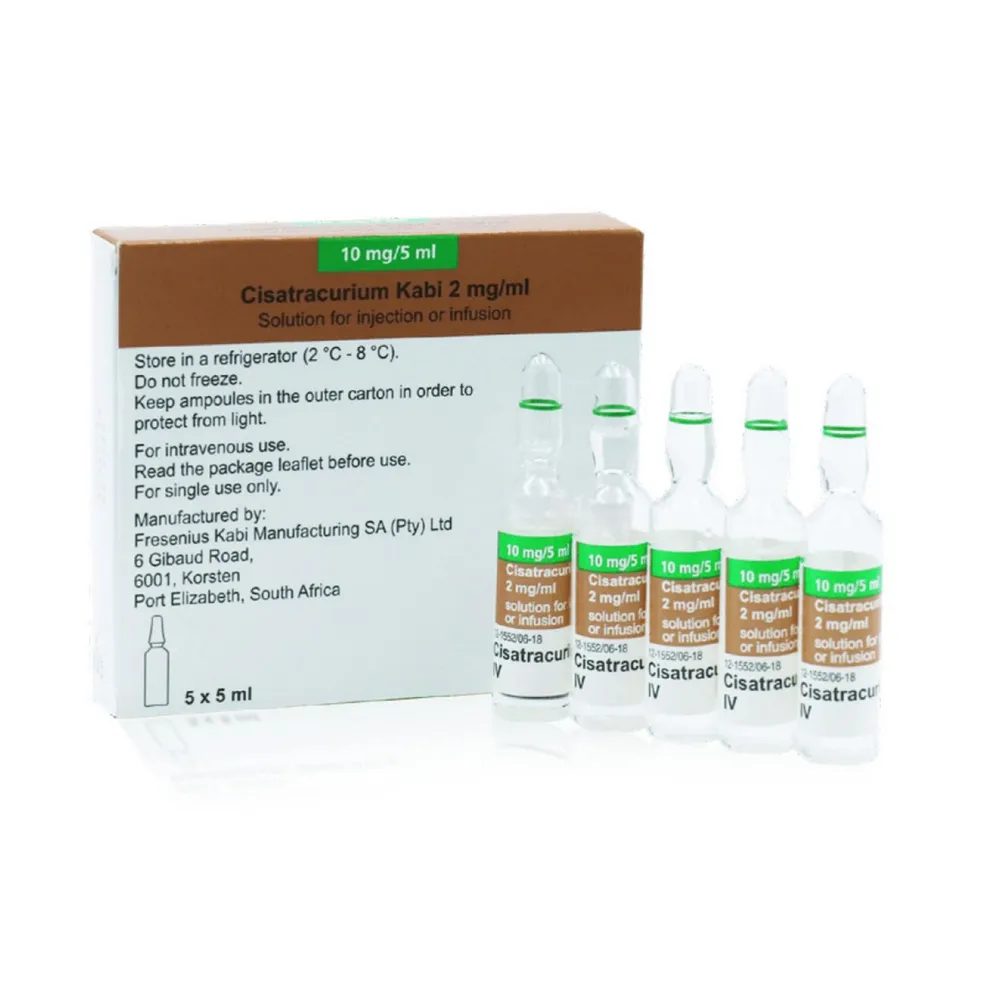
Table of Contents
Package leaflet: Information for the user
Cisatracurium Noridem, 2 mg/ml, solution for injection / infusion
cisatracurium
Please read all of this leaflet carefully before using this medicine because it contains important information for you.
- Keep this leaflet as you may need to read it again.
- If you have any further questions, ask your doctor, pharmacist, or nurse.
- If you experience any side effects, including any not listed in this leaflet, tell your doctor, pharmacist, or nurse. See section 4.
The name of this medicine is Cisatracurium Noridem.
In the remainder of this leaflet, Cisatracurium Noridem will be referred to as Cisatracurium.
Contents of the leaflet
- What Cisatracurium is and what it is used for
- What you need to know before you are given Cisatracurium
- How Cisatracurium is given
- Possible side effects
- How to store Cisatracurium
- Contents of the pack and other information
1. What Cisatracurium is and what it is used for
The active substance is cisatracurium besilate, which belongs to a group of medicines called muscle relaxants.
Cisatracurium is used:
- To relax muscles during surgery in adults and children over 1 month of age, including cardiac surgery.
- To facilitate insertion of a plastic tube into the patient's trachea (endotracheal intubation) when the patient requires assisted ventilation.
- In intensive care units to relax muscles.
- For further information about the medicine, consult your doctor.
2. Important information before using Cisatracurium Noridem
When not to use Cisatracurium Noridem:
- If the patient is allergic to the active substance, any other muscle relaxant, or any of the other ingredients of this medicine listed in section 6.
- If the patient has previously experienced an abnormal reaction to anaesthetic medicines.
If any of the above situations apply to the patient, Cisatracurium Noridem must not be used. If in doubt, consult a doctor, pharmacist or nurse before administering Cisatracurium Noridem.
When to exercise special caution with Cisatracurium Noridem
Contact a doctor, nurse or pharmacist:
- If the patient has muscle weakness and fatigue or difficulty with coordination (myasthenia).
- If the patient has a neuromuscular disease such as muscular atrophy, paralysis, amyotrophic lateral sclerosis, or cerebral palsy.
- If the patient has burns requiring treatment.
If in doubt whether any of the above conditions apply to the patient, consult a doctor or nurse before administering Cisatracurium Noridem.
Cisatracurium Noridem and other medicines
Inform the doctor about all medicines the patient is currently taking or has recently taken, including herbal products available without a prescription.
In particular, inform the doctor if the patient is taking any of the following medicines:
- Anaesthetics (used to block sensation and pain during surgical procedures).
- Antibiotics (used to treat infections).
- Medicines used to treat heart rhythm disorders (antiarrhythmics).
- Medicines used to treat high blood pressure.
- Diuretics (water pills), such as furosemide.
- Medicines used to treat inflammatory joint disorders, such as chloroquine or D-penicillamine.
- Steroids.
- Medicines used to treat seizures (epilepsy), such as phenytoin or carbamazepine.
- Medicines used to treat psychiatric disorders, such as lithium or chlorpromazine (also used as an antiemetic).
- Medicines containing magnesium.
- Anticholinesterases used in the treatment of Alzheimer's disease, such as donepezil.
Pregnancy and breastfeeding
If the patient is pregnant or breastfeeding, suspects she may be pregnant, or is planning to have a child, she should consult her doctor before using this medicine.
A harmful effect of cisatracurium on the breastfed infant cannot be ruled out; however, no effect is expected if breastfeeding is resumed after the effect of the drug has worn off.
Cisatracurium is rapidly eliminated from the body. A woman should not breastfeed for 3 hours after the end of administration of the medicine.
Driving and using machines
If the patient is undergoing a day-case hospital procedure, the doctor will advise how long to wait before leaving the hospital or before driving. Driving too soon after a surgical procedure may be dangerous.
3. How to use Cisatracurium Noridem
The patient must never administer this medicine himself. The medicine will always be given by a
qualified person.
Cisatracurium Noridem can be administered:
- as a single intravenous injection (intravenous bolus)
- as a continuous intravenous infusion; the medicine is then administered slowly over a prolonged period.
The method of administration and the dose received by the patient will be determined by the doctor. This will depend on:
- the patient's body weight,
- the required duration and degree of muscle relaxation,
- the expected response of the patient to the medicine.
Use in children
Cisatracurium Noridem must not be used in children under 1 month of age.
Administration of a higher than recommended dose of Cisatracurium Noridem
Cisatracurium Noridem will always be administered under medical supervision. However, if the
patient thinks that a higher than recommended dose has been administered, he should immediately
inform the doctor or nurse.
If there are any further doubts concerning the use of this medicine, consult the doctor.
4. Possible side effects
Like all medicines, this medicine can cause side effects, although not everybody will experience them.
If any of the side effects worsen, or if you notice any side effects not listed in this leaflet, inform your doctor.
Allergic reactions (may occur in less than 1 in 10,000 patients)
If an allergic reaction occurs, inform your doctor or nurse immediately.
Possible symptoms include:
- Sudden wheezing, chest pain or tightness
- Swelling of the eyelids, face, lips, mouth or tongue
- Raised, itchy rash (hives) appearing anywhere on the body
- Collapse and shock
Inform your doctor or nurse if any of the following side effects occur:
Common side effects (may occur in less than 1 in 10 patients)
- Slow heart rate
- Low blood pressure
Uncommon side effects (may occur in less than 1 in 100 patients)
- Skin rash or redness
- Wheezing or cough
Allergic reactions (may occur in less than 1 in 10,000 patients)
- Muscle weakness or muscle pain
Reporting of side effects
If you experience any side effects, including those not listed in this leaflet, inform your doctor, pharmacist, or nurse. Side effects can also be reported directly to:
Department for Monitoring Adverse Drug Reactions
Office for Registration of Medicinal Products, Medical Devices and Biocidal Products
Al. Jerozolimskie 181C
PL-02 222 Warsaw
Tel.: + 48 22 49 21 301
Fax: + 48 22 49 21 309
Website: https://smz.ezdrowie.gov.pl
Reporting side effects helps provide more information on the safety of this medicine.
5. How to store Cisatracurium Noridem
- Keep this medicine out of the sight and reach of children.
- Do not use this medicine after the expiry date stated on the container, after the "EXP" symbol. The expiry date refers to the last day of the stated month.
- Store in a refrigerator (at a temperature between 2°C and 8°C). Do not freeze.
- Store in the original packaging to protect from light.
- The diluted infusion solution should be stored at a temperature between 2°C and 8°C and used within 24 hours. Any unused intravenous infusion solution should be discarded 24 hours after preparation.
- Medicines must not be disposed of via wastewater or household waste. Your doctor or nurse will dispose of any unused medicine. This helps protect the environment.
6. Contents of the package and other information
What Cisatracurium contains
- The active substance is cisatracurium (as cisatracurium besilate).
- The other ingredients are benzenesulfonic acid and water for injections.
What Cisatracurium looks like and contents of the pack
Cisatracurium is supplied in clear glass ampoules, in packs of 5 and 1 ampoule.
Each 10 ml ampoule contains 20 mg of cisatracurium.
Each 5 ml ampoule contains 10 mg of cisatracurium.
Each 2.5 ml ampoule contains 5 mg of cisatracurium.
Not all pack sizes may be marketed.
Marketing Authorisation Holder
Noridem Enterprises Limited, Evagorou & Makariou, Mitsi Building 3,
Office 115, 1065 Nicosia, Cyprus.
Manufacturer
DEMO S.A., PHARMACEUTICAL INDUSTRY 21 km National Road Athens-Lamia,
14568 Krioneri, Attica, Greece, T: +30 210 8161802, F: +30 2108161587.
This medicinal product is authorised for sale in the European Economic Area under the following names:
IE: Cisatracurium 2 mg/ml Solution for injection/infusion
EL: CISATRAL 2 mg/ml Διάλυμα για ένεση/έγχυση
DE: Cisatracurium Noridem 2 mg/ml Injektions-/Infusionslösung
AT: Cisatracurium Noridem 2 mg/ml Injektions-/Infusionslösung
PL: Cisatracurium Noridem
The following information is intended exclusively for medical or healthcare personnel.
The product is for single use only. Only clear, almost colourless to pale yellow or greenish-yellow solutions should be used. The appearance of the solution should be checked before administration. If the solution appears altered or the container is damaged, the product must be discarded.
Diluted Cisatracurium Noridem is physically and chemically stable for at least 24 hours at 5°C and 25°C at concentrations of 0.1–1 mg/ml in the following infusion fluids in polypropylene containers:
- Sodium chloride solution (0.9% w/v) for infusion
- Glucose solution (5% w/v) for infusion
- Sodium chloride (0.18% w/v) and glucose (4% w/v) solution for infusion
- Sodium chloride (0.45% w/v) and glucose (2.5% w/v) solution for infusion
However, since the product does not contain antimicrobial preservatives, it should be diluted immediately before use. Otherwise, it should be stored in accordance with the recommendations given in section 6.3.
Under conditions simulating Y-site infusion, Cisatracurium Noridem has shown no pharmaceutical incompatibilities with the following drugs commonly used in the perioperative period: fentanyl citrate and midazolam hydrochloride.
If other drugs are administered through the same indwelling needle or cannula as Cisatracurium Noridem, it is recommended to flush the line with an appropriate volume of a suitable intravenous administration fluid (e.g. sodium chloride solution for infusion 0.9% w/v) after the injection of each drug.
As with other intravenously administered drugs, if a small vein is used as the injection site, the vein should be flushed with an appropriate intravenous administration fluid (e.g. sodium chloride solution for infusion 0.9% w/v) after administration of Cisatracurium Noridem.