Cisatracurium kabi
Poland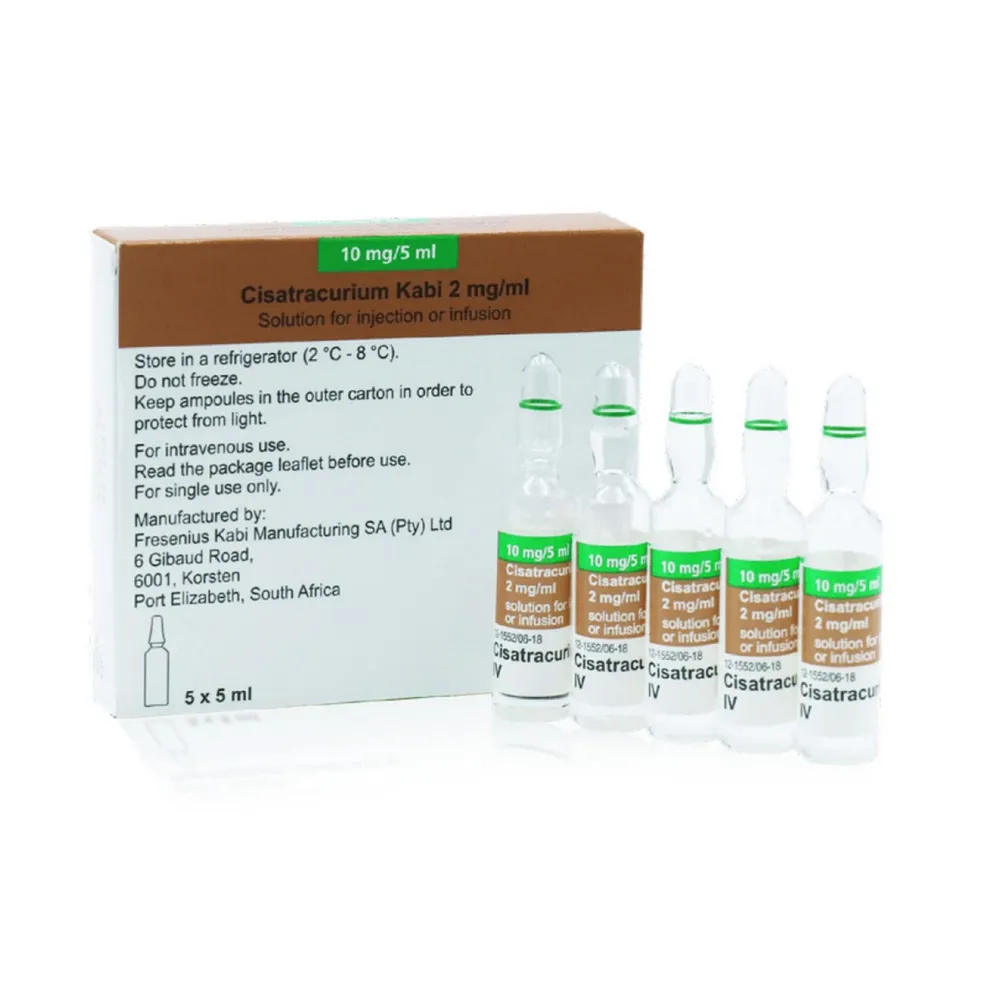
Table of Contents
- Package leaflet: Information for the user
- 1. What Cisatracurium Kabi is and what it is used for
- 2. Important information before using Cisatracurium Kabi
- 3. How to use Cisatracurium Kabi
- 4. Possible adverse reactions
- 5. How to store Cisatracurium Kabi
- 6. Contents of the package and other information
- Information intended exclusively for medical professionals:
Package leaflet: Information for the user
Cisatracurium Kabi, 2 mg/ml, solution for injection/infusion
Cisatracurium
Please read all of this leaflet carefully before this medicine is administered, as it contains important information for you.
Keep this leaflet, as you may need to read it again.
If you have any further questions, ask your doctor, nurse or pharmacist.
If you experience any side effects, including any not listed in this leaflet, inform your doctor, nurse or pharmacist. See section 4.
Contents of the leaflet
- What Cisatracurium Kabi is and what it is used for
- What you need to know before you are given Cisatracurium Kabi
- How Cisatracurium Kabi is given
- Possible side effects
- How to store Cisatracurium Kabi
- Contents of the pack and other information
1. What Cisatracurium Kabi is and what it is used for
Cisatracurium Kabi belongs to a group of medicines called muscle relaxants.
Cisatracurium Kabi is used:
during various types of surgical procedures to relax muscles in adult and paediatric patients over 1 month of age;
to assist insertion of a plastic tube into the patient's windpipe (endotracheal intubation), when breathing support is required;
in Intensive Care Units (ICU) to relax muscles.
2. Important information before using Cisatracurium Kabi
When not to use Cisatracurium Kabi
– if the patient is allergic to cisatracurium, atracurium, or benzenesulfonic acid.
Warnings and precautions
Before starting treatment with Cisatracurium Kabi, consult a doctor, nurse, or pharmacist:
– if the patient experiences muscle weakness, fatigue, or difficulty with coordination (myasthenia);
– if the patient has neuromuscular disorders such as muscular dystrophy, paralysis, motor neuron disease, or cerebral palsy;
– if the patient has burns requiring treatment;
– if the patient has severe acid-base or electrolyte imbalances;
– if the patient previously experienced an allergic reaction to another muscle relaxant administered during a surgical procedure.
If there is any doubt whether any of the above situations apply to the patient, this should be discussed with the doctor, nurse, or pharmacist before administering Cisatracurium Kabi.
Children
Cisatracurium Kabi must not be given to children (neonates) under one month of age.
Cisatracurium Kabi and other medicines
Inform the doctor, nurse, or pharmacist about all medicines currently used, recently used, or planned for use. It is particularly important to inform the doctor or pharmacist about the following medicines, as they may affect the action of Cisatracurium Kabi:
– anaesthetic agents (used to sedate and relieve pain during surgery, such as enflurane, isoflurane, halothane, and ketamine);
– other muscle relaxants, such as suxamethonium;
– antibiotics (used to treat infections, such as aminoglycosides, polymyxins, spectinomycin, tetracyclines, lincomycin, and clindamycin);
– antiarrhythmic drugs (used to control heart rhythm, such as propranolol, oxprenolol, calcium channel blockers, lidocaine, procainamide, and quinidine);
– antihypertensive drugs, such as trimethaphan or hexamethonium;
– diuretics (water tablets, such as furosemide, thiazides, mannitol, and acetazolamide);
– antirheumatic drugs, such as chloroquine or d-penicillamine;
– steroid medicines;
– antiepileptic drugs, such as phenytoin or carbamazepine;
– drugs used to treat psychiatric disorders, such as lithium salts or chlorpromazine;
– magnesium-containing medicines;
– drugs used in the treatment of Alzheimer's disease (acetylcholinesterase inhibitors, e.g. donepezil).
Treatment with Cisatracurium Kabi may still be appropriate, and the doctor will decide what is suitable for the patient.
Pregnancy, breastfeeding, and effects on fertility
There are insufficient data on the use of Cisatracurium Kabi in pregnant or breastfeeding women.
A harmful effect of cisatracurium on a breastfed infant cannot be ruled out; however, no effect is expected if breastfeeding is resumed after the drug's effects have worn off.
Cisatracurium is rapidly eliminated from the body. Women should not breastfeed for 3 hours after the end of drug administration.
During pregnancy or breastfeeding, or if pregnancy is suspected or planned, this medicine should only be used after consulting a doctor or pharmacist.
Driving and operating machinery
Cisatracurium Kabi is used as part of general anaesthesia. General anaesthesia significantly affects the ability to drive and operate machinery. Driving, operating machinery, or working in hazardous conditions too soon after surgery may be dangerous.
The doctor will inform the patient when it is safe to resume driving and operating machinery.
3. How to use Cisatracurium Kabi
How the injection is administered
Cisatracurium Kabi is administered by, or under the supervision of, a physician experienced
in the use of this type of medication. The medicine will always be given to the patient under strictly controlled conditions and in units equipped with equipment enabling monitoring and support of the patient's circulation and respiration.
Dosage
The physician will decide the dose of Cisatracurium Kabi.
The dose of Cisatracurium Kabi administered depends on:
- the patient's body weight;
- the required degree and duration of muscle relaxation;
- the expected response of the patient to the medicine.
Method of administration
Cisatracurium Kabi may be given as:
- a single intravenous bolus injection (rapid intravenous injection);
- continuous intravenous infusion (intravenous infusion or "drip"). The medicine is slowly administered into the patient's vein over a prolonged period.
Administration of a higher than recommended dose of Cisatracurium Kabi
Cisatracurium Kabi is administered under strictly controlled conditions, so it is unlikely that a patient will receive a higher than recommended dose.
If a patient has received a higher than recommended dose, or if there is suspicion of an overdose, the physician will take appropriate actions.
If you have any further questions about the use of this medicine, consult your doctor or pharmacist.
4. Possible adverse reactions
Like all medicines, this medicine can cause adverse reactions, although not everyone will experience them.
Allergic reactions (may occur in less than 1 in 10,000 patients)
If you experience an allergic reaction, tell your doctor or nurse immediately. The following symptoms may occur:
- sudden wheezing, chest pain or a feeling of tightness in the chest;
- swelling of the eyelids, face, lips, mouth or tongue;
- lumpy rash or hives anywhere on the body;
- collapse and shock.
The following adverse reactions have been observed:
Common (may affect up to 1 in 10 patients):
- slow heart rate;
- low blood pressure.
Uncommon (may affect up to 1 in 100 patients):
- skin rash or redness;
- bronchospasm (asthma-like symptoms).
Very rare (may affect up to 1 in 10,000 patients):
- muscle weakness or pain.
Reporting of adverse reactions
If any adverse reactions occur, including any not listed in this leaflet, tell your doctor, nurse or pharmacist. Adverse reactions can be reported directly to the Department of Monitoring Adverse Drug Reactions, Office for Registration of Medicinal Products, Medical Devices and Biocidal Products
Al. Jerozolimskie 181C
02-222 Warsaw
Phone: +48 22 49 21 301
Fax: +48 22 49 21 309
Website: https://smz.ezdrowie.gov.pl
Adverse reactions can also be reported to the marketing authorization holder.
Reporting adverse reactions helps to provide more information on the safety of the medicine.
5. How to store Cisatracurium Kabi
Keep the medicine out of the sight and reach of children.
Do not use this medicine after the expiry date stated on the carton after "EXP". The expiry date refers to the last day of the stated month.
Storage conditions
Before opening: Store in a refrigerator (2°C–8°C).
Do not freeze.
Keep the ampoules in their original packaging to protect from light.
After opening and (or) after dilution:
For single use only.
Cisatracurium Kabi should be used immediately after opening the ampoule and (or) after dilution.
Any unused portions of the solution must be discarded.
Do not use this medicine if the solution is not clear and free from visible solid particles, or if the packaging is damaged.
Medicines should not be disposed of via wastewater or household waste. Ask your pharmacist how to dispose of medicines no longer required. This will help protect the environment.
6. Contents of the package and other information
What Cisatracurium Kabi contains
The active substance is cisatracurium.
1 ml of Cisatracurium Kabi contains 2 mg of cisatracurium as 2.68 mg of cisatracurium besilate.
The other components are: 1% benzene sulfonic acid and water for injections.
What Cisatracurium Kabi looks like and contents of the pack
Cisatracurium Kabi is a clear, colourless to pale yellow or greenish-yellow solution for injection/infusion.
Cisatracurium Kabi is available in colourless glass ampoules containing 2.5 ml, 5 ml or 10 ml of solution.
Pack sizes:
1, 5, 10 or 50 ampoules per pack.
Not all pack sizes may be marketed.
Marketing Authorisation Holder and Manufacturer
Marketing Authorisation Holder
Fresenius Kabi Polska Sp. z o.o.
Al. Jerozolimskie 134
02-305 Warsaw
Poland
Manufacturer
Fresenius Kabi Deutschland GmbH
Pfingstweide 53
61169 Friedberg
Germany
For further information about this medicinal product, please contact the Marketing Authorisation Holder:
Fresenius Kabi Polska Sp. z o.o.
Al. Jerozolimskie 134
02-305 Warsaw
Poland
Tel. +48 22 345 67 89
This medicinal product is authorised in the Member States of the European Economic Area under the following names:
Belgium Cisatracurium Fresenius Kabi 2 mg/ml solution for injection/infusion
Czech Republic Cisatracurium Kabi
Denmark Cisatracurium Fresenius Kabi
Estonia Cisatracurium Kabi 2 mg/ml
Finland Cisatracurium Fresenius Kabi 2 mg/ml
France Cisatracurium Kabi 2 mg/ml, solution injectable/pour perfusion
Greece Cisatracurium/Kabi 2mg/ml, Διάλυμα για ένεση/έγχυση
Spain Cisatracurio Kabi 2mg/ml solución inyectable y para perfusión EFG
Netherlands Cisatracurium Fresenius Kabi 2 mg/ml oplossing voor injectie of infusie
Lithuania Cisatracurium Kabi 2 mg/ml injekcinis tirpalas arba infuzinis tirpalas
Luxembourg Cisatracurium Kabi 2 mg/ml Injektionslösung/Infusionslösung
Latvia Cisatracurium Kabi 2mg/ml šķīdums injekcijām vai infūzijām
Germany Cisatracurium Kabi 2 mg/ml Injektions-/Infusionslösung
Poland Cisatracurium Kabi
Portugal Besilato de Cisatracúrio Kabi
Hungary Cisatracurium Kabi 2 mg/ml oldatos injekció vagy infúzió
United Kingdom Cisatracurium 2 mg/ml solution for injection/infusion
Information intended exclusively for medical professionals:
MEDICATION PREPARATION INSTRUCTIONS
Cisatracurium Kabi, 2 mg/ml, solution for injection/infusion
Read all information before preparing this medication.
This is a summary of the preparation instructions for Cisatracurium Kabi. For complete information, refer to the Summary of Product Characteristics.
Pharmaceutical incompatibilities
This medication must not be mixed with other medications except those listed below.
Since cisatracurium is stable only in acidic solutions, it must not be mixed in the same syringe or administered through the same needle with alkaline solutions, such as sodium thiopental.
Cisatracurium Kabi is pharmaceutically incompatible with ketorolac tromethamine or propofol emulsion for injection.
Instructions for dilution of the medication
Diluted to concentrations between 0.1 and 2 mg cisatracurium/ml, Cisatracurium Kabi is physically and chemically stable in 9 mg/ml (0.9%) sodium chloride solution, in 9 mg/ml (0.9%) sodium chloride and 50 mg/ml (5%) glucose solution, and in 50 mg/ml (5%) glucose solution for 24 hours at 25°C.
Physical and chemical stability has been demonstrated for 24 hours at 25°C.
From a microbiological standpoint, the medication should be used immediately. If not used immediately, the user is responsible for ensuring the storage duration and conditions prior to use. The storage period for the diluted medication should not exceed 24 hours at 2–8°C.
Dosage and method of administration
See: Summary of Product Characteristics.
Special precautions for disposal and preparation of the medication prior to use
The medication should be inspected visually before administration. Only clear, colorless or almost colorless to pale yellow or greenish-yellow solutions, free from visible particulate matter and contained in undamaged packaging, should be used. If the solution's appearance has changed or if the packaging is damaged, the medication must be discarded.
For single use only.
The medication should be used immediately after opening the ampoule.
Any unused medication or waste material must be disposed of in accordance with local regulations.
Under simulated Y-site infusion conditions, cisatracurium has been shown to be compatible with the following commonly used perioperative medications: alfentanil hydrochloride, droperidol, fentanyl citrate, midazolam hydrochloride, and sufentanil citrate. If other medications are administered through the same fixed needle or cannula as Cisatracurium Kabi, it is recommended to flush the system with an appropriate volume of a compatible infusion fluid (e.g., 9 mg/ml (0.9%) sodium chloride infusion solution) after administration of each medication.