Celipres 200
Poland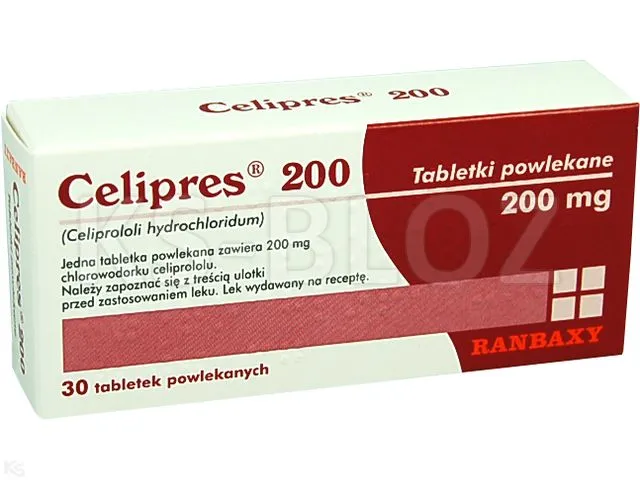
Table of Contents
Package leaflet: Information for the patient
Celipres 200, 200 mg, coated tablets
Celiprolol hydrochloride
Please read all of this leaflet carefully before taking this medicine, because it contains
important information for you.
- Keep this leafleaflet for future reference.
- If you have any further questions, please consult your doctor or pharmacist.
- This medicine has been prescribed for a specific individual only. Do not pass it on to others. This medicine may harm other people, even if their symptoms are the same.
- If you experience any adverse effects, including any not listed in this leaflet, inform your doctor or pharmacist. See section 4.
Table of contents of the leaflet
- What Celipres is and what it is used for
- Important information before taking Celipres
- How to take Celipres
- Possible side effects
- How to store Celipres
- Contents of the pack and other information
1. What Celipres is and what it is used for
The active substance in Celipres is celiprolol hydrochloride, which belongs to a group of medicines called beta-blockers.
Celipres is used in the treatment of mild to moderate arterial hypertension and chest pain caused by angina pectoris. The pain occurs when the heart muscle receives insufficient oxygen.
This medicine lowers blood pressure and reduces the heart rate during physical exertion, while having only a slight effect on the resting heart rate.
2. Important information before using Celipres
When not to use Celipres:
- if the patient is allergic to celiprolol or other beta-blockers (e.g. propranolol, atenolol), or to any of the other ingredients of this medicine (listed in section 6) – allergic reactions may include rash, itching, swelling of the face, lips or hands (or feet), or difficulty breathing;
- if the patient has uncontrolled heart failure;
- if the patient has a slow (at rest below 45-50 beats per minute) or irregular heartbeat;
- if the patient has conduction disorders in the heart (second- or third-degree atrioventricular block, sick sinus syndrome);
- if the patient has cardiogenic shock (inadequate blood flow to tissues);
- if the patient has excessive acidification of the blood (metabolic acidosis);
- if the patient has low blood pressure;
- if the patient has severe kidney function disorders;
- if the patient has severe asthma or other serious breathing difficulties;
- if the patient has an untreated phaeochromocytoma (a tumour of the adrenal gland);
- if the patient has advanced peripheral arterial disease (serious circulation problems in the legs caused by narrowing or blockage of blood vessels);
- if the patient has chronic obstructive pulmonary disease (COPD);
- if the patient is taking verapamil (used to treat high blood pressure and certain heart conditions);
- if the patient is taking theophylline (used to treat asthma or chronic bronchitis).
Warnings and precautions
Before using Celipres, consult a doctor:
- if the patient is pregnant or planning to become pregnant, or is breastfeeding;
- if the patient has kidney or liver disease; the doctor may decide to reduce the dose;
- if the patient has a specific type of heart disease (with chest pain) called Prinzmetal's angina;
- if the patient has ischaemic heart disease. Do not stop taking the medicine abruptly, as this may increase the frequency and severity of angina attacks (chest pain) or worsen the overall condition of the heart muscle. If discontinuation is necessary, the doctor will usually recommend gradually reducing the dose over a period of 1-2 weeks;
- if the patient is taking medicines for heart function disorders, such as congestive heart failure;
- if the patient has thyrotoxicosis (a condition caused by overactive thyroid) – celiprolol may mask symptoms of thyrotoxicosis;
- if the patient has chronic obstructive respiratory disease, asthma, wheezing – bronchospasm;
- if the patient has a slow heart rate of less than 50-55 beats per minute at rest (bradycardia) or an irregular heartbeat;
- if the patient has conduction disorders in the heart (first-degree atrioventricular block);
- if the patient has conditions such as Raynaud's disease (impaired blood circulation in the hands (or feet), causing temporary skin colour changes (from white to blue to red) and coldness in the extremities, with or without pain and burning sensation) or Buerger's disease (reduced blood flow in the legs causing calf or thigh pain after walking a certain distance, which usually subsides after rest);
- if the patient has diabetes (celiprolol may mask symptoms of low blood sugar);
- if the patient has a skin condition called psoriasis; celiprolol may worsen psoriasis symptoms;
- if the patient has had previous allergic reactions or is undergoing desensitisation therapy;
- if the patient is an athlete and will undergo doping tests, as celiprolol may cause a positive test result. The use of beta-blockers may be prohibited in certain sports disciplines.
If the patient requires surgery or anaesthesia,
the patient should inform the doctor or dentist about taking this medicine.
Consult a doctor even if any of the above conditions occurred in the past.
Children and adolescents
The safety and efficacy of celiprolol in children have not been established.
Celipres with other medicines
Inform the doctor about all medicines currently taken or recently taken, as well as any medicines the patient plans to take.
Exercise caution when using the following medicines:
- diltiazem, verapamil or nifedipine (used to treat high blood pressure and certain heart disorders);
- medicines used in shock or hypotension;
- disopyramide, quinidine, amiodarone or sotalol (used to treat heart rhythm disorders);
- chlorothalidone or hydrochlorothiazide (diuretics);
- clonidine (used to treat high blood pressure). If clonidine and celiprolol are used together, do not stop clonidine unless advised by a doctor. The doctor may recommend stopping celiprolol several days before discontinuing clonidine;
- medicines known as monoamine oxidase inhibitors (MAO inhibitors used to treat depression), e.g. phenelzine, tranylcypromine, moclobemide and isocarboxazid;
- reserpine, methyldopa, guanfacine (used to treat high blood pressure);
- digitoxin or digoxin (used to treat heart failure and certain types of heart rhythm disorders);
- insulin or oral antidiabetic medicines (e.g. glibenclamide, metformin);
- noradrenaline or adrenaline (used to treat low blood pressure, heart failure, asthma or allergy); noradrenaline and adrenaline are always administered under medical supervision;
- phenylephrine, pseudoephedrine, phenylpropanolamine (contained in cough medicines or nasal and eye drops);
- non-steroidal anti-inflammatory drugs (used for inflammatory conditions and pain), e.g. ibuprofen, indomethacin;
- mefloquine, as it may cause bradycardia (slow heart rate);
- medicines used to treat psychiatric disorders, such as phenothiazines (e.g. chlorpromazine, trifluoperazine) or tricyclic antidepressants (e.g. imipramine, amitriptyline, clomipramine, desipramine).
Celipres with food and drink
Celipres should be taken in the morning, immediately after waking, one hour before a meal or two hours after a meal.
Pregnancy and breastfeeding
If the patient is pregnant or breastfeeding, suspects she may be pregnant, or is planning to have a baby, she should consult a doctor or pharmacist before using this medicine.
Driving and operating machinery
Celipres has negligible influence on the ability to drive motor vehicles or operate machinery. However, very rarely during treatment dizziness, fatigue, tremor, headache or blurred vision may occur. If such symptoms occur, the patient should not drive, use tools, or operate machinery.
Celipres contains quinoline yellow
The medicine contains quinoline yellow, which may cause allergic reactions.
Celipres contains mannitol
The medicine may have a mild laxative effect.
Celipres contains sodium
The medicine contains less than 1 mmol (23 mg) of sodium per tablet, meaning the medicine is considered "sodium-free".
3. How to use Celipres
This medicine should always be used exactly as prescribed by the doctor. In case of doubt, consult
your doctor or pharmacist.
Hypertension
The usual dose is 100 mg to 200 mg once daily. If after 2 to 4 weeks of treatment the clinical response is
inadequate, your doctor may increase the dose to 400 mg of celiprolol once daily.
If the patient has liver or kidney disease, the doctor may decide to start treatment with a lower dose and
increase it if necessary.
Stable angina pectoris
The usual dose is 200 mg once daily. If after 2 to 4 weeks of treatment the clinical response is
inadequate, your doctor may increase the dose to 400 mg of celiprolol once daily.
Gradual discontinuation of the medicine over 1–2 weeks is recommended. Abrupt withdrawal of the
medicine may cause cardiac disturbances, especially in patients with ischaemic heart disease.
Patients with kidney disease
In patients with moderate renal impairment (creatinine clearance of 15 to 40 ml/min), the dose may
need to be halved. Celiprolol is contraindicated in patients with severe renal impairment (creatinine
clearance less than 15 ml/min).
Celipres tablets should be swallowed whole with a glass of water. Tablets may be taken in the morning,
immediately after waking, once daily, one hour before a meal or two hours after a meal.
The division line on the tablet is not intended for breaking the tablet.
To help remember to take the medicine, it should be taken at the same time every day.
The medicine should be taken for as long as prescribed by the doctor. It is important not to stop taking
the medicine when the patient feels better, as symptoms may recur.
If the patient feels that the effect of Celipres is too strong or too weak, consult a doctor or pharmacist.
Taking more Celipres than prescribed
If more Celipres than prescribed has been taken, seek advice from a doctor or the nearest hospital
emergency department immediately. If possible, bring any remaining tablets, the packaging and the
leaflet, so that the doctor knows immediately which medicine has been taken.
Missed dose of Celipres
If a dose is missed, take it as soon as possible. However, if it is almost time for the next dose, only take
the next tablet according to the regular schedule. Do not take a double dose to make up for a missed
dose.
Stopping Celipres
Do not stop taking Celipres without first consulting your doctor. Abruptly stopping Celipres may
worsen the patient's condition. Your doctor will advise gradual discontinuation of Celipres over a
period of 7 to 10 days.
If in doubt about the use of this medicine, consult your doctor or pharmacist.
4. Possible adverse reactions
Like all medicines, this medicine can cause adverse reactions, although not everyone will experience them.
If any of the following adverse symptoms occur, stop taking Celipres immediately and contact a doctor or go to the nearest hospital emergency department straight away.
- Rash, urticaria, chest tightness, shortness of breath, or swelling of the face, lips, hands, feet, fainting, elevated body temperature.
These are very serious adverse reactions. If they occur, the patient may have experienced a severe allergic reaction to celiprolol. Immediate medical intervention or hospitalization may be necessary.
If any of the following adverse symptoms occur, contact a doctor or go to the nearest hospital emergency department immediately:
- Dizziness or a feeling of "emptiness" in the head, weakness or fainting, especially when standing up from a lying position,
- Fast, slow, or irregular heartbeat,
- Difficulty breathing,
- Worsening of pre-existing heart failure,
- Worsening of diabetes. Previously undiagnosed diabetes may become apparent (manifesting as increased thirst, frequent urination, increased appetite, weight loss). Inform your doctor if any of these symptoms occur.
Inform your doctor if you notice any of the following adverse reactions:
Common (may occur in less than 1 in 10 patients):
- Headache and dizziness, drowsiness, nightmares and insomnia (sleep disturbances); tremor and feeling of coldness in the extremities, sudden flushing (especially of the face);
- Palpitations, slowed heart rate, significant drop in blood pressure, including upon standing from a lying position;
- Muscle cramps;
- Fainting;
- Nausea or vomiting, abdominal pain or discomfort.
Uncommon (may occur in less than 1 in 1000 patients):
-
Positive antinuclear antibody (ANA) test, isolated and reversible cases of lupus-like syndrome;
-
Depression;
-
Paresthesia (sensory disturbances);
-
Tinnitus;
-
Diarrhea, constipation;
-
Skin reactions (e.g. itching, redness, rash, pruritus, urticaria, purpura);
-
Cardiac conduction disturbances;
-
Worsening of cardiac conduction disturbances (in susceptible patients);
-
Worsening of pre-existing heart failure with peripheral edema (swelling of limbs) and/or exertional dyspnea;
-
Worsening of pre-existing circulatory disorders such as intermittent claudication, Raynaud's syndrome [impaired blood circulation in hands/feet, characterized by transient skin color changes (from white to blue to red), cold sensation in the limbs, with or without pain and burning];
-
Fatigue;
-
Allergic pneumonia, bronchospasm, especially in patients with bronchial asthma or history of asthmatic reactions;
-
Muscle weakness;
-
Decreased libido, impotence (in men);
-
Low blood sugar (hypoglycemia), high blood sugar (hyperglycemia);
-
In patients with hyperthyroidism, clinical symptoms of thyrotoxicosis (tachycardia, tremor) may be masked.
Warning signs of hypoglycemia (tachycardia, tremors) may be diminished.
Very rare (may occur in less than 1 in 10,000 patients):
-
Hallucinations, psychoses;
-
Confusion;
-
Psoriasis-like symptoms, worsening of pre-existing psoriasis;
-
Visual disturbances, reduced tear production (dry eyes).
-
Unknown (frequency cannot be estimated from available data):
-
Abnormal liver function test results (aminotransferases - AlAT, AspAT).
Reporting of adverse reactions
If any adverse reactions occur, including any not listed in this leaflet, inform your doctor, pharmacist, or nurse. Adverse reactions can be reported directly to the Department of Monitoring Adverse Drug Reactions, Office for Registration of Medicinal Products, Medical Devices and Biocidal Products, Al. Jerozolimskie 181C, 02-222 Warsaw, Phone: +48 22 49 21 301, Fax: +48 22 49 21 309, Website: https://smz.ezdrowie.gov.pl.
Adverse reactions can also be reported to the marketing authorization holder.
Reporting adverse reactions helps to provide more information on the safety of the medicine.
5. How to store Celipres
Keep out of the sight and reach of children.
Store below 25°C.
Do not use this medicine after the expiry date stated on the label. The expiry date refers to the last day of the specified month.
Medicines must not be disposed of via wastewater or household waste. Ask your pharmacist what to do with medicines no longer required. This will help protect the environment.
6. Contents of the packaging and other information
What Celipres contains
- The active substance is celiprolol hydrochloride. One tablet contains 200 mg of celiprolol hydrochloride.
- The other ingredients are: microcrystalline cellulose, mannitol, sodium croscarmellose, colloidal anhydrous silica, magnesium stearate, and a coating containing hypromellose 2910 6cP, titanium dioxide (E 171), macrogol 400, quinoline yellow (E 104), lac.
What Celipres looks like and contents of the pack
Yellow, heart-shaped coated tablets, with the imprint "200" on one side and a breakline on the other side.
The breakline on the tablet is not intended for breaking the tablet.
Celipres packaging contains 30 coated tablets in blisters (3x10).
Marketing Authorisation Holder and Manufacturer
Marketing Authorisation Holder
Ranbaxy (Poland) Sp. z o.o.
Idzikowskiego Street 16
00-710 Warsaw
Manufacturer
Sun Pharmaceutical Industries Europe B.V.
Polarisavenue 87
2132 JH Hoofddorp
The Netherlands