Cefalgin migraplus
Poland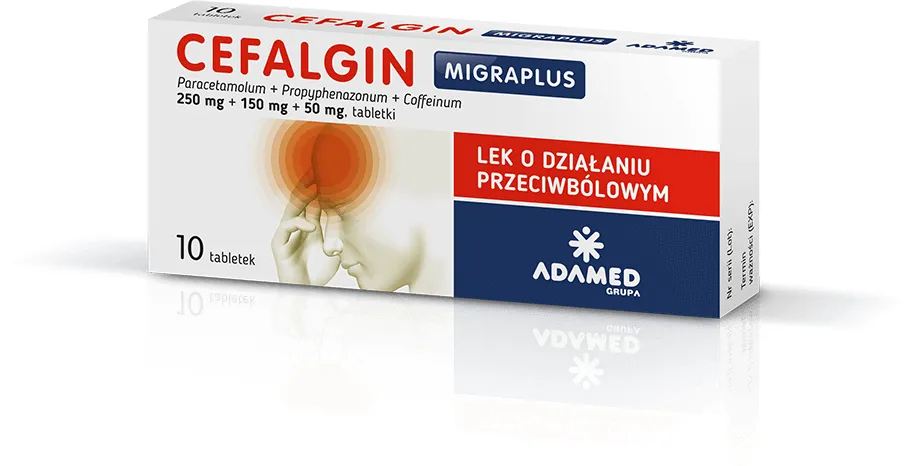
Table of Contents
Package leaflet: Information for the user
Cefalgin Migraplus, 250 mg + 150 mg + 50 mg, tablets
Paracetamolum + Propyphenazonum + Coffeinum
Please read all of this leaflet carefully before taking this medicine, because it contains
important information for you.
This medicine should always be taken exactly as described in this patient leaflet or as directed by
your doctor or pharmacist.
- Keep this leaflet, as you may need to read it again.
- If you need advice or further information, please contact your pharmacist.
- If you experience any adverse reactions, including any possible side effects not listed in this leaflet, inform your doctor or pharmacist. See section 4.
- If there is no improvement or if you feel worse after 7 days, you should consult your doctor.
Leaflet contents:
- What Cefalgin Migraplus is and what it is used for
- Important information before taking Cefalgin Migraplus
- How to take Cefalgin Migraplus
- Possible side effects
- How to store Cefalgin Migraplus
- Contents of the pack and other information
1. What Cefalgin Migraplus is and what it is used for
Cefalgin Migraplus is a combination medicine containing paracetamol and propyphenazone, which have analgesic and antipyretic properties, and a small amount of caffeine. The active substances in this medicine mutually enhance each other's effects. Caffeine intensifies the analgesic effect of paracetamol.
Indications:
- Mild to moderate pain: migraine headaches, toothache, menstrual pain, neuralgia;
- Fever.
2. Information before using Cefalgin Migraplus
When not to use Cefalgin Migraplus:
- if the patient is allergic (hypersensitive) to paracetamol, caffeine, or acetylsalicylic acid, or to any of the other ingredients of this medicine (listed in section 6);
- if the patient is allergic to drugs from the pyrazolone group or their derivatives present in other medicines (phenazone, propyphenazone, aminophenazone, phenylbutazone or metamizole);
- if the patient has severe liver and/or kidney failure;
- if the patient has blood abnormalities such as anaemia, leucopenia (reduced number of white blood cells), agranulocytosis (lack of granulocytes in the blood);
- if the patient has congenital deficiency of glucose-6-phosphate dehydrogenase;
- if the patient has hypertension;
- if the patient has peptic ulcer disease of the stomach and/or duodenum;
- if the patient has acute hepatic porphyria (a disease characterized by excessive production of porphyrin pigments in the liver);
- if the patient has alcoholic liver disease.
Warnings and precautions
Before starting treatment with Cefalgin Migraplus, consult a doctor or pharmacist.
Do not consume alcohol while taking Cefalgin Migraplus.
Cefalgin Migraplus contains paracetamol. Due to the risk of overdose, Cefalgin Migraplus should not be taken simultaneously with other medicines containing paracetamol.
The medicine should not be used for prolonged periods or in doses exceeding the recommended ones, as this may cause liver and kidney dysfunction. Discontinue use and contact a doctor if symptoms of organ failure occur.
Cefalgin Migraplus should be used with caution (reduced dose or frequency) in patients with liver or kidney impairment, Gilbert's syndrome (a mild jaundice caused by deficiency of glucuronyltransferase), and haematopoietic disorders (blood cell formation disorders).
There is an increased risk of liver damage in patients with alcoholic liver disease and malnutrition.
Cefalgin Migraplus should be used with caution in patients with asthma, chronic rhinitis, or chronic urticaria, particularly if they are allergic to other anti-inflammatory drugs such as acetylsalicylic acid.
Extreme caution is required when using Cefalgin Migraplus concomitantly with zidovudine.
Cefalgin Migraplus should not be used in patients with severe liver and/or kidney dysfunction.
Cefalgin Migraplus should be used with caution in elderly patients due to the presence of caffeine.
Children and adolescents
Cefalgin Migraplus should not be used in children.
Cefalgin Migraplus with other medicines
Inform your doctor or pharmacist about all medicines currently used, recently used, or planned for use.
Some medicines taken concomitantly with Cefalgin Migraplus may increase the risk of liver damage (rifampicin, chloramphenicol, certain sleeping pills, antiepileptic drugs – barbiturates, phenytoin, carbamazepine) and kidney damage (acetylsalicylic acid, salicylates, and non-steroidal anti-inflammatory drugs).
Paracetamol enhances the effect of anticoagulant drugs of the coumarin derivatives group (e.g. warfarin).
Cigarette smoking and barbiturates accelerate caffeine metabolism, whereas oral contraceptives, cimetidine, and disulfiram reduce caffeine metabolism.
Use Cefalgin Migraplus with caution when taken concomitantly with zidovudine, sympathomimetic drugs (e.g. ephedrine), thyroxine, theophylline, and sedatives (barbiturates and antihistamines).
When paracetamol and flucloxacillin (an antibiotic) are used together, there is a serious risk of fluid and electrolyte disturbances (metabolic acidosis with high anion gap), which require urgent treatment. This risk is particularly high in patients with severe kidney dysfunction, sepsis (a condition in which bacteria and their toxins circulate in the blood, leading to organ damage), malnutrition, chronic alcoholism, and in patients receiving maximum daily doses of paracetamol.
Cefalgin Migraplus with food, drink and alcohol
Cefalgin Migraplus should be taken after meals, with plenty of water.
Alcohol increases the toxic effect of paracetamol on the liver.
Pregnancy and breastfeeding
If the patient is pregnant or breastfeeding, suspects she may be pregnant, or is planning to become pregnant, she should consult a doctor or pharmacist before using this medicine.
Cefalgin Migraplus should not be used during pregnancy and breastfeeding.
Driving and operating machinery
Cefalgin Migraplus, when used at the recommended dose, does not affect the ability to drive or operate machinery.
Cefalgin Migraplus contains sodium.
The medicine contains less than 1 mmol (23 mg) of sodium per tablet, meaning it is considered "sodium-free".
3. How to use Cefalgin Migraplus
This medicine should always be taken exactly as described in the patient information leaflet or as directed by a physician or pharmacist. If in doubt, consult a doctor or pharmacist.
The medicine is taken orally.
Recommended dose:
Adults: 1 to 2 tablets at a time.
If necessary, the dose may be repeated up to 3 times daily.
The tablet should be taken with a large amount of water.
This medicine should not be taken for longer than 7 days without consulting a doctor.
If you feel that the effect of Cefalgin Migraplus is too strong or too weak, consult your doctor.
Taking more than the recommended dose of Cefalgin Migraplus
Accidental or intentional overdose may cause symptoms within a few to several hours, such as nausea, vomiting, excessive sweating, drowsiness, and general weakness. These symptoms may subside the next day, even though liver damage may have started to develop, which later manifests as upper abdominal discomfort, recurrence of nausea, and jaundice. In every case of ingesting more than 5 g of paracetamol at one time, vomiting should be induced (if no more than one hour has passed since ingestion), and medical advice should be sought immediately.
In case of taking more than the recommended dose, seek immediate medical attention from a doctor or pharmacist.
Missing a dose of Cefalgin Migraplus
Do not take a double dose to make up for a missed dose.
4. Possible adverse reactions
Like all medicines, this medicine can cause adverse reactions, although not everybody will experience them.
Liver and biliary disorders
Prolonged use may cause liver damage.
Renal and urinary disorders
Long-term use may cause disturbances in kidney function.
Skin and subcutaneous tissue disorders
Skin reactions such as erythema, rash, itching or urticaria, which are symptoms of hypersensitivity reactions.
In rare cases, severe skin reactions have been reported.
Gastrointestinal disorders
Nausea, abdominal pain, vomiting, heartburn.
Blood and lymphatic system disorders
Rarely, changes in peripheral blood count such as thrombocytopenia (reduced number of platelets), leukopenia (reduced number of white blood cells), agranulocytosis (absence of granulocytes), pancytopenia (deficiency of all normal blood cells, i.e. red blood cells, white blood cells and platelets), methemoglobinemia (increased levels of methemoglobin formed as a result of hemoglobin oxidation).
Immune system disorders
Angioedema, dyspnea, asthma attacks as symptoms of allergic (hypersensitivity) reactions, anaphylactic shock.
Nervous system disorders
Headaches, sleep disturbances, muscle tremors.
Reporting of adverse reactions
If any adverse reactions occur, including any adverse reactions not listed in this leaflet, inform your doctor or pharmacist. Adverse reactions can be reported directly to the Department of Monitoring Adverse Drug Reactions of the Office for Registration of Medicinal Products, Medical Devices and Biocidal Products
Al. Jerozolimskie 181C, 02-222 Warsaw
Tel.: + 48 22 49 21 301
Fax: + 48 22 49 21 309
Website: https://smz.ezdrowie.gov.pl
Adverse reactions can also be reported to the responsible entity.
By reporting adverse reactions, additional information on the safety of the medicine can be collected.
5. How to store Cefalgin Migraplus
Keep the medicine out of the sight and reach of children.
Store below 25 °C.
Do not use this medicine after the expiry date stated on the packaging.
The expiry date refers to the last day of the stated month.
Medicines must not be disposed of via wastewater or household waste. Ask your pharmacist how to dispose of medicines no longer required. This will help protect the environment.
6. Contents of the pack and other information
What Cefalgin Migraplus contains
The active substances in the medicine are: paracetamol, propyphenazone, caffeine.
Each tablet contains:
paracetamol 250 mg;
propyphenazone 150 mg;
caffeine 50 mg.
The other excipients are: potato starch, sodium lauryl sulfate, polyvinyl alcohol, gelatin, colloidal anhydrous silica, magnesium stearate.
What Cefalgin Migraplus looks like and contents of the pack
Cefalgin Migraplus is white tablets with a yellowish tint, round, flat on both sides, with bevelled edges and marked with "-" on one side. The tablets are packed in blisters made of PVC/Aluminium foil and cardboard boxes.
The pack contains 10 tablets.
Marketing Authorisation Holder
Adamed Pharma S.A.
Pieńków, ul. M. Adamkiewicza 6A
05-152 Czosnów
Manufacturer
Adamed Pharma S.A.
Pieńków, ul. M. Adamkiewicza 6A
05-152 Czosnów