Catalin
PolandTable of Contents
Package leaflet: Information for the user
Catalin
0.75 mg, tablet and solvent for preparing eye drops
Pirenoxine
Please read all of this leaflet carefully before using this medicine because it contains important
information for you.
- Keep this leaflet, as you may need to read it again.
- If you have any questions, ask your doctor or pharmacist.
- This medicine has been prescribed for a specific individual. Do not share it with others. This medicine may harm another person, even if their symptoms are the same.
- If you experience any adverse effects, including any not listed in this leaflet, tell your doctor or pharmacist. See section 4.
Contents of the leaflet:
- What Catalin is and what it is used for
- Important information before using Catalin
- How to use Catalin
- Possible side effects
- How to store Catalin
- Contents of the pack and other information
1. What Catalin is and what it is used for
Catalin is indicated for senile cataract. The active substance in Catalin is
pirenoxine. The pack contains a tablet and a solvent; the tablet is light orange and
the solvent is clear and colourless. Although the exact cause of cataract has not yet been
fully elucidated, it is believed that lens opacification results from the transformation of
its soluble proteins into insoluble proteins. Catalin preparation inhibits and prevents the progression of
cataract.
2. Important information before using Catalin
When not to use Catalin
If the patient is allergic to pyrenoxine or any of the other ingredients of this medicine
(listed in section 6).
Warnings and precautions
Before starting treatment with Catalin, discuss this with your doctor or pharmacist.
Catalin and other medicines
Tell your doctor about all medicines you are currently taking or have recently taken, as well as any medicines you plan to use.
There is no data available regarding interactions with other medicines or other types of interactions.
Use of Catalin with food, drink and alcohol
Not applicable.
Pregnancy, breastfeeding and fertility
If the patient is pregnant or breastfeeding, suspects she may be pregnant, or is planning to have a baby, she should consult her doctor before using this medicine.
There are no data available on the safety of using Catalin during pregnancy and breastfeeding.
Driving and operating machinery
Catalin has no influence on the ability to drive or operate machinery.
Catalin contains the excipients: methyl parahydroxybenzoate, propyl parahydroxybenzoate, which may cause allergic reactions (possibly delayed-type reactions).
3. How to use Catalin
This medicine should always be used exactly as recommended by your doctor or pharmacist. If in doubt,
you should consult your doctor or pharmacist.
Method of preparing the solution
Dissolve the tablet in 15 ml of solvent. A clear, yellow solution is formed.
Available pack 1 tablet and 15 ml of solvent.
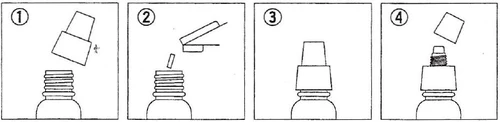
Remove the white Open the tablet Close the bottle Shake well Before use
cap from the bottle. container and insert the thoroughly until the Remove the brown the dropper
Do not touch the tablet into the the tablet has dissolved. stopper. into the eye.
tablet directly bottle. Do not touch the eye
with your fingers with the dropper tip
Method of administration:
- Prepare the medicine bottle and a mirror.
- Wash your hands.
- Remove the cap.
- Hold the bottle in your hand with the bottom facing upwards, grasping it between your thumb and middle finger.
- Tilt your head backwards. Gently pull down the lower eyelid with a clean finger to create a "pocket" between the eyeball and eyelid; this is where the drop should be placed.
- Bring the dropper tip close to the eye. For convenience, you may use a mirror.
- Do not touch the eye, eyelid, surrounding areas, or any other surface with the dropper tip. This may contaminate the drops. Using contaminated drops may lead to serious complications and even loss of vision.
- To release a single drop of medicine, gently squeeze the bottom of the bottle.
- If the drop does not enter the eye, repeat the instillation procedure.
- After instilling the medicine, gently close the eye and press with a finger at the inner corner of the eye near the nose for at least one minute. This helps prevent the medicine from being absorbed into the rest of the body.
- If using drops in both eyes, repeat the above steps to instill the drops into the second eye.
- Immediately after use, replace the cap.
Dosage
Instill 1 or 2 drops into the conjunctival sac 3 to 5 times daily.
Use of a higher than recommended dose of Catalin
Symptoms of overdose with Catalin in humans are unknown. An antidote is not necessary because
overdose with pirenoxine is practically impossible.
4. Possible adverse reactions
Like all medicines, this medicine can cause adverse reactions, although not everyone will experience them.
If the patient experiences allergic reactions, including rash, swelling of the face, lips, tongue and/or throat,
which may cause difficulty in breathing or swallowing, or if other serious adverse reactions occur,
treatment with Catalin should be discontinued and immediate contact should be made with a doctor or
the nearest hospital Emergency Department.
The following may occur during treatment with Catalin:
Rare (less than 1 in 1,000 people):
diffuse superficial keratitis, blepharitis, conjunctival hyperemia, pain, itching.
Reporting of adverse reactions
If any adverse reactions occur, including any adverse reactions not listed in this leaflet, inform a doctor, pharmacist, or nurse. Adverse reactions can be reported directly to the Department of Monitoring Adverse Drug Reactions of the Office for Registration of Medicinal Products, Medical Devices and Biocidal Products:
Al. Jerozolimskie 181C,
02-222 Warsaw,
tel.: +48 22 49 21 301
fax: +48 22 49 21 309
e-mail: [email protected]
Adverse reactions can also be reported to the marketing authorization holder.
By reporting adverse reactions, additional information on the safety of the medicine can be collected.
5. How to store Catalin
Keep the medicine out of the sight and reach of children.
Do not use this medicine after the expiry date stated on the cardboard box and label.
Store below 25°C. After preparation, the solution should be stored in a cool place and protected from light.
Shelf life after dissolving the tablet: 20 days.
6. Contents of the packaging and other information
What the medicine Catalin contains
The active substance is pirenoxine in the form of sodium salt, in a dose of 0.75 mg.
Other components are:
- in the tablet: taurine, boric acid;
- in the solvent: boric acid, potassium chloride, sodium tetraborate, methyl parahydroxybenzoate, propyl parahydroxybenzoate, purified water.
What the medicine Catalin looks like and contents of the packaging
The cardboard box contains one tablet in an Al/PVC blister and the solvent in a 15 ml PP bottle. The tablet is light orange, and the solvent is clear and colourless.
Marketing Authorisation Holder
Senju Poland Sp. z o.o.
Rondo Ignacego Daszyńskiego 2B,
00-843 Warsaw
tel.: + 48 22 236 05 05
e-mail: [email protected]
Importers at whose premises batch release takes place:
PROFARM PS Sp. z o.o.
ul. Słoneczna 96
05-500 Stara Iwiczna
FARMACOL S.A.
ul. Szopienicka 77
40-431 Katowice
Synoptis Industrial Sp. z o.o.
ul. Rabowicka 15
62-020 Swarzędz
For further information, please contact the Marketing Authorisation Holder.