Cartexan
Poland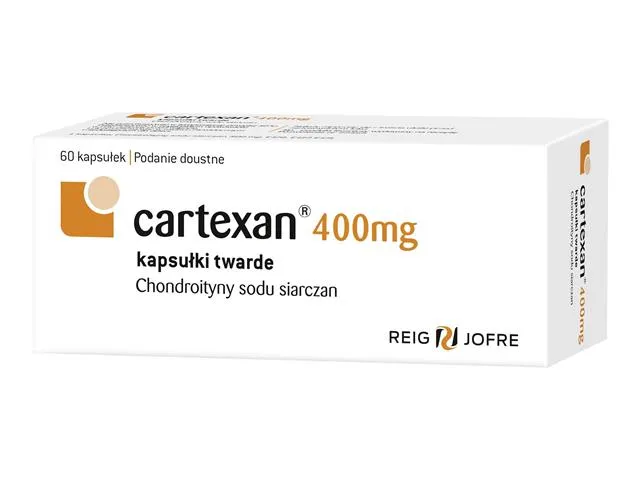
Table of Contents
Patient Information Leaflet
Warning! Keep this leaflet! Information on the immediate packaging in a foreign language.
Cartexan (Condrosan), 400 mg, hard capsules
Sodium chondroitin sulfate
Cartexan and Condrosan are different trade names for the same medicine.
Please read this leaflet carefully before taking this medicine, as it contains
important information for the patient.
- Keep this leaflet for future reference.
- If you have any questions, please consult your doctor or pharmacist.
- This medicine has been prescribed for a specific individual. Do not pass it on to others. It may harm someone else, even if their symptoms are the same.
- If you experience any adverse effects, including any not listed in this leaflet, inform your doctor or pharmacist. See section 4. Contents of the leaflet:
- What Cartexan is and what it is used for
- What you need to know before taking Cartexan
- How to take Cartexan
- Possible side effects
- How to store Cartexan
- Contents of the pack and other information
1. What Cartexan is and what it is used for
The active substance in Cartexan, sodium chondroitin sulfate, is a naturally occurring substance in the human body. It is one of the structural components of joint cartilage.
Cartexan is used in the symptomatic treatment of osteoarthritis of the knee and hip joints. The effect of the medicine develops slowly, usually within 6 to 8 weeks; therefore, for the treatment of acute or short-term pain, other medicines are recommended. The therapeutic effect usually persists for 2 to 3 months after discontinuation of treatment.
If there is no improvement, or if the patient feels worse, consult a doctor.
2. Important information before taking Cartexan
When not to take Cartexan
- if the patient is allergic to sodium chondroitin sulfate or any of the other ingredients of this medicine (listed in section 6).
Warnings and precautions
Before starting to take Cartexan, discuss this with a doctor or pharmacist.
- if the patient suffers from heart disease (heart failure) or kidney failure. Cartexan may cause fluid retention and edema;
- if the patient suffers from liver failure;
- if the patient is taking medicines affecting blood clotting (such as acetylsalicylic acid, dipyridamole or clopidogrel);
- if the patient is taking painkillers, as the use of sodium chondroitin sulfate may reduce the need for pain-relieving medicines.
Children
Cartexan is not recommended for use in children.
Cartexan and other medicines
Tell your doctor or pharmacist about all medicines the patient is currently taking or has recently taken, as well as any medicines the patient plans to take. This particularly applies to medicines affecting blood clotting (such as warfarin, acetylsalicylic acid, dipyridamole or clopidogrel).
If the patient is taking warfarin, the doctor may recommend more frequent INR monitoring after starting or stopping treatment with Cartexan.
Cartexan with food and drink
Cartexan may be taken before, during or after meals. If the patient is prone to stomach problems, the medicine should be taken after a meal.
Pregnancy and breastfeeding
If the patient is pregnant or breastfeeding, suspects she may be pregnant or plans to become pregnant, she should consult a doctor or pharmacist before using this medicine.
There is no data available on the use of Cartexan during pregnancy or breastfeeding, and therefore the medicine should not be used during pregnancy or breastfeeding.
Driving and operating machinery
It has not been shown that Cartexan affects the ability to drive or operate machinery.
3. How to take Cartexan
This medicine should always be taken according to the doctor's instructions. If in doubt, consult
your doctor or pharmacist.
Do not chew the capsules; swallow them whole with an adequate amount of liquid (e.g. a glass
of water).
The recommended dose is 800 mg, i.e. 2 capsules as a single daily dose taken for three
months.
In more severe cases, the recommended dose is 1200 mg, i.e. 3 capsules per day for the first
4 to 6 weeks of treatment, followed by 800 mg as a single daily dose for the remainder of the three-month
treatment period. The daily dose of 1200 mg may be taken at once or divided into three
doses, i.e. 1 capsule three times a day.
Treatment consists of repeated cycles of three-month therapy with two-month breaks during which the
medicine is not taken.
Use in children
Cartexan is not recommended for children.
Taking more Cartexan than recommended
One report has been received of accidental or intentional overdose with no consequences for
the patient (no vomiting, nausea, or changes in blood electrolyte concentrations). Based on
studies, harmful effects or symptoms are not expected. In case of overdose, always contact the
Poison Information Centre (tel. 607 218 174).
Missing a dose of Cartexan:
No special effects are expected. Do not take a double dose to make up for a missed dose; continue
treatment by taking the next normal dose the following day.
Stopping Cartexan treatment
No special effects are expected.
If you have any further doubts regarding the use of this medicine, consult your doctor or pharmacist.
4. Possible adverse reactions
Like any medicine, this medicine can cause adverse reactions, although not everyone will experience them.
Adverse reactions occurring rarely (in up to 1 user per 1,000):
Gastrointestinal disorders: Gastrointestinal disturbances (such as upper abdominal pain, nausea, or
diarrhea).
Skin and subcutaneous tissue disorders: Erythema, papular skin eruptions, irritant dermatitis.
Adverse reactions occurring very rarely (in up to 1 user per 10,000):
Skin and subcutaneous tissue disorders: Eczema, skin itching, urticaria.
General disorders: Swelling.
Reporting of adverse reactions
If any adverse symptoms occur, including any adverse effects not listed in this leaflet, please inform your doctor or pharmacist. Adverse reactions can be reported directly to the Department of Monitoring Adverse Drug Reactions of the Office for Registration of Medicinal Products, Medical Devices and Biocidal Products, Al. Jerozolimskie 181C, 02-222 Warsaw, phone: + 48 22 49 21 301, fax: + 48 22 49 21 309, website: https://smz.ezdrowie.gov.pl.
Reporting adverse reactions helps to provide more information on the safety of the medicine.
5. How to store Cartexan
Keep this medicine out of the sight and reach of children.
Store in the original packaging to protect from moisture.
Do not use this medicine after the expiry date stated on the packaging. The expiry date refers to the last day of the stated month.
Medicines must not be disposed of via wastewater or household waste. Ask your pharmacist how to dispose of medicines no longer required. This will help protect the environment.
6. Contents of the packaging and other information
What Cartexan contains
- The active substance is chondroitin sodium sulfate. Each hard capsule contains 400 mg of chondroitin sodium sulfate.
- Other ingredients: magnesium stearate. Excipients in the capsule shell: gelatin, titanium dioxide (E171), indigo carmine (E132), quinoline yellow (E104).
What Cartexan looks like and contents of the packaging
Cartexan capsules are available in packages containing 24 and 60 capsules.
For more detailed information, please contact the marketing authorization holder or the parallel importer.
Marketing Authorization Holder in Spain, country of export:
Laboratorio Reig Jofre, S.A.
Gran Capitán, 10
08970 Sant Joan Despí (Barcelona)
Spain
Manufacturer:
Noucor Health, S.A.
Avda. Camí Reial, 51-57
08184 Palau-solità i Plegamans (Barcelona)
Spain
Parallel Importer:
InPharm Sp. z o.o., ul. Strumykowa 28/11, 03-138 Warsaw
Repackaged in:
InPharm Sp. z o.o. Services sp. k., ul. Chełmżyńska 249, 04-458 Warsaw
Spanish Marketing Authorization Number (country of export): 815241.4
Parallel Import Authorization Number: 243/25
This medicinal product is authorized for marketing in the European Economic Area member states under the following names:
Austria, Finland, Hungary and Poland – Cartexan
Czech Republic – Condrodin