Calcium sandoz + vitamin d3
Poland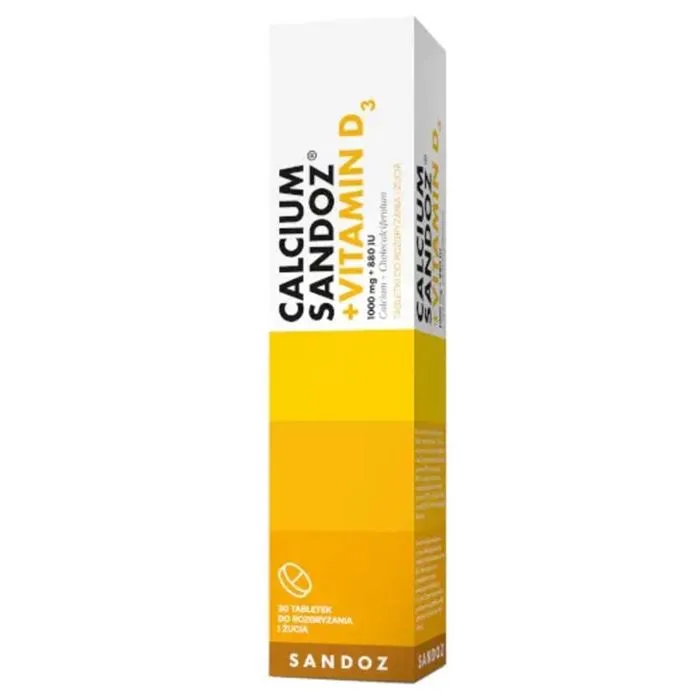
Table of Contents
- Package leaflet: Information for the user
- 1. What Calcium Sandoz + Vitamin D is and what it is used for
- 2. Important information before using Calcium Sandoz + Vitamin D
- 3. How to take Calcium Sandoz + Vitamin D
- 4. Possible adverse reactions
- 5. How to store Calcium Sandoz + Vitamin D3
- 6. Contents of the pack and other information
Package leaflet: Information for the user
Calcium Sandoz + Vitamin D, 1000 mg + 880 IU, chewable tablets
Calcium + Cholecalciferolum
For use in adults
Please read all of this leaflet carefully before taking this medicine because it contains important information for you.
This medicine should always be taken exactly as described in this patient leaflet or as advised by your doctor or pharmacist.
- Keep this leaflet so that you can read it again if necessary.
- If you need advice or further information, please consult your pharmacist.
- If you experience any adverse reactions, including any possible side effects not listed in this leaflet, tell your doctor or pharmacist. See section 4.
- If your symptoms do not improve or if you feel worse, you should consult your doctor.
Contents of the leaflet:
- What Calcium Sandoz + Vitamin D is and what it is used for
- Important information before taking Calcium Sandoz + Vitamin D
- How to take Calcium Sandoz + Vitamin D
- Possible side effects
- How to store Calcium Sandoz + Vitamin D
- Contents of the pack and other information
1. What Calcium Sandoz + Vitamin D is and what it is used for
Calcium Sandoz + Vitamin D contains two active substances – calcium and vitamin D. The medicine is a calcium and vitamin D supplement.
Calcium Sandoz + Vitamin D is used:
- for the prevention and treatment of calcium and vitamin D deficiency in elderly people;
- as a supplement of vitamin D and calcium in the supportive treatment of osteoporosis (bone thinning).
2. Important information before using Calcium Sandoz + Vitamin D
When not to use Calcium Sandoz + Vitamin D
if the patient is allergic to calcium, vitamin D, or to any of the other ingredients
of this medicine (listed in section 6);
if the patient has high levels of calcium in the blood (hypercalcaemia);
if the patient has high levels of calcium in the urine (hypercalciuria);
if the patient has hyperparathyroidism;
if the patient suffers from multiple myeloma (a type of bone marrow cancer);
if the patient suffers from cancer that has spread to the bones;
if the patient has limited limb mobility (prolonged immobilization) associated with
hypercalcaemia and/or hypercalciuria;
if the patient has kidney stones (nephrolithiasis);
if calcium deposits (nephrocalcinosis) have been detected in the patient's kidneys;
if the patient is taking excessive amounts of vitamin D (hypervitaminosis D);
if the patient has severe kidney function disorders;
if the patient is under 18 years of age.
Warnings and precautions
Please consult your doctor or pharmacist if any of the following situations apply to you, either before or during treatment with Calcium Sandoz + Vitamin D:
Long-term treatment
During prolonged treatment, calcium levels in blood and urine should be monitored regularly, and kidney function should be assessed. This is particularly important for patients prone to developing kidney stones. Depending on test results, the doctor may reduce the dose or discontinue treatment.
Concomitant use of cardiac glycosides or thiazide diuretics
due to heart conditions
In such cases, calcium levels in blood and urine should be monitored regularly, and kidney function should be assessed, especially in elderly patients. Depending on test results, the doctor may reduce the dose or discontinue treatment.
Kidney function disorders
Patients with impaired kidney function should use Calcium Sandoz + Vitamin D with particular caution, especially if they are also taking preparations containing aluminium, as citric acid contained in Calcium Sandoz + Vitamin D may increase aluminium absorption by the body. Calcium levels in blood and urine should be monitored. Patients with severe kidney function disorders should take vitamin D in a form other than cholecalciferol.
Additional intake of calcium and vitamin D supplements
Close medical supervision is required, with frequent monitoring of calcium levels in blood and urine.
Sarcoidosis (an immune system disorder that may affect the liver, lungs, skin, or lymph nodes)
Patients with sarcoidosis should exercise particular caution when using Calcium Sandoz + Vitamin D. There is a risk of an excessive response to the medicine, leading to calcium overdose. Monitoring of calcium levels in blood and urine is necessary.
Osteoporosis in immobilized patients
Particular caution is required. Increased calcium levels in blood may occur.
Children and adolescents
Calcium Sandoz + Vitamin D must not be used in children and adolescents under 18 years of age (see "When not to use Calcium Sandoz + Vitamin D").
Calcium Sandoz + Vitamin D and other medicines
Tell your doctor or pharmacist about all medicines you are currently taking, have recently taken, or plan to take.
If the patient is also being treated with cardiac glycosides, heart rhythm disturbances may occur. Close monitoring of the patient is therefore necessary, including ECG and measurement of blood calcium levels.
If the patient is taking thiazide diuretics simultaneously, blood calcium levels should be monitored regularly, as these medicines reduce calcium excretion in urine.
Calcium Sandoz + Vitamin D may reduce the absorption and thus the effectiveness of certain antibiotics (tetracyclines) taken at the same time. The antibiotic should be taken at least 2 hours before or 4 to 6 hours after taking Calcium Sandoz + Vitamin D.
The effectiveness of other medicines such as fluoride (used to strengthen tooth enamel or treat osteoporosis), quinolone antibiotics, and bisphosphonates (used in the treatment of osteoporosis) may also be altered due to interactions. Therefore, these medicines should be taken at least 3 hours before taking Calcium Sandoz + Vitamin D.
A maximum possible interval should be maintained between taking Calcium Sandoz + Vitamin D and cholestyramine (a medicine used to lower elevated cholesterol levels), orlistat (a medicine used to treat obesity), or laxatives (such as liquid paraffin), due to the risk of impaired vitamin D absorption.
Concomitant use of Calcium Sandoz + Vitamin D with rifaximin (an antibiotic used to treat travellers' diarrhoea), phenytoin (used to treat epilepsy), or barbiturates (sleeping pills) may reduce the effectiveness of vitamin D.
Concomitant use of Calcium Sandoz + Vitamin D and glucocorticoids (e.g. cortisone) may reduce the effectiveness of vitamin D and decrease blood calcium levels.
Taking additional calcium and vitamin D supplements requires strict medical supervision and regular monitoring of calcium levels in blood and urine.
Calcium may reduce the absorption of iron, zinc, or strontium ranelate. These medicines should be taken at least two hours before or after taking Calcium Sandoz + Vitamin D.
Calcium may reduce the absorption of estramustine (a medicine used in chemotherapy) and thyroid hormones (used to treat hypothyroidism). These medicines should be taken at least two hours after taking Calcium Sandoz + Vitamin D.
Calcium Sandoz + Vitamin D with food, drink and alcohol
Note that oxalic acid (e.g. found in spinach and rhubarb) and phytic acid (e.g. found in whole grain products) may reduce the amount of calcium absorbed in the intestine. Calcium-containing medicines should be taken with a 2-hour interval from consuming products containing oxalic or phytic acid.
Pregnancy and breastfeeding
Pregnancy
Calcium Sandoz + Vitamin D may be used in pregnant women with calcium and vitamin D deficiency. The daily dose must not exceed half a tablet. During pregnancy, the total daily intake of calcium should not exceed 1500 mg, and the total daily intake of vitamin D should not exceed 600 IU (international units).
Prolonged overdosage of calcium and vitamin D during pregnancy should be avoided due to the risk of high blood calcium levels and adverse effects on the unborn child.
Breastfeeding
Calcium Sandoz + Vitamin D may be used during breastfeeding. Both calcium and vitamin D pass into breast milk; therefore, consult your doctor whether the infant is also receiving other vitamin D-containing products.
If you are pregnant or breastfeeding, think you may be pregnant, or are planning to have a baby, you should consult your doctor or pharmacist before using this medicine.
Driving and using machines
The effect of Calcium Sandoz + Vitamin D on the ability to drive and operate machinery is unknown.
Calcium Sandoz + Vitamin D contains sodium, aspartame (E 951), sorbitol, isomalt (E 953), sucrose and benzyl alcohol
This medicine contains less than 1 mmol (23 mg) of sodium per tablet, meaning it is considered "sodium-free".
This medicine contains 1.00 mg of aspartame in each tablet. Aspartame is a source of phenylalanine. It may be harmful to patients with phenylketonuria. This is a rare genetic disorder in which phenylalanine accumulates in the body due to improper excretion.
The medicine contains up to 152.89 mg of sorbitol (E 420) in each tablet. Sorbitol is a source of fructose. If the patient (or their child) has previously been diagnosed with intolerance to certain sugars or hereditary fructose intolerance—a rare genetic disorder in which the body cannot break down fructose—the patient should consult a doctor before taking the medicine or giving it to a child.
This medicine also contains isomalt (E 953) and sucrose. If the patient has previously been diagnosed with intolerance to certain sugars, they should consult a doctor before taking the medicine. The medicine may have adverse effects on teeth.
This medicine contains 0.02 mg of benzyl alcohol in each tablet. Benzyl alcohol may cause allergic reactions.
3. How to take Calcium Sandoz + Vitamin D
This medicine should always be taken exactly as described in this patient leaflet or as directed by your doctor or pharmacist. If in doubt, consult your doctor or pharmacist.
Recommended dose
Adults and elderly patients should take 1 tablet daily (corresponding to 1000 mg of calcium and 880 IU [international units] of vitamin D).
Pregnant women should take only half a tablet daily (corresponding to 500 mg of calcium and 440 IU [international units] of vitamin D). The daily dose of half a tablet must not be exceeded.
Use in children and adolescents
Calcium Sandoz + Vitamin D must not be used in children and adolescents under 18 years of age (see also "When not to take Calcium Sandoz + Vitamin D").
Method of administration
For oral use.
The tablet should be chewed and then swallowed. It can be taken at any time, independently of meals. The tablet may be divided into equal doses.
Duration of treatment
Calcium Sandoz + Vitamin D should be taken for a prolonged period. Consult your doctor regarding this (see also section 2 "Warnings and precautions").
Taking more Calcium Sandoz + Vitamin D than recommended
If overdose is suspected, contact your doctor or pharmacist immediately and show them the medicine packaging and any remaining tablets.
Overdose of Calcium Sandoz + Vitamin D may cause the following symptoms: nausea, vomiting, increased thirst, increased urination, dehydration, or constipation (milk-alkali syndrome, see also section 4 "Possible side effects").
Missed dose of Calcium Sandoz + Vitamin D
If a patient forgets to take a tablet, they should take it as soon as they remember, unless it is almost time for the next dose. In that case, the next dose should be taken at the usual time, and a double dose must not be taken to make up for the missed dose.
Stopping Calcium Sandoz + Vitamin D
If a patient plans to stop or discontinue treatment prematurely, they should discuss this with their doctor or pharmacist.
If you have any further questions about the use of this medicine, consult your doctor or pharmacist.
4. Possible adverse reactions
Like all medicines, this medicine can cause adverse reactions, although not everybody gets them.
If any of the following severe adverse reactions occur,
stop taking Calcium Sandoz + Vitamin D immediately
and consult a doctor:
Frequency unknown (frequency cannot be estimated from the available data)
- severe allergic reactions: swelling of the face, lips, tongue or throat with sudden breathing difficulties and severe rash,
- frequent need to urinate, persistent headache, prolonged loss of appetite, nausea or vomiting, unusual tiredness or weakness, hypercalcemia, alkalosis and kidney function disorders (milk-alkali syndrome).
Other reported adverse reactions:
Not common (may affect fewer than 1 in 100 people)
- high blood calcium levels (hypercalcemia) or high calcium levels in urine (hypercalciuria).
Rare (may affect fewer than 1 in 1,000 people)
- nausea, diarrhoea, stomach pain, constipation, flatulence, bloating (feeling of abdominal fullness)
- skin rash, itching, urticaria
Frequency unknown (frequency cannot be estimated from the available data)
- vomiting
In patients with impaired kidney function, there is an increased risk of elevated blood phosphate levels, increased calcium deposition in the kidneys, and kidney stone formation.
Reporting of adverse reactions
If any adverse reactions occur, including any not listed in this leaflet, inform your doctor, pharmacist or nurse. Adverse reactions can be reported directly to the Department of Monitoring Adverse Reactions of Medicinal Products at the Office for Registration of Medicinal Products, Medical Devices and Biocidal Products: Al. Jerozolimskie 181C, 02-222 Warsaw
Tel.: +48 22 4921 301, Fax: +48 22 4921 309, Website: https://smz.ezdrowie.gov.pl
Adverse reactions can also be reported to the marketing authorization holder.
Reporting adverse reactions helps to provide more information on the safety of this medicine.
5. How to store Calcium Sandoz + Vitamin D3
Keep the medicine out of sight and reach of children.
Do not use this medicine after the expiry date stated on the carton, container, and foil under EXP. The expiry date refers to the last day of the specified month.
Container: after first opening, keep the container tightly closed to protect from moisture.
Blister packs: no special storage conditions required.
Medicines must not be disposed of via wastewater or household waste. Ask your pharmacist how to dispose of medicines no longer required. These measures will help protect the environment.
6. Contents of the pack and other information
What Calcium Sandoz + Vitamin D contains
- The active substances are calcium and cholecalciferol. One tablet contains 1000 mg of calcium (in the form of calcium carbonate) and 22 micrograms of cholecalciferol (vitamin D) corresponding to 880 IU, in the form of powder concentrate.
- Other ingredients are: isomalt (E 953), xylitol, sorbitol (E 420), anhydrous citric acid, sodium dihydrogen citrate, magnesium stearate, sodium carmellose, orange flavour “CPB” and orange flavour “CVT” [both contain sorbitol (E 420)], aspartame (E 951), acesulfame potassium, sodium ascorbate, modified corn starch, sucrose, medium-chain saturated triglycerides and colloidal anhydrous silica. The orange flavour “CPB” also contains benzyl alcohol as a component of natural or nature-identical mandarin oil.
What Calcium Sandoz + Vitamin D looks like and contents of the pack
Round, white tablets with a smooth surface and a score line to facilitate division.
The tablets are available in polypropylene tablet containers with polyethylene caps containing a desiccant, or in soft blisters made of aluminium laminated paper.
Pack sizes:
Packs containing 10, 20, 28 or 30 tablets.
Marketing Authorisation Holder and Manufacturer
Marketing Authorisation Holder
Sandoz GmbH
Biochemiestrasse 10
A-6250 Kundl, Austria
Manufacturer
Hermes Pharma GmbH
Georg-Kalb-Straße 5 - 8
82049 Pullach i.Isratal
Germany
Salutas Pharma GmbH
Otto-von-Guericke-Allee 1
39179 Barleben, Germany
For further information about this medicinal product and its names in the Member States of the European Economic Area, please contact:
Sandoz Polska Sp. z o.o.
ul. Domaniewska 50 C
02-672 Warszawa
tel. 22 209 70 00