Calcium chloride wzf
Poland
Table of Contents
- Package leaflet: information for the patient
- 1. What Calcium chloratum WZF is and what it is used for
- 2. Important information before using Calcium chloratum WZF
- 3. How to use Calcium chloratum WZF
- 4. Possible adverse reactions
- 5. How to store Calcium chloratum WZF
- 6. Contents of the package and other information
Package leaflet: information for the patient
CALCIUM CHLORATUM WZF, 67 mg/ml, solution for injection
Calcii chloridum dihydricum
Please read carefully all the information in this leaflet before using this medicine, as it contains
important information for the patient.
- Keep this leaflet, so that you can read it again if necessary.
- If you have any doubts, please consult your doctor or pharmacist.
- This medicine has been prescribed for a specific individual. Do not pass it on to others. The medicine may harm another person, even if their symptoms are the same.
- If the patient experiences any adverse reactions, including any adverse reactions not listed in this leaflet, inform the doctor or pharmacist immediately. See section 4.
Table of contents of the leaflet
- What Calcium chloratum WZF is and what it is used for
- Important information before using Calcium chloratum WZF
- How to use Calcium chloratum WZF
- Possible side effects
- How to store Calcium chloratum WZF
- Contents of the pack and other information
1. What Calcium chloratum WZF is and what it is used for
The medicine contains calcium chloride in the form of an injectable solution, which is used:
- in calcium deficiency states requiring rapid replenishment;
- in poisoning: calcium channel antagonists (when circulatory disturbances occur, such as decreased arterial pressure, conduction disturbances), magnesium sulfate, fluorides, and oxalates;
- in cardiopulmonary resuscitation;
- in significant hyperkalemia (increased blood potassium levels) with ECG changes.
2. Important information before using Calcium chloratum WZF
When not to use Calcium chloratum WZF
- if the patient is allergic to calcium chloride or any of the other ingredients of this medicine (listed in section 6);
- if the patient has hypercalcaemia (excessively high calcium levels in the blood);
- if the patient has hypercalciuria (excessively high calcium levels in the urine);
- if the patient has kidney stones;
- if the patient has acute renal failure.
Warnings and precautions
Before starting treatment with Calcium chloratum WZF, discuss it with your doctor or pharmacist.
Administration of calcium chloride is not recommended in patients with hypocalcaemia due to renal failure, respiratory acidosis or respiratory insufficiency, due to its acidic properties.
Calcium salts should be administered cautiously in patients with sarcoidosis.
Caution is required when administering intravenous calcium preparations to patients with cardiac arrhythmias, as calcium salts may increase the risk of arrhythmias.
Do not administer the medicine subcutaneously or intramuscularly, as tissue necrosis may occur at the injection site.
The medicine must be administered intravenously only, slowly, into large veins or central veins, to avoid venous irritation and prevent adverse reactions. Extreme caution must be taken to avoid extravasation of the infused solution. Prior to each administration of calcium chloride, ensure that the needle or catheter is properly positioned within the vessel lumen.
In case of extravasation and infiltration into surrounding tissues, administration of the medicine must be stopped immediately. Appropriate measures should be taken to minimize the risk of damage to surrounding tissues. If possible, carefully aspirate the extravasated solution. Local infiltration of the extravasation site with 1% procaine hydrochloride solution containing hyaluronidase may reduce vasoconstriction and dilute the calcium solution extravasated into surrounding tissues. Application of a warm compress locally may also be helpful.
Hypotension may occur after administration of the medicine.
Rapid administration and/or excessive doses leading to high calcium concentrations in the blood reaching the heart may increase the risk of cardiac-related loss of consciousness.
Do not administer calcium solutions and sodium bicarbonate solutions simultaneously through the same vascular access.
Children
In infants, do not inject the medicine into scalp veins. Do not administer the medicine orally to infants, as severe gastrointestinal irritation may occur.
Calcium chloratum WZF and other medicines
Inform your doctor or pharmacist about all medicines currently used or recently used, as well as any medicines you plan to use.
- Intravenous administration of calcium salts to patients receiving cardiac glycosides (e.g. digoxin) may provoke life-threatening cardiac arrhythmias. If administration is necessary in such cases, it should be performed slowly in small doses, preferably by intravenous infusion under intensive care conditions.
- Thiazide diuretics (e.g. hydrochlorothiazide), used in the treatment of hypertension, may increase the risk of elevated serum calcium levels above physiological norms (hypercalcaemia).
- Bisphosphonates (bisphosphonic acid derivatives) used in the treatment of osteoporosis or Paget's disease may interact with calcium chloride, resulting in reduced absorption of bisphosphonates.
- Calcium salts reduce the absorption of tetracycline antibiotics.
Pregnancy and breastfeeding
If the patient is pregnant or breastfeeding, suspects she may be pregnant, or is planning to become pregnant, she should consult her doctor or pharmacist before using this medicine.
This medicine may be used during pregnancy if, in the physician’s opinion, the benefit to the mother outweighs the potential risk to the fetus.
Calcium chloride passes into human milk in such small amounts that it has no effect on the breastfed infant.
Driving and operating machinery
Calcium chloratum WZF has no influence on the ability to drive or operate machinery.
Calcium chloratum WZF contains sodium
The medicine contains less than 1 mmol (23 mg) of sodium per 1 ml, meaning it is considered "sodium-free".
The medicine may be diluted with 0.9% sodium chloride solution or 5% glucose solution. The sodium content from the diluent should be taken into account when calculating the total sodium content in the prepared diluted solution. For accurate information regarding sodium content in the diluent solution used, please refer to the patient leaflet of the diluent being used.
3. How to use Calcium chloratum WZF
This medicine should always be used as directed by a physician or pharmacist. If in doubt,
consult a doctor or pharmacist.
Dosage is individual and depends on the degree of calcium deficiency. The medicine should be administered slowly,
at a rate not exceeding 1 millimole of calcium ions per minute. If the patient experiences
any adverse symptoms, administration of the medicine should be discontinued. Administration may be resumed
after symptoms have subsided. After injection, the patient should remain lying down for several minutes.
The medicine is intended exclusively for slow intravenous administration into large veins or central veins.
The medicine must not be administered subcutaneously or intramuscularly, as tissue necrosis may occur at the injection site.
The solution intended for administration should be at room temperature.
- Calcium deficiency states requiring rapid supplementation
Adults: 5 to 10 ml of solution (2.3 mmol to 4.6 mmol calcium ions) administered very slowly intravenously.
The next dose may be given after an interval of 1 to 3 days, depending on the patient's response and (or) serum calcium concentration test results. In cases of increased calcium excretion, repeat dosing may be necessary.
Children: 0.2 ml/kg body weight/dose (0.092 mmol calcium ions/kg body weight/dose) of solution administered very slowly intravenously.
Maximum dose: 1 to 10 ml per day.
-
Poisonings: calcium antagonists (when circulatory disturbances occur: drop in arterial pressure, conduction disturbances), magnesium sulfate, fluorides, or oxalates
Adults: Initially, 5 ml of solution (2.3 mmol calcium ions) administered immediately after diagnosis of poisoning. The dose may be repeated if necessary. -
Cardiac resuscitation
Adults: 5 to 10 ml of solution (2.3 mmol to 4.6 mmol calcium ions) administered very slowly intravenously. -
Significant hyperkalemia with ECG changes
Adults: Calcium chloride should be administered exclusively under ECG monitoring.
Note: Calcium chloride should not be mixed with carbonates, phosphates, sulfates, tartrates, or tetracyclines in solutions intended for parenteral administration.
For dilution of the medicine, 0.9% sodium chloride solution or 5% glucose solution may be used. Dilution of the medicine in a ratio of at least 1:1 in the above-mentioned solutions is recommended. The diluted solution should be used immediately due to the absence of preservatives in the medicine formulation.
Instructions for opening the ampoule
Before opening the ampoule, ensure that all the solution is in the lower part of the ampoule.
Gently shake the ampoule or tap it with a finger to help the solution flow down.
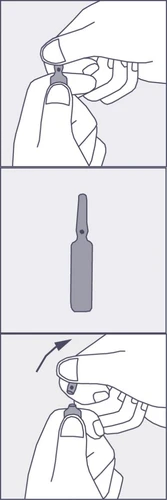
Each ampoule has a colored dot (see Figure 1) indicating the score line located beneath it.
- To open the ampoule, hold it vertically in both hands, with the colored dots facing each other—see Figure 2. The upper part of the ampoule should be gripped so that the thumb is positioned above the colored dot.
- Press in the direction of the arrow shown in Figure 3. Ampoules are intended for single use only and should be opened immediately before use. Any unused portion of the product should be destroyed in accordance with applicable regulations.
Figure 1 Figure 2 Figure 3
Use of a higher than recommended dose of Calcium chloratum WZF
Administration of large doses of calcium salts may lead to hypercalcemia; symptoms of hypercalcemia include:
loss of appetite, nausea, vomiting, constipation, abdominal pain, muscle weakness, mental disturbances, excessive thirst, polyuria, kidney stones, and in severe cases, cardiac arrhythmias and coma.
Treatment, carried out by medical personnel, includes patient hydration, administration of loop diuretics, chelating agents, calcitonin, and corticosteroids. Serum calcium concentration should be frequently monitored at regular intervals to adjust treatment to the patient's condition.
If you have any further doubts regarding the use of this medicine, consult a doctor or pharmacist.
4. Possible adverse reactions
Like all medicines, this medicine can cause adverse reactions, although not everyone will experience them.
Administration of calcium salts may cause an irritant effect. Intramuscular and subcutaneous administration
of the medicine is associated with a particular risk of such a reaction and is contraindicated.
Soft tissue calcifications have been observed during parenteral administration of calcium salts.
Administration of high doses of calcium salts may lead to hypercalcaemia (see section
“Use of a larger than recommended dose of Calcium chloratum WZF”).
Too rapid intravenous injection of calcium salts may also lead to hypercalcaemia,
as well as a chalky taste in the mouth, hot flushes, and peripheral vasodilation.
Reporting of adverse reactions
If any adverse reactions occur, including any adverse reactions not listed
in this leaflet, inform your doctor or pharmacist. Adverse reactions can be reported
directly to the Department of Monitoring Adverse Drug Reactions of the Office for Registration of Medicinal Products, Medical Devices and Biocidal Products
Al. Jerozolimskie 181C
02-222 Warsaw
Phone: +48 22 49 21 301
Fax: +48 22 49 21 309
Website: https://smz.ezdrowie.gov.pl
Adverse reactions may also be reported to the marketing authorization holder.
Reporting adverse reactions helps to provide more information on the safety of the medicine.
5. How to store Calcium chloratum WZF
Do not freeze.
Chemical and physical stability of the diluted solution has been demonstrated for 24 hours at a temperature of 15°C–25°C.
From a microbiological standpoint, the diluted product should be used immediately. If not used immediately, the user is responsible for the conditions and duration of storage.
Keep the medicine out of the sight and reach of children.
Do not use this medicine after the expiry date stated on the packaging. The expiry date refers to the last day of the stated month.
The label on the packaging shows the expiry date after the abbreviation EXP and the batch number after the abbreviation Lot.
Medicines must not be disposed of via wastewater or household waste. Ask your pharmacist how to dispose of medicines no longer in use. This will help protect the environment.
6. Contents of the package and other information
- The active substance is calcium chloride dihydrate. Each ml of solution contains 67 mg of calcium chloride dihydrate, corresponding to 0.46 mmol (18.3 mg) of calcium ions.
- Other components: sodium hydroxide 10% or hydrochloric acid 10% (for pH adjustment), water for injections.
What Calcium chloratum WZF looks like and contents of the pack
10 ampoules of 10 ml each
Marketing Authorisation Holder and Manufacturer
POLPHARMA S.A. Pharmaceutical Works
Pelplińska Street 19, 83-200 Starogard Gdański, Poland
tel. + 48 22 364 61 01