Buscopan
Poland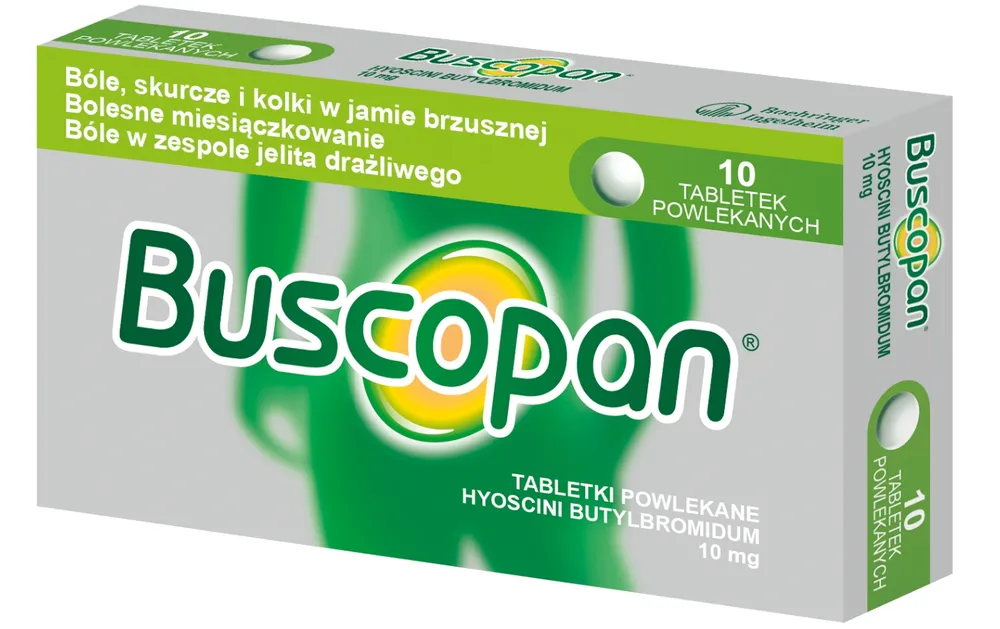
Table of Contents
Patient Information Leaflet
Warning! Please retain this leaflet. The information on the immediate packaging is in a foreign language.
Buscopan (Buscopan Rx), 10 mg, film-coated tablets
Hyoscini butylbromidum
Buscopan and Buscopan Rx are different brand names for the same medicine.
Please read this leaflet carefully before using the medicine, as it contains
important information for the patient.
This medicine should always be used exactly as described in this patient leaflet or as directed by a
physician or pharmacist.
- Keep this leaflet for future reference.
- If you need advice or further information, please consult your pharmacist.
- If you experience any adverse reactions, including any possible side effects not listed in this leaflet, inform your doctor, pharmacist, or nurse. See section 4.
- If there is no improvement after 3 days, or if your condition worsens, contact your doctor.
Table of contents:
- What Buscopan is and what it is used for
- What you need to know before taking Buscopan
- How to take Buscopan
- Possible side effects
- How to store Buscopan
- Contents of the pack and other information
1. What Buscopan is and what it is used for
Hyoscine butylbromide, the active substance in Buscopan, is an antispasmodic agent.
Antispasmodics reduce spasms of smooth muscles in the internal organs of the abdominal cavity –
in the gastrointestinal tract, biliary passages, urinary system, and female reproductive tract, thereby
relieving pain.
They are used to alleviate colicky pain, i.e. abdominal pain originating from the aforementioned
internal organs, which fluctuates in intensity and is difficult to localize precisely.
Buscopan may be used in spastic conditions of the smooth muscles of the gastrointestinal tract
(functional disorders of the gastrointestinal tract, painful gastric spasms, intestinal colic, irritable bowel syndrome), in spastic and dyskinetic conditions of the biliary tract (functional disorders of the biliary tract, acute biliary pain, biliary colic), and in spastic conditions of the urogenital system (painful menstruation, renal colic, spastic conditions associated with ureteric calculi).
2. Important information before using Buscopan
When not to use Buscopan
- if the patient has a known allergy (hypersensitivity) to butylscopolamine bromide or to any of the other ingredients of the medicine (listed in section 6);
- in patients with muscle weakness ( myasthenia gravis ) – a disease characterized by significant muscle weakness, even inability to move;
- in patients with pathological dilation of the large intestine ( megacolon ) – marked enlargement of the large intestine;
- if the patient has intolerance to certain sugars, because the medicine contains sucrose (see section "Buscopan contains sucrose").
Warnings and precautions
Exercise particular caution under the following circumstances:
- if the patient has heart conditions (irregular heartbeat, high blood pressure);
- if the patient has narrow-angle glaucoma;
- if the patient has had intestinal obstruction in the past or suspicion thereof;
- if the patient has had urinary tract obstruction in the past or suspicion thereof;
- if the patient has an enlarged prostate gland;
- if abdominal discomfort and pain in the patient differ from previous episodes previously treated with Buscopan as advised by a physician;
- if the patient experiences sudden, severe, or acute pain clearly different from usual cramp-related pain or discomfort;
- if cramp-related abdominal pain or discomfort rapidly worsens;
- if the patient's abdomen is tender to touch (pain upon touching the abdomen – tenderness);
- if the patient has fever;
- if the patient experiences nausea or vomiting;
- if the patient has low blood pressure or feels faint;
- if blood is present in the patient's stool;
- if the patient notices unexpected changes in bowel habits, e.g. diarrhea;
- if the patient has rapidly and unexpectedly lost weight;
- if the patient is currently taking other prescribed medications for abdominal pain and cramps.
If any of the above symptoms or medical conditions are present or have occurred in the patient, Buscopan should not be taken without first consulting a doctor. To determine the cause of symptoms, the doctor may recommend appropriate diagnostic tests.
The patient should stop taking Buscopan and contact a doctor:
- if pain worsens within 24 hours or persists for more than 3 days;
- if abdominal tenderness develops;
- if the patient experiences rectal bleeding or recurrent bleeding;
- if any additional symptoms occur.
Buscopan and other medicines
Inform your doctor or pharmacist about all medicines the patient is currently taking or has recently taken, as well as any medicines the patient intends to take.
Consult a doctor before starting Buscopan if the patient is taking any of the following medicines:
- tricyclic and tetracyclic antidepressants (used in the treatment of depression);
- antihistamines (used in the treatment of certain allergic conditions);
- antipsychotics (reducing psychotic symptoms of mental disorders);
- beta-sympathomimetic agents (used in the treatment of heart failure and/or asthma);
- quinidine (used in the treatment of cardiac arrhythmias);
- amantadine (used in the treatment of Parkinson's disease);
- disopyramide (used in the treatment of irregular heartbeat);
- other anticholinergic medicines such as ipratropium or tiotropium (used in the treatment of chronic obstructive pulmonary disease) or atropine-like compounds; because Buscopan may enhance the effects of these medicines.
Also inform the doctor if metoclopramide (used to treat nausea, vomiting, or gastrointestinal symptoms) is being taken, as reduced efficacy of both Buscopan and metoclopramide may occur.
Pregnancy, breastfeeding, and effects on fertility
If the patient is pregnant or breastfeeding, suspects she may be pregnant, or is planning to have a child, she should consult a doctor or pharmacist before using this medicine.
It is recommended to avoid using Buscopan during pregnancy and breastfeeding.
Driving and operating machinery
No studies have been conducted on the effects of the medicine on the ability to drive or operate machinery. There are no specific recommendations regarding the use of Buscopan when driving or operating machinery.
Buscopan contains sucrose
One coated tablet contains approximately 41.2 mg of sucrose, equivalent to 411.8 mg of sucrose at the maximum recommended daily dose. If the patient has previously been diagnosed with intolerance to certain sugars, the patient should consult a doctor before taking the medicine.
3. How to use Buscopan
This medicine should always be taken exactly as described in the patient information leaflet or as directed by a doctor or pharmacist. If in doubt, consult a doctor or pharmacist.
Recommended dose:
Unless otherwise advised by a doctor:
Children 6 to 12 years: 1 tablet 3 times daily,
Adults and children over 12 years: 1 or 2 tablets 3 to 5 times daily.
The tablets should be swallowed whole with liquid.
Do not use Buscopan for longer than 3 days without consulting a doctor. If the patient needs to use Buscopan continuously or for a prolonged period, medical advice should be sought to determine the underlying cause of symptoms.
Use in children and adolescents
Buscopan may be used in children over 6 years only on the advice of a doctor.
Buscopan is not recommended for children under 6 years due to the high content of the active substance.
Taking more than the recommended dose of Buscopan
If more than the recommended dose of Buscopan has been taken, or if the medicine has been taken by a child under 12 years, seek immediate medical advice.
The following symptoms may occur: dry mouth, skin flushing, difficulty in urination, increased heart rate, and visual disturbances.
Missed dose of Buscopan
If a dose is missed, take it as soon as remembered. However, do not take a double dose to make up for the missed dose. Take the next dose at the usual time.
Stopping Buscopan
Buscopan should be taken only when needed and treatment should be discontinued once symptoms have resolved.
If there are any further questions about the use of this medicine, consult a doctor or pharmacist.
4. Possible side effects
Like all medicines, Buscopan may cause side effects, although not everybody gets them.
Many of the side effects listed below are due to the anticholinergic action of the medicine.
They are usually mild and transient.
The following side effects have additionally been reported:
Uncommon (occur less frequently than in 1 in 100 patients, but more frequently than in 1 in 1000
patients):
fast heartbeat, dry mouth, reduced sweating, skin reactions (urticaria, itching).
Rare (occur less frequently than in 1 in 1000 patients, but more frequently than in 1 in 10,000 patients):
urinary retention.
Frequency not known (frequency cannot be estimated from the available data):
anaphylactic shock (a sudden and severe allergic reaction characterized by breathing difficulties, circulatory collapse, and sudden swelling), anaphylactic reactions with episodes of breathing disorders, skin reactions (rash, redness), and other hypersensitivity reactions.
Reporting of side effects
If any side effects occur, including any side effects not listed in this leaflet, inform your doctor, pharmacist, or nurse. Side effects can also be reported directly to the Department of Monitoring Adverse Drug Reactions of the Office for Registration of Medicinal Products, Medical Devices and Biocidal Products
Al. Jerozolimskie 181C
02-222 Warsaw
Phone: +48 (22) 4921301
Fax: +48 (22) 4921309
Website: https://smz.ezdrowie.gov.pl
Reporting side effects helps to provide more information on the safety of the medicine.
5. How to store Buscopan
Keep this medicine out of the sight and reach of children.
Store below 30°C. Keep in the original packaging in order to protect from light.
Do not use Buscopan after the expiry date stated on the container. The expiry date refers to the last day of the stated month.
Medicines should not be disposed of via wastewater or household waste. Ask your pharmacist how to dispose of medicines no longer required. These measures will help protect the environment.
6. Contents of the pack and other information
What Buscopan contains
- Each coated tablet contains 10 mg of hyoscine butylbromide (Hyoscini butylbromidum).
- Other ingredients are: calcium hydrogen phosphate anhydrous, maize starch, colloidal anhydrous silica, pregelatinised starch, tartaric acid, stearic/palmitic acid, coating (povidone, sucrose, gum arabic, talc, titanium dioxide (E 171), macrogol 6000, carnauba wax, white wax).
What Buscopan looks like and contents of the pack
Buscopan is a coated tablet.
Pack: PVC/Al blister in a cardboard carton.
Pack size: 14 coated tablets.
For further information, please contact the responsible party or the parallel importer.
Responsible party in Ireland, country of export:
Opella Healthcare France SAS, T/A Sanofi
82 Avenue Raspail
94250 Gentilly, France
Manufacturer:
Istituto De Angeli S.r.l.
Località Prulli n. 103/c, 50066 Reggello (FI), Italy
Parallel importer:
Delfarma Sp. z o.o.
ul. Św. Teresy od Dzieciątka Jezus 111
91-222 Łódź
Repackaged in:
Delfarma Sp. z o.o.
ul. Św. Teresy od Dzieciątka Jezus 111
91-222 Łódź
Irish licence number, country of export: PA23180/022/001
Parallel import licence number: 409/22