Buscolysin
Poland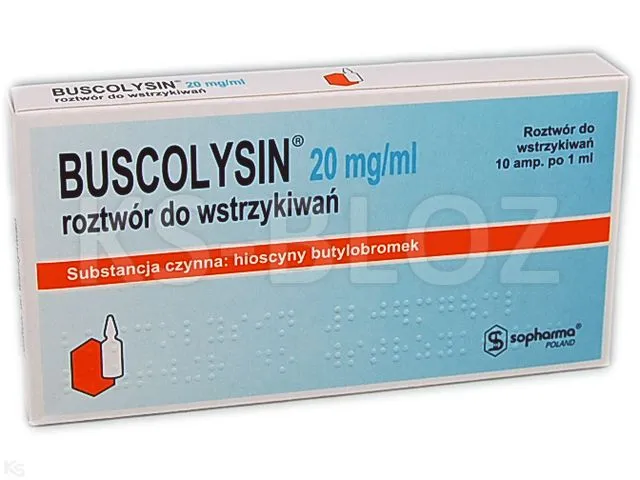
Table of Contents
Package leaflet: Information for the patient
Buscolysin
20 mg/ml injection solution,
( Hyoscine butylbromide )
Please read all of this leaflet carefully before using this medicine, because it contains
important information for the patient.
- Keep this leaflet, so that you can read it again if necessary.
- If you have any doubts, please consult your doctor or nurse.
- This medicine has been prescribed for a specific individual. Do not pass it on to others. This medicine may harm another person, even if their symptoms are the same as yours.
- If you experience any adverse effects, including any not listed in this leaflet, inform your doctor or nurse. See section 4.
Contents of the leaflet:
- What Buscolysin is and what it is used for
- Important information before using Buscolysin
- How to use Buscolysin
- Possible side effects
- How to store Buscolysin
- Contents of the pack and other information
1. What Buscolysin is and what it is used for
Buscolysin exhibits parasympatholytic activity similar to atropine, but, acting peripherally, it lacks central effects associated with atropine. Compared to atropine, Buscolysin acts faster but for a shorter duration.
Buscolysin blocks muscarinic receptors, resulting in reduced smooth muscle tone, decreased gastrointestinal motility and gastric secretion, and also relieves spasms of the biliary and urinary tracts.
Buscolysin is used in the following conditions:
- Acute spastic conditions of the gastrointestinal tract: esophageal, cardial and pyloric spasms, spastic constipation, hyperkinetic biliary dyskinesia,
- Gastritis and duodenitis, gastric and duodenal ulcers,
- Biliary colic,
- Acute spastic conditions of the urinary tract, especially during renal calculi, renal colic, painful urge to urinate,
- As an adjunct in radiological diagnostics of the gastrointestinal and urinary tracts, in endoscopic examinations and procedures related to them, as well as after surgical procedures,
- In obstetrics and gynecology: birth canal spasms during labor, postpartum endometritis, placental removal, spastic dysmenorrhea, and as supportive treatment during abortion (in the initial phase).
2. Important information before using Buscolysin
When not to use Buscolysin
- if the patient is allergic to hyoscine or any of the other ingredients of the medicine (listed in section 6);
- if the patient has:
- hypersensitivity to butylbromide hyoscine, atropine, or any component of the medicine;
- glaucoma;
- benign prostatic hyperplasia with urinary retention;
- gastrointestinal tract obstruction;
- cardiac arrhythmia (tachycardia);
- angina pectoris;
- heart failure;
- megacolon.
Warnings and precautions
Consult a doctor before using Buscolysin.
Butylbromide hyoscine may cause urinary retention or worsen the clinical condition, especially in elderly patients with the following conditions: benign prostatic hyperplasia without obstruction, uropathy (impaired urine flow) due to urinary tract obstruction, such as bladder neck obstruction caused by benign prostatic hyperplasia. In such cases, particular caution is required when using the medicine.
Caution is advised when using the medicine in patients with mechanical gastrointestinal obstruction of any origin, pyloric stenosis, or megacolon, as administration of the medicine may lead to gastrointestinal stasis, bloating, and intoxication, which may exacerbate the course of the aforementioned conditions.
Particular caution is required when using the medicine in patients with heart diseases, especially cardiac arrhythmias (tachycardia, tachyarrhythmia).
The medicine should not be administered to patients with closed-angle glaucoma or high fever, as butylbromide hyoscine inhibits sweat gland activity; its use may lead to overheating of the body with all its consequences.
Particular caution is required when using the medicine in patients with symptoms of dry mouth, drying rhinitis, hypertonia (increased muscle tension), or hyperthyroidism.
If any symptoms of hypersensitivity occur, the medicine must be discontinued.
Administration of the medicine is not recommended within 24 hours before testing gastric acid secretion.
Children
Buscolysin is not recommended for use in children under 6 years of age.
Buscolysin and other medicines
Inform your doctor or pharmacist about any other medicines you are currently taking or plan to use.
- cholinomimetic agents (pilocarpine – a medicine used in glaucoma treatment) and anticholinesterase agents (galantamine, physostigmine, pyridostigmine – medicines enhancing neurotransmission) antagonize (inhibit) the action of butylbromide hyoscine;
- amantadine (a medicine used in Parkinson's disease), quinidine (an antiarrhythmic medicine), tricyclic antidepressants, neuroleptics (medicines used in psychiatric disorders), antihistamine compounds (antiallergic medicines), and medicines for Parkinson's disease enhance the anticholinergic (spasmolytic) effect of butylbromide hyoscine;
- butylbromide hyoscine may reduce gastrointestinal motility, thereby delaying the absorption and pharmacological action of other medicines;
- the action of butylbromide hyoscine leads to increased absorption and elevated serum concentration of digoxin (by approximately 1/3), which may result in relative overdose;
- concomitant use of corticosteroids (medicines with, among others, anti-inflammatory action) and butylbromide hyoscine increases the risk of elevated intraocular pressure and the likelihood of glaucoma development;
- excretion of the medicine may be reduced by using urine-alkalizing agents, e.g. citrates, etc.;
- simultaneous use of butylbromide hyoscine with ketoconazole (a medicine used in fungal infections) or metoclopramide (an antiemetic medicine) may reduce the therapeutic effect of these latter medicines;
- concomitant administration of MAO inhibitors (antidepressant medicines) may inhibit the metabolism of anticholinergic medicines, including butylbromide hyoscine, thereby intensifying their therapeutic effects and adverse reactions.
Taking Buscolysin with food, drink and alcohol
Not applicable.
Pregnancy, breastfeeding and fertility
Pregnancy
If the patient is pregnant or breastfeeding, suspects she may be pregnant, or is planning to have a child, she should consult a doctor before using this medicine.
Experimental animal studies have not shown any direct or indirect harmful effects of the medicine on pregnancy, embryo/fetal development, parturition, or postnatal development.
During pregnancy, the medicine may be used only when medically indicated, under medical supervision, and only when the benefit to the mother outweighs the potential risk to the fetus.
Breastfeeding
The active substance of the medicine partially passes into breast milk. Therefore, its use during breastfeeding is not recommended. If use of the medicine is necessary, breastfeeding should be discontinued. Butylbromide hyoscine may also reduce milk secretion due to suppressed exocrine gland function.
Fertility
There is no information available regarding any adverse effects of the product on reproductive capacity in animals.
Driving and operating machinery
Prolonged use of the medicine may lead to accommodation disorders. Therefore, during treatment with Buscolysin, driving motor vehicles and operating mechanical equipment should be avoided until full visual function is restored.
Buscolysin contains less than 1 mmol (23 mg) of sodium per dose, which means the medicinal product is considered sodium-free.
3. How to use Buscolysin
The dosage and duration of treatment will be determined by a physician.
If you feel that the effect of the medicine is too strong or too weak, consult your doctor. In case of any doubts, consult your doctor or nurse.
The treating physician will determine the daily dose of Buscolysin depending on the severity of clinical symptoms and any concomitant diseases, if present.
Adults:
One ampoule (20 mg) administered intramuscularly or intravenously; if necessary, further doses may be given every 30 minutes. Intravenous injection should be performed "slowly" (rapid administration may lead to a significant drop in blood pressure and even shock caused by butylbromide hyoscine).
The maximum daily dose in adults is 100 mg.
Children over 6 years of age:
Buscolysin should be administered intramuscularly or slowly intravenously at a dose of 5–10 mg, two to four times daily.
Method of administration
Buscolysin should be administered intramuscularly or slowly intravenously, or as an intravenous infusion.
Intramuscular administration in children over 6 years of age should be performed slowly over at least 1 minute.
Use of a higher than recommended dose of Buscolysin
Contact your physician immediately.
Overdose symptoms vary depending on the severity of poisoning and may include:
skin redness and dryness, dry mucous membranes, pupil dilation, cardiac arrhythmias, difficulty swallowing, neuropsychiatric disturbances (delirium, visual hallucinations, agitation and anxiety, ataxia), progressing to loss of consciousness, high fever, urinary retention, collapse, and coma.
In case of overdose, the patient should be hospitalized and symptomatic treatment initiated.
Symptoms of overdose may be reduced by administration of parasympathomimetic drugs such as galantamine or physostigmine.
In severe poisoning, barbiturates and a benzodiazepine should be administered, and resuscitation measures initiated if indicated.
4. Possible adverse reactions
Like all medicines, this medicine can cause adverse reactions, although not everyone experiences them.
The adverse reactions listed below are classified according to system organ classes.
Common (may occur in up to 1 in 10 people):
- Eye accommodation disorders
- Tachycardia (heart beating faster than normal)
- Dizziness
- Dry mouth, constipation
Unknown *: (cannot be estimated from available data)
- Anaphylactic shock, including fatal cases, anaphylactic reactions (severe allergic reaction causing swelling of the face or throat), dyspnoea (difficulty breathing), skin reactions (e.g. urticaria, rash, erythema, itching) and other hypersensitivity reactions,
- Pupil dilation (dilation of the eye pupil), increased intraocular pressure,
- Hypotension, skin flushing,
- Urinary retention,
- Decreased sweating.
Pain at the injection site may occur, particularly after intramuscular administration.
Butylbromide of hyoscine, the active substance of the medicinal product Buscolysin, due to its chemical structure (quaternary ammonium compound) should not penetrate the central nervous system. Butylbromide of hyoscine does not cross the blood-brain barrier. However, it cannot be completely ruled out that after administration of the medicinal product Buscolysin, psychiatric disorders (e.g. disorientation) may occur.
*This adverse reaction has been observed after marketing authorization of the medicinal product. With a certainty of 95%, it can be stated that the frequency of occurrence is not higher than in the "common" category, but may be lower. An exact estimation of frequency is impossible, as this adverse reaction did not occur during clinical trials in a group of 185 patients.
Reporting of adverse reactions
If any adverse reactions occur, including any adverse reactions not listed in this leaflet, inform your doctor or pharmacist. Adverse reactions can be reported directly to the Department of Monitoring of Adverse Drug Reactions of the Office for Registration of Medicinal Products, Medical Devices and Biocidal Products:
Al. Jerozolimskie 181C, 02-222 Warsaw, tel.: +48 22 49 21 301, fax: +48 22 49 21 309,
website: https://smz.ezdrowie.gov.pl
Adverse reactions can also be reported to the marketing authorization holder.
Reporting of adverse reactions enables continuous monitoring of the benefit-risk balance of the medicine.
5. How to store Buscolysin
Store below 25°C. Keep in a place out of sight and reach of children.
Do not use this medicine after the expiry date stated on the packaging after: EXP.
The expiry date refers to the last day of the stated month.
Medicines must not be disposed of via wastewater or household waste. Ask your pharmacist how to properly dispose of medicines no longer in use. This will help protect the environment.
6. Contents of the package and other information
What Buscolysin contains
- The active substance is hyoscine butylbromide. One 1 ml ampoule of injection solution contains 20 mg of hyoscine butylbromide (Hyoscini butylbromidum).
- The other components are sodium chloride and water for injections.
What Buscolysin looks like and contents of the pack
Ampoules made of amber glass type I in soft blisters made of PVC film, placed in a cardboard box together with a patient leaflet.
Pack sizes:
1 blister with 10 ampoules per box
10 blisters with 10 ampoules per box
Marketing Authorisation Holder and Manufacturer
Marketing Authorisation Holder:
Sopharma Warszawa Sp. z o.o.
Al. Jerozolimskie 136
02-305 Warsaw
Manufacturer:
SOPHARMA AD
16 Iliensko Shosse str.
1220 Sofia, Bulgaria