Braunovidon
Poland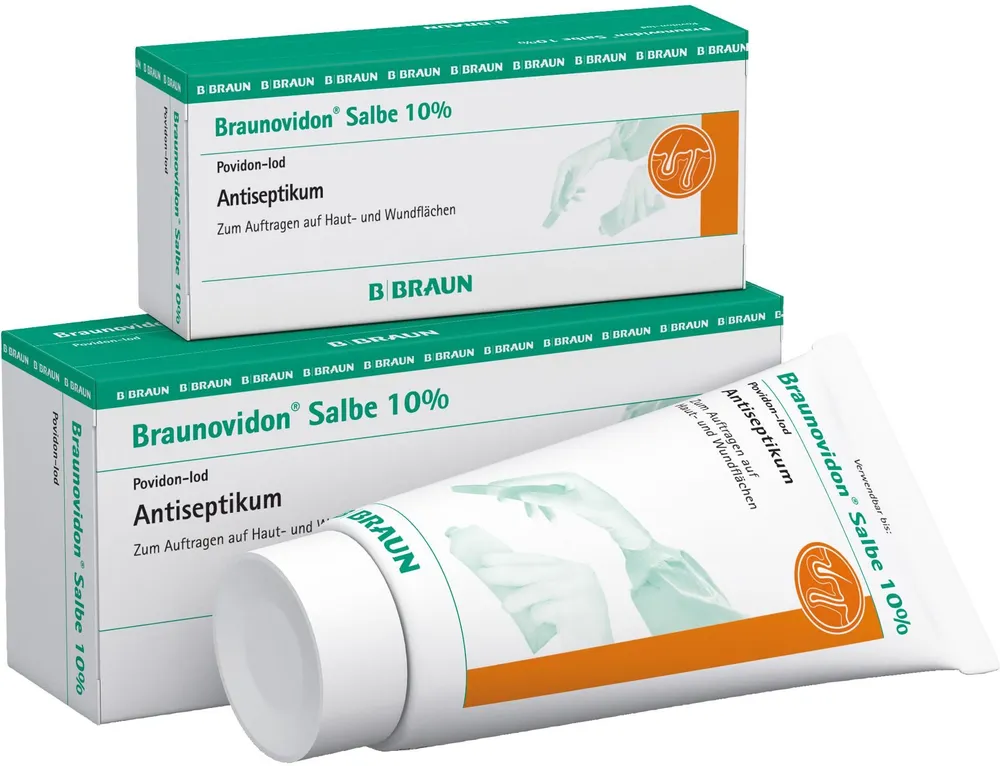
Table of Contents
Package leaflet: Information for the patient
Warning! Keep the leaflet. Information on the immediate packaging in a foreign language.
Braunovidon
100 mg/g, ointment
Povidone iodine
Please read the entire leaflet before using the medicine, as it contains important information
for the patient.
- This medicine should always be used exactly as described in this patient leaflet or as directed by the doctor, pharmacist, or nurse.
- Keep this leaflet for future reference.
- If advice or further information is needed, please consult your pharmacist.
- If the patient experiences any adverse reactions, including any possible side effects not listed in this leaflet, inform the doctor, pharmacist, or nurse. See section 4. If there is no improvement or if the patient feels worse, contact the doctor.
Table of contents of the leaflet:
- What Braunovidon is and what it is used for
- Important information before using Braunovidon
- How to use Braunovidon
- Possible side effects
- How to store Braunovidon
- Contents of the packaging and other information
1. What Braunovidon is and what it is used for
Pharmaceutical form
Braunovidon is an ointment for topical application. The medicine contains the active substance povidone iodine.
The medicine is used as a disinfectant for repeated use over a defined period.
Braunovidon is indicated for flame or scald burns of the skin, infected ulcers, pressure sores, infected superficial skin defects not showing healing tendency with inflammatory reaction or deeper ulceration, purulent skin conditions (pyoderma), bacterial or fungal skin diseases, or secondary infections with the same agent following previous treatment.
2. Important information before using Braunovidon
When not to use Braunovidon:
- if the patient is allergic to povidone-iodine or any of the other ingredients of this medicine (listed in section 6),
- in thyroid disorders,
- in herpes dermatitis syndrome (a rare skin disease characterized by burning, itching and other symptoms, primarily affecting the skin of hands, feet, arms and buttocks),
- if planning or having recently completed therapy with radioactive iodine (until completion of therapy),
- in newborns and infants up to 6 months of age.
Warnings and precautions:
Before starting treatment, discuss this with your doctor or pharmacist.
- Due to the risk of mercury iodide burns, povidone-iodine should not be used simultaneously or after application of mercury-containing medicinal products.
- Regular use of Braunovidon is not recommended during lithium therapy.
- The oxidizing effect of povidone-iodine may lead to false-positive results in certain diagnostic laboratory tests (e.g. determination of hemoglobin or glucose in feces or urine using o-toluidine or guaiac resin).
- Povidone-iodine may interfere with thyroid function tests (scintigraphy, protein-bound iodine determination, diagnosis using radioactive iodine isotopes), which may in turn prevent treatment with radioactive iodine. A new scintigram may be performed no earlier than 1–2 weeks after discontinuation of Braunovidon.
- Stains on clothing can be removed with soap and water. Persistent stains may be removed with a solution of liquid ammonia or sodium thiosulfate.
Children
Do not use in newborns, especially premature infants, and in infants up to 6 months of age.
Braunovidon and other medicines
Inform your doctor or pharmacist about all medicines the patient is currently using or has recently used, as well as any medicines the patient plans to use.
Povidone-iodine reacts with proteins and certain organic compounds, e.g. components of blood or pus, which may reduce its effectiveness.
Concurrent use of povidone-iodine and enzyme-containing wound care products leads to oxidation of enzyme components, rendering them ineffective.
Braunovidon should not be used simultaneously or shortly after the use of wound care products or disinfectants containing mercury, as iodine and mercury may react to form corrosive chemical substances.
Braunovidon should not be used simultaneously with reducing agents, alkaloid salts, tannic acid, salicylic acid, silver salts, bismuth salts, taurolidine, or hydrogen peroxide.
In patients undergoing lithium therapy, concomitant use of Braunovidon is not recommended. Absorbed iodine may exacerbate hypothyroidism, which may be induced by lithium.
Pregnancy, breastfeeding, and effects on fertility
If the patient is pregnant or breastfeeding, suspects she may be pregnant, or is planning to have a child, she should consult a doctor or pharmacist before using this medicine.
Braunovidon may be used during pregnancy up to the ninth week only if there are strong medical indications as determined by a physician.
Use of Braunovidon after the ninth week of pregnancy and during breastfeeding is contraindicated, as iodine, including in the form of povidone-iodine, crosses the placental barrier and is excreted in breast milk.
Driving and operating machinery
Braunovidon has no influence on the ability to drive vehicles or operate machinery.
3. How to use Braunovidon
This medicine should always be used exactly as described in the patient leaflet or as directed by a doctor, pharmacist, or nurse. If in doubt, consult a doctor, pharmacist, or nurse.
Apply the ointment several times daily to the affected area of skin.
In the initial phase of treatment, to maintain optimal bactericidal activity, apply the ointment every 4–6 hours to infected or exuding wounds.
The duration of treatment with Braunovidon depends on the patient's clinical condition.
The ointment may remain on the skin for a prolonged period. Dressings should be changed when the brown color of the ointment fades.
For effective action, the entire wound surface must be completely covered with ointment.
If you feel the medicine's effect is too strong or too weak, consult your doctor.
Children
Do not use in newborns, especially premature infants, or in infants under 6 months of age.
Note:
The brown color of the ointment is a characteristic feature. It indicates the presence of available iodine and thus confirms its efficacy. Fading of the color signals that a new layer of ointment should be applied. It is important that the ointment covers the entire infected skin surface, as Braunovidon acts as a local antiseptic.
Use of a higher than recommended dose of Braunovidon
If more than the recommended dose has been used, consult a doctor immediately.
There are no data on overdose when the medicine is used according to the indications and method of administration.
When large doses are applied over large skin areas, wounds, or burns, symptoms of iodine poisoning may occur.
Accidental ingestion of Braunovidon
If the medicine is swallowed, consult a doctor immediately.
Symptoms
In case of accidental ingestion, the stomach should be emptied and washed out with starch solution or a 5% sodium thiosulfate solution. If necessary, correct disturbances in water and electrolyte balance.
Emergency treatment and antidote
In cases of excessive systemic absorption of Braunovidon during wound treatment, toxic levels of iodine in plasma can be effectively reduced by hemodialysis or peritoneal dialysis. Further treatment should be based on the underlying disease and symptoms of overdose (e.g. metabolic acidosis, kidney dysfunction) and should follow general principles. Since iodine may exacerbate hyperthyroidism, treatment with antithyroid agents may be less effective or delayed.
4. Possible adverse effects
Like all medicines, Braunovidon may cause adverse effects, although not everyone will experience them.
Important adverse effects or symptoms to be aware of, and preventive measures to be taken if they occur
Frequency unknown (cannot be estimated based on available data):
skin reactions in cases of hypersensitivity (allergy), e.g. delayed contact allergy with symptoms such as itching, redness, blisters, etc.
Very rare (may occur in not more than 1 in 10,000 patients):
severe hypersensitivity reactions (anaphylactic reactions) affecting other organs (e.g. skin, respiratory system, circulatory system).
If any of the above adverse effects occur, use of Braunovidon must be discontinued immediately and medical advice must be sought without delay.
Other adverse effects
Frequency unknown (cannot be estimated based on available data):
- unfavourable effects on wound healing, and transient pain, burning sensation, and warmth with prolonged use;
- thyroid function disorders resulting from application over large body surface areas or repeated application, particularly on damaged skin – routine monitoring of thyroid function is necessary in such cases;
- cases of serum osmolality disturbances, electrolyte imbalances, renal failure, and severe metabolic acidosis due to systemic absorption of large amounts of povidone-iodine.
If any adverse effects occur, consult a doctor or pharmacist. This includes adverse effects not listed in this leaflet.
Reporting of adverse effects
If any adverse symptoms occur, including those not listed in this leaflet, inform your doctor, pharmacist, or nurse.
Adverse effects can be reported directly to the Department of Monitoring of Adverse Drug Reactions at the Office for Registration of Medicinal Products, Medical Devices and Biocidal Products: Al. Jerozolimskie 181C, 02-222 Warsaw, Phone: +48 22 49 21 301, Fax: +48 22 49 21 309, Website: https://smz.ezdrowie.gov.pl
Reporting adverse effects helps to enhance knowledge about the safety of the medicine.
5. How to store Braunovidon
Keep this medicine out of sight and reach of children.
Store below 25°C.
Do not use this medicine after the expiry date stated on the container. The expiry date refers to the last day of the stated month.
Medicines must not be disposed of via wastewater or household waste. Ask your pharmacist how to dispose of medicines no longer required. This will help protect the environment.
6. Contents of the package and other information
What Braunovidon contains
- Active substance: povidone-iodine with 10% available iodine. 10 g of povidone-iodine is contained in 100 g of ointment.
- Excipients: macrogol 400, macrogol 4000, purified water, sodium hydrogen carbonate.
What Braunovidon looks like and contents of the pack
The medicinal product is a brown ointment.
Polyethylene tubes containing 20 g or 100 g of ointment, packed in a cardboard box.
For further information, contact the responsible entity or the parallel importer.
Responsible entity in the Czech Republic, country of export:
B. Braun Melsungen AG
Carl-Braun Str. 1, 34212 Melsungen, Germany
Manufacturer:
B. Braun Melsungen AG
Am Schwerzelshof 1, 34212 Melsungen, Germany
Parallel importer:
Delfarma Sp. z o.o.
ul. Św. Teresy od Dzieciątka Jezus 111
91-222 Łódź
Repackaged in:
Delfarma Sp. z o.o.
ul. Św. Teresy od Dzieciątka Jezus 111
91-222 Łódź
Authorization number in the Czech Republic, country of export: 32/172/98-C
Parallel import authorization number: 148/22