Binabic
Poland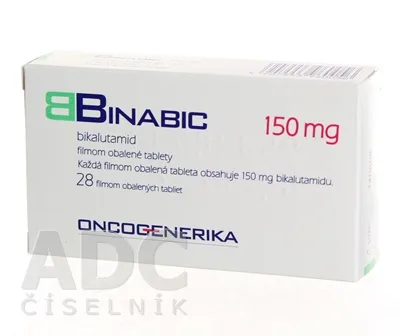
Table of Contents
Package leaflet: Information for the patient
Warning! Keep the leaflet, information on the immediate packaging in a foreign language!
Binabic, 50 mg, film-coated tablets
Bicalutamide
Please read the entire leaflet carefully before using this medicine, as it contains
important information for the patient.
- Keep this leaflet, so that you can read it again if necessary.
- If you have any questions, please consult your doctor or pharmacist.
- This medicine has been prescribed for a specific individual. Do not give it to others. This medicine may harm other people, even if their symptoms are the same.
- If the patient experiences any adverse reactions, including any adverse reactions not listed in this leaflet, inform the doctor or pharmacist. See section 4.
Table of contents of the leaflet
- What Binabic is and what it is used for
- Important information before taking Binabic
- How to take Binabic
- Possible side effects
- How to store Binabic
- Contents of the pack and other information
1. What Binabic is and what it is used for
Bicalutamide, the active substance in Binabic, belongs to a group of medicines called anti-androgens.
- Binabic is used in the treatment of prostate cancer.
- Binabic works by blocking male sex hormones such as testosterone.
Contact your doctor if the patient does not feel better or if symptoms worsen.
2. Important information before using Binabic
When not to use Binabic
- if the patient is allergic (hypersensitive) to bicalutamide or any of the other ingredients of Binabic (listed in section 6);
- when taking a medicine called cisapride or antihistamines (terfenadine or astemizole);
- in women. Binabic should not be taken if any of the above situations apply to the patient. If in doubt, consult a doctor or pharmacist before taking Binabic. Binabic must not be given to children.
Warnings and precautions
Before starting Binabic, discuss with your doctor if:
- the patient has liver disease;
- the patient has diabetes and is taking LHRH analogues such as goserelin, buserelin, leuprorelin, or triptorelin.
If admitted to hospital, inform the medical staff that you are taking Binabic.
Inform your doctor if any of the following situations apply to the patient:
any heart or blood vessel disorders, including heart rhythm disorders (arrhythmia), or if
the patient is being treated with medicines used for these conditions. When taking Binabic,
there may be an increased risk of heart rhythm disturbances.
Binabic and other medicines
Tell your doctor about all medicines the patient is currently taking or has recently taken,
as well as any medicines the patient plans to take.
Do not take Binabic if the patient is already taking any of the following medicines:
- cisapride (a medicine used in certain types of indigestion);
- certain antihistamines (terfenadine or astemizole).
Inform the treating doctor if the patient is taking any of the following medicines:
- oral anticoagulants (oral blood thinners);
- cyclosporine (a medicine that suppresses immune system function);
- calcium channel blockers (medicines used for high blood pressure and certain heart conditions).
Binabic may interfere with the action of certain medicines used to treat heart rhythm disorders
(e.g. quinidine, procainamide, amiodarone, and sotalol), or may increase the risk of heart rhythm disturbances when taken together with certain other medicines (e.g. methadone
(used to relieve pain and in detoxification programs for drug-dependent individuals),
moxifloxacin (an antibiotic), or medicines used to treat serious psychiatric disorders).
Pregnancy, breastfeeding, and fertility
Binabic must not be used in women. Binabic is contraindicated in women who are pregnant or breastfeeding.
Driving and operating machinery
It is unlikely that Binabic affects the ability to drive or operate machinery. However, as drowsiness may occur after taking Binabic, caution should be exercised if this symptom occurs.
Binabic contains monohydrate lactose
If the patient has previously been diagnosed with intolerance to certain sugars, the patient should consult a doctor before taking Binabic.
Binabic contains sodium
This medicine contains less than 1 mmol (23 mg) of sodium per tablet; i.e. it is considered "sodium-free".
3. How to use Binabic
Binabic must always be used exactly as directed by the doctor. In case of doubt, consult your doctor.
- The usual dose of Binabic is one 50 mg tablet once daily.
- The tablet should be swallowed whole with water.
- It is recommended to take the medicine at the same time each day.
- Do not stop taking the medicine even if you feel better. The decision to discontinue treatment should be made by the doctor who prescribed it.
Use in children and adolescents
Binabic must not be given to patients under 18 years of age.
Taking more Binabic than recommended
If you take more Binabic than recommended, contact your doctor immediately or go to hospital.
Missed dose of Binabic
- If you miss a dose, do not take the missed dose. Take the next dose at the usual time.
- Do not take a double dose to make up for a missed dose.
4. Possible adverse reactions
Like all medicines, this medicine can cause adverse reactions, although not everyone will experience them.
Allergic reactions
Occurring not very commonly (less frequently than in 1 out of 100 treated patients). Symptoms may include sudden onset of reactions such as:
- rash, itching, or hives on the skin;
- swelling of the face, lips, tongue, throat, which may cause difficulty swallowing or swelling of other body parts;
- shortness of breath, wheezing, or breathing difficulties.
If any of the above adverse reactions occur, seek medical advice immediately.
Contact your doctor immediately also if any of the following adverse reactions occur:
very common (in more than 1 out of 10 treated patients)
- abdominal pain;
- presence of blood in the urine.
common (in less than 1 out of 10 treated patients)
- yellowing of the skin or whites of the eyes (jaundice). These may be symptoms of liver dysfunction or, in rare cases (in less than 1 out of 1000 people), liver failure.
not very common (in less than 1 out of 100 treated patients)
- severe shortness of breath or sudden worsening of breath with cough or high fever. These may be symptoms of a lung disorder called "interstitial lung disease".
Other adverse reactions:
very common (in more than 1 out of 10 treated patients)
- dizziness,
- constipation,
- nausea,
- breast tenderness and swelling,
- hot flushes,
- fatigue,
- swelling,
- decrease in red blood cells (anaemia) causing weakness or pale skin.
common (in less than 1 out of 10 treated patients)
- loss of appetite,
- decreased libido,
- depression,
- drowsiness,
- indigestion,
- bloating,
- hair loss,
- regrowth of hair or excessive hair growth,
- dry skin,
- itchy skin,
- rash,
- erectile dysfunction (impotence),
- weight gain,
- chest pain,
- heart failure,
- myocardial infarction.
frequency not known (frequency cannot be estimated from available data)
- changes in ECG (prolongation of QT interval).
Your doctor may recommend periodic blood tests to monitor for any possible changes.
The above list of possible adverse reactions should not cause concern, as the patient may not experience any of them. If any adverse symptoms occur, including any adverse reactions not listed in this leaflet, inform your doctor or pharmacist.
Reporting of adverse reactions
If any adverse reactions occur, including any not listed in this leaflet, inform your doctor, nurse, or pharmacist.
Adverse reactions can be reported directly to the Department of Monitoring of Adverse Drug Reactions, Office for Registration of Medicinal Products, Medical Devices and Biocidal Products
Al. Jerozolimskie 181C
PL-02 222 Warsaw
Tel.: + 48 22 49 21 301
Fax: + 48 22 49 21 309
Website: https://smz.ezdrowie.gov.pl
Reporting adverse reactions helps to provide more information on the safety of this medicine.
5. How to store the medicine Binabic
Keep the medicine out of sight and reach of children.
No special storage instructions apply.
Do not use the Binabic medicine after the expiry date stated on the packaging. The expiry date refers to the last day of the stated month.
Medicines must not be disposed of via wastewater or household waste. Ask your pharmacist how to dispose of medicines no longer in use. This will help protect the environment.
6. Contents of the package and other information
What Binabic contains
- The active substance is bicalutamide: each tablet contains 50 mg of bicalutamide.
- Other components of the medicine are: Core: lactose monohydrate, magnesium stearate, povidone K 25, sodium carboxymethyl starch (type A). Coating: Opadry OY-S-9622 with the following composition: hypromellose (E464), titanium dioxide (E171), propylene glycol.
What Binabic looks like and contents of the pack
Binabic is presented as white, round, biconvex coated tablets.
Each cardboard box contains 28 coated tablets packed in PVC/PVDC/Aluminium blisters.
For more detailed information, please contact the Marketing Authorisation Holder or the Parallel Importer.
Marketing Authorisation Holder in the Czech Republic, country of export:
Vipharm S.A.
ul. A. i F. Radziwiłłów 9
05-850 Ożarów Mazowiecki
Poland
Manufacturer:
Genepharm S.A.
18th km Marathonos Avenue
153 51 Pallini Attikis
Greece
Parallel Importer:
Medezin Sp. z o.o.
ul. Zbąszyńska 3
91-342 Łódź
Repackaged in:
Medezin Sp. z o.o.
ul. Zbąszyńska 3
91-342 Łódź
Marketing Authorisation number in the Czech Republic, country of export: 44/569/08-C
Parallel Import Licence number: 192/25
This medicinal product is authorised for sale in the European Economic Area countries under the following names:
Poland Binabic 50 mg
Czech Republic Binabic 50 mg
Slovakia Binabic 50 mg