Beto 200 zk
Poland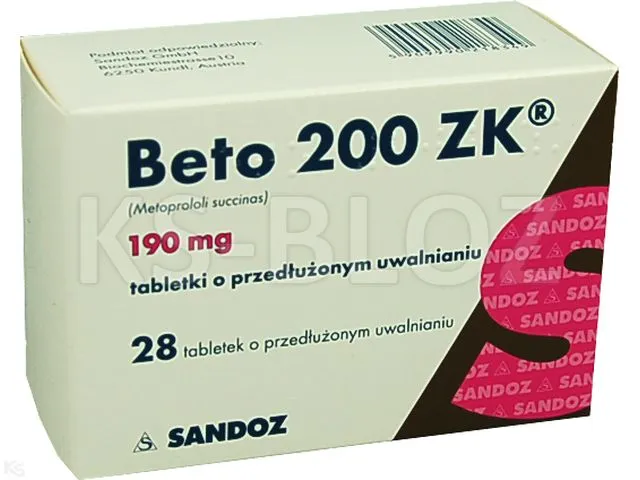
Table of Contents
Patient Information Leaflet
Warning! Keep this leaflet! Information on the immediate packaging is in a foreign language.
Beto 200 ZK (Metoprololsuccinaat Sandoz retard 200), 190 mg, prolonged-release tablets
Metoprololi succinas
Beto 200 ZK and Metoprololsuccinaat Sandoz retard 200 are different brand names for the same
medicinal product.
Read the entire leaflet carefully before using the medicine, as it contains important information for the patient.
Keep this leaflet for future reference.
If you have any doubts, consult your doctor or pharmacist.
This medicine has been prescribed for a specific individual. Do not share it with others.
This medicine may harm another person, even if their symptoms are identical.
If you experience any adverse reactions, including any not listed in this leaflet, inform your doctor or pharmacist. See section 4.
Table of contents:
- What Beto ZK is and what it is used for
- Important information before taking Beto ZK
- How to take Beto ZK
- Possible side effects
- How to store Beto ZK
- Contents of the pack and other information
1. What Beto ZK is and what it is used for
Metoprolol succinate (a selective beta-adrenolytic agent), the active substance in Beto ZK, blocks certain beta-adrenergic receptors in the body, primarily located in the heart.
Beto ZK is used:
- for the treatment of high blood pressure,
- for the treatment of chest pain (angina),
- for the treatment of heart rhythm disorders, including rapid heartbeat,
- for prophylaxis following the acute phase of myocardial infarction,
- in cases of unpleasant sensations of irregular and/or forceful heartbeats,
- for the prevention of migraine,
- for the treatment of heart failure.
In children and adolescents aged 6 to 18 years:
- for the treatment of high blood pressure (hypertension).
2. Important information before using Beto ZK
When not to use Beto ZK
- if the patient is allergic to metoprolol succinate or to any of the other ingredients of this medicine (listed in section 6);
- if the patient is allergic to other beta-blocking agents;
- if the patient has severe asthma or severe attacks of wheezing;
- if the patient is experiencing shock due to severe heart dysfunction;
- if the patient has been diagnosed with cardiac conduction disorders (second- or third-degree atrioventricular block, high-grade sinoatrial block) or cardiac arrhythmias (sick sinus syndrome), except in patients with an implanted cardiac pacemaker;
- if the patient has severe circulatory disorders (severe peripheral arterial disease);
- if the patient has untreated and uncontrolled heart failure (a condition usually causing breathlessness and swelling around the ankles);
- if the patient has a slow heart rate (<50 beats/min at rest before treatment);
- if the patient has very low blood pressure (systolic blood pressure <90 mmHg);
- if the patient has been diagnosed with abnormally high acidity of the blood (so-called metabolic acidosis);
- if the patient is taking any of the following medicines:
o monoamine oxidase inhibitors (MAOIs) – medicines used in the treatment of depression;
o verapamil and diltiazem (medicines used to reduce blood pressure);
o antiarrhythmic medicines such as disopyramide (medicines used to treat irregular heart rhythms).
Metoprolol must not be used in patients with chronic heart failure if:
- they have unstable, decompensated heart failure (which may manifest as fluid accumulation in the lungs, poor circulation, or low blood pressure);
- they are receiving continuously or intermittently drugs that increase the force of heart contractions;
- they have a slow heart rate (less than 68 beats/min at rest before treatment);
- their systolic blood pressure is persistently below 100 mmHg.
Warnings and precautions
Before starting Beto ZK, consult a doctor or pharmacist if:
- the patient has asthma, bronchitis, or lung function disorders;
- the patient has heart (e.g. slow heart rate) or circulatory disorders (taking Beto ZK may worsen these conditions);
- the patient has been diagnosed with diabetes;
- the patient has thyroid dysfunction;
- the patient has severe liver disease;
- the patient has ever experienced a severe allergic reaction to any allergen;
- the patient has a rare form of angina called Prinzmetal's angina;
- the patient is scheduled for surgery requiring general anaesthesia. The anaesthetist must be informed about the use of Beto ZK.
- the patient has a hormone-secreting tumour of the adrenal medulla (pheochromocytoma): in such cases, prior and concomitant treatment with an alpha-adrenergic receptor blocker is required;
- the patient has psoriasis.
Use of metoprolol may lead to positive results in anti-doping tests.
Children and adolescents
Experience with treatment in children under 6 years of age is limited. Use of Beto ZK is not recommended in children under 6 years of age.
Beto ZK and other medicines
Inform the doctor or pharmacist about all medicines currently used or recently used, as well as any medicines the patient plans to take.
Beto ZK interacts with many other medicines.
- Medicines used to treat high blood pressure (including prazosin, clonidine, hydralazine, guanethidine, betanidine, reserpine, alpha-methyldopa, and so-called calcium antagonists, e.g. verapamil, diltiazem or nifedipine).
- Other beta-blocking agents (including those contained in eye drops).
- Medicines affecting peripheral blood circulation (in fingers and toes), such as ergot alkaloids (which may be used in the treatment of migraine).
- Medicines used to treat depression.
- Medicines used to treat other psychiatric disorders.
- Antiretroviral medicines used in the treatment of AIDS and certain other diseases.
- Antihistamines (including over-the-counter medicines used for hay fever and other allergies, colds and other conditions).
- Medicines used for malaria prevention.
- Medicines used to treat fungal infections.
- Medicines affecting liver enzyme activity, such as rifampicin used in the treatment of tuberculosis.
- Medicines used to treat heart disorders (including angina), such as amiodarone, digoxin, nitrates, and antiarrhythmic agents.
- Other medicines that reduce heart rate: concomitant use of fingolimod (a medicine used in adults, children and adolescents for the treatment of relapsing-remitting multiple sclerosis) with beta-blockers may enhance the heart rate-lowering effect during the first days of fingolimod treatment.
- Other medicines that lower blood pressure: concomitant use of aldesleukin (a synthetic protein used in the treatment of metastatic kidney cancer) with beta-blockers may lead to an enhanced blood pressure-lowering effect.
- Insulin and other antidiabetic medicines.
- Non-steroidal anti-inflammatory drugs (NSAIDs) used to treat pain and inflammation.
- Local anaesthetics containing lidocaine.
- A medicine called dipyridamole, used to prevent blood clots.
Beto ZK, food, drink and alcohol
Beto ZK and alcohol may mutually enhance their sedative effects. Blood alcohol concentration may reach higher levels and decrease more slowly.
Alcohol consumption should be avoided during treatment with Beto ZK.
Pregnancy, breastfeeding and fertility
If the patient is pregnant, breastfeeding, suspects she may be pregnant, or is planning to have a baby, she should consult a doctor or pharmacist before using this medicine.
Pregnancy
Beto ZK may be used during pregnancy only if clearly indicated and after careful assessment by the doctor of the benefit-risk ratio. There is evidence that metoprolol reduces placental blood flow, which may lead to disturbances in fetal development. Treatment with Beto ZK should be discontinued 48 to 72 hours before the expected delivery date. If this is not possible, the newborn should be closely monitored by the doctor for 48 to 72 hours after birth.
Breastfeeding
Beto ZK passes into breast milk.
Metoprolol succinate should not be taken during breastfeeding unless absolutely necessary. Although adverse effects are unlikely when recommended doses are used, breastfed infants should be carefully monitored for possible drug-related symptoms (e.g. the doctor will monitor heart function).
Driving and operating machinery
During treatment with Beto ZK, dizziness or fatigue may occur. These symptoms may impair reaction speed to an extent that may interfere with the ability to drive, operate machinery, or work under potentially hazardous conditions. These symptoms may be especially pronounced when alcohol is consumed concurrently or when switching from another medicine.
Beto ZK contains glucose, lactose and sucrose (sugar)
If the patient has previously been diagnosed with intolerance to certain sugars, the patient should consult a doctor before taking Beto ZK.
3. How to take Beto ZK
This medicine should always be taken exactly as prescribed by your doctor. If in doubt, consult your doctor or pharmacist.
Your doctor will inform you how many tablets to take and when. The prescribed dose depends on the type of condition and its severity.
If your doctor has not advised otherwise, the usual dosage is as follows:
High blood pressure (hypertension)
- Patients with mild to moderate hypertension should take 47.5 mg of metoprolol succinate once daily.
- If necessary, your doctor may increase the dose to 95–190 mg of metoprolol succinate once daily, or add another medicine to lower blood pressure.
Chest pain (angina pectoris)
- 95–190 mg of metoprolol succinate once daily.
- If necessary, your doctor may add another medicine used in the treatment of ischemic heart disease.
Heart rhythm disorders, including rapid heartbeat (arrhythmias)
- 95–190 mg of metoprolol succinate once daily.
Treatment after myocardial infarction (heart attack)
- 190 mg of metoprolol succinate once daily.
Unpleasant sensation of irregular and/or forceful heartbeat (palpitations)
- 95 mg of metoprolol succinate once daily.
- If necessary, your doctor may increase the dose to 190 mg of metoprolol succinate once daily.
Prevention of migraine
- 95–190 mg of metoprolol succinate once daily.
Heart muscle weakness (heart failure)
Before starting treatment for heart muscle weakness, it is necessary to stabilize the patient’s condition with medicines usually used in heart failure treatment. The dose of Beto ZK should then be individually adjusted for each patient.
- The recommended initial dose in the first week for patients with heart muscle weakness (classified as NYHA class III–IV heart failure) is 11.88 mg of metoprolol succinate once daily. Your doctor may increase the dose in the second week to 23.75 mg of metoprolol succinate once daily. The recommended initial dose for the first 2 weeks in patients with heart muscle weakness (classified as NYHA class II heart failure) is 23.75 mg of metoprolol succinate once daily.
- Your doctor will then double the dose. The dose may be doubled every two weeks until reaching 190 mg of metoprolol succinate once daily, or until the highest dose tolerated by the patient is achieved.
- The recommended dose for long-term maintenance treatment is 190 mg of metoprolol succinate once daily, or the highest dose tolerated by the patient.
Use in children and adolescents
High blood pressure:
In children aged 6 years and older, the dose depends on body weight. Your doctor will determine the appropriate dose for the patient.
The usual initial dose of metoprolol succinate is typically 0.48 mg/kg body weight once daily, but not exceeding 47.5 mg. The dose should be adjusted to the nearest available tablet strength. Your doctor may increase the dose up to 1.9 mg/kg body weight, depending on the blood pressure response. Doses higher than 190 mg daily have not been studied in children and adolescents.
Beto ZK is not recommended for children under 6 years of age.
The duration of treatment is determined by your doctor.
If you feel that the effect of Beto ZK is too strong or too weak, consult your doctor or pharmacist.
Elderly patients
Clinical studies have not included patients over 80 years of age. Therefore, your doctor will increase the dose particularly cautiously in such patients.
Beto ZK is intended for oral administration.
Tablets should be taken once daily, preferably with breakfast. Tablets may be divided into equal doses. They may be swallowed whole or split, but should not be chewed or crushed. Tablets should be taken with water (at least half a glass).
Taking more Beto ZK than prescribed
Seek immediate medical advice from your doctor or go to the nearest hospital emergency department. Based on the severity of poisoning symptoms, the doctor will decide on the appropriate management.
Show the medicine packaging to the doctor so they know which medicine has been taken and what treatment is required.
Symptoms of overdose
Symptoms that may occur due to overdose of Beto ZK include dangerously low blood pressure, severe heart function disturbances, breathing difficulties, loss of consciousness (or even coma), seizures, nausea, vomiting, cyanosis (bluish or purplish skin discoloration), and death.
The first symptoms of overdose may appear between 20 minutes and 2 hours after taking Beto ZK, and the effects of a significant overdose may last for several days.
Treatment of overdose
The patient should be treated in a hospital, preferably in an intensive care unit. Even patients who appear to be in good condition after a minor metoprolol overdose should be closely observed by a doctor for at least 4 hours for any signs of poisoning.
Missed dose of Beto ZK
Do not take a double dose to make up for a missed dose. Continue treatment as prescribed by your doctor.
Stopping treatment with Beto ZK
Before stopping or discontinuing treatment with Beto ZK, consult your doctor.
Beto ZK should not be stopped abruptly, but the dose should be gradually reduced. Sudden discontinuation of beta-blockers may worsen symptoms of heart failure and increase the risk of myocardial infarction and sudden cardiac death.
If you have any further questions about the use of this medicine, consult your doctor or pharmacist.
4. Possible adverse effects
Like all medicines, this medicine can cause adverse effects, although not everyone will experience them.
Very common (may affect more than 1 in 10 people):
- feeling of fatigue
Common (may affect less than 1 in 10 people):
- dizziness, headache
- slow heart rate (bradycardia)
- palpitations
- significant drop in blood pressure, especially when changing position from lying to standing, very rarely with loss of consciousness
- coldness of hands and feet
- breathing difficulties during physical exertion in predisposed patients (e.g. patients with asthma)
- nausea, abdominal pain, diarrhoea, constipation
Uncommon (may affect less than 1 in 100 people):
- weight gain
- depression, drowsiness, sleep disturbances, nightmares, concentration difficulties
- abnormal sensations of tingling, pricking, or numbness of the skin (paresthesia)
- transient worsening of symptoms of heart muscle weakness (with ankle and foot swelling), first-degree atrioventricular conduction block (first-degree atrioventricular block), chest pain (chest pain), poor heart pump function (cardiogenic shock) in patients with myocardial infarction (acute myocardial infarction)
- respiratory tract constriction (bronchospasm)
- skin rash (psoriasiform and dystrophic skin changes), excessive sweating
- muscle cramps
Rare (may affect less than 1 in 1,000 people):
- worsening of diabetes without characteristic symptoms (latent diabetes)
- nervousness
- blurred vision, dryness or irritation of the eyes (noticeable when wearing contact lenses), conjunctivitis
- heart rhythm disorders (arrhythmia), conduction disturbances
- nasal congestion
- dry mouth
- abnormal liver function test results
- hair loss
- impotence and libido disorders, Peyronie's disease (plastic induration of the penis)
Very rare (may affect less than 1 in 10,000 people):
- reduced platelet count (thrombocytopenia), reduced white blood cell count (leukopenia)
- forgetfulness or memory disturbances, confusion, hallucinations, personality changes (e.g. mood swings)
- ringing in the ears (tinnitus), hearing impairment
- tissue necrosis in patients with severe peripheral circulatory disorders prior to treatment
- taste disturbances
- hepatitis
- photosensitivity with development of skin rashes after exposure to light, exacerbation of psoriasis symptoms, development of psoriasis
- joint pain, muscle weakness
Frequency not known (frequency cannot be estimated from available data):
- abnormal blood levels of certain types of lipids such as cholesterol or triglycerides
- worsening of symptoms in patients with intermittent claudication or with blood vessel spasms in the fingers and toes (Raynaud's phenomenon).
Reporting of adverse effects
If any adverse effects occur, including any adverse effects not listed in this leaflet, please inform your doctor, pharmacist, or nurse.
Adverse effects can be reported directly to the Department of Monitoring Adverse Drug Reactions of the Office for Registration of Medicinal Products, Medical Devices and Biocidal Products: Al. Jerozolimskie 181C, 02-222 Warsaw, tel.: +48 22 49 21 301, fax: +48 22 49 21 309, website: https://smz.ezdrowie.gov.pl
By reporting adverse effects, additional information on the safety of the medicine can be collected.
5. How to store Beto ZK
Keep the medicine out of sight and reach of children.
Do not use this medicine after the expiry date stated on the packaging. The expiry date refers to the last day of the stated month.
Store below 25°C.
Medicines must not be disposed of via wastewater or household waste. Ask your pharmacist how to dispose of medicines no longer in use. This helps protect the environment.
6. Contents of the packaging and other information
What Beto ZK contains
The active substance is metoprolol succinate.
Each prolonged-release tablet contains 190 mg of metoprolol succinate, equivalent to
200 mg of metoprolol tartrate.
The other ingredients are: sucrose, maize starch, liquid glucose, polyacrylate dispersion 30%,
talc (E 553B), magnesium stearate (E 470b), microcrystalline cellulose (E 460), crospovidone,
colloidal anhydrous silica (E 551).
Coating: [lactose monohydrate, hypromellose (E 464), titanium dioxide (E 171), macrogol 4000].
What Beto ZK looks like and contents of the pack
Beto 200 ZK
White, elongated tablets, with a score line on both sides.
Prolonged-release tablets are packed in PP/Aluminium foil blisters or PVC/Aclar/Aluminium foil blisters, and placed in a cardboard box.
Blisters:
Pack sizes: 30 and 60 prolonged-release tablets
For more detailed information, please contact the responsible party or the parallel importer.
Marketing Authorisation Holder in the Netherlands, country of export:
Sandoz B.V.
Veluwezoom 22
1327 AH Almere
The Netherlands
Manufacturer:
Salutas Pharma GmbH
Otto-von-Guericke Allee 1
39179 Barleben
Germany
Parallel Importer:
Aga Kommerz spol. s r.o.
Frydecka 2006
737 01 Český Těšín
Czech Republic
Repackaged in:
CEFEA Sp. z o.o. Sp. komandytowa
Działkowa Street 56
02-234 Warsaw
Euceryn Wytwórnia Farmaceutyczna COEL S.J. E.Z.M. KONSTANTY
Wł. Żeleńskiego Street 45
31-353 Kraków
Medezin Sp. z o.o.
Zbąszyńska Street 3
91-342 Łódź
Pharma Innovations Sp. z o.o.
Jagiellońska Street 76
03-301 Warsaw
Marketing Authorisation number in the Netherlands, country of export: RVG 32380
Parallel Import Authorisation number: 104/22
[Information about the registered trademark]