Betadine
Poland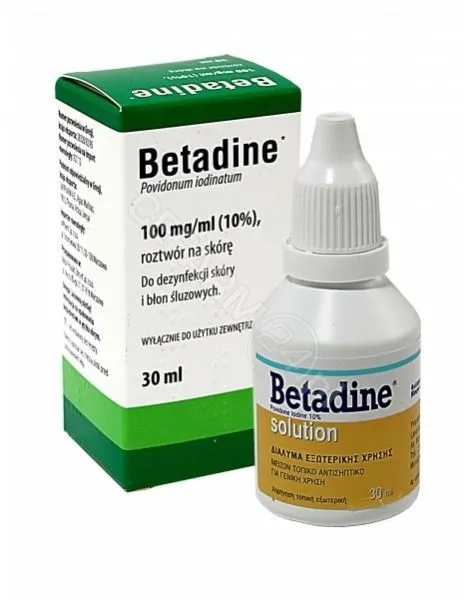
Table of Contents
- PACKAGE LEAFLET: INFORMATION FOR THE USER
- 1. What Betadine 100 mg/ml cutaneous solution is and what it is used for
- 2. Important information before using Betadine, 100 mg/ml, cutaneous solution
- 3. How to use Betadine, 100 mg/ml, cutaneous solution
- 4. Possible adverse reactions
- 5. How to store Betadine 100 mg/ml solution for skin application
- 6. Contents of the pack and other information
PACKAGE LEAFLET: INFORMATION FOR THE USER
Warning! Keep the leaflet. The information on the immediate packaging is in a foreign language!
Betadine
100 mg/ml, cutaneous solution
Povidone iodine
Please read this leaflet carefully before using the medicine, as it contains
important information for the patient.
This medicine should always be used exactly as described in this patient leaflet or as directed by
the physician or pharmacist.
- Keep this leaflet for future reference.
- If advice or further information is needed, consult a pharmacist.
- If the patient experiences any adverse reactions, including any adverse reactions not listed in this leaflet, inform the doctor, pharmacist, or nurse. See section 4.
- If there is no improvement or the patient feels worse, contact the doctor.
Leaflet contents:
- What Betadine 100 mg/ml cutaneous solution is and what it is used for
- Important information before using Betadine 100 mg/ml cutaneous solution
- How to use Betadine 100 mg/ml cutaneous solution
- Possible side effects
- How to store Betadine 100 mg/ml cutaneous solution
- Contents of the pack and other information
1. What Betadine 100 mg/ml cutaneous solution is and what it is used for
Betadine 100 mg/ml cutaneous solution is intended for external use only.
It acts against a wide range of microorganisms (bactericidal, fungicidal, and selectively virucidal).
The product is indicated for skin disinfection prior to injection, blood collection, needle biopsy, transfusion; for disinfection of skin and mucous membranes before surgical procedures; for aseptic wound care, treatment of bacterial and fungal infections, and for complete or partial patient disinfection prior to surgery.
If there is no improvement or the patient feels worse, contact the doctor.
2. Important information before using Betadine, 100 mg/ml, cutaneous solution
When not to use Betadine, 100 mg/ml, cutaneous solution
- if the patient is allergic to iodine or povidone, or to any of the other ingredients of this medicine (listed in section 6),
- if the patient has thyroid dysfunction (e.g. if the patient's thyroid gland is not functioning properly),
- if the patient has dermatitis herpetiformis (Duhring's disease),
- if the patient has renal insufficiency,
- before, during, or after radioactive iodine scintigraphy (a test involving administration of radioactive iodine) and before, during, or after radioactive iodine therapy for thyroid diseases (see section "Warnings and precautions"),
- with medicines containing mercury, as concomitant use may damage the skin.
Betadine must not be used in newborns and infants under 1 year of age, and its use is not recommended in children under 2 years of age.
Warnings and precautions
Before starting to use Betadine, 100 mg/ml, cutaneous solution, consult a doctor or pharmacist.
During surgical preparation, avoid pooling of the solution under the patient. Prolonged exposure to the medicine may cause irritation or, less frequently, severe skin reactions. Chemical skin burns may occur due to accumulation of the solution. If skin irritation, contact dermatitis, or hypersensitivity to the medicine occurs, discontinue use.
This medicine may temporarily stain the skin at the application site; this is due to the inherent colour of the medicine.
Do not heat the medicine before application.
The oxidising properties of the medicine may cause corrosion of metals, whereas plastics and synthetic materials are generally resistant to povidone-iodine. Reversible discolouration of certain textile materials, e.g. clothing, may occasionally occur.
The medicine can be easily removed from textiles and other materials using warm water and soap. For stubborn stains, use an ammonia solution or sodium thiosulfate solution.
Exposure to light and temperatures above 40°C accelerates the decomposition of the medicine. The medicine is effective within a pH range of 2.0–7.0.
Avoid contact with the eyes. If the medicine gets into the eyes, open the eyelids and rinse the eyes thoroughly with large amounts of running water for 10–15 minutes. The patient should be examined by an ophthalmologist.
Avoid contact with jewellery, especially silver-containing items.
Children and adolescents
Betadine, 100 mg/ml, cutaneous solution must not be used in newborns and infants under 1 year of age, and its use is not recommended in children under 2 years of age.
Betadine, 100 mg/ml, cutaneous solution and other medicines
Inform your doctor or pharmacist about all medicines currently or recently used, or those planned for future use.
- Concomitant use of povidone-iodine with enzymatic wound healing agents may reduce the efficacy of both medicines. Wound treatments containing hydrogen peroxide, silver, or taurolidine, as well as antiseptic agents, may interact with povidone-iodine, leading to mutual reduction in effectiveness. This medicine should not be used with reducing agents, alkalis, tannic acid, salicylic acid, silver salts, mercury salts, bismuth salts, taurolidine, or hydrogen peroxide.
- This medicine must not be used simultaneously with mercury-containing medicines due to the risk of forming a corrosive compound of iodine and mercury (see section "When not to use Betadine, 100 mg/ml, cutaneous solution").
- Use of this medicine before or after application of antiseptic agents containing octenidine may cause transient skin discolouration; therefore, it should not be used simultaneously with such agents.
- The povidone-iodine complex may react with proteins and other unsaturated organic compounds, leading to reduced efficacy.
- Chronic use of this medicine should be avoided, especially over large surface areas, in patients receiving lithium therapy.
During treatment with Betadine, various diagnostic tests may yield false positive laboratory results (e.g. toluidine and guaiac resin tests for faecal or urinary haemoglobin or glucose). Inform the doctor about Betadine use before undergoing laboratory tests.
Use of a medicine containing povidone-iodine may affect the results of certain thyroid function tests (e.g. thyroid scintigraphy, protein-bound iodine determination, radioactive iodine testing) or may prevent radioactive iodine therapy for thyroid disorders.
To obtain accurate test results, a 4-week interval should be maintained after discontinuation of Betadine treatment before performing a new thyroid scintigram (see section "When not to use Betadine, 100 mg/ml, cutaneous solution").
Pregnancy, breastfeeding and fertility
If the patient is pregnant, breastfeeding, suspects she may be pregnant, or is planning to have a child, she should consult a doctor before using this medicine.
During pregnancy and breastfeeding, the medicine should be used only when strictly indicated and prescribed by the attending physician. If possible, avoid use due to the ability of iodine in the medicine to cross the placenta and be excreted in breast milk. Because of the high sensitivity of the fetal and neonatal thyroid gland to iodine, povidone-iodine may cause thyroid dysfunction in the fetus or newborn.
Limited human fertility data are available for povidone-iodine. No fertility outcome data are available.
Driving and operating machinery
Betadine, 100 mg/ml, cutaneous solution has no effect on the ability to drive or operate machinery.
3. How to use Betadine, 100 mg/ml, cutaneous solution
This medicine should always be used exactly as described in this patient information leaflet or as directed by a physician or pharmacist. If in doubt, consult a physician or pharmacist.
Betadine 100 mg/ml cutaneous solution may be used either undiluted or as a 10% aqueous solution (dilution 1:10) or a 1% aqueous solution (dilution 1:100), depending on the site of application.
The diluted solution should be prepared immediately before use.
For skin disinfection prior to injection, blood sampling, needle biopsy, transfusion, or infusion, apply the medicine to healthy, intact skin for 1–2 minutes.
For aseptic wound care, disinfection of mucous membranes, and treatment of bacterial and fungal infections, a 10% (1:10) solution of the medicine should be used.
For preoperative patient bathing, a 1% (1:100) solution of the medicine should be used. It is best to evenly distribute the diluted solution over the entire body and leave it in place for at least 2 minutes, then rinse off with lukewarm water.
During preoperative preparation, pooling of the solution under the patient should be avoided. Prolonged exposure to the medicine may cause irritation or, less frequently, severe skin reactions. Chemical skin burns may occur as a result of fluid accumulation.
Use in children
Betadine 100 mg/ml cutaneous solution must not be used in children under 1 year of age and is not recommended for use in children under 2 years of age (see section "When not to use Betadine 100 mg/ml cutaneous solution").
Use of a higher than recommended dose of the medicine:
Betadine 100 mg/ml cutaneous solution is intended for external use only. When used as directed in this leaflet, there is no risk of overdose.
In case of accidental ingestion and observation of the following symptoms of acute poisoning, seek immediate medical attention from a physician or hospital emergency department:
- abdominal symptoms,
- circulatory failure,
- metabolic disturbances (including metabolic acidosis),
- kidney dysfunction (including anuria),
- rapid heartbeat (tachycardia),
- low blood pressure (hypotension),
- breathing difficulties (laryngeal edema leading to asphyxiation or pulmonary edema),
- seizures,
- fever,
- hyperthyroidism or hypothyroidism may also occur.
If you have any further questions about the use of this medicine, consult your physician, pharmacist, or nurse.
4. Possible adverse reactions
Like all medicines, this medicine can cause adverse reactions, although not everyone will experience them.
Rare (may affect up to 1 in 1,000 people):
- Hypersensitivity reactions.
Very rare (may affect up to 1 in 10,000 people):
- Anaphylactic reaction (a serious allergic reaction causing, among others, breathing difficulties, dizziness, and decreased blood pressure).
- Angioedema (a serious allergic reaction causing swelling of the face or throat).
The following adverse reactions have also been reported:
Rare (may affect up to 1 in 1,000 people):
- Skin inflammation (so-called contact dermatitis) with symptoms such as redness, small blisters, and itching.
Very rare (may affect up to 1 in 10,000 people):
- Hyperthyroidism (may manifest as increased appetite, weight loss, sweating, faster heartbeat, or motor restlessness in patients with thyroid disease).
Adverse reactions with unknown frequency (frequency cannot be estimated from the available data):
- Hypothyroidism (may manifest, for example, as fatigue, weight gain, slower heartbeat),
- Kidney function disorders,
- Chemical skin burn (may occur due to accumulation of the medicine under the patient during surgical preparation),
- Electrolyte disturbances (disturbances in water-electrolyte balance),
- Metabolic acidosis (decrease in blood pH due to accumulation of acids in the body),
- Acute kidney failure,
- Abnormal blood osmolality (amount of osmotically active substances in the blood),
- Skin discoloration at the application site.
Reporting of adverse reactions
If any adverse reactions occur, including those not listed in this leaflet, inform your doctor, pharmacist, or nurse.
Adverse reactions can be reported directly to the Department of Monitoring Adverse Drug Reactions at the Office for Registration of Medicinal Products, Medical Devices and Biocidal Products
Al. Jerozolimskie 181C, 02-222 Warsaw
Tel.: + 48 22 49 21 301
Fax: + 48 22 49 21 309
Website: https://smz.ezdrowie.gov.pl
Reporting adverse reactions helps to provide more information on the safety of the medicine.
5. How to store Betadine 100 mg/ml solution for skin application
Do not store above 25°C.
After first opening, the product remains stable for 3 months when stored at 5°C - 15°C.
Do not use this medicinal product after the expiry date stated on the container. The expiry date refers to the last day of the stated month.
Keep out of sight and reach of children.
Medicines should not be disposed of via wastewater or household waste. Ask your pharmacist how to dispose of medicines no longer required. Such measures help protect the environment.
6. Contents of the pack and other information
1 ml of solution contains 100 mg of povidone-iodine and excipients: glycerol,
nonoxynol-9, sodium phosphate, citric acid, sodium hydroxide, potassium iodate, purified water.
What Betadine 100 mg/ml, solution for skin, looks like and contents of the pack
The medicine is a solution of iodine colour.
Plastic bottle in a cardboard box.
For further information, please contact the responsible party or parallel importer.
Responsible party in Greece, country of export:
Lavipharm S.A.
Agias Marinas
190 02 Peania, Attica
Greece
Manufacturer:
Lavipharm S.A.
Agias Marinas
190 02 Peania, Attica
Greece
Parallel importer:
Medezin Sp. z o.o.
Zbąszyńska 3
91-342 Łódź
Poland
Repackaged in:
Medezin Sp. z o.o.
Zbąszyńska 3
91-342 Łódź
Poland
Marketing authorization number in Greece, country of export: 44734/07/6-5-2008
Parallel import authorization number: 292/20