Berodual
Poland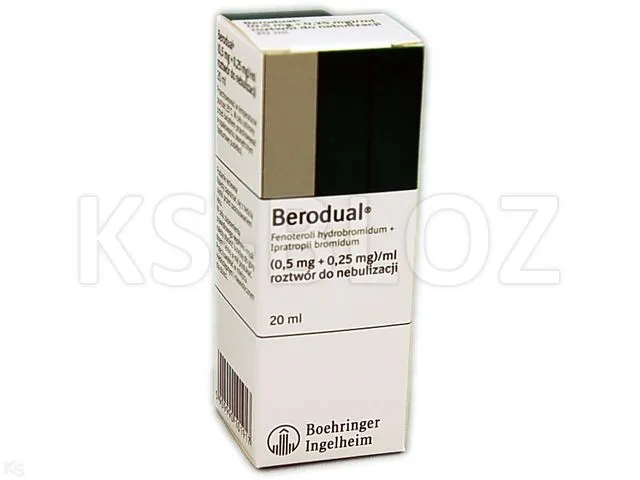
Table of Contents
- Package leaflet: Information for the user
- 1. What Berodual is and what it is used for
- 2. Important Information Before Using Berodual
- 3. How to use Berodual
- 4. Possible adverse reactions
- 5. How to store Berodual
- 6. Contents of the pack and other information
- Information intended exclusively for healthcare professionals:
Package leaflet: Information for the user
Berodual, (0.5 mg + 0.25 mg)/ml, solution for nebulization
Fenoteroli hydrobromidum + Ipratropii bromidum
Please read all of this leaflet carefully before using this medicine, because it contains
important information for the patient.
- Keep this leaflet, as you may need to read it again.
- If you have any further questions, please consult your doctor or pharmacist.
- This medicine has been prescribed for a specific individual. Do not pass it on to others. This medicine may harm others, even if their symptoms appear identical.
- If the patient experiences any adverse reactions, including any not listed in this leaflet, they should inform their doctor or pharmacist. See section 4.
Leaflet contents:
- What Berodual is and what it is used for
- Important information before using Berodual
- How to use Berodual
- Possible side effects
- How to store Berodual
- Contents of the pack and other information
1. What Berodual is and what it is used for
Berodual contains two active substances: fenoterol, which belongs to a group of substances known as "selective beta-2 adrenergic receptor agonists", and ipratropium bromide, which belongs to a group of substances known as "anticholinergic agents". The different mechanisms of action of these two substances in dilating the airways make them effective in the treatment of asthma and other inflammatory conditions associated with reversible airway obstruction. Berodual acts rapidly after administration and is therefore used in the treatment of acute asthma attacks.
Berodual is indicated as a bronchodilator for prophylactic (preventive) use and for bronchodilator treatment of symptoms in chronic obstructive respiratory diseases with reversible bronchospasm: bronchial asthma and particularly chronic bronchitis. If the patient has bronchial asthma or chronic obstructive pulmonary disease (COPD), the doctor may prescribe an additional anti-inflammatory medication in accordance with current treatment guidelines for these conditions.
2. Important Information Before Using Berodual
When not to use Berodual:
- if the patient is allergic to fenoterol hydrobromide, ipratropium bromide, substances similar to atropine, or any of the other ingredients of this medicine (listed in section 6).
- if the patient has tachyarrhythmia (a heart rhythm disorder with increased heart rate).
- if the patient has a heart condition known as obstructive hypertrophic cardiomyopathy.
Warnings and precautions
Before starting treatment with Berodual, discuss with your doctor or pharmacist:
- in case of sudden narrowing of the airways after inhalation: treatment with Berodual must be stopped immediately and medical advice sought to consider alternative treatments.
- if the patient experiences acute, rapidly worsening breathlessness, they should contact a doctor immediately.
- if the patient has narrow-angle glaucoma (increased pressure within the eye): eyes must be protected during inhalation.
- if the patient experiences visual disturbances such as eye pain or discomfort, blurred vision, seeing halos (colored rings) around lights, or colored vision accompanied by red eyes, they should consult an ophthalmologist immediately, as these symptoms may indicate complications (dilated pupils, increased intraocular pressure, narrow-angle glaucoma).
- if the patient has recently had a myocardial infarction (heart attack).
- if the patient has diabetes.
- if the patient has heart or blood vessel disorders.
- if the patient has severe heart disease: immediate medical consultation is required in case of chest pain or other signs of worsening heart condition.
- if the patient develops symptoms such as difficulty breathing or chest pain: prompt medical evaluation is necessary, as these may indicate diseases of either the respiratory or cardiovascular system.
- if the patient has a pheochromocytoma (a type of adrenal gland tumor).
- if the patient has hyperthyroidism (overactive thyroid gland).
- if the patient has a history of urinary retention or if this condition is suspected.
- if the patient experiences loss of appetite, constipation, fluid retention or leg swelling, irregular pulse, or muscle weakness: these may be signs of low potassium levels. Special precautions may be required (e.g. blood tests).
- if the patient has cystic fibrosis: gastrointestinal motility disorders may occur.
- if breathing difficulties persist or worsen: medical advice should be sought to reassess current treatment. Additional medications may be needed. Never increase the prescribed dose, as this may lead to serious adverse effects.
- if the patient is using other medicines belonging to the group of "selective beta-2 adrenergic receptor agonists": these should be used only under strict medical supervision (see section "Berodual with other medicines").
Immediate hypersensitivity reactions may occur after using Berodual, such as:
rare cases of urticaria, angioedema (sudden swelling of the skin, mucous membranes of the mouth and throat, potentially impairing breathing), rash, bronchospasm, swelling of lips and throat, and rapidly progressing, life-threatening allergic reactions. In case of such symptoms, immediate medical attention or hospitalization is required.
Extreme care should be taken during nebulization of Berodual to prevent the medicine from entering the eye. Use of a mouthpiece is recommended. If this is not possible, a tightly fitting face mask for nebulization should be used.
If long-term use of Berodual is necessary for asthma treatment, the doctor will recommend using Berodual only for acute symptoms, not on a regular basis. If long-term treatment with Berodual is required for mild forms of other conditions with reversible airway obstruction, the doctor may recommend using Berodual only for acute episodes and intermittently. The doctor may also decide to prescribe additional medication or higher doses of anti-inflammatory drugs.
Use of Berodual may result in positive test results for fenoterol in doping tests for non-medical use of substances aimed at enhancing athletic performance.
Berodual with other medicines
Inform your doctor about all medicines currently or recently taken, as well as any medicines planned for future use.
Other bronchodilators may enhance the effect of Berodual. Concurrent use of other beta-2 adrenergic agonists, oral anticholinergic drugs, or xanthine derivatives (theophylline) may also increase the risk of adverse effects. Since long-term concurrent use of other anticholinergic drugs with Berodual has not been studied, consult your doctor for advice.
Certain medicines used to treat high blood pressure (called "beta-blockers") may reduce the effect of Berodual.
Using beta-2 adrenergic agonists such as those contained in Berodual together with theophylline, corticosteroids, or diuretics (medicines that increase urine excretion) may lead to decreased potassium levels, especially in severe asthma. Low potassium levels increase susceptibility to irregular heartbeat, particularly if the patient is taking digoxin or has low blood oxygen levels. In such cases, the doctor may decide to take special precautions (e.g. blood tests).
It is important that the doctor knows if the patient is taking antidepressants (monoamine oxidase inhibitors or tricyclic antidepressants). In such cases, caution is required when using beta-2 adrenergic receptor agonists, as their effects may be intensified.
Inhalation of halogenated anesthetic agents such as halothane, trichloroethylene, and enflurane may enhance the cardiovascular effects of beta-2 adrenergic agonists (e.g. may cause irregular heartbeat).
Pregnancy and breastfeeding
If the patient is pregnant or breastfeeding, suspects she may be pregnant, or is planning to become pregnant, she should consult her doctor or pharmacist before using this medicine.
Although non-clinical studies on fenoterol hydrobromide and ipratropium bromide and available human data have not shown risk to the unborn child, Berodual should be used only if clearly recommended by a doctor. This is particularly important during the first trimester and immediately before delivery (Berodual has an inhibitory effect on uterine contractions).
Non-clinical studies have shown that fenoterol hydrobromide passes into human milk. It is unknown whether ipratropium bromide passes into human milk. Therefore, Berodual should be used during pregnancy and breastfeeding only if clearly recommended by a doctor.
Driving and operating machinery
No studies have been conducted on the effect of Berodual on the ability to drive or operate machinery.
During treatment with Berodual, adverse effects such as dizziness, muscle tremor, accommodation disorders (blurred vision), pupil dilation, and blurred vision may occur. Therefore, caution should be exercised when driving a car or operating machinery. If any of the above adverse effects occur, potentially hazardous activities such as driving vehicles or operating machinery should be avoided.
Berodual contains benzalkonium chloride
This medicine contains 0.1 mg of benzalkonium chloride per ml. Benzalkonium chloride may cause wheezing (whistling breath) or respiratory disturbances (bronchospasm), especially in patients with asthma.
3. How to use Berodual
This medicine should always be used exactly as directed by your doctor. If in doubt, consult your doctor or pharmacist.
During initiation of treatment and throughout the course of treatment, patients should remain under medical supervision, for example in a hospital setting. However, your doctor may decide, under certain circumstances, that treatment at home is appropriate.
Dosage adjustment depends on the decision of the doctor, who will tailor it to the individual needs of the patient. Treatment should always begin with the lowest recommended dose. Administration should be discontinued once sufficient symptom relief has been achieved. The following dosing is recommended:
Adults (including elderly patients) and adolescents over 12 years of age:
Treatment of acute asthma attacks:
Depending on the severity of the acute attack, the doctor will determine the appropriate dose, which may range from 1 ml (20 drops) to 2.5 ml (50 drops). In particularly severe cases, e.g. under medical supervision in a hospital emergency department, doses up to 4 ml (80 drops) may be used.
Children aged 6 to 12 years:
Treatment of acute asthma attacks:
Depending on the severity of the acute attack, the doctor will determine the appropriate dose, which may range from 0.5 ml (10 drops) to 2 ml (40 drops).
Children under 6 years of age (with body weight less than 22 kg):
Berodual should be administered only under medical supervision. The doctor will adjust the dose according to the child's body weight: 0.1 ml (2 drops) per kg of body weight, up to a maximum of 0.5 ml (10 drops).
Method of administration
The Berodual nebuliser solution should be used according to the following principles:
The nebuliser solution should be administered by inhalation using nebulisers. Do not take orally.
The medicine may be delivered using various nebulisers available on the market. Patients should follow the instructions provided by the manufacturer of the specific nebuliser regarding its proper use, storage, and maintenance in a clean condition.
If an oxygen wall supply is available, a flow rate of 6–8 litres per minute should be used.
The dose delivered to the lungs and the amount of medicine absorbed into the bloodstream may depend on the type of nebuliser used, and due to device efficiency, it may be higher than with Berodual N inhalation aerosol, solution. Inhalation time may be adjusted by the volume of the solution.
The recommended dose should be diluted with 0.9% sodium chloride solution to a final volume of 3 to 4 ml and inhaled until sufficient symptom relief is achieved. The solution should not be diluted with distilled water. The nebuliser solution should be diluted immediately before each use, and any remaining diluted solution that has not been used must be discarded. A fresh diluted solution should be prepared each time before use.
The diluted solution should be used immediately after preparation.
If you feel that the effect of the medicine is too strong or too weak, consult your doctor.
Use of a higher than recommended dose of Berodual
If a higher than recommended dose of Berodual is used, consult your doctor or pharmacist.
Symptoms of overdose are mainly related to the effects of fenoterol bromide and include: tachycardia (increased heart rate), palpitations, tremor, increased or decreased blood pressure, widening of the difference between systolic and diastolic blood pressure, angina (chest pain), cardiac arrhythmias, facial flushing.
Metabolic acidosis (disturbance of acid-base balance in the body) and hypokalaemia (decreased potassium levels in the blood) have also been observed during fenoterol use at doses higher than those recommended for approved indications of Berodual.
Potential symptoms of ipratropium bromide overdose (such as dryness of the oral mucosa, accommodation disturbances) are mild.
Missed dose of Berodual
If Berodual has been prescribed for regular use and a dose is missed, it should be taken as soon as possible. However, do not take a double dose to make up for a missed dose. The next dose should be taken at the usual time. If the patient has asthma, Berodual should be used only during acute attacks.
Stopping Berodual
If you stop using Berodual, breathing problems may recur or even worsen. Therefore, continue using Berodual for as long as your doctor recommends. Always consult your doctor before stopping treatment with Berodual.
If you have any further questions about the use of this medicine, consult your doctor or pharmacist.
4. Possible adverse reactions
Like all medicines, this medicine can cause adverse reactions, although not everybody will experience them.
After administration of Berodual, immediate hypersensitivity reactions may occur, such as:
rare cases of urticaria, angioedema (sudden swelling of the throat, skin and mucous membranes
of the oral cavity and pharynx which may impair breathing), rash, bronchoconstriction, swelling
of the lips and throat, and rapidly progressing, life-threatening allergic reactions. If any of these
symptoms occur, seek immediate medical attention from a doctor or go to hospital.
As with other inhaled medicines, Berodual may cause local irritation. The most commonly reported
adverse reactions during clinical trials were cough, dry mouth, headache, skeletal muscle tremor,
pharyngitis (inflammation of the throat), nausea, dizziness, dysphonia (voice disturbances),
tachycardia (increased heart rate), palpitations, vomiting, increased systolic blood pressure, and nervousness.
Common (may occur in fewer than 1 in 10 people)
- cough
Uncommon (may occur in fewer than 1 in 100 people)
- fast heartbeat
- increased heart rate
- palpitations
- increased systolic blood pressure
- muscle tremor
- nervousness
- headache
- dizziness
- local irritation such as upper respiratory tract inflammation
- voice disturbances
- dry mouth
- nausea
- vomiting
Rare (may occur in fewer than 1 in 1,000 people)
- life-threatening allergic (anaphylactic) reactions
- hypersensitivity (allergy-type reactions)
- decreased potassium levels
- irregular heartbeat
- atrial fibrillation (very rapid, irregular heart rhythm)
- supraventricular tachycardia (abnormal rapid heart rhythm)
- inadequate blood supply to the heart muscle
- decreased diastolic blood pressure
- excitation
- psychiatric disturbances
- increased intraocular pressure (glaucoma)
- increased intraocular pressure
- accommodation disorder
- dilated pupils
- blurred vision
- eye pain
- redness of the white part of the eye
- swelling of the outer protective layer of the eye
- halos around lights (visual halos)
- sore throat
- bronchoconstriction
- throat swelling (swelling of the upper part of the throat)
- sudden laryngospasm (may affect breathing and speech)
- inhaled-induced (paradoxical) bronchoconstriction
- dry throat
- inflammation of the oral mucosa
- glossitis (inflammation of the tongue)
- diarrhoea related to gastrointestinal motility disorder
- constipation
- oral cavity swelling
- skin rash
- urticaria
- pruritus (itching)
- angioedema (rapidly progressive swelling of the skin or mucous membranes which may cause breathing difficulties)
- excessive sweating
- muscle pain
- muscle cramps
- muscle weakness
- urinary retention
Reporting of adverse reactions
If any adverse reactions occur, including any adverse reactions not listed in this leaflet, inform your
doctor, pharmacist, or nurse. Adverse reactions can be reported directly to the Department of Monitoring Adverse Drug Reactions of the Office for Registration of Medicinal Products, Medical Devices
and Biocidal Products: Al. Jerozolimskie 181C, 02-222 Warsaw, tel.: 22 49-21-301,
fax: 22 49-21-309, website: https://smz.ezdrowie.gov.pl .
Adverse reactions can also be reported to the marketing authorization holder. Reporting adverse
reactions helps provide more information on the safety of the medicine.
5. How to store Berodual
Keep the medicine out of sight and reach of children.
Store below 25°C. Keep in the original packaging (carton box) to protect from light.
Do not use this medicine after the expiry date stated on the packaging after: EXP.
The expiry date refers to the last day of the stated month.
Period of validity after first opening of the bottle: 1 year.
Medicines must not be disposed of via wastewater or household waste. Ask your pharmacist how to dispose of medicines no longer required. These measures will help protect the environment.
6. Contents of the pack and other information
What Berodual contains
- The active substances are: fenoterol hydrobromide and ipratropium bromide. 1 ml (20 drops) of nebuliser solution contains 0.5 mg of fenoterol hydrobromide and 0.25 mg of ipratropium bromide.
- Other components are: benzalkonium chloride, disodium edetate dihydrate, sodium chloride, hydrochloric acid 1N, purified water.
What Berodual looks like and contents of the pack
Pack: an amber glass bottle of type III, placed in a cardboard box.
The bottle is equipped with a dropper and closed with a plastic screw cap.
Pack size: 20 ml.
Marketing Authorisation Holder
Boehringer Ingelheim International GmbH
Binger Strasse 173
D-55216 Ingelheim/Rhein
Germany
Manufacturer
ISTITUTO DE ANGELI S.R.L
Localita Prulli,
103/C-50066 Reggello (FI)
Italy
For further information about this medicinal product, please contact the local representative of the Marketing Authorisation Holder:
Poland
Boehringer Ingelheim Sp. z o.o.
Tel.: +48 22 699 0 699
Information intended exclusively for healthcare professionals:
Overdose
Symptoms
Symptoms of overdose are primarily related to fenoterol's effects. Potential symptoms due to excessive beta-adrenergic stimulation include in particular: tachycardia, palpitations, muscle tremor, increased or decreased arterial blood pressure, widened pulse pressure, angina pectoris, cardiac arrhythmias, facial flushing. Metabolic acidosis and hypokalemia have also been observed during fenoterol administration at doses higher than those recommended for the approved indications of Berodual.
Potential symptoms of overdose with ipratropium bromide (such as dryness of oral mucous membranes, accommodation disturbances) are mild, due to the very low systemic bioavailability of inhaled ipratropium.
Treatment
Treatment with Berodual should be discontinued. Monitoring of acid-base and electrolyte balance should be considered.
Administration of sedatives may be indicated; in severe cases, intensive therapy may be required.
Beta-adrenergic receptor blocking agents, preferably beta-selective blockers, may be used as specific antidotes. However, one must remember about the possible reduction in bronchial patency and particularly careful dose adjustment in patients with bronchial asthma or chronic obstructive pulmonary disease due to the risk of sudden severe bronchospasm, which may be fatal.