Baladex
Poland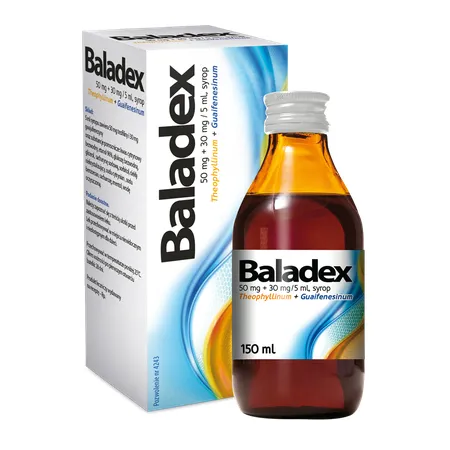
Table of Contents
Patient Information Leaflet
Baladex, (50 mg + 30 mg)/5 mL, syrup
Theophyllinum + Guaifenesinum
Please read this leaflet carefully before taking this medicine, as it contains important information for you.
- Keep this leaflet, so that you can read it again if necessary.
- If you have any questions, please consult your doctor or pharmacist.
- This medicine has been prescribed for a specific individual. Do not pass it on to others. This medicine may harm other people, even if their symptoms are the same.
- If you experience any adverse reactions, including any not listed in this leaflet, inform your doctor or pharmacist. See section 4.
Table of Contents
- What Baladex is and what it is used for
- Important information before taking Baladex
- How to take Baladex
- Possible side effects
- How to store Baladex
- Contents of the pack and other information
1. What Baladex is and what it is used for
Baladex is a syrup containing two active substances: theophylline and guaifenesin.
Theophylline acts as a bronchodilator by relaxing the smooth muscles of the bronchi, while guaifenesin has expectorant properties.
Indications
Treatment and prevention of dyspnoea (shortness of breath) occurring in:
- bronchial asthma, bronchitis;
- and chronic obstructive pulmonary disease (chronic bronchitis, pulmonary emphysema).
2. Important information before taking Baladex
When not to take Baladex
- if the patient is allergic to theophylline or guaifenesin, or to any of the other ingredients of this medicine (listed in section 6);
- if the patient has peptic ulcer disease of the stomach and/or duodenum;
- if the patient has suffered a heart attack or has cardiac arrhythmias;
- if the patient has epilepsy or hyperthyroidism;
- if the patient has impaired kidney function;
- in children under 6 years of age.
Warnings and precautions
Before starting treatment with Baladex, discuss with your doctor:
- if the patient has cardiovascular diseases or hypertension;
- if the patient has respiratory disorders;
- if the patient has liver diseases;
- if the patient has alcoholic liver disease;
- if the patient has fever persisting for more than 3 days;
- if the patient is obese;
- if the patient is over 55 years old.
The medicine contains theophylline and guaifenesin
Due to the risk of overdose, check before use whether other medicines being taken contain theophylline or guaifenesin.
Children
This medicine should not be given to children under 6 years of age.
Baladex and other medicines
Tell your doctor or pharmacist about all medicines currently taken or recently taken, as well as any medicines the patient plans to take.
If the patient is taking any of the following medicines, they should inform their doctor:
- cimetidine (a medicine used in the treatment of peptic ulcer disease of the stomach and duodenum);
- macrolide antibiotics;
- clindamycin, lincomycin (antibiotics belonging to the lincosamide group);
- isoniazid (an antituberculosis medicine);
- quinolone derivatives (antibacterial antibiotics, e.g. pefloxacin);
- oral contraceptives;
- mexiletine (an antiarrhythmic medicine);
- allopurinol (a medicine used in the treatment of gout);
- furosemide (a diuretic);
- oral anticoagulants;
- halothane (used in inhalational anaesthesia);
- sympathomimetics (e.g. ephedrine);
- cardiac glycosides (used in the treatment of heart diseases);
- reserpine (used in the treatment of hypertension);
- ketamine (used in anaesthesia);
- nicotine;
- barbiturates (medicines used in the treatment of insomnia and epilepsy);
- rifampicin (an antibiotic used in the treatment of tuberculosis);
- phenytoin (a medicine used in the treatment of epilepsy).
Theophylline reduces the effect of lithium salts, propranolol, and non-depolarizing muscle relaxants; it intensifies hypoglycaemia occurring during treatment with glucocorticosteroids, β-adrenomimetics (salbutamol, fenoterol), and diuretics.
Medicines protecting the gastric mucosa reduce the effect of guaifenesin. If the patient is unsure whether they are taking any of the above-mentioned medicines, they should contact their doctor or pharmacist.
Pregnancy and breastfeeding
If the patient is pregnant or breastfeeding, suspects she may be pregnant, or is planning to have a child, she should consult her doctor or pharmacist before using this medicine.
Pregnancy
Baladex may be used during pregnancy only if the benefits to the mother outweigh the potential risks to the fetus.
Breastfeeding
Baladex may be used during breastfeeding only if the benefits to the mother outweigh the potential risks to the infant. Theophylline passes into breast milk and may cause adverse effects in breastfed infants.
Driving and operating machinery
Do not drive or operate machinery after taking this medicine.
Baladex contains ethanol, glucose, sucrose, sodium benzoate, liquid non-crystallizing sorbitol, and sodium
Ethanol
This medicine contains 618.8 mg of alcohol (ethanol) in each 5 mL of syrup, equivalent to 12.38% (w/v). The amount of alcohol in 5 mL of this medicine is equivalent to 16 mL of beer or 7 mL of wine.
The alcohol in this medicine may affect children. Symptoms may include drowsiness and changes in behaviour. It may also affect their ability to concentrate and physical activity.
The amount of alcohol in this medicine may affect the ability to drive and operate machinery, as it may impair judgment and reaction speed.
If the patient has liver problems, they should consult their doctor or pharmacist before using this medicine.
The amount of alcohol in this medicine may alter the effect of other medicines. If the patient is taking other medicines, they should consult their doctor or pharmacist.
If the patient is pregnant or breastfeeding, they should consult their doctor or pharmacist before using this medicine.
If the patient is alcohol-dependent, they should consult their doctor or pharmacist before using this medicine.
Glucose
The medicine contains 260 mg of glucose in each 5 mL of syrup. If the patient has previously been diagnosed with intolerance to certain sugars, they should contact their doctor before taking this medicine.
Sucrose
The medicine contains 2.5 g of sucrose in each 5 mL of syrup. This should be taken into account in patients with diabetes. If the patient has previously been diagnosed with intolerance to certain sugars, they should contact their doctor before taking this medicine.
Sodium benzoate
The medicine contains 10 mg of sodium benzoate in each 5 mL of syrup.
Liquid non-crystallizing sorbitol
The medicine contains 250 mg of liquid non-crystallizing sorbitol, equivalent to 165.6 mg of pure sorbitol in each 5 mL of syrup, corresponding to 0.01 ww.
Sorbitol is a source of fructose. If the patient (or child) has previously been diagnosed with intolerance to certain sugars or hereditary fructose intolerance, a rare genetic disorder in which the body cannot break down fructose, the patient should contact their doctor before taking this medicine or giving it to a child.
Sodium
The medicine contains 11.38 mg of sodium (main component of table salt) in each 5 mL of syrup. This corresponds to 0.57% of the maximum recommended daily dietary sodium intake for adults.
3. How to take Baladex
This medicine should always be taken according to the doctor's instructions. In case of doubt, consult
your doctor or pharmacist.
This is an oral medicine.
The dosage is determined individually by the doctor, depending on the patient's response to treatment.
The measuring device provided with the packaging must be used for dosing. This ensures accurate
measurement of the dose.
Recommended dose
Adults and children over 6 years of age weighing more than 40 kg: 5 to 10 mL (50 to 100 mg
theophylline) 2 to 3 times daily.
Children over 6 years of age weighing less than 40 kg: 11 to 16.5 mg/kg body weight of theophylline
per day, divided into 2 or 3 doses.
Use in children
Do not use in children under 6 years of age.
Taking more Baladex than recommended
If you take more medicine than recommended, contact your doctor. After overdose, the following
symptoms may occur: seizures, severe cardiac arrhythmias with cardiac arrest.
Missing a dose of Baladex
Continue taking the medicine as prescribed, without increasing the next dose.
Do not take a double dose to make up for a missed dose.
If you have any further questions about the use of this medicine, consult your doctor or pharmacist.
4. Possible adverse effects
Like all medicines, this medicine can cause adverse effects, although they do not occur in everyone.
The following adverse effects may occur:
- nausea, vomiting, diarrhoea;
- headache, anxiety, restlessness, clonic-tonic seizures, especially in cases of significant overdose;
- hypotonia (arterial hypotension – significant decrease in blood pressure);
- circulatory failure;
- cardiac arrhythmias, tachycardia (rapid heartbeat);
- rash;
- hypokalaemia (reduced potassium serum levels);
- hyperglycaemia (increased blood glucose levels).
Reporting of adverse effects
If any adverse effects occur, including any adverse effects not listed
in this leaflet, inform your doctor or pharmacist.
Adverse effects can be reported directly to the Department of Monitoring Adverse Drug Reactions of the Office for Registration of Medicinal Products, Medical Devices and Biocidal Products
Al. Jerozolimskie 181C, 02-222 Warsaw
Tel.: + 48 22 49 21 301
Fax: + 48 22 49 21 309
Website: https://smz.ezdrowie.gov.pl
Adverse effects can also be reported to the responsible entity.
Reporting adverse effects enables the collection of further information on the safety of using the medicine.
5. How to store Baladex medication
Keep the medicine out of the sight and reach of children.
Store below 25°C.
The shelf life after first opening the bottle – 28 days.
Do not use this medicine after the expiry date stated on the label and on the carton.
The expiry date refers to the last day of the stated month.
Medicines must not be disposed of via wastewater or household waste. Ask your pharmacist
how to dispose of medicines no longer in use. This will help protect the environment.
6. Contents of the packaging and other information
What Baladex contains
- The active substances in the medicine are theophylline and guaifenesin. 5 mL of syrup contains 50 mg of theophylline and 30 mg of guaifenesin.
- Other ingredients are: citric acid, ethanol 96%, glucose, glycerol, sodium saccharin, liquid non-crystallizing sorbitol, sodium citrate, sodium benzoate, sucrose, levomenthol, purified water.
What Baladex looks like and contents of the pack
The medicine is a syrup.
The packaging consists of: an amber glass bottle containing 150 mL of syrup, closed with a white aluminium cap and including a measuring cup, placed in a cardboard box.
Marketing Authorisation Holder
Aflofarm Farmacja Polska Sp. z o.o.
ul. Partyzancka 133/151
95-200 Pabianice
Tel. (42) 22-53-100
Manufacturer
Aflofarm Farmacja Polska Sp. z o.o.
ul. Krzywa 2
95-030 Rzgów