Bactroban
Poland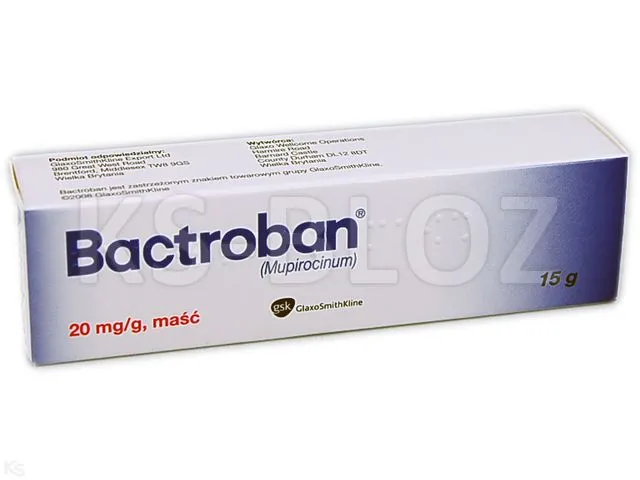
Table of Contents
Package leaflet: Information for the user
Warning! Keep this leaflet! Information on the immediate packaging in a foreign language
Bactroban, 20 mg/g, nasal ointment
Mupirocin
Please read the entire leaflet carefully before using the medicine, as it contains
important information for the patient.
- Keep this leaflet, as you may need to read it again.
- If you have any further questions, please consult your doctor, pharmacist, or nurse.
- This medicine has been prescribed for a specific individual. Do not pass it on to others. The medicine may harm someone else, even if their symptoms are the same.
- If you experience any adverse reactions, including any not listed in this leaflet, inform your doctor, pharmacist, or nurse. See section 4.
Table of contents
- What Bactroban is and what it is used for
- Important information before using Bactroban
- How to use Bactroban
- Possible side effects
- How to store Bactroban
- Contents of the pack and other information
1. What Bactroban is and what it is used for
Bactroban ointment (referred to as Bactroban in this leaflet) contains an antibiotic called mupirocin in the form of mupirocin calcium.
It is used:
- to eliminate from the nose bacteria belonging to a group called staphylococci. This group includes MRSA (methicillin-resistant Staphylococcus aureus strains).
This ointment is intended for nasal use only.
2. Important information before using Bactroban
When not to use Bactroban
Do not use Bactroban if the patient is allergic to mupirocin or to any of the other ingredients of this medicine (listed in section 6).
If in doubt about using the medicine, consult your doctor or pharmacist.
Warnings and precautions
- do not use in newborns and infants.
- do not apply Bactroban ointment to the eyes or near the eyes. Avoid contact with the eyes. If the ointment gets into the eye, rinse thoroughly with water until all traces of the ointment are removed.
- do not apply Bactroban to the mouth or swallow it.
Bactroban and other medicines
Tell your doctor or pharmacist about all medicines you are currently taking or have recently taken, including those obtained without a prescription, herbal medicines, and any medicines you plan to take.
Pregnancy and breastfeeding
If the patient is pregnant or breastfeeding, suspects she may be pregnant, or is planning to have a child, she should consult her doctor or pharmacist before using this medicine.
3. How to use Bactroban
This medicine should always be used as directed by a doctor or pharmacist. If in doubt,
consult a doctor or pharmacist.
How to use the medicine
Apply Bactroban into the nose twice daily.
- Wash and dry your hands.
- Squeeze a small amount of ointment, about the size of a match head, onto the fingertip.
- Apply it inside one nostril.
- Repeat steps 2 and 3 for the other nostril.
- Press the sides of the nose together gently to spread the ointment evenly inside the nostrils.
- Replace the cap on the tube and wash your hands.
Small children and elderly patients
Instead of using the fingertip, cosmetic swabs may be used to apply Bactroban into the nose.
Special precautions should be taken in these patients. Bactroban should not be used in newborns and infants.
How long to use Bactroban
Use Bactroban for as long as directed by your doctor. If in doubt, contact your doctor or pharmacist.
Usually, bacteria in the nose are eliminated within 3–5 days after starting treatment.
Do not use Bactroban for longer than 10 days.
Accidental overdose of Bactroban
If more Bactroban has been used than recommended, contact your doctor or pharmacist.
Carefully remove any excess ointment.
If Bactroban has been swallowed, contact your doctor immediately and inform them what and how much has been ingested.
Missed dose of Bactroban
If a dose is missed, apply it as soon as remembered. However, if the next dose is due within one hour, skip the missed dose.
Do not use a double dose to make up for a missed dose.
Stopping Bactroban treatment prematurely
If Bactroban treatment is stopped too early, not all bacteria may be killed and they may continue to multiply.
Ask your doctor or pharmacist when to stop using the ointment.
If in doubt about the use of this medicine, consult your doctor or pharmacist.
4. Possible adverse reactions
Like all medicines, this medicine can cause adverse reactions, although not everyone experiences them.
Below are the adverse reactions that may occur with this medicine.
Uncommon (may occur in 1 in 100 to 1 in 1000 patients):
- itching, redness, burning, tingling or stinging in the nose,
- nasal congestion (catarrh).
Very rare (may occur in fewer than 1 in 10,000 patients):
- skin hypersensitivity reactions (rash, itching, redness, pain),
- systemic allergic reactions, such as:
- generalized rash, urticaria,
- angioedema (swelling, sometimes affecting the face and lips, which may lead to breathing difficulties),
- fainting or loss of consciousness. If any of these symptoms occur, stop using the medicine immediately and contact a doctor immediately.
If skin irritation or hypersensitivity occurs:
- remove the ointment from the skin,
- discontinue use of the medicine,
- inform the treating physician as quickly as possible.
In rare cases, medicines such as Bactroban nasal ointment may cause inflammation of the colon (large intestine) – characterized by the onset of diarrhoea, usually bloody and containing mucus, abdominal pain, and fever (pseudomembranous colitis).
If any of the above symptoms occur, contact a doctor as soon as possible.
Reporting of adverse reactions
If any adverse reactions occur, including any adverse reactions not listed in this leaflet, inform a doctor, pharmacist, or nurse. Adverse reactions can be reported directly to the Department of Monitoring Adverse Drug Reactions of the Office for Registration of Medicinal Products, Medical Devices and Biocidal Products, Al. Jerozolimskie 181C, 02-222 Warsaw, phone: +48 22 49 21 301, fax: +48 22 49 21 309, website: https://smz.ezdrowie.gov.pl.
Reporting adverse reactions helps to provide more information on the safety of this medicine.
5. How to store Bactroban
Keep this medicine out of sight and reach of children.
Store below 25°C.
Do not use this medicine after the expiry date stated on the container. The expiry date refers to the last day of the stated month.
Do not use Bactroban if it looks different from normal (see description in section 6).
Medicines should not be disposed of via wastewater or household waste. Ask your pharmacist how to dispose of medicines no longer required. These measures will help protect the environment.
6. Contents of the pack and other information
What Bactroban contains
- The active substance is mupirocin as mupirocin calcium. Each gram of nasal ointment contains 20 mg of mupirocin.
- Other ingredients: white soft paraffin, Softisan 649.
What Bactroban looks like and contents of the pack
Bactroban is a white, homogeneous ointment.
The medicine is supplied in an aluminium tube with a screw cap made of plastic, containing 3 g of ointment, packed in a cardboard box.
For more detailed information, please contact the responsible entity or the parallel importer.
Marketing Authorisation Holder in Bulgaria, the country of export:
GlaxoSmithKline Trading Services Limited
12 Riverwalk, Citywest Business Campus, Dublin 24, Ireland
Manufacturer:
GlaxoSmithKline Trading Services Limited
12 Riverwalk, Citywest Business Campus, Dublin 24, Ireland
Parallel Importer:
InPharm Sp. z o.o.
ul. Strumykowa 28/11
03-138 Warsaw, Poland
Repackaged by:
InPharm Sp. z o.o. Services sp. k.
ul. Chełmżyńska 249
04-458 Warsaw, Poland
Marketing Authorisation Number in Bulgaria, the country of export: 20010150
Parallel Import Authorisation Number: 316/24