Azzalure
Poland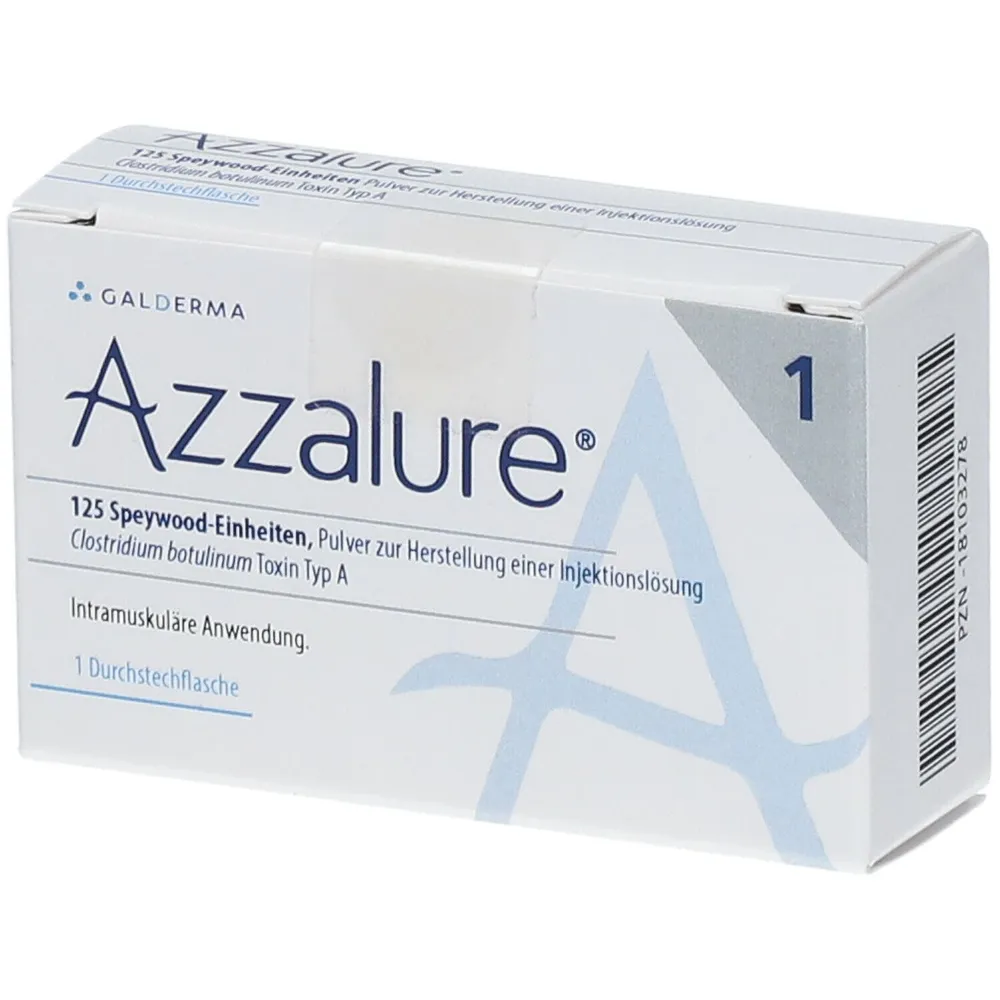
Table of Contents
Caution! Keep the leaflet! Information on the immediate packaging in a foreign language.
Azzalure, 125 Speywood units, powder for solution for injection
Botulinum toxin (type A) for injection
Please read the entire leaflet before using the medicine, as it contains important information for the patient.
- Keep this leaflet, as you may need to read it again.
- If you have any questions, consult your doctor.
- If any adverse reactions occur in the patient, including any adverse reactions not listed in this leaflet, inform your doctor or pharmacist. See section 4.
Table of contents of the leaflet:
- What Azzalure is and what it is used for
- Important information before using Azzalure
- How to use Azzalure
- Possible side effects
- How to store Azzalure
- Contents of the packaging and other information
1. What Azzalure is and what it is used for
Azzalure contains botulinum toxin type A, which causes muscle relaxation. Azzalure acts at the junction between nerves and muscles, preventing the release of the chemical messenger acetylcholine from nerve endings. This prevents muscle contraction.
Muscle relaxation is temporary and gradually wears off.
Some people are concerned about facial wrinkles. Azzalure may be used in adults under 65 years of age for the temporary improvement in the appearance of moderate to severe glabellar lines (vertical lines between the eyebrows) and wrinkles around the outer corner of the eye (crow's feet).
2. Important information before using Azzalure
When not to use Azzalure injections:
- if the patient is allergic to Clostridium botulinum toxin type A or to any of the other components of this medicine (listed in section 6);
- in case of infection at the proposed injection site;
- in case of myasthenia gravis, Lambert-Eaton syndrome or amyotrophic lateral sclerosis.
Warnings and precautions
Before administering Azzalure injections, discuss the following with the doctor:
- if the patient has neuromuscular disorders;
- if the patient frequently experiences difficulty swallowing (dysphagia);
- if the patient frequently chokes on food or drink, causing coughing or choking episodes;
- if there is inflammation at the proposed injection site;
- if the muscles at the proposed injection site are weak;
- if the patient has bleeding disorders, meaning prolonged clotting time, such as haemophilia (inherited blood clotting disorders due to deficiency of clotting factors);
- if the patient has undergone facial surgery or if such surgery or other surgical procedures are planned in the near future;
- if the patient has previously received injections of another botulinum toxin;
- if there was no significant improvement in wrinkles after the last botulinum toxin treatment.
During treatment with Azzalure, dry eye may occur. Azzalure may cause reduced blink rate or decreased tear production, which may damage the eye surface.
This information will help the doctor make an appropriate decision regarding the risks and benefits of treatment.
Special warnings
Very rarely, botulinum toxin may cause muscle weakness in areas distant from the injection site.
When botulinum toxins are used more frequently than every 12 weeks or in higher doses for the treatment of other diseases, the formation of antibodies in patients has been rarely observed. The development of neutralizing antibodies may reduce treatment effectiveness.
Whenever visiting a doctor (regardless of the reason for the visit), inform the doctor about prior treatment with Azzalure.
Children and adolescents
Azzalure is not recommended for use in individuals under 18 years of age.
Azzalure and other medicines
Tell the doctor about all medicines currently taken or recently taken, as well as any medicines the patient plans to take, because Azzalure may interact with other medicines, particularly:
- antibiotics used for infections (e.g. aminoglycoside antibiotics such as gentamicin or amikacin) or
- other muscle relaxants.
Use of Azzalure with food and drink
Azzalure injections may be administered before or after eating or drinking.
Pregnancy and breastfeeding
Azzalure should not be used during pregnancy.
Use of Azzalure is not recommended in breastfeeding women. If the patient is pregnant, planning to become pregnant, or breastfeeding, she should consult a doctor before using any medicine.
Driving and operating machinery
After injection of Azzalure, transient blurred vision, muscle weakness, or generalised weakness may occur. If such effects occur, the patient must not drive or operate machinery.
3. How to use Azzalure
Azzalure must be administered only by physicians with appropriate qualifications and experience in this type of treatment, and who have access to the necessary equipment. The physician will prepare and administer the medicine to the patient. The Azzalure vial should be used for only one patient during a single treatment session.
The recommended dose of Azzalure is:
- Forehead lines: 50 units, administered as 10 units at each of 5 injection sites on the forehead, in the area above the nose and eyebrows;
- Periorbital lines (crow's feet): 60 units, administered as 10 units at each of 6 injection sites, bilaterally, in the areas affected by crow's feet wrinkles.
Units used for other botulinum toxin products are not equivalent. Speywood units of Azzalure cannot be interchanged with units of other botulinum toxin products.
The effect of treatment should become apparent within a few days after injection.
The interval between subsequent Azzalure injections will be determined by the physician. Azzalure should not be used more frequently than every 12 weeks.
Azzalure is not indicated for use in patients under 18 years of age.
Use of a higher than recommended Azzalure dose
Administration of a dose higher than recommended may cause weakening of certain muscles located outside the injection site. This may occur some time after the injection. If this occurs, you should inform your doctor immediately.
4. Possible adverse reactions
Like all medicines, Azzalure may cause adverse reactions, although not everyone experiences them.
Seek immediate medical attention if the patient experiences:
- Difficulty breathing, swallowing, or speaking;
- Facial swelling or skin redness, or itchy, lumpy rash. These symptoms may indicate an allergic reaction to Azzalure.
Inform the doctor if the patient experiences any of the following adverse reactions:
Glabellar lines:
Very common (occurring in more than 1 in 10 patients)
- Redness, swelling, irritation, rash, itching, tingling, pain, discomfort, stinging, or bruising at the injection site
- Headache
Common (occurring in 1 to 10 in 100 patients)
- Eye fatigue or blurred vision, drooping of the upper eyelid, eyelid swelling, watery eyes, dry eye syndrome, muscle twitching around the eye
- Transient facial paralysis
Uncommon (occurring in 1 to 10 in 1,000 patients)
- Impaired, blurred, or double vision
- Dizziness
- Itching, rash
- Allergic reactions
Rare (occurring in 1 to 10 in 10,000 patients)
- Itchy, lumpy rash
- Eye movement disorders
Unknown (frequency cannot be estimated from available data)
- Numbness
- Decreased muscle mass
- Generalized weakness
- Fatigue
- Influenza-like symptoms
Crow’s feet:
Common (occurring in 1 to 10 in 100 patients)
- Headache
- Eyelid swelling
- Bruising, itching, and swelling around the eyes
- Drooping of the upper eyelid
- Transient facial paralysis
Uncommon (occurring in 1 to 10 in 1,000 patients)
- Dry eye
Unknown (frequency cannot be estimated from available data)
- Allergic reactions
- Numbness
- Decreased muscle mass
- Generalized weakness
- Fatigue
- Influenza-like symptoms
These adverse reactions usually occurred within the first week after injection and resolved quickly. They were generally mild or moderate in severity.
Very rarely, adverse effects affecting muscles other than those injected with botulinum toxin have been reported. These include increased muscle weakness, difficulty swallowing, coughing, and choking during swallowing (when food or liquids enter the airways during swallowing, respiratory disturbances such as lung infections may occur). If any of these effects occur, contact a doctor immediately.
Reporting of adverse reactions
If any adverse reactions occur, including any not listed in this leaflet, inform a doctor or pharmacist. Adverse reactions can be reported directly to the Department of Monitoring Adverse Drug Reactions, Office for Registration of Medicinal Products, Medical Devices and Biocidal Products, Al. Jerozolimskie 181C, 02-222 Warsaw, Tel: +48 22 49 21 301, Fax: +48 22 49 21 309, website: https://smz.ezdrowie.gov.pl.
Reporting adverse reactions helps to provide more information on the safety of the medicine.
5. How to store Azzalure
Keep the medicine out of the sight and reach of children.
Do not use Azzalure after the expiry date stated on the packaging.
The expiry date refers to the last day of the stated month.
Store Azzalure in a refrigerator (2°C–8°C). Do not freeze.
Your doctor will reconstitute Azzalure and prepare the solution for injection.
Chemical and physical stability of the solution has been demonstrated for 24 hours at 2°C–8°C.
From a microbiological standpoint, the solution should be used immediately, unless the method of
reconstitution excludes the risk of microbiological contamination. If the medicine is not used immediately,
the user is responsible for the duration and conditions of storage prior to use.
6. Contents of the pack and other information
What Azzalure contains
- The active substance is botulinum toxin (type A) for injection*. One vial contains 125 Speywood units.
- The other ingredients are human albumin and monohydrate lactose.
*Complex of Clostridium botulinum toxin (bacterium) (type A) with hemagglutinin
Speywood units of Azzalure are specific to this product and cannot be interchanged with
other preparations containing botulinum toxin.
What Azzalure looks like and contents of the pack
Azzalure is a powder for solution for injection. Packs containing 1 or 2 vials are available.
Azzalure is a white powder.
For more detailed information, please contact the marketing authorisation holder or the parallel importer.
Marketing authorisation holder in Slovakia, country of export:
Ipsen Pharma
65 Quai Georges Gorse
92100 Boulogne-Billancourt
France
Manufacturer:
Ipsen Manufacturing Ireland Limited
Blanchardstown Industrial Park
Blanchardstown
Dublin 15, Ireland
Parallel importer:
InPharm Sp. z o.o.
ul. Strumykowa 28/11
03-138 Warsaw
Poland
Repackaged in:
InPharm Sp. z o.o. Services sp. k.
ul. Chełmżyńska 249
04-458 Warsaw
Poland
Marketing authorisation number in Slovakia, country of export: 63/0115/10-S
Parallel import authorisation number: 442/24
The following information is intended for professional medical personnel only:
Azzalure, 125 Speywood units, powder for solution for injection
Botulinum toxin (type A) for injection
Dosage and method of administration:
See section 3 of the Patient Leaflet.
Special precautions for disposal and preparation of the medicinal product for administration
Instructions regarding use, preparation, and disposal of the medicinal product must be strictly followed.
Reconstitution must be performed in accordance with good practice, particularly with regard to aseptic technique.
The Azzalure medicinal product must be dissolved in 0.9% sodium chloride solution (9 mg/ml) for injection.
According to the reconstitution table below, the required volume of 0.9% sodium chloride solution (9 mg/ml) for injection should be drawn into a syringe to obtain a clear, colourless solution with the following concentration:
| Volume of solvent (0.9% sodium chloride solution) added to the vial containing 125 IU | Resulting dose |
| 0.63 ml | 10 IU in 0.05 ml |
| 1.25 ml | 10 IU in 0.1 ml |
Accurate measurement of 0.63 ml or 1.25 ml can be achieved using syringes graduated in 0.1 ml and 0.01 ml increments.
RECOMMENDATIONS FOR DISPOSAL OF CONTAMINATED MATERIALS
Immediately after use and before disposal, any unused Azzalure medication remaining after reconstitution (in vial or syringe) must be inactivated using 2 ml of diluted sodium hypochlorite solution at a concentration of 0.55% or 1% (Dakin's solution).
Do not empty used vials, syringes, or materials. They should be discarded into appropriate containers and disposed of in accordance with local requirements.
RECOMMENDATIONS IN CASE OF AN INCIDENT DURING PREPARATION OF BOTULINUM TOXIN
- Spilled product should be wiped: using an absorbent material soaked in sodium hypochlorite solution (bleach) in case of powder, or using dry absorbent material in case of reconstituted product.
- Contaminated surfaces should be cleaned with an absorbent material soaked in sodium hypochlorite solution (bleach), then dried.
- In case of broken vial, follow the above instructions. Carefully collect the fragments of broken glass and wipe the product, taking care not to cut the skin.
- If the product has come into contact with the skin, wash the contaminated area with sodium hypochlorite solution (bleach), then rinse thoroughly with water.
- If the product has come into contact with the eyes, rinse the eyes thoroughly with abundant water or ophthalmic eye wash solution.
- If the product has come into contact with a wound, cut, or damaged skin, the contaminated area should be thoroughly rinsed with abundant water and appropriate medical measures should be taken depending on the injected dose.
The instructions for use, preparation, and disposal of the medicinal product must be strictly followed.