Azithromycin genoptim
Poland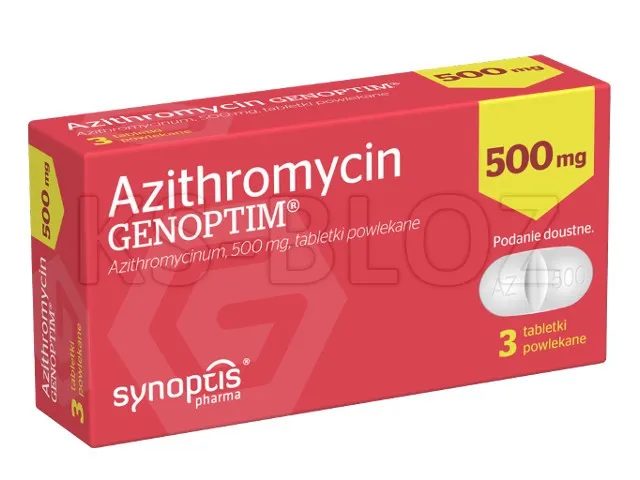
Table of Contents
- Package leaflet: Information for the patient
- 1. What Azithromycin Genoptim is and what it is used for
- 2. Important information before taking Azithromycin Genoptim
- 3. How to take Azithromycin Genoptim
- 4. Possible side effects
- 5. How to store Azithromycin Genoptim
- 6. Contents of the pack and other information
Package leaflet: Information for the patient
Azithromycin Genoptim, 500 mg, film-coated tablets
Azithromycinum
Please read all of this leaflet carefully before taking this medicine, because it contains
important information for you.
- Keep this leaflet, as you may need to read it again.
- If you have any further questions, please ask your doctor, pharmacist, or nurse.
- This medicine has been prescribed for a specific individual. Do not pass it on to others. It may harm other people, even if their symptoms are the same as yours.
- If you experience any adverse effects, including any not listed in this leaflet, please inform your doctor, pharmacist, or nurse. See section 4.
Contents of the leaflet:
- What Azithromycin Genoptim is and what it is used for
- Important information before taking Azithromycin Genoptim
- How to take Azithromycin Genoptim
- Possible side effects
- How to store Azithromycin Genoptim
- Contents of the pack and other information
1. What Azithromycin Genoptim is and what it is used for
Azithromycin Genoptim is an antibiotic belonging to the macrolide group.
It is used to treat infections caused by bacteria sensitive to azithromycin. These infections include:
- exacerbation of chronic bronchitis and pneumonia,
- sinusitis, pharyngitis, tonsillitis,
- acute otitis media,
- mild to moderate skin and soft tissue infections, e.g. hair follicle infection (folliculitis), bacterial skin infection and deeper layers (cellulitis), skin infections with shiny red rash (erysipelas),
- uncomplicated urethritis or cervicitis caused by Chlamydia trachomatis bacteria.
2. Important information before taking Azithromycin Genoptim
When not to take Azithromycin Genoptim
- If the patient is allergic to azithromycin, erythromycin, or any of the other ingredients of this medicine (listed in section 6).
- If the patient has an allergy (hypersensitivity) to another macrolide or ketolide antibiotic.
Do not take this medicine if any of the above situations apply. If in doubt,
consult a doctor or pharmacist before taking Azithromycin Genoptim.
Warnings and precautions
Talk to a doctor or pharmacist before taking this medicine if:
- the patient has severe liver or kidney disease,
- the patient has severe heart problems or severe disturbances in heart rhythm (visible on ECG recording or ECG monitor),
- the patient has low levels of potassium or magnesium in the blood,
- the patient shows signs of another infection,
- the patient has neurological or psychiatric disorders.
Stop taking Azithromycin Genoptim and contact a doctor immediately if the patient experiences any of the following serious adverse effects during treatment:
- swelling of the face, lips, tongue, or throat, difficulty breathing or swallowing, rash, itching of the skin progressing to large blisters or sores on the skin, or ulcers on the lips, eyes, nose, mouth, or genitals. These may be signs of a severe allergic reaction, angioedema, or anaphylactic reaction.
- persistent diarrhoea with blood or mucus in the stool. This may be a symptom of a serious intestinal condition called pseudomembranous colitis.
Azithromycin Genoptim and other medicines
Tell the doctor or pharmacist about all medicines the patient is currently taking or has recently taken, including those obtained without a prescription, as well as any medicines the patient plans to take.
Tell the doctor or pharmacist if the patient is taking any of the following medicines:
- antacids – used to treat heartburn and indigestion. Azithromycin Genoptim should be taken at least one hour before or two hours after taking an antacid;
- ergotamine – used to treat migraine;
- warfarin or similar medicines – used to thin the blood. Azithromycin Genoptim may increase the blood-thinning effect;
- cisapride – used to treat gastrointestinal disorders. Serious heart problems may occur (visible on ECG recording or ECG monitor);
- terfenadine – used to treat hay fever. Serious heart problems may occur (visible on ECG recording or ECG monitor);
- zidovudine or nelfinavir – used to treat HIV infections. Taking nelfinavir together with Azithromycin Genoptim may increase the number of adverse effects listed in this leaflet;
- rifabutin – used to treat tuberculosis;
- quinidine – used to treat heart rhythm disorders;
- cyclosporine – a medicine used to prevent rejection of transplanted organs. In such cases, the doctor may recommend regular monitoring of cyclosporine blood levels and may adjust the dose.
Tell the doctor or pharmacist if the patient is taking any of the following medicines, as Azithromycin Genoptim may enhance their effects. The doctor may need to adjust the dose:
- alfentanil – a sedative used during surgical procedures,
- digoxin – used to treat heart disorders,
- colchicine – used to treat gout and familial Mediterranean fever,
- astemizole – used to treat hay fever,
- pimozide – used to treat psychiatric disorders.
Pregnancy, breastfeeding, and fertility
Azithromycin may be used during pregnancy and breastfeeding only when strictly necessary.
Before taking any medicine, consult a doctor or pharmacist.
Driving and operating machinery
If taking this medicine causes dizziness or other symptoms affecting concentration, do not drive or operate machinery.
Azithromycin Genoptim contains lactose (as lactose monohydrate)
If the patient has previously been diagnosed with intolerance to certain sugars, consult a doctor before taking this medicine.
Azithromycin Genoptim contains sodium
This medicine contains less than 1 mmol (23 mg) of sodium per tablet; therefore, it is considered "sodium-free".
3. How to take Azithromycin Genoptim
This medicine should always be taken exactly as prescribed by your doctor. In case of doubt,
please consult your doctor, pharmacist, or nurse.
How to take the medicine
- Swallow the tablet whole with water.
- Do not crush or chew the tablet.
- The 500 mg tablet may be divided in half.
- The tablet may be taken with or without food.
Dosage
Adults, adolescents with body weight at least 45 kg, and elderly patients:
The recommended total dose is 1500 mg. This may be taken in one of two ways. Your doctor will
inform you which method to follow:
- for 3 days: one 500 mg tablet once daily, or
- for 5 days: one 500 mg tablet on day 1, followed by one 250 mg tablet on days 2, 3, 4, and 5.
A different dose may be prescribed if the patient has inflammation of the urethra (the tube carrying urine from the bladder) or of the mucous membrane at the junction of the uterus and vagina (cervix) caused by Chlamydia trachomatis bacteria. In such cases, the doctor may prescribe a single 1000 mg dose.
Children and adolescents with body weight below 45 kg:
The tablet form is not recommended. For children and adolescents with body weight below 45 kg,
the medicine should be administered in another form, e.g. as a suspension.
Patients with impaired kidney or liver function:
If the patient has impaired kidney or liver function, this should be reported to the doctor.
Accidental overdose of Azithromycin Genoptim
If you take more Azithromycin Genoptim than prescribed, contact your doctor immediately or go to the nearest hospital emergency department. Bring the medicine packaging with you. The following symptoms may occur after an overdose:
- transient hearing impairment,
- severe nausea, vomiting, and diarrhoea.
Missed dose of Azithromycin Genoptim
- If you miss a dose, take it as soon as you remember.
- However, do not take the missed dose if it is almost time for your next scheduled dose.
- Do not take a double dose to make up for a missed dose.
- Despite missing a dose, continue taking all prescribed tablets. This means your treatment will end one day later.
Stopping Azithromycin Genoptim
Do not stop taking Azithromycin Genoptim without consulting your doctor.
If you have any further questions about the use of this medicine, consult your doctor or pharmacist.
4. Possible side effects
Like all medicines, Azithromycin Genoptim can cause side effects, although not everyone will experience them.
Stop taking Azithromycin Genoptim and contact your doctor immediately if the patient experiences any of the following serious side effects:
- Swelling of the face, lips, tongue or throat, difficulty breathing or swallowing (occur uncommonly: affects 1 to 10 people in 1,000 patients), rash, itching, large blisters on the skin, ulceration of the lips, eyes, nose, mouth or genitals (occur rarely: affects fewer than 1 person in 10,000). These may be signs of a severe allergic reaction, angioedema or anaphylactic reaction.
- Severe, prolonged diarrhoea with blood or mucus in the stool. This may be a symptom of a serious intestinal condition called pseudomembranous colitis (frequency unknown).
- Fever, red skin lesions, blisters or skin peeling, joint pain, swollen eyes. These may be caused by serious conditions such as Stevens-Johnson syndrome (occur uncommonly: affects 1 to 10 people in 1,000 patients) or toxic epidermal necrolysis (frequency unknown).
Other side effects that may occur:
Very common (affects more than 1 in 10 people):
- Nausea
- Diarrhoea, abdominal pain, bloating.
Common (affects 1 to 10 people in 100):
- Loss of appetite
- Dizziness
- Headache
- Tingling or numbness (paraesthesia)
- Changes in taste and smell perception
- Visual disturbances
- Deafness
- Vomiting, abdominal pain or cramps, loss of appetite, digestive problems
- Rash and itching
- Joint pain
- Fatigue
- Changes in white blood cell count and blood bicarbonate levels.
Uncommon (affects 1 to 10 people in 1,000):
- Fungal infection (candidiasis)
- Vaginitis
- Decreased white blood cell count
- Nervousness
- Reduced sense of touch (hypoesthesia)
- Drowsiness
- Difficulty falling asleep (insomnia)
- Hearing loss or tinnitus (ringing in the ears)
- Palpitations
- Gastritis
- Constipation
- Hepatitis
- Photosensitivity, skin redness, peeling and swelling
- Urticaria (hives)
- Chest pain
- Oedema (swelling)
- Malaise
- Weakness
- Changes in liver enzyme levels and abnormal blood test results.
Rare (affects 1 to 10 people in 10,000):
- Restlessness
- Dizziness
- Abnormal liver function
- Skin eruption characterized by rapid appearance of red skin areas covered with small vesicles filled with white or yellow fluid (vesicular rash).
Frequency not known (cannot be estimated from available data):
- Decreased red blood cell count due to their destruction (haemolytic anaemia); decreased platelet count
- Anaphylactic reaction
- Irritability, aggression
- Fainting
- Seizures
- Hyperactivity
- Smell disorders (anosmia, parosmia)
- Taste disturbances (ageusia)
- Worsening of condition or exacerbation of symptoms in myasthenia gravis
- Rapid or irregular heartbeat, sometimes life-threatening, changes in heart rhythm observed on electrocardiogram
- Low blood pressure
- Pancreatitis
- Tongue discoloration
- Erythema multiforme
- Kidney function disorders.
If any of the side effects worsen or if any side effects not listed in this leaflet occur, consult a doctor or pharmacist. The doctor may then decide to adjust the dosage or discontinue treatment.
Reporting of side effects
If any side effects occur, including any side effects not listed in this leaflet, inform your doctor, pharmacist or nurse. Side effects can be reported directly to the Department of Monitoring Adverse Drug Reactions, Office for Registration of Medicinal Products, Medical Devices and Biocidal Products: Al. Jerozolimskie 181C, 02-222 Warsaw,
Tel.: +48 22 49 21 301
Fax: +48 22 49 21 309
Website: https://smz.ezdrowie.gov.pl
Side effects can also be reported to the marketing authorisation holder.
Reporting side effects helps provide more information on the safety of the medicine.
5. How to store Azithromycin Genoptim
- Keep out of the sight and reach of children.
- No special storage instructions required.
Do not use this medicine after the expiry date stated on the packaging after EXP.
The expiry date refers to the last day of the stated month. The abbreviation Lot on the packaging stands for
batch number.
Medicines must not be disposed of via wastewater or household waste. Ask your pharmacist how to dispose of medicines no longer required. Such measures will help protect
the environment.
6. Contents of the pack and other information
What Azithromycin Genoptim contains
The active substance is azithromycin.
One tablet of Azithromycin Genoptim 500 mg, coated tablets, contains azithromycin dihydrate equivalent to 500 mg of azithromycin.
The other ingredients are:
Tablet core:
anhydrous calcium hydrogen phosphate, sodium croscarmellose, pregelatinized starch, hypromellose, sodium lauryl sulfate, magnesium stearate.
Coating of the tablet (Opadry White 31K58902):
hypromellose 15cp, lactose monohydrate, titanium dioxide (E 171), triacetin.
What Azithromycin Genoptim looks like and contents of the pack
Azithromycin Genoptim 500 mg are white or almost white, capsule-shaped, coated tablets, embossed with the characters "AZ" and "500" on either side of the break line dividing the tablet in half on one side, and unmarked on the other side.
The coated tablets are available in blisters containing 2, 3, 6 or 30 tablets.
Not all pack sizes may be marketed.
Marketing Authorisation Holder:
Synoptis Pharma Sp. z o.o.
ul. Krakowiaków 65
02-255 Warszawa
Poland
Manufacturer:
PSI Supply nv
Axxes Business Park
Guldensporenpark 22 – Block C
9820 Merelbeke
Belgium
Manufacturer/Importer:
Synoptis Industrial Sp. z o.o.
ul. Rabowicka 15
62-020 Swarzędz
Poland