Asterdan
Poland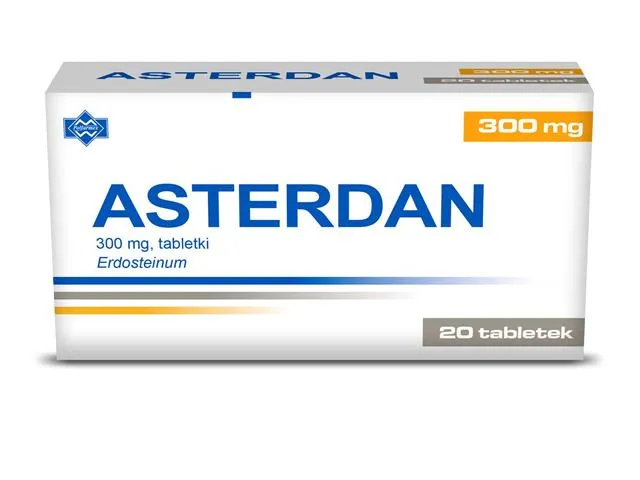
Table of Contents
Patient Information Leaflet
ASTERDAN, 300 mg, tablets
Erdosteine
Please read all of this leaflet carefully before taking this medicine, because it contains important information for you.
- Keep this leaflet as you may need to read it again.
- If you have any questions, ask your doctor, pharmacist, or nurse.
- This medicine has been prescribed for you personally. Do not share it with others. This medicine may harm other people, even if their symptoms are the same as yours.
- If you experience any side effects, including any not listed in this leaflet, tell your doctor, pharmacist, or nurse. See section 4.
Contents of the leaflet:
- What ASTERDAN is and what it is used for
- What you need to know before taking ASTERDAN
- How to take ASTERDAN
- Possible side effects
- How to store ASTERDAN
- Contents of the pack and other information
1. What ASTERDAN is and what it is used for
ASTERDAN contains the active substance erdosteine, which belongs to a group of medicines called mucolytics, which reduce the viscosity of bronchial secretions and facilitate expectoration. ASTERDAN is indicated for mucolytic treatment in acute and chronic diseases of the upper respiratory tract, bronchi and lungs associated with abnormal mucus secretion and impaired mucus transport. It is also used for the prophylactic treatment of seasonal exacerbations of chronic bronchitis. ASTERDAN is indicated for use in adults and adolescents above 12 years of age.
2. Important information before using ASTERDAN
When not to use ASTERDAN:
- if the patient has hypersensitivity (allergy) to the active substance, to substances containing free -SH groups, or to any of the other components of this medicine (listed in section 6)
- if the patient has liver function disorders
- if the patient has renal failure
- if the patient has homocystinuria (especially in patients on a methionine-free diet)
- in children under 12 years of age.
Warnings and precautions
In case typical symptoms of hypersensitivity occur (rash, urticaria), treatment must be discontinued immediately.
Use with caution in patients with weakened cough reflex or impaired ciliary clearance (due to the risk of accumulation of large amounts of mucus).
The risk of adverse reactions can be reduced by using the smallest effective doses for the shortest possible duration. If no improvement occurs, the physician will consider discontinuing treatment.
Dose adjustment is not required in adults with chronic obstructive pulmonary disease (COPD).
Children
This medicine should not be administered to children under 12 years of age.
Taking ASTERDAN with food and drink
Food and drink do not affect the absorption of the medicine.
Use of ASTERDAN in patients with renal impairment
In patients with severe renal failure, metabolites of erdosteine formed in the liver may accumulate.
Use of ASTERDAN in elderly patients
No dosage adjustment is necessary in patients over 65 years of age.
ASTERDAN and other medicines
Tell your doctor about all medicines the patient is currently taking or has recently taken, as well as any medicines the patient plans to take.
No interactions have been observed with other medicines used in the treatment of respiratory tract infections and chronic obstructive pulmonary disease, such as: theophylline, bronchodilators (corticosteroids), erythromycin, amoxicillin, or co-trimoxazole.
After administration of erdosteine, increased concentrations of amoxicillin in the respiratory tract have been demonstrated.
Concomitant use with antitussive medicines (cough suppressants) may lead to accumulation of large amounts of bronchial secretions, which may worsen the patient's condition, for example by impairing respiratory function.
To avoid complications, antitussive and secretolytic (mucus-increasing) medicines should not be routinely combined, especially before sleep.
Pregnancy, breastfeeding, and fertility
If the patient is pregnant or breastfeeding, suspects she may be pregnant, or is planning to have a child, she should consult a doctor before using this medicine.
The decision on using the medicine is made by the doctor.
Driving and operating machinery
ASTERDAN has no influence on the ability to drive or operate machinery.
3. How to use ASTERDAN
This medicine should always be used as directed by a doctor or pharmacist. If in doubt,
consult a doctor or pharmacist.
The recommended dose for adults and adolescents over 12 years of age is:
1 tablet of 300 mg twice daily.
This medicine should not be taken before going to bed.
Taking more ASTERDAN than recommended
No cases of overdose have been reported.
If more than the recommended dose is taken, consult a doctor immediately.
Missed dose of ASTERDAN
Take the missed dose as soon as possible, then continue according to the prescribed schedule.
If it is almost time for the next dose, take only one dose and continue with the prescribed dosing schedule.
Do not take a double dose to make up for a missed dose.
If you have any further doubts about the use of this medicine, consult your doctor or pharmacist.
4. Possible adverse reactions
Like all medicines, this medicine can cause adverse reactions, although not everyone will experience them.
- Common (may occur in less than 1 in 10 people): stomach discomfort, nausea, headache
- Uncommon (may occur in less than 1 in 100 people): heartburn
- Rare (may occur in less than 1 in 1000 people): loss of taste sensation or taste disturbances, constipation, dry mouth, dizziness, general malaise, diarrhoea, allergic reactions: rash, urticaria, fever.
Other adverse reactions may occur in some individuals during treatment with ASTERDAN.
Reporting of adverse reactions
If any adverse reactions occur, including any adverse reactions not listed
in this leaflet, inform your doctor or pharmacist. Adverse reactions can be reported
directly to the Department of Monitoring Adverse Drug Reactions of the Office for Registration of Medicinal Products, Medical Devices and Biocidal Products:
Al. Jerozolimskie 181C, 02-222 Warsaw, tel. + 48 22 49 21 301, fax: + 48 22 49 21 309,
website: https://smz.ezdrowie.gov.pl
Adverse reactions can also be reported to the marketing authorization holder.
Reporting adverse reactions helps to provide more information on the safety of this medicine.
5. How to store ASTERDAN
Store below 25°C, in the original packaging to protect from moisture.
Keep the medicine out of the sight and reach of children.
Do not use this medicine after the expiry date stated on the packaging after "EXP".
The expiry date refers to the last day of the stated month.
Medicines must not be disposed of via wastewater or household waste. Ask your pharmacist how to dispose of medicines no longer required. Such measures help protect the environment.
6. Contents of the pack and other information
What ASTERDAN contains
- The active substance is erdosteine. One tablet contains 300 mg of erdosteine.
- The other ingredients are: cellulose, microcrystalline (type 102), magnesium stearate, silica, colloidal anhydrous, cellulose, microcrystalline (type 101), povidone K-25.
What ASTERDAN looks like and contents of the pack
ASTERDAN is a white or cream-white tablet, round with bevelled edges.
PVC/PVDC/Aluminium blister or OPA/Aluminium/PVC/Aluminium blister, in a cardboard box.
The pack contains 10 or 20 tablets in blisters.
Marketing Authorisation Holder and Manufacturer
Polfarmex S.A.
ul. Józefów 9
99-300 Kutno
Poland
Tel.: 24 357 44 44
Fax: 24 357 45 45
e-mail: [email protected]