Arthryl
Poland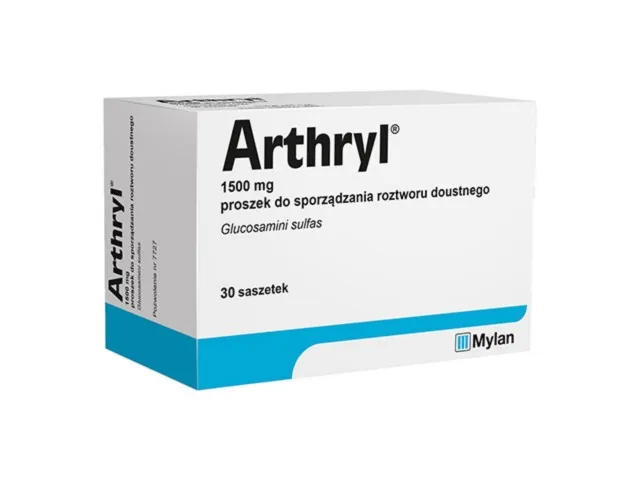
Table of Contents
Package leaflet: Information for the patient
Warning! Keep the leaflet! Information on the immediate packaging in a foreign language.
Arthryl (Viartril-S), 1500 mg, powder for oral solution
Glucosamini sulfas
Arthryl and Viartril-S are different trade names for the same medicinal product.
Please read the leaflet carefully before using the medicine, as it contains important information for the patient.
- Keep this leaflet so that you can read it again if necessary.
- If you have any questions, consult your doctor or pharmacist.
- This medicine has been prescribed for a specific individual. Do not pass it on to others. The medicine may harm others, even if their symptoms are the same.
- If you experience any adverse reactions, including those not listed in this leaflet, inform your doctor or pharmacist. See section 4.
Table of contents of the leaflet:
- What Arthryl is and what it is used for
- Important information before taking Arthryl
- How to take Arthryl
- Possible side effects
- How to store Arthryl
- Contents of the pack and other information
1. WHAT ARTHRYL IS AND WHAT IT IS USED FOR
Arthryl is used in the treatment of symptoms of mild to moderate osteoarthritis of the knee joints.
2. IMPORTANT INFORMATION BEFORE USING ARTHRYL
When not to use Arthryl:
- if the patient is allergic (hypersensitive) to glucosamine sulfate or to any of the other ingredients of this medicine (listed in section 6),
- if the patient is allergic to shellfish, as glucosamine is derived from shellfish,
- in patients with phenylketonuria, as the medicine contains aspartame.
Warnings and precautions
- Caution is advised when using this medicine in patients with asthma, as symptoms may worsen.
- Particular caution should be exercised when administering the medicine to patients with severe liver or kidney impairment.
- Caution is recommended in diabetic patients; close monitoring of blood glucose levels may be necessary at the beginning of treatment.
Children and adolescents
Arthryl must not be used in children.
Arthryl and other medicines
Inform your doctor about all medicines currently taken or recently taken by the patient, including those obtained without a prescription, as well as any medicines the patient plans to use.
No interactions between glucosamine sulfate and other medicines have been observed in clinical studies.
Caution is advised when Arthryl must be used concomitantly with other medicines, particularly with certain types of anticoagulants (e.g. warfarin, dicoumarol, phenprocoumon, acenocoumarol and fluindione). The effect of these medicines may be enhanced during concomitant use of glucosamine. Patients receiving such combinations should be monitored very carefully when starting and stopping glucosamine treatment.
Non-steroidal anti-inflammatory and analgesic medicines may be used simultaneously during treatment with glucosamine sulfate.
Pregnancy, breastfeeding and fertility
If the patient is pregnant or breastfeeding, suspects she may be pregnant, or is planning to have a child, she should consult her doctor or pharmacist before using this medicine.
Data from animal studies on the effects of glucosamine sulfate on fertility and lactation are insufficient. There are no adequate data on the use of glucosamine in pregnant women or in breastfeeding women.
This medicine must not be used during pregnancy.
Use during breastfeeding is not recommended, as there are no safety data available for newborns.
Driving and operating machinery
Arthryl has no significant influence on the ability to drive or operate machinery. However, caution is advised in case of headache, drowsiness, fatigue, dizziness or visual disturbances.
Arthryl contains aspartame, sorbitol and sodium
Arthryl contains aspartame
The medicine contains 2.5 mg of aspartame (E 951) per sachet. Aspartame is a source of phenylalanine.
It may be harmful to patients with phenylketonuria. This is a rare genetic disorder in which phenylalanine accumulates in the body due to impaired excretion.
The medicine contains sorbitol
The medicine contains 2028.5 mg of sorbitol (E 420) per sachet. Sorbitol is a source of fructose. If the patient has previously been diagnosed with intolerance to certain sugars or with hereditary fructose intolerance—a rare genetic disorder in which the patient's body cannot break down fructose—the patient should consult a doctor before taking this medicine.
The medicine contains sodium
The medicine contains approximately 6.6 mmol (151 mg) of sodium (main component of table salt) per sachet. This corresponds to approximately 7.6% of the maximum recommended daily dietary intake of sodium for adults. Patients who are controlling their sodium intake should take this into account.
3. HOW TO USE ARTHRYL
This medicine should always be used as directed by the physician. In case of doubt, consult
your doctor or pharmacist.
The contents of 1 sachet should be dissolved in a glass of water and taken once daily, preferably
with a meal.
Use of a higher than recommended dose of Arthryl
Cases of overdose have not been reported so far. Results of animal studies indicate that
toxic effects are unlikely, even after administration of very high doses of the medicine.
Missed dose
Do not take a double dose to make up for a missed dose. Take the next dose at the usual time.
Stopping Arthryl treatment
Do not discontinue treatment without consulting your doctor. If you have any further
doubts regarding the use of this medicine, consult your doctor or pharmacist.
4. POSSIBLE ADVERSE REACTIONS
Like all medicines, this medicine can cause adverse reactions, although they do not occur in everyone.
Clinical studies have shown that the medicine is well tolerated. Adverse reactions were observed in a small number of patients. They were usually transient and mild in intensity.
Observed adverse reactions have been classified according to the following frequency:
Common adverse reactions (occurring in less than 1 in 10 but more than 1 in 100 patients treated)
Gastrointestinal disorders: abdominal pain, nausea, bloating, constipation, diarrhoea, or dyspepsia.
Nervous system disorders: headache, drowsiness.
Vascular disorders: sudden flushing, especially of the face.
General disorders and administration site conditions: fatigue.
Uncommon adverse reactions (occurring in less than 1 in 100 but more than 1 in 1000 patients treated)
Skin and subcutaneous tissue disorders: rash, itching, skin redness.
Adverse reactions with unknown frequency (cannot be estimated from available data)
Immune system disorders: allergic reactions (hypersensitivity).
Metabolism and nutrition disorders: inadequate control of blood glucose levels in diabetic patients.
Psychiatric disorders: insomnia.
Nervous system disorders: dizziness.
Eye disorders: visual disturbances.
Cardiac disorders: heart rhythm disturbances, e.g. tachycardia (increased heart rate).
Respiratory, thoracic and mediastinal disorders: asthma or worsening of asthma.
Gastrointestinal disorders: vomiting.
Hepatobiliary disorders: jaundice.
Skin and subcutaneous tissue disorders: angioedema, urticaria.
General disorders and administration site conditions: swelling or peripheral oedema.
Investigations: increased liver enzyme activity, increased blood glucose concentration, fluctuations in INR (International Normalized Ratio, a measure of blood coagulation).
Cases of hypercholesterolaemia have been reported; however, a causal relationship with the use of the medicine has not been established.
Reporting of adverse reactions
If any adverse reactions occur, including any adverse reactions not listed in this leaflet, inform your doctor or pharmacist. Adverse reactions can be reported directly to the Department of Monitoring Adverse Drug Reactions at the Office for Registration of Medicinal Products, Medical Devices and Biocidal Products:
Al. Jerozolimskie 181C, 02-222 Warsaw, tel.: + 48 22 49 21 301, fax: + 48 22 49 21 309,
website: https://smz.ezdrowie.gov.pl.
Reporting adverse reactions helps to provide more information on the safety of the medicine.
5. HOW TO STORE ARTHRYL MEDICINAL PRODUCT
Keep the medicine out of sight and reach of children.
Store below 25°C.
Do not use this medicine after the expiry date stated on the packaging. The expiry date refers to the last day of the stated month.
Medicines must not be disposed of via wastewater or household waste. Ask your pharmacist how to dispose of medicines no longer in use. This will help protect the environment.
6. PACK CONTENTS AND OTHER INFORMATION
What Arthryl contains
The active substance in Arthryl is glucosamine sulfate.
One sachet contains 1500 mg of glucosamine sulfate (Glucosamini sulfas) in the form of 1884 mg
of glucosamine sulfate with sodium chloride (containing 384 mg of sodium chloride) – see also
section "Arthryl contains sodium" in section 2.
Other ingredients in the medicine are: aspartame (see also section "Arthryl contains aspartame" in
section 2), sorbitol (see also section "Arthryl contains sorbitol" in section 2), macrogol 4000, citric acid.
What Arthryl looks like and contents of the pack
White, crystalline, odourless powder for oral solution in a single-dose sachet.
The carton box contains 20 sachets.
For more detailed information, please contact the marketing authorisation holder or the parallel importer.
Marketing Authorisation Holder in Portugal, country of export:
BGP Products, Unipessoal Lda.
Av. D. João II, Edifício Atlantis, nº 44C – 7.3 and 7.4
1990-095 Lisbon
Portugal
Manufacturer:
Rottapharm Ltd.
Damastown, Industrial Park
Mulhuddart
Dublin 15
Ireland
Parallel Importer:
InPharm Sp. z o.o.
ul. Strumykowa 28/11
03-138 Warsaw
Poland
Repackaged in:
InPharm Sp. z o.o. Services sp. k.
ul. Chełmżyńska 249
04-458 Warsaw
Poland
Marketing Authorisation Number in Portugal, country of export: 2799286
Parallel Import Licence Number: 363/17