Arimidex
Poland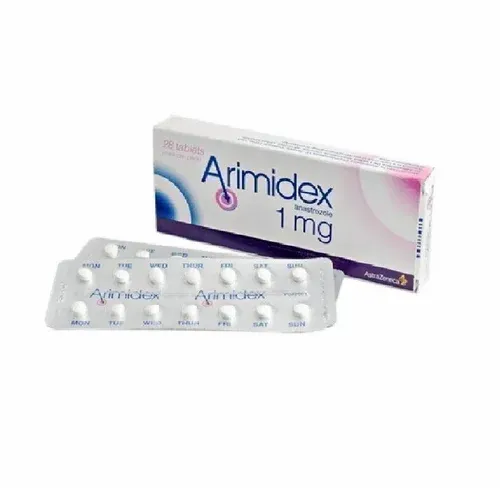
Table of Contents
Package leaflet: Information for the user
Arimidex, 1 mg, film-coated tablets
Anastrozol
Please read the entire leaflet carefully before taking this medicine, as it contains
important information for the patient.
- Keep this leaflet, so that you can read it again if necessary.
- If you have any further questions, please consult your doctor, pharmacist, or nurse.
- This medicine has been prescribed for a specific individual. Do not pass it on to others. This medicine may harm other people, even if their symptoms are the same.
- If you experience any adverse effects, including any not listed in this leaflet, inform your doctor, pharmacist, or nurse. See section 4.
Leaflet contents:
- What Arimidex is and what it is used for
- Important information before taking Arimidex
- How to take Arimidex
- Possible side effects
- How to store Arimidex
- Contents of the pack and other information
1. What Arimidex is and what it is used for
Anastrozole, the active substance in Arimidex, belongs to a group of medicines called aromatase inhibitors. Arimidex is used to treat postmenopausal women with breast cancer. Arimidex inhibits the action of aromatase—an enzyme involved in the synthesis of female sex hormones such as estrogens. This occurs through inhibition of a substance (enzyme) called aromatase.
2. Important information before using Arimidex
When not to use Arimidex
- if the patient is allergic to anastrozole or any of the other ingredients of this medicine (listed in section 6);
- if the patient is pregnant or breastfeeding (see section "Pregnancy and breastfeeding").
If any of the situations listed above apply, Arimidex should not be used.
If in doubt, consult a doctor or pharmacist.
Warnings and precautions
Before starting Arimidex, consult a doctor, pharmacist, or nurse if:
- the patient is still menstruating (menopause has not yet occurred);
- the patient is taking a medicine containing tamoxifen or medicines containing estrogens (see "Arimidex with other medicines");
- the patient has ever been diagnosed with a condition affecting bone strength (osteoporosis);
- the patient has kidney or liver disease.
If in doubt about any of the above information, consult a doctor or pharmacist before taking Arimidex.
If hospitalised, inform medical staff that Arimidex is being taken.
Arimidex with other medicines
Tell the doctor about all medicines currently taken or recently taken, including those obtained without a prescription and herbal preparations, because Arimidex may affect how some medicines work, and some medicines may affect how Arimidex works.
Do not take Arimidex if the patient is already taking any of the following medicines:
- certain medicines used to treat breast cancer (selective estrogen receptor modulators), e.g. medicines containing tamoxifen, because Arimidex may stop working properly;
- medicines containing estrogen, such as hormone replacement therapy (HRT). If this applies, contact a doctor or pharmacist.
Tell the doctor if:
- the patient is taking any medicine belonging to the group of LHRH analogues, such as: gonadorelin, buserelin, goserelin, leuprorelin, and triptorelin. These medicines are used in the treatment of breast cancer, certain gynaecological conditions, and infertility.
Pregnancy and breastfeeding
Do not use Arimidex during pregnancy or while breastfeeding. Arimidex should be discontinued and a doctor consulted if pregnancy occurs.
Before taking any medicine, consult a doctor or pharmacist.
Driving and operating machinery
It is unlikely that Arimidex impairs the ability to drive or operate machinery. However, weakness and drowsiness have been observed in some patients taking Arimidex. If these symptoms occur, contact a doctor or pharmacist.
Arimidex contains lactose
This medicine contains the sugar lactose. If the patient has previously been diagnosed with intolerance to certain sugars, the patient should consult a doctor before taking this medicine.
Sodium content in Arimidex
This medicine contains less than 1 mmol of sodium (23 mg) per tablet, i.e. it is essentially "sodium-free".
3. How to take Arimidex
Armedix should always be taken exactly as directed by your doctor or pharmacist. If you are unsure, consult your doctor or pharmacist.
- The recommended dose of Arimidex is 1 tablet once daily.
- The medicine should be taken regularly, at the same time each day.
- The tablet should be swallowed whole with water.
- Arimidex may be taken before, during, or after a meal.
Armedix should be taken for as long as recommended by your doctor or pharmacist. Treatment with Arimidex is long-term and may last several years. If in doubt, speak to your doctor or pharmacist.
Use in children and adolescents
Armedix must not be used in children and adolescents.
Taking more Arimidex than recommended
If you take more than the recommended dose, contact your doctor immediately.
If you miss a dose of Arimidex
If you miss a dose, take the next dose the following day at your usual time. Do not take a double dose (two doses at the same time) to make up for a missed dose.
Stopping Arimidex
Do not stop taking Arimidex without consulting your doctor.
If you have any further questions about the use of this medicine, consult your doctor or pharmacist.
4. Possible adverse reactions
Like all medicines, this medicine can cause adverse reactions, although not everyone will experience them.
If the patient experiences any of the following severe but very rare adverse reactions,
treatment with Arimidex must be discontinued immediately and medical advice must be sought urgently:
- extremely severe skin reactions with ulceration or blistering of the skin, known as Stevens-Johnson syndrome;
- allergic reactions (hypersensitivity) with swelling of the throat and larynx, which may cause difficulty in swallowing and breathing, known as angioedema.
Very common (in more than 1 in 10 patients):
- headache
- hot flushes
- nausea
- rash
- joint pain or stiffness
- arthritis
- fatigue
- bone demineralisation (osteoporosis)
- depression
Common (in 1 to 10 in 100 patients):
- loss of appetite
- increased serum cholesterol levels (a fatty substance, detected in blood tests)
- drowsiness
- carpal tunnel syndrome (tingling, pain, reduced temperature sensation, weakness in part of the hand)
- tingling, numbness or paraesthesia of the skin, loss of or absence of taste
- diarrhoea
- vomiting
- changes in blood test results related to liver function (liver function parameters)
- hair thinning (hair loss)
- allergic reactions (hypersensitivity) affecting the face, mouth, tongue
- bone pain
- vaginal dryness
- vaginal bleeding (observed mainly during the first weeks of treatment – if bleeding persists, contact your doctor)
- muscle pain
Uncommon (in 1 to 10 in 1,000 patients):
- changes in blood test results related to liver function (liver function parameters: gamma-glutamyl transferase [gamma-GT] and serum bilirubin levels);
- hepatitis;
- urticaria;
- trigger finger (a condition in which a finger or thumb locks in a bent position and straightening is difficult);
- increased calcium levels in the blood; if nausea, vomiting, and excessive thirst occur, contact your doctor, pharmacist, or nurse, as blood tests may be required.
Rare (in 1 to 10 in 10,000 patients):
- inflammatory skin conditions with red spots or blisters
- skin rashes due to hypersensitivity (caused by allergy or anaphylactoid reaction)
- inflammation of small blood vessels causing red or purpuric skin discoloration. Very rarely, joint, abdominal, and kidney pain may occur, known as Henoch-Schönlein purpura.
Adverse reactions with unknown frequency (frequency cannot be estimated from the available data)
- dry eye syndrome
- lichenoid rash (small, red or violet, itchy papules on the skin)
- tendonitis (inflammation of the connective tissue linking muscles to bones)
- tendon rupture (rupture of the connective tissue linking muscles to bones)
- memory impairment
Effect on bones
Arimidex reduces the level of oestrogens in the blood, which may lead to a decrease in mineral content of the bones. This may result in reduced bone strength and an increased risk of bone fractures. Your doctor will take appropriate preventive and therapeutic measures to reduce these risks, in accordance with therapeutic guidelines for the prevention and treatment of bone problems in postmenopausal women.
Discuss these risks and available treatment options for bone problems with your doctor.
Reporting of adverse reactions
If any adverse reactions occur, including any not listed in this leaflet, inform your doctor, pharmacist, or nurse. Adverse reactions can be reported directly to the Department of Monitoring Adverse Drug Reactions, Office for Registration of Medicinal Products, Medical Devices and Biocidal Products, Al. Jerozolimskie 181C, 02-222 Warsaw, Tel: +48 22 49 21 301, Fax: +48 22 49 21 309, website: https://smz.ezdrowie.gov.pl .
Reporting adverse reactions helps provide more information on the safety of the medicine.
Adverse reactions can also be reported to the marketing authorisation holder.
5. How to store Arimidex
Store at a temperature not exceeding 30°C.
Keep the medicine out of the sight and reach of children.
This medicine could harm them.
Do not use Arimidex after the expiry date stated on the carton and blister after EXP.
The expiry date refers to the last day of that month.
Keep the medicine in its original packaging.
Medicines should not be disposed of via wastewater or household waste. Ask your pharmacist how to dispose of medicines no longer in use. This will help protect the environment.
6. Package contents and other information
What Arimidex contains
- The active substance is anastrozole. One coated tablet contains 1 mg of anastrozole.
- Other ingredients: monohydrate lactose, povidone, sodium carboxymethyl starch, magnesium stearate, hypromellose, macrogol 300, titanium dioxide.
What Arimidex looks like and contents of the pack
White, round, biconvex coated tablets approximately 6.1 mm in diameter, marked with "A" on one side and "Adx1" on the other.
Pack sizes
28 tablets
Marketing Authorization Holder
Laboratoires Juvisé Pharmaceuticals
149 boulevard Bataille de Stalingrad
69100 Villeurbanne
France
Manufacturer
Haupt Pharma Muenster GmbH
Schleebrueggenkamp 15, Muenster
Nordrhein-Westfalen, 48 159
Germany
AstraZeneca AB
Gärtunavägen
SE-151 85
Södertälje Sweden
This medicinal product is authorized in the Member States of the European Economic Area under the following names:
Arimidex: Austria, Belgium, Bulgaria, Cyprus, Czech Republic, Denmark, Estonia, Finland, France, Greece, Spain, Netherlands, Ireland, Iceland, Lithuania, Luxembourg, Latvia, Malta, Germany, Norway, Poland, Portugal, Romania, Slovakia, Sweden, Hungary, United Kingdom, Italy.
Arimidex 1mg filmsko obložene tablet: Slovenia
Detailed information about this medicine is available on the website of the Office for Registration of Medicinal Products, Medical Devices and Biocidal Products: http://www.urpl.gov.pl