Apo-tamis
Poland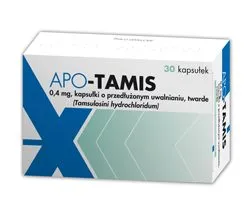
Table of Contents
Package leaflet: Information for the patient
Apo-Tamis, 0.4 mg, prolonged-release capsules, hard
Tamsulosini hydrochloridum
Please read carefully the entire leaflet before using the medicine, as it contains
important information for the patient.
- Keep this leaflet, so that you can read it again if necessary.
- If you have any questions, please consult your doctor or pharmacist.
- This medicine has been prescribed for a specific individual. Do not pass it on to others. The medicine may harm another person, even if their symptoms are the same.
- If you experience any adverse reactions, including those not listed in this leaflet, inform your doctor or pharmacist. See section 4.
Table of contents of the leaflet:
- What Apo-Tamis is and what it is used for
- Important information before taking Apo-Tamis
- How to take Apo-Tamis
- Possible side effects
- How to store Apo-Tamis
- Contents of the pack and other information
1. What Apo-Tamis is and what it is used for
The active substance in Apo-Tamis is tamsulosin. Tamsulosin is a selective antagonist of
alpha-adrenergic receptors. Tamsulosin reduces the tone of smooth muscles in the prostate gland and
the urethra, facilitating urine flow through the urethra and urination. In addition,
it reduces the sensation of urinary urgency.
Apo-Tamis is used in men for the treatment of lower urinary tract symptoms associated with
enlargement of the prostate gland (benign prostatic hyperplasia). These symptoms may include
difficulty urinating (weak stream), dribbling after urination, sudden urge to urinate, and increased
frequency of urination both during the night and during the day.
2. Important information before using Apo-Tamis
When not to use Apo-Tamis
- if the patient has hypersensitivity (allergy) to tamsulosin or to any of the other ingredients of this medicine (listed in section 6). Hypersensitivity may manifest as sudden local swelling of soft tissues (e.g. throat or tongue), difficulty in breathing and/or itching and rash (angioedema).
- if the patient has severe hepatic impairment.
- if the patient has low blood pressure upon changing position (sitting or standing up), which may cause fainting.
Warnings and precautions
Before starting treatment with Apo-Tamis, discuss this with your doctor or pharmacist.
- Regular medical check-ups are necessary to monitor the course of the disease.
- While taking Apo-Tamis, as with other drugs of this type, fainting may rarely occur. If dizziness or weakness occurs, the patient should sit or lie down until symptoms resolve.
- If the patient has severe renal impairment, this should be reported to the doctor.
- If the patient is scheduled for surgery due to cataract or increased intraocular pressure (glaucoma), the patient should inform the doctor that he has been taking, is currently taking, or
intends to take Apo-Tamis. The doctor may take appropriate precautions, taking into
account concomitant medications and surgical techniques. When preparing for cataract
surgery or surgical treatment of increased intraocular pressure (glaucoma), the patient
should ask the doctor whether treatment with Apo-Tamis should be postponed or temporarily
discontinued.
- Do not use tamsulosin concomitantly with drugs known as strong CYP3A4 inhibitors in patients who are CYP2D6 poor metabolizers. Consult your doctor before taking any other medicines.
Children and adolescents
This medicine should not be used in children and adolescents under 18 years of age, as it is not effective
in this population.
Apo-Tamis and other medicines
Inform your doctor or pharmacist about all medicines the patient is currently taking or has recently taken, as well as any medicines the patient plans to use. This includes also medicines available without prescription.
Inform your doctor or pharmacist if the patient is taking any of the following medicines
Concomitant use of tamsulosin with other drugs of the same class (alpha receptor antagonists, e.g.
doxazosin, prazosin or alfuzosin) may cause undesirable lowering of blood pressure.
Inform your doctor about all recently taken medicines that may reduce tamsulosin elimination from the body (e.g. ketoconazole, erythromycin).
Concomitant use with diclofenac or warfarin may increase tamsulosin elimination.
Apo-Tamis with food and drink
Apo-Tamis should be taken after breakfast or after the first meal of the day, with a glass of water.
Pregnancy and breastfeeding
Apo-Tamis is not indicated for use in women.
Effect on fertility
Retrograde ejaculation has been reported during treatment with tamsulosin.
Driving and operating machinery
Apo-Tamis may cause dizziness. Do not drive, use tools or operate machinery until the patient knows how Apo-Tamis affects him. If in doubt, consult your doctor or pharmacist.
If any of the above apply to the patient (or if there are any doubts), consult your doctor or pharmacist before using Apo-Tamis.
Apo-Tamis contains sodium
This medicine contains less than 1 mmol of sodium (23 mg) per capsule, which means it is essentially "sodium-free".
3. How to use Apo-Tamis
This medicine should always be taken as directed by a doctor or pharmacist. In case of
doubt, contact your doctor or pharmacist.
- The usual dose is one capsule per day.
Apo-Tamis should be taken after breakfast or after the first meal of the day, with a glass of water.
The capsule should be swallowed whole and not chewed or crushed, as this would disrupt the
ability for the active substance to be released gradually. However, the capsule may be opened and
its contents swallowed without chewing.
Taking more than the recommended dose of Apo-Tamis
If a patient takes more than the recommended dose of Apo-Tamis, undesirable effects such as
a drop in blood pressure, increased heart rate, or a feeling of fainting may occur. In case of
accidental overdose, contact a doctor as soon as possible.
Missing a dose of Apo-Tamis
If a patient forgets to take a dose of Apo-Tamis as directed, they may take it later on the same
day. If a capsule has not been taken on a given day, treatment should continue according to the
previous dosing schedule. Do not take a double dose to make up for a missed dose (capsule).
Stopping Apo-Tamis treatment
If treatment with Apo-Tamis is stopped too early, symptoms of the disease may return. Therefore,
Apo-Tamis should be taken for as long as prescribed by the doctor, even if symptoms have
disappeared. Always consult your doctor before stopping treatment.
If you have any further questions about the use of this medicine, consult your doctor or pharmacist.
4. Possible adverse effects
Like all medicines, Apo-Tamis may cause adverse effects, although not everyone experiences them. The following adverse effects have been reported during use of this medicine:
Common (may occur in up to 1 in 10 patients):
Dizziness, blurred vision, visual disturbances, abnormal ejaculation (retrograde ejaculation) or ejaculation disorders, low volume or absence of semen during ejaculation (inability to ejaculate).
Uncommon (may occur in up to 1 in 100 patients):
Headache, palpitations (awareness of a fast or irregular heartbeat), dizziness especially when sitting or standing up from a lying position, nasal mucosal inflammation, gastrointestinal reactions (constipation, diarrhoea, nausea, vomiting), allergic reactions (rash, itching, urticaria), weakness.
Rare (may occur in up to 1 in 1000 patients):
Fainting and sudden localized swelling of soft tissues (e.g. throat or tongue), breathing difficulties, and/or itching and rash, often due to an allergic reaction (angioedema).
Treatment should be stopped immediately. Therapy may be resumed after resolution of skin reactions and consultation with a physician.
Very rare (may occur in up to 1 in 10,000 patients):
Priapism (prolonged and painful penile erection requiring immediate treatment). Rash, a disease characterized by inflammation and blister formation on the skin and/or mucous membranes around the mouth, eyes, nose and genital organs (Stevens-Johnson syndrome).
If a patient is undergoing cataract surgery (clouding of the eye's lens) and is currently taking or has taken Apo-Tamis, poor pupil dilation and iris flaccidity (floppy iris syndrome – the coloured circular part of the eye) may occur during the procedure.
Not known (frequency cannot be estimated from available data):
Irregular, disturbed heart rhythm (atrial fibrillation, arrhythmia, tachycardia), difficulty breathing (dyspnoea), nosebleeds, itchy skin rash, often with target-like lesions (dark center surrounded by a lighter ring with a dark ring at the edge – erythema multiforme), a skin-shedding disease characterized by extensive peeling and redness of the skin (exfoliative dermatitis), dry mouth.
Reporting of adverse effects
If any adverse effects occur, including any not listed in this leaflet, inform your doctor or pharmacist. Adverse effects can be reported directly to the Department of Monitoring Adverse Drug Reactions, Office for Registration of Medicinal Products, Medical Devices and Biocidal Products, Al. Jerozolimskie 181C, PL-02 222 Warsaw, tel.: + 48 22 49 21 301, fax: + 48 22 49 21 309, website: https://smz.ezdrowie.gov.pl .
Adverse effects can also be reported to the marketing authorisation holder or its representative in Poland. Reporting adverse effects helps to provide more information on the safety of the medicine.
5. How to store Apo-Tamis
- Keep the medicine out of sight and reach of children.
- Do not store above 30°C.
- Store in the original packaging.
Do not use Apo-Tamis after the expiry date stated on the carton and blister pack following:
Expiry date (EXP). The expiry date refers to the last day of the stated month.
The batch number follows the abbreviation "Lot".
Medicines must not be disposed of via wastewater or household waste. Ask your pharmacist how to dispose of medicines no longer required. These measures help protect the environment.
6. Contents of the pack and other information
What Apo-Tamis contains
- The active substance is tamsulosin hydrochloride. Each prolonged-release capsule contains 0.4 mg of tamsulosin hydrochloride.
- Other ingredients are:
Capsule contents: sodium alginate, methacrylic acid and ethyl acrylate copolymer (1:1), glyceryl dibehenate, maltodextrin, sodium lauryl sulfate, macrogol 6000, polysorbate 80, sodium hydroxide, simethicone aqueous emulsion 30% (simethicone, methylcellulose, sorbic acid), colloidal anhydrous silica.
Capsule shell: Body: titanium dioxide (E171), iron oxide red (E172), iron oxide yellow (E172), gelatin. Cap: titanium dioxide (E171), iron oxide red (E172), iron oxide yellow (E172), gelatin.
What Apo-Tamis looks like and contents of the pack
Orange, gelatin, size 2 capsules containing white or yellowish granules.
Apo-Tamis is available in packs of 30, 90 and 100 capsules.
Not all pack sizes may be marketed.
Marketing Authorisation Holder and Manufacturer
Marketing Authorisation Holder:
Aurovitas Pharma Polska Sp. z o.o.
Sokratesa Street 13D, lok.27
01-909 Warsaw
Poland
Manufacturer:
APL Swift Services (Malta) Limited
HF26, Hal Far Industrial Estate
Hal Far, Birzebbugia, BBG 3000
Malta
This medicinal product is authorised in the European Economic Area countries under the following names:
| Country | Drug name |
| Czech Republic | Tamsulosin Aurovitas |
| Poland | Apo-Tamis |
| Netherlands | TAMSULOSINE HCl AURO RETARD 0,4 mg |