Apo-doxan 4
Poland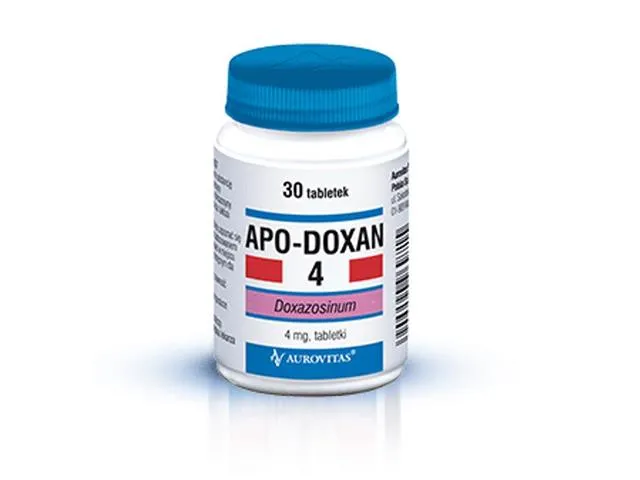
Table of Contents
Package leaflet: Information for the patient
Apo-Doxan 4, 4 mg, tablets
Doxazosinum
Please read all of this leaflet carefully before taking this medicine, because it contains
important information for you.
- Keep this leaflet. You may need to read it again.
- If you have any further questions, please ask your doctor or pharmacist.
- This medicine has been prescribed for a specific individual. Do not pass it on to others. It may harm someone else, even if their symptoms are the same.
- If you experience any adverse reactions, including any not listed in this leaflet, tell your doctor or pharmacist. See section 4.
Leaflet contents
- What Apo-Doxan 4 is and what it is used for
- What you need to know before taking Apo-Doxan 4
- How to take Apo-Doxan 4
- Possible side effects
- How to store Apo-Doxan 4
- Contents of the pack and other information
1. What Apo-Doxan 4 is and what it is used for
Apo-Doxan 4 belongs to a group of medicines called alpha-adrenolytic agents. It acts by dilating blood vessels, reducing peripheral resistance, which leads to a decrease in arterial blood pressure.
Apo-Doxan 4 is also an antagonist of alpha-adrenergic receptors located in the prostate gland and urinary bladder. It reduces symptoms associated with impaired urine flow and improves urodynamic test results (related to urine flow).
Apo-Doxan 4 is indicated for the treatment of:
- essential hypertension,
- clinical symptoms of benign prostatic hyperplasia (BPH).
2. Important information before taking Apo-Doxan 4
When not to use Apo-Doxan 4
- if the patient is allergic to the active substance or to quinazoline derivatives (such as prazosin,
- terazosin), or to any of the other ingredients of this medicine (listed in section 6),
- in patients with a history of orthostatic hypotension,
- in patients with mild benign prostatic hyperplasia accompanied by congestion of the upper urinary tract, chronic urinary tract infections, or bladder stones,
- in patients with arterial hypotension.
Apo-Doxan 4 is contraindicated as monotherapy in patients with bladder overdistension,
anuria without progressive renal failure or with progressive renal failure.
Warnings and precautions
Before starting treatment with Apo-Doxan 4, discuss this with your doctor or pharmacist.
- At the beginning of treatment, orthostatic hypotension may occur, manifesting as dizziness, weakness, and rarely fainting. Your doctor may recommend monitoring blood pressure at the start of therapy.
- In patients with severe heart disease (pulmonary edema caused by aortic stenosis or mitral valve stenosis, heart failure with high cardiac output, right ventricular heart failure due to pulmonary embolism or pericardial effusion, left ventricular heart failure with low filling pressure), rapid and significant reduction in blood pressure may exacerbate angina symptoms.
- Administration of doxazosin is not recommended in patients with diagnosed liver impairment.
- In patients concurrently taking PDE-5 inhibitors (e.g., sildenafil, tadalafil, vardenafil – medicines used for erectile dysfunction), symptomatic arterial hypotension may occur.
- Prolonged, painful erections (priapism) may very rarely occur. In such a case, contact a doctor immediately.
- Before starting treatment with Apo-Doxan 4, your doctor may perform tests aimed at excluding other diseases, including prostate cancer, which causes symptoms similar to those of benign prostatic hyperplasia.
Use in patients undergoing cataract surgery
During cataract surgery, "intraoperative floppy iris syndrome" (a variant of small pupil syndrome) has been observed in some patients currently or previously taking tamsulosin. Inform your ophthalmologist before the procedure that you are taking alpha-adrenergic blocking medications.
Consult your doctor, even if the above warnings concern conditions that occurred in the past.
Children and adolescents
Apo-Doxan 4 is not recommended for use in children and adolescents under 18 years of age, as safety and efficacy have not yet been established in this age group.
Apo-Doxan 4 and other medicines
Tell your doctor or pharmacist about all medicines you are currently taking or have recently taken, as well as any medicines you plan to take.
Ask your doctor or pharmacist before taking Apo-Doxan 4 if you are using any of the following medicines, as they may alter the effect of Apo-Doxan 4:
- medicines known as PDE-5 inhibitors, used to treat erectile dysfunction, e.g., sildenafil, tadalafil, vardenafil (see section "Warnings and precautions");
- medicines that lower blood pressure;
- medicines used to treat bacterial or fungal infections, e.g., clarithromycin, itraconazole, ketoconazole, telithromycin, voriconazole;
- medicines used to treat HIV, e.g., indinavir, nelfinavir, ritonavir, saquinavir;
- nefazodone, a medicine used to treat depression;
- vasodilators or nitrates (medicines used for heart conditions).
The blood pressure-lowering effect of doxazosin may be reduced by:
- NSAIDs (non-steroidal anti-inflammatory drugs),
- estrogens,
- sympathomimetics.
Doxazosin may reduce the effect of dopamine, ephedrine, epinephrine, metaraminol, methoxamine, and phenylephrine on blood pressure and blood vessels. As there are no data on interactions with drugs affecting hepatic metabolism (e.g., cimetidine), particular caution is advised when administering these drugs with doxazosin.
In vitro studies have shown that doxazosin does not affect the plasma protein binding of digoxin, warfarin, phenytoin, or indomethacin.
In clinical trials, no interactions were observed between doxazosin and thiazide diuretics, furosemide, beta-blockers, non-steroidal anti-inflammatory drugs, antibiotics, oral hypoglycemic agents (used in diabetes), uricosuric agents, and anticoagulants. Doxazosin may increase plasma renin activity and urinary excretion of vanillylmandelic acid. This should be taken into account when interpreting laboratory test results.
Doxazosin enhances the blood pressure-lowering effect of other alpha-adrenergic blocking agents and other antihypertensive drugs.
Clinical studies have shown that doxazosin has a beneficial effect on lipids, significantly reducing total triglyceride, total cholesterol, and LDL cholesterol levels in plasma. Treatment with doxazosin favorably affects hypertension and lipid levels, thereby reducing the risk of coronary artery disease.
Some patients taking alpha-adrenergic blocking agents for high blood pressure or enlarged prostate may experience dizziness or a sensation of emptiness in the head, which may be caused by a sudden drop in blood pressure due to rapid changes in body position when sitting or standing up. Some patients have experienced these symptoms while taking alpha-adrenergic blocking agents together with medicines used for erectile dysfunction (impotence). To reduce the likelihood of these symptoms, it is recommended to take daily doses of alpha-adrenergic blocking agents regularly before starting treatment with erectile dysfunction medicines.
Pregnancy and breastfeeding
If you are pregnant, breastfeeding, think you may be pregnant, or are planning to have a child, you should consult your doctor or pharmacist before taking this medicine.
The use of doxazosin has not been evaluated in pregnant women.
Doxazosin passes into human milk in small amounts. Breastfeeding women should not take this medicine unless otherwise directed by a doctor.
Driving and operating machinery
Due to individual responses to doxazosin, the ability to perform activities such as driving vehicles or operating machinery, or performing specific types of work requiring balance, may be impaired, especially at the beginning of treatment, after dose increase, when switching to another medicine, or when consuming alcohol.
Apo-Doxan 4 contains lactose.
If you have been previously diagnosed with an intolerance to certain sugars, you should contact your doctor before taking this medicine.
Apo-Doxan 4 contains sodium.
The medicine contains less than 1 mmol (23 mg) of sodium per tablet, meaning the medicine is considered "sodium-free".
3. How to use Apo-Doxan 4
This medicine should always be taken exactly as prescribed by the doctor. In case of doubt, consult your
doctor or pharmacist.
Essential hypertension
The initial dose is 1 mg once daily. Depending on efficacy, after 1–2 weeks the doctor may increase the
dose to 2 mg doxazosin once daily, then to 4 mg doxazosin once daily, and finally to 8 mg doxazosin once daily. The average maintenance dose ranges from 2 to 4 mg doxazosin once daily.
The maximum recommended dose is 16 mg doxazosin per day.
The following dosing schedule is recommended when starting treatment:
day 1–8: 1 mg doxazosin in the morning
day 9–14: 2 mg doxazosin in the morning
Thereafter, the dose should be increased gradually to an effective maintenance dose.
Benign prostatic hyperplasia (BPH)
The initial dose is 1 mg once daily. If necessary, after one to two weeks the doctor may increase the dose
to 2 mg doxazosin once daily, and subsequently to 4 mg doxazosin once daily.
The maximum recommended dose is 8 mg doxazosin once daily.
The following dosing schedule is recommended when starting treatment:
day 1–8: 1 mg doxazosin once daily
day 9–14: 2 mg doxazosin once daily
Thereafter, the dose may be individually increased to an effective maintenance dose.
Use in children and adolescents
Apo-Doxan 4 is not recommended for use in children and adolescents under 18 years of age.
Patients with renal function impairment
There is no need to adjust the dose in patients with impaired renal function. However, the dose should
be kept as low as possible, and any dose increase should be performed under strict medical supervision.
Patients with hepatic function impairment
Extreme caution is required. There is no clinical experience with the use of this medicine in patients
with severe hepatic impairment.
Elderly patients
There is no need to adjust the dose in elderly patients. However, the dose should be kept as low as
possible, and any dose increase should be performed under strict medical supervision.
Use of a higher than recommended dose of Apo-Doxan 4
Hypotension may occur after overdose.
If a higher than recommended dose of Apo-Doxan 4 has been taken, contact a doctor immediately.
Depending on the symptoms present, the doctor will initiate appropriate treatment. Since doxazosin is
98% protein-bound, dialysis is not indicated as a treatment method for overdose.
Missed dose of Apo-Doxan 4
If a patient forgets to take Apo-Doxan 4, they should take it as soon as possible, unless it is almost time
for the next dose. In that case, the next dose should be taken at the scheduled time. A double dose should
not be taken to make up for a missed dose.
4. Possible adverse reactions
Like all medicines, this medicine can cause adverse reactions, although not everyone will experience them.
The following adverse reactions may occur:
Common adverse reactions (which may occur in more than 1 in 100 patients)
Respiratory tract infections, urinary tract infections, somnolence, dizziness, headache, accommodation disorders, vertigo, palpitations, tachycardia, chest pain, hypotension, orthostatic hypotension, oedema, bronchitis, cough, dyspnoea, rhinitis, abdominal pain, dyspepsia, dry mouth, nausea, pruritus, back pain, muscle pain, cystitis, urinary incontinence, increased urge to urinate, pollakiuria, asthenia, influenza-like symptoms, generalized oedema, peripheral oedema.
Uncommon adverse reactions (which may occur in more than 1 in 1,000 patients)
Allergic reactions, anorexia, gout, thirst, increased appetite, restlessness, insomnia, nervousness, agitation, depression, emotional lability, stroke, hypothyroidism, fainting, tremor, apathy, lacrimation, photophobia, tinnitus, myocardial infarction, syncope, angina pectoris, peripheral ischaemia, pharyngitis, epistaxis, constipation, flatulence and passage of flatus, vomiting, gastritis and enteritis, diarrhoea, abnormal liver function test results, increased liver enzyme activity, rash, joint pain, dysuria, urinary frequency disorders, haematuria, impotence, pain, fever, chills, facial oedema, hot flushes, pallor, hypokalaemia, weight gain.
Rarely reported adverse reactions (which may occur in more than 1 in 10,000 patients)
Cerebrovascular disorders, laryngeal oedema, polyuria, hypoglycaemia.
Very rarely reported adverse reactions (which may occur in less than 1 in 10,000 patients)
Leukopenia, thrombocytopenia, anaemia, hypersensitivity, muscle stiffness, taste disturbances, nightmares, memory loss, orthostatic dizziness, paraesthesia, blurred vision, bradycardia, cardiac arrhythmias, flushing, bronchospasm, hepatitis, cholestasis, jaundice, urticaria, alopecia, purpura, muscle cramps, muscle weakness, urinary disorders, increased creatinine concentration in urine and plasma, increased diuresis, nocturia, gynaecomastia, fatigue, malaise, decreased body temperature in elderly patients.
Prolonged, painful erection. Seek immediate medical advice.
Frequency not known (cannot be estimated from available data)
Intraoperative floppy iris syndrome, retrograde ejaculation.
Reporting of adverse reactions
If any adverse reactions occur, including any not listed in this leaflet, inform your doctor, pharmacist, or nurse. Adverse reactions can be reported directly to the Department of Monitoring of Adverse Drug Reactions of the Office for Registration of Medicinal Products, Medical Devices and Biocidal Products, Al. Jerozolimskie 181C, PL-02 222 Warsaw, Tel.: + 48 22 49 21 301, Fax: + 48 22 49 21 309, website: https://smz.ezdrowie.gov.pl Adverse reactions can also be reported to the marketing authorisation holder. Reporting adverse reactions helps provide more information on the safety of the medicine.
5. How to store Apo-Doxan 4
Store below 25°C.
Keep the medicine out of sight and reach of children.
Do not use this medicine after the expiry date stated on the label after: ‘Expiry date’.
Medicines should not be disposed of via wastewater or household waste. Ask your pharmacist how to dispose of medicines no longer required. These measures will help protect the environment.
6. Contents of the pack and other information
What Apo-Doxan 4 contains
- The active substance is doxazosin. Each tablet contains the active substance 4 mg of doxazosin in the form of doxazosin mesylate.
- The other ingredients are: microcrystalline cellulose, lactose monohydrate, sodium croscarmellose, magnesium stearate.
What Apo-Doxan 4 looks like and contents of the pack
White, biconvex diamond-shaped tablets, marked with "APO" on one side and "D4" on the other.
The pack contains 30 or 60 tablets.
Marketing Authorisation Holder and Manufacturer/Importer
Marketing Authorisation Holder:
Aurovitas Pharma Polska Sp. z o.o.
ul. Sokratesa 13D lok.27
01-909 Warszawa
Poland
Manufacturer:
Generis Farmacêutica, S.A.
Rua João de Deus, no 19
Venda Nova, 2700-487 Amadora
Portugal
Importer:
APL Swift Services (Malta) Limited
HF26, Hal Far Industrial Estate, Hal Far
Birzebbugia, BBG 3000
Malta
For further information, please contact the Marketing Authorisation Holder:
Aurovitas Pharma Polska Sp. z o.o.
Tel.: (22) 311 20 00