Apap pain and fever c plus
Poland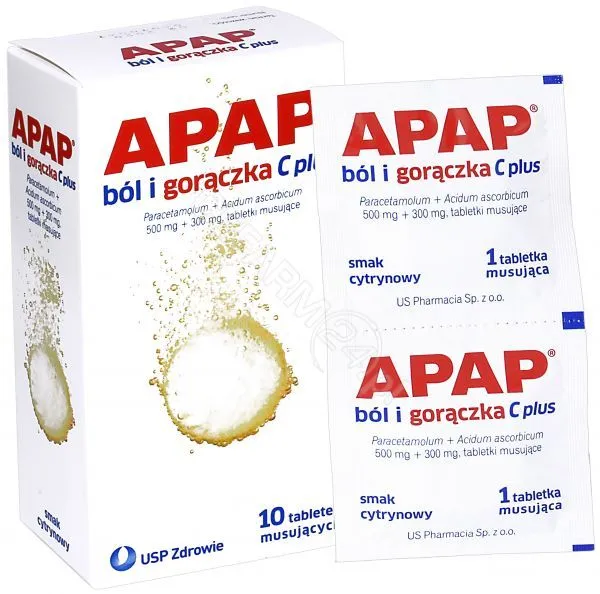
Table of Contents
- Patient Information Leaflet
- 1. What APAP pain and fever C plus is and what it is used for
- 2. Important information before taking APAP pain and fever C plus
- 3. How to use the medicine APAP ból i gorączka C plus
- 4. Possible side effects
- 5. How to store APAP ból i gorączka C plus
- 6. Contents of the pack and other information
Patient Information Leaflet
APAP pain and fever C plus
500 mg + 300 mg, effervescent tablets
Paracetamolum + Acidum ascorbicum
Please read all of this leaflet carefully before taking this medicine, because it contains
important information for you.
Always use this medicine exactly as described in this leaflet or as directed by your doctor or pharmacist.
- Keep this leaflet, as you may need to read it again.
- If you need advice or further information, please contact your pharmacist.
- If you experience any side effects, including any possible side effects not listed in this leaflet, tell your doctor or pharmacist. See section 4.
- If there is no improvement after 5 days of treatment for pain or 3 days for fever, or if you feel worse, consult your doctor.
Leaflet Contents
1. What APAP pain and fever C plus is and what it is used for
2. Important information before taking APAP pain and fever C plus
3. How to take APAP pain and fever C plus
4. Possible side effects
5. How to store APAP pain and fever C plus
6. Contents of the pack and other information
1. What APAP pain and fever C plus is and what it is used for
APAP pain and fever C plus contains paracetamol and vitamin C. Paracetamol has analgesic and antipyretic properties. Ascorbic acid (vitamin C) helps correct vitamin C deficiency and supports the body's immune response during viral infections.
APAP pain and fever C plus is indicated for short-term relief of pain and/or fever.
If there is no improvement after 5 days of treatment for pain or 3 days for fever, or if you feel worse, consult your doctor.
2. Important information before taking APAP pain and fever C plus
Do not take APAP pain and fever C plus if:
- you are allergic to paracetamol, ascorbic acid, or any of the other ingredients listed in section 6;
- you have any of the following conditions:
- glucose-6-phosphate dehydrogenase deficiency (a hereditary enzyme deficiency),
- severe liver or kidney failure,
- viral hepatitis,
- urinary tract stones (urolithiasis),
- alcoholic liver disease,
- phenylketonuria (due to the presence of aspartame);
- you are undergoing treatment with zidovudine or monoamine oxidase inhibitors (MAO inhibitors used in HIV therapy or depression), or within 2 weeks after stopping these medications;
- you are pregnant or breastfeeding;
- you are under 12 years of age.
Warnings and precautions
Talk to your doctor or pharmacist before taking APAP pain and fever C plus.
Contact your doctor immediately during treatment if you:
- have severe underlying diseases, including severe kidney dysfunction or sepsis (when bacteria and their toxins circulate in the blood, leading to organ damage), malnutrition, chronic alcoholism, or if you are also taking flucloxacillin (an antibiotic).
In such cases, severe metabolic acidosis (a disturbance in blood and body fluid balance) has been reported in patients taking paracetamol regularly over a long period or taking paracetamol together with flucloxacillin.
Symptoms of metabolic acidosis may include: serious breathing difficulties, including rapid deep breathing, drowsiness, nausea, and vomiting.
When to exercise special caution with APAP pain and fever C plus:
- if you consume alcohol excessively or are fasting, as this increases the risk of liver damage;
- if you have liver or kidney impairment, bronchial asthma, hemochromatosis (a disorder of iron metabolism), or are on a low-sodium diet.
Children
Use in children under 12 years of age is contraindicated.
APAP pain and fever C plus with other medicines
Tell your doctor or pharmacist about all medicines you are currently taking, have recently taken, or plan to take.
Do not take this medicine simultaneously with:
- other medicines containing paracetamol (a common ingredient in many cold and flu remedies) or vitamin C;
- drugs that accelerate or delay gastric emptying (e.g. metoclopramide or propantheline);
- monoamine oxidase inhibitors (MAO inhibitors, see Do not take APAP pain and fever C plus if).
Consult your doctor or pharmacist before using APAP pain and fever C plus together with:
- anticoagulants (e.g. warfarin, coumarin),
- zidovudine (an HIV medication; concomitant use is contraindicated),
- rifampicin, isoniazid (medications used in tuberculosis treatment),
- antiepileptic drugs, e.g. phenytoin, carbamazepine,
- sedatives and hypnotics, e.g. phenobarbital,
- medicines containing aluminium (used to relieve heartburn), iron (used to prevent or treat anaemia),
- chloramphenicol (an antibiotic),
- chlorzoxazone (a skeletal muscle relaxant).
Inform your doctor or pharmacist if you are taking:
- flucloxacillin (an antibiotic), due to the serious risk of blood and body fluid disturbances (called metabolic acidosis), which require urgent treatment (see section 2).
This medicine may cause false results in certain laboratory tests (e.g. glucose or creatinine measurements).
APAP pain and fever C plus with food, drink or alcohol
Taking the medicine with food may reduce its absorption.
Do not drink alcohol while taking this medicine, due to increased risk of liver damage. The risk is particularly high in fasting individuals and regular alcohol consumers.
Pregnancy, breastfeeding and fertility
If you are pregnant or breastfeeding, think you may be pregnant, or are planning to have a baby, consult your doctor or pharmacist before using this medicine.
Driving and using machines
APAP pain and fever C plus has no effect on the ability to drive or operate machinery.
The medicine contains excipients with known effects:
Aspartame (E 951)
Each effervescent tablet contains 15 mg of aspartame. Aspartam is a source of phenylalanine.
It may be harmful to patients with phenylketonuria. This is a rare genetic disorder in which phenylalanine accumulates in the body due to impaired excretion.
Sodium
Each effervescent tablet contains 375 mg of sodium (the main component of table salt).
This corresponds to 18.75% of the maximum recommended daily sodium intake in the adult diet.
Glucose and sucrose
The medicine contains glucose (from maltodextrin in flavourings) and sucrose (from flavourings).
If you have previously been diagnosed with intolerance to certain sugars, consult your doctor before taking this medicine.
3. How to use the medicine APAP ból i gorączka C plus
This medicine should always be used exactly as described in this patient leaflet or as directed by a doctor or pharmacist. If in doubt, consult your doctor or pharmacist.
Use in children and adolescents
Use in children under 12 years of age is contraindicated.
Adults and adolescents over 12 years of age
One tablet at a time. Take every 4–6 hours.
Do not use more than 3 tablets per day.
Before taking, dissolve the tablet in ½ glass of water.
Use of a higher than recommended dose of APAP ból i gorączka C plus
If more than the recommended dose has been taken, stop taking the medicine immediately and contact a doctor or the nearest hospital emergency department without delay.
Bring the package leaflet and the medicine packaging with you.
Management in case of overdose:
- if the patient is conscious and less than one hour has passed since the overdose, induce vomiting;
- administer 60–100 g of activated charcoal orally, preferably mixed with water. Antidotes: N-acetylcysteine, methionine, within 24 hours after overdose.
Overdose of paracetamol may cause severe liver damage, particularly in individuals who have previously been fasting or who are chronic alcohol users.
Symptoms may include nausea, vomiting, excessive sweating, drowsiness, and general weakness. These symptoms may resolve the following day, even though liver damage may have started to develop, later manifesting as upper abdominal pain, recurrence of nausea, and jaundice.
Missed dose of APAP ból i gorączka C plus
APAP ból i gorączka C plus is intended for immediate, short-term relief of pain and/or fever symptoms.
If a dose is missed and symptoms persist, take the next dose as scheduled. Do not take a double dose to make up for a missed dose.
Stopping treatment with APAP ból i gorączka C plus
If you have any further questions about the use of this medicine, consult your doctor or pharmacist.
4. Possible side effects
Like all medicines, APAP ból i gorączka C plus can cause side effects, although they may not occur in
every individual. These include:
Uncommon side effects (occurring in 1 to 10 out of 1,000 patients taking the medicine):
- Skin and subcutaneous tissue disorders: erythematous, urticarial skin reactions and skin redness.
Rare side effects (occurring in 1 to 10 out of 10,000 patients taking the medicine):
Immune system disorders: allergic reactions such as Quincke's edema, shortness of breath,
bronchospasm, profuse sweating, nausea, drop in blood pressure up to shock symptoms;
Gastrointestinal disorders: nausea, vomiting.
Very rare side effects (occurring in fewer than 1 out of 10,000 patients
taking the medicine):
Severe skin reactions presenting as acute generalized pustular rash over the entire body
or blisters and erosions on the skin, in the mouth, eyes and genital organs,
fever and joint pain, or rupturing giant blisters,
extensive skin erosions, large-scale peeling of the epidermis, along with fever;
Blood and lymphatic system disorders:
thrombocytopenia (reduced number of platelets),
leukopenia (decreased number of white blood cells in blood),
agranulocytosis (absence of granulocytes in blood),
granulocytopenia (reduced number of granulocytes in blood),
neutropenia (reduced number of neutrophil granulocytes),
hemolytic anemia (rapid breakdown of red blood cells);
Hepatobiliary disorders: liver damage;
Renal and urinary disorders: renal colic, renal papillary necrosis, acute kidney failure, nephrolithiasis.
Side effects with unknown frequency (cannot be estimated from available data):
a serious condition which may lead to blood acidification (so-called metabolic acidosis)
in patients with severe disease taking paracetamol (see section 2).
Reporting of side effects
If any side effects occur, including any side effects not listed in this leaflet, inform your doctor or pharmacist.
Side effects can be reported directly to the Department of Monitoring of Adverse Drug Reactions at the Office for Registration of Medicinal Products, Medical Devices and Biocidal Products
Al. Jerozolimskie 181C, 02-222 Warsaw
Tel.: + 48 (22) 492 13 01,
Fax: + 48 (22) 492 13 09
Website: https://smz.ezdrowie.gov.pl
Side effects can also be reported to the marketing authorization holder.
Reporting side effects helps provide more information on the safety of this medicine.
5. How to store APAP ból i gorączka C plus
Store the medicine below 25 °C.
Keep the medicine out of the sight and reach of children.
Do not use the medicine after the expiry date stated on the packaging.
The expiry date refers to the last day of the specified month.
Labelling on the immediate packaging: EXP - expiry date, Lot - batch number.
Medicines must not be disposed of via wastewater or household waste. Ask your pharmacist how to dispose of medicines no longer required. This will help protect the environment.
6. Contents of the pack and other information
What APAP ból i gorączka C plus contains
The active substances are: Each tablet contains 500 mg paracetamol and 300 mg ascorbic acid (vitamin C).
The other ingredients are: citric acid, sodium hydrogen carbonate, anhydrous sodium carbonate, povidone,
Macrogol 6000, lemon flavour 135460 (containing citral, maltodextrin from waxy maize, sucrose), sodium saccharin, aspartame (E 951), lemon-lime flavour 135459 (containing citral, geraniol, linalool, maize maltodextrin, butylated hydroxyanisole (E 320)), magnesium stearate, sodium phosphate of riboflavin.
What APAP ból i gorączka C plus looks like and contents of the pack
Moisture-absorbing container with a screw cap, packed in a cardboard box.
Soft blister pack packed in a cardboard box.
Available pack sizes:
Soft blisters in a cardboard box with leaflet:
2 tablets (1 soft blister with 2 tablets)
6 tablets (3 soft blisters with 2 tablets each)
10 tablets (5 soft blisters with 2 tablets each)
20 tablets (10 soft blisters with 2 tablets each)
Containers in a cardboard box with leaflet:
10 tablets (1 container with 10 tablets)
20 tablets (2 containers with 10 tablets each)
Not all pack sizes may be marketed.
Marketing Authorisation Holder and Importer:
US Pharmacia Sp. z o.o.
ul. Ziębicka 40
50-507 Wrocław
or
Manufacturer:
Wörwag Pharma Operations Sp. z o.o.
ul. gen. Mariana Langiewicza 58
95-050 Konstantynów Łódzki
For further information about this medicinal product, please contact:
USP Zdrowie Sp. z o.o.
ul. Poleczki 35
02-822 Warszawa
tel.: + 48 (22) 543 60 00