Antithrombin iii nf takeda
Poland
Table of Contents
- Package leaflet: Information for the user
- 1. What Antithrombin III NF Takeda is and what it is used for
- 2. Important information before using Antithrombin III NF Takeda
- 3. How to use Antithrombin III NF Takeda
- 4. Possible adverse reactions
- 5. How to store Antithrombin III NF Takeda
- 6. Contents of the pack and other information
- Information intended exclusively for healthcare professionals:
Package leaflet: Information for the user
Antithrombin III NF Takeda, 50 IU/ml, powder and solvent for solution for infusion
Human antithrombin III derived from plasma
Please read all of this leaflet carefully before this medicine is administered, because it contains important information for the patient.
- Keep this leaflet, so that you can read it again if necessary.
- If you have any further questions, please ask your doctor or pharmacist.
- If you experience any side effects, including any not listed in this leaflet, please inform your doctor or pharmacist. See section 4.
Contents of the leaflet
- What Antithrombin III NF Takeda is and what it is used for
- Important information before administration of Antithrombin III NF Takeda
- How to use Antithrombin III NF Takeda
- Possible side effects
- How to store Antithrombin III NF Takeda
- Contents of the pack and other information
1. What Antithrombin III NF Takeda is and what it is used for
Antithrombin III NF Takeda is supplied as a pale yellow to pale greenish powder with a solvent for preparation of a solution for infusion.
Antithrombin III NF Takeda is available in packs containing:
- 500 IU antithrombin III and 10 ml solvent or
- 1000 IU antithrombin III and 20 ml solvent
Antithrombin III NF Takeda belongs to the pharmacotherapeutic group of antithrombotic agents.
Antithrombin III NF Takeda is used for the treatment of congenital or acquired antithrombin III deficiency, where acquired deficiency may occur in the course of various clinical disorders.
2. Important information before using Antithrombin III NF Takeda
When not to use Antithrombin III NF Takeda
- if the patient is allergic to antithrombin III or to any of the other ingredients of this medicine (listed in section 6)
- in patients with a history of heparin-induced thrombocytopenia (i.e. reduced platelet count)
Warnings and precautions
Traceability
To improve the traceability of biological medicinal products, the name and batch number of the administered product should be clearly documented.
- Inform the treating physician immediately if first signs of an allergic reaction occur (e.g. urticaria, including generalized urticaria, chest tightness, wheezing, hypotension and anaphylactic shock). Severe symptoms may require emergency treatment.
- Inform the physician if the patient is currently taking or has recently taken heparin-containing medications (e.g. for treatment of thrombosis), as the activity of antithrombin is significantly enhanced by heparin.
- Antithrombin III NF Takeda is manufactured from human plasma. When administering medicines derived from human blood or plasma, the risk of transmitting infectious agents cannot be completely excluded, including pathogens not yet known. However, the risk of transmission of infectious agents is reduced by careful selection of donors and plasma, screening of plasma pools, and by virus inactivation/removal procedures.
Children
Do not use this medicine in children under 6 years of age, as safety and efficacy have not yet been established in this age group.
Antithrombin III NF Takeda and other medicines
Inform the physician about all medicines the patient is currently taking or has recently taken, as well as any medicines the patient intends to take.
Inform the physician about any heparin-containing medicines currently used or recently taken (e.g. for treatment of thrombosis), as the activity of antithrombin is significantly enhanced by heparin.
Pregnancy, breastfeeding and fertility
Inform the physician if the patient is pregnant or breastfeeding. The physician will decide whether it is possible to use Antithrombin III NF Takeda during pregnancy or breastfeeding.
If the patient is pregnant or breastfeeding, suspects she may be pregnant, or is planning to become pregnant, she should consult a physician or pharmacist before using this medicine.
Driving and operating machinery
Although no effect on the ability to drive or operate machinery has been observed, such an effect cannot be ruled out. Therefore, it is recommended that patients do not drive or operate machinery without prior consultation with their physician.
Antithrombin III NF Takeda contains sodium
500 IU/10 ml
The medicine contains 37.7 mg of sodium (a main component of table salt) per vial. This corresponds to 1.9% of the WHO recommended maximum daily intake of 2 g of sodium for adults.
1000 IU/20 ml
The medicine contains 75.5 mg of sodium (a main component of table salt) per vial. This corresponds to 3.8% of the WHO recommended maximum daily intake of 2 g of sodium for adults.
3. How to use Antithrombin III NF Takeda
Antithrombin III NF Takeda will be administered exclusively under medical supervision. The dose will depend on body weight and the individual requirements of the patient. Your doctor will determine the dose to be administered. Antithrombin III NF Takeda is given by intravenous infusion.
Use of more than the recommended dose of Antithrombin III NF Takeda
Symptoms of overdose have not been reported.
Missed dose of Antithrombin III NF Takeda
Not applicable.
Stopping Antithrombin III NF Takeda
Not applicable.
4. Possible adverse reactions
Like all medicines, this medicine can cause adverse reactions, although not everyone will experience them.
Adverse reactions observed after Antithrombin III NF Takeda was placed on the market include hypersensitivity, anaphylactic reaction, tremor, and hot flushes.
- Hypersensitivity or allergic reactions such as angioedema, burning and stinging at the infusion site, chills, hot flushes, generalized urticaria, headache, pruritic rash, hypotension, somnolence, nausea, restlessness, tachycardia, chest tightness, paresthesia, vomiting, and wheezing have been observed rarely, but may in some cases progress to severe anaphylactic reaction (including shock).
- Fever has been observed rarely.
- Thrombocytopenia (i.e. decreased platelet count), mediated by heparin-induced antibodies, may occur rarely. A decrease in platelet count below 100,000/µL or a reduction in platelet count by 50% has been observed.
If any of the adverse reactions worsen or if any adverse reactions not listed in this leaflet occur, inform your doctor.
Reporting of adverse reactions
If any adverse reactions occur, including those not listed in this leaflet, inform your doctor or pharmacist. Adverse reactions can be reported directly to the Department of Monitoring Adverse Drug Reactions at the Office for Registration of Medicinal Products, Medical Devices and Biocidal Products:
Al. Jerozolimskie 181C
02-222 Warsaw
Phone: +48 22 4921 301
Fax: +48 22 4921 309
Website: https://smz.ezdrowie.gov.pl
Adverse reactions can also be reported to the marketing authorization holder.
Reporting adverse reactions helps to provide more information on the safety of this medicine.
5. How to store Antithrombin III NF Takeda
Keep this medicine out of the sight and reach of children.
Store in a refrigerator (2°C to 8°C). Do not freeze.
Store in the original packaging to protect from light.
Do not use this medicine after the expiry date stated on the label and carton after EXP. The expiry date refers to the last day of the stated month.
Do not use this medicine if the solution is cloudy or contains particles.
Medicines must not be disposed of via wastewater or household waste. Ask your pharmacist how to dispose of medicines no longer required. These measures will help protect the environment.
6. Contents of the pack and other information
What Antithrombin III NF Takeda contains
- The active substance is human antithrombin III derived from plasma
- The other components are glucose, sodium chloride, disodium citrate dihydrate and tris(hydroxymethyl)aminomethane
What Antithrombin III NF Takeda looks like and contents of the pack
Antithrombin III NF Takeda is a lyophilised powder for solution for infusion, containing nominally 500 IU (or 1000 IU) of antithrombin derived from human plasma per vial, together with solvent.
500 IU/10 ml
After reconstitution with 10 ml of sterile water for injections, the solution contains approximately 50 IU/ml (500 IU/10 ml) of human antithrombin III from plasma.
1000 IU/20 ml
After reconstitution with 20 ml of sterile water for injections, the solution contains approximately 50 IU/ml (1000 IU/20 ml) of human antithrombin III from plasma.
Antithrombin III NF Takeda is a pale yellow or pale green friable substance or powder.
Each pack also contains:
- 1 transfer needle
- 1 filter needle
- 1 venting needle
- 1 single-use needle
- 1 infusion set
Marketing Authorisation Holder and Manufacturer
Marketing Authorisation Holder
Takeda Pharma Sp. z o.o.
ul. Prosta 68
00-838 Warsaw
Manufacturer
Takeda Manufacturing Austria AG
Industriestrasse 67
1221 Vienna, Austria
Information intended exclusively for healthcare professionals:
Dosage and administration
Treatment should be supervised by a physician experienced in managing patients with antithrombin deficiency.
Dosage
In congenital antithrombin deficiency, the dose should be individually adjusted for each patient, taking into account family history of thromboembolic events, current risk factors, and laboratory test results.
The dosage and duration of replacement therapy in acquired antithrombin deficiency depend on plasma antithrombin levels, presence of signs indicating increased consumption, underlying cause of the disorder, and the clinical severity of the patient's condition. In all cases, the dose and frequency of administration must be determined based on laboratory results and clinical assessment of the patient's condition and response to treatment.
The amount of antithrombin administered is expressed in International Units (IU), referring to the current WHO standard for antithrombin. Plasma antithrombin activity is expressed as a percentage (relative to normal human plasma) or in International Units (referring to the International Standard for plasma antithrombin).
One International Unit (IU) of antithrombin activity corresponds to the amount of antithrombin present in 1 ml of normal human plasma. The required antithrombin dose is calculated based on empirical data showing that administration of 1 IU of antithrombin per kilogram of body weight increases plasma antithrombin activity by approximately 2%.
The initial dose is calculated using the following formula:
Required number of units = body weight (kg) x (Target level – current antithrombin activity [%]) x 0.5
The initial target plasma antithrombin activity depends on the clinical assessment of the patient's condition. Once replacement therapy is indicated, a single dose should achieve the target plasma antithrombin activity and maintain it at the desired level. The administered dose should be determined and monitored based on measurements of antithrombin activity, which should be performed at least twice daily until the patient's condition stabilizes, and thereafter once daily, preferably just before the next infusion. Dose adjustments should take into account both increased antithrombin consumption and laboratory results and clinical symptoms. During treatment, antithrombin activity should be maintained above 80%, unless clinical considerations require a different, effective level.
The average initial dose in congenital deficiency is 30–50 IU/kg body weight.
Subsequently, the dose, frequency of administration, and duration of treatment should be adjusted according to laboratory results and the patient's clinical condition.
Children and adolescents
The safety and efficacy of Antithrombin III NF Takeda in children under 6 years of age have not been established. Therefore, use in this patient group is not recommended.
Route of administration
Administer intravenously. The maximum infusion rate is 5 ml/min.
Special precautions for disposal and preparation of the medicinal product for use
Antithrombin III NF Takeda should be reconstituted immediately before use, as the product does not contain preservatives.
Use only the provided infusion set. Aseptic techniques must be used during solution preparation. The prepared solution should be used immediately after reconstitution.
Before administration, inspect the reconstituted product for insoluble particles and discoloration. The solution should be clear or slightly opalescent. Do not use solutions that are cloudy or contain precipitates.
Do not store in the refrigerator after reconstitution.
Preparation of the solution:
- Bring the vial containing the solvent (water for injections) to room temperature (max. 37°C).
- Remove protective caps from both the powder and solvent vials (Fig. A) and disinfect the rubber stoppers of both vials.
- Remove the protective cap from one end of the transfer needle by twisting and pulling (Fig. B). Insert the exposed end of the needle into the rubber stopper of the solvent vial (Fig. C).
- Remove the protective cap from the other end of the transfer needle, taking care not to touch the exposed part.
- Invert the solvent vial and insert the free end of the transfer needle into the stopper of the powder vial (Fig. D). The solvent will be drawn into the powder vial by vacuum.
- Disconnect the vials by removing the needle from the powder vial (Fig. E). Gently swirl the vial to accelerate dissolution.
- After complete dissolution of the powder, insert the provided venting needle (Fig. F) until the foam subsides. Remove the venting needle.
Administration:
- Remove the protective cap from the provided filter needle by twisting and pulling, and attach it to a sterile single-use syringe. Draw the solution into the syringe (Fig. G).
- Detach the filter needle from the syringe and, after attaching the provided single-use needle (or the provided infusion set), administer the solution slowly intravenously (maximum administration rate: 5 ml/min).
If the medicinal product was not filtered during reconstitution, use a single-use infusion set with an appropriate filter (maximum infusion rate: 5 ml/min).
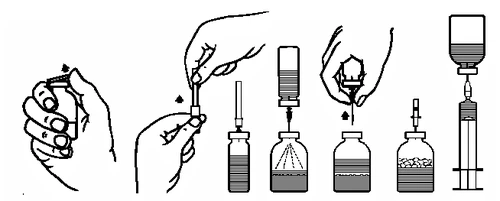
Fig. A Fig. B Fig. C Fig. D Fig. E Fig. F Fig. G
Any unused medicinal product or waste material should be disposed of in accordance with local regulations.
Incompatibilities
This medicinal product must not be mixed with other medicinal products.
Special warnings and precautions for use
As with other protein-containing medicinal products administered by intravenous infusion, administration of Antithrombin III NF Takeda may cause allergic-type hypersensitivity reactions.
Hypersensitivity and anaphylactic reactions have been reported post-marketing for Antithrombin III NF Takeda. In some cases, these may progress to severe anaphylaxis (including anaphylactic shock).
Patients must be closely monitored during infusion and carefully observed for any signs of adverse reactions. Patients should be informed about early symptoms of hypersensitivity reactions, such as itching rash, generalized urticaria, chest tightness, wheezing, hypotension, and anaphylactic shock. If these symptoms occur after administration of the medicinal product, the patient should contact their treating physician immediately.
In the event of shock, standard treatment should be initiated.
Takeda is a registered trademark of Takeda Pharmaceutical Company Limited.