Anosin
Poland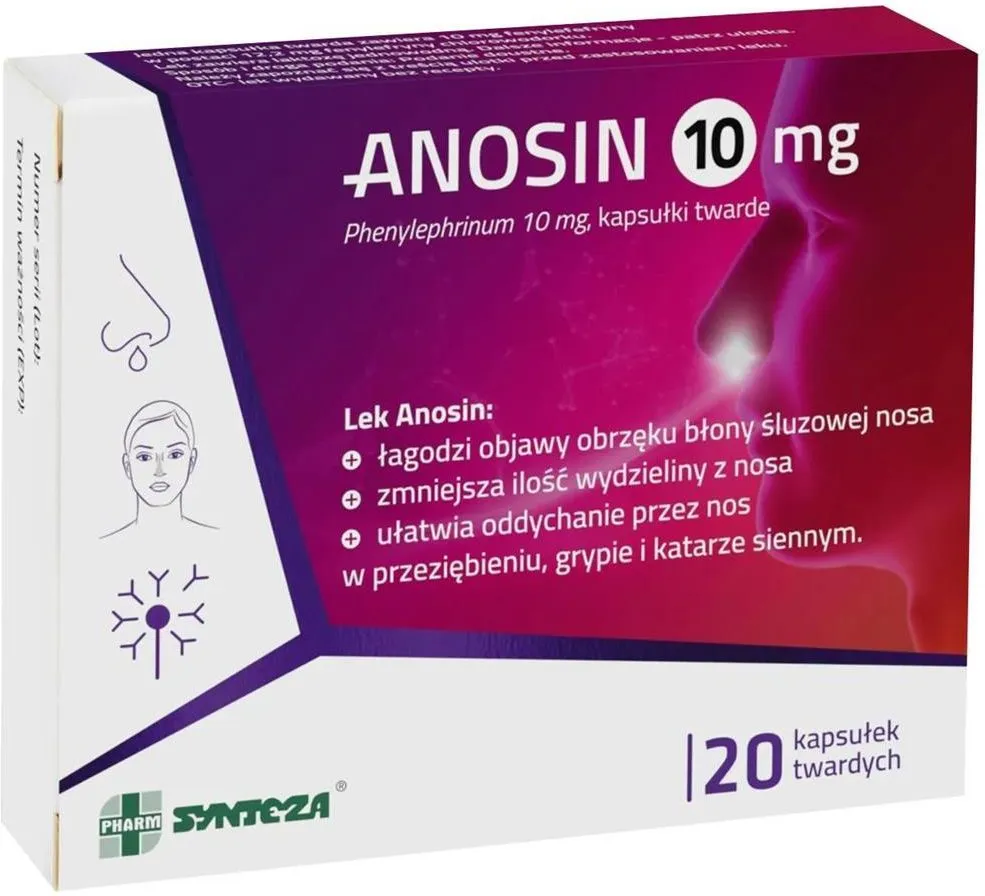
Table of Contents
Package leaflet: Information for the patient
Anosin, 10 mg, hard capsules
Phenylephrinum
Please read all of this leaflet carefully before taking this medicine, because it contains
important information for the patient.
This medicine should always be taken exactly as described in this patient leaflet or as directed by
the doctor, pharmacist, or nurse.
- Keep this leaflet, as you may need to read it again.
- If you need advice or more information, consult your pharmacist.
- If you experience any side effects, including any not listed in this leaflet, tell your doctor, pharmacist, or nurse. See section 4.
- If there is no improvement after 7 days, or if you feel worse, you should consult a doctor.
Table of contents of the leaflet
- What Anosin is and what it is used for
- Important information before taking Anosin
- How to take Anosin
- Possible side effects
- How to store Anosin
- Contents of the pack and other information
1. What Anosin is and what it is used for
Anosin contains phenylephrine, which causes constriction of small blood vessels in the nasal
mucosa, thereby reducing swelling, making breathing easier, and decreasing nasal discharge.
The medicine is taken orally and is intended for use in adults and adolescents over 12 years of age.
Anosin is used for:
- Short-term relief of nasal mucosal swelling (nasal congestion) associated with colds and influenza;
- Allergic rhinitis (hay fever).
2. Important information before using Anosin
When not to use Anosin:
- if the patient is allergic to phenylephrine, other medicines belonging to the group of sympathomimetic amines (medicines with similar structure and action), or any of the other ingredients of this medicine (listed in section 6);
- if the patient has any of the following conditions:
- cardiovascular disorders such as: hypertension, cardiac arrhythmias, coronary heart disease, cerebral circulation disorders;
- pheochromocytoma;
- diabetes;
- closed-angle glaucoma;
- hyperthyroidism;
- benign prostatic hyperplasia;
- during treatment with certain medicines used for hypotension and depression (monoamine oxidase inhibitors [MAO inhibitors]) and within 14 days after discontinuation of such treatment;
- during pregnancy or breastfeeding;
- in children under 12 years of age.
Warnings and precautions
Before starting to use Anosin, consult a doctor or pharmacist if the patient has:
- Raynaud's syndrome (pallor followed by cyanosis of fingers, toes, earlobes, and nasal tip, often triggered by cold or emotional stress);
- obliterative vascular disease;
- respiratory insufficiency or bronchial asthma;
Use with caution in patients taking medicines from the group of β-adrenergic receptor antagonists (medicines used, for example, in the treatment of hypertension).
Children and adolescents
This medicine must not be used in children under 12 years of age.
Anosin with other medicines
Tell your doctor or pharmacist about all medicines the patient is currently taking, has recently taken, or plans to take.
Do not use this medicine simultaneously with other medicines containing:
- phenylephrine or pseudoephedrine (medicines used for symptomatic treatment of rhinitis, i.e. nasal congestion);
- other active substances with similar action to phenylephrine or MAO inhibitors (medicines used for hypotension and depression).
Consult a doctor before using Anosin together with:
- indomethacin (an analgesic and anti-inflammatory medicine used in rheumatic diseases);
- β-adrenergic receptor antagonists (medicines used in hypertension and circulatory disorders);
- tricyclic antidepressants (medicines used in psychiatric disorders);
- guanethidine, mecamylamine, reserpine (medicines used in hypertension), or methyldopa.
Concomitant use of phenylephrine with ergot alkaloids and digitalis glycosides is not recommended.
Anosin with food and drink
Food does not affect the absorption of the medicine. Anosin can be taken regardless of meals.
Pregnancy and breastfeeding
If the patient is pregnant or breastfeeding, suspects she may be pregnant, or is planning to become pregnant, she should consult a doctor before using this medicine.
Pregnancy
Do not use during pregnancy.
Breastfeeding
Do not use during breastfeeding.
Fertility
There is no data available on the effect of phenylephrine on human fertility.
Driving and operating machinery
Exercise caution when driving vehicles or operating machinery during treatment with Anosin.
Anosin contains monohydrate lactose
If the patient has previously been diagnosed with intolerance to certain sugars, the patient should consult a doctor before taking this medicine.
3. How to use Anosin
This medicine should always be taken exactly as described in this patient leaflet or as directed by a doctor, pharmacist, or nurse. If in doubt, consult a doctor, pharmacist, or nurse.
Oral use.
Use in adults and adolescents over 12 years of age
1 hard capsule every 4 to 6 hours (maximum 4 capsules per day).
Anosin must not be used in children under 12 years of age.
Use in elderly patients
There is no need to reduce the dose in elderly patients.
Anosin should not be used for longer than 7 days without medical advice.
Taking more Anosin than recommended
If you take more Anosin than recommended, contact a doctor immediately.
In case of overdose, symptoms may include increased heart rate, elevated blood pressure, vasodilation causing a significant drop in blood pressure, and breathing difficulties.
If less than 1 hour has passed since the overdose, induce vomiting and contact a doctor, as specialized hospital treatment may be necessary.
Treatment includes gastric lavage and administration of β-adrenolytic drugs. In cases of severe poisoning, monitoring of vital functions, respiratory and circulatory support in intensive care conditions are required. The doctor will decide on the treatment method and the need for monitoring vital functions.
If you forget to take Anosin
Do not take a double dose to make up for a missed dose.
Stopping Anosin
If you have any further questions about the use of this medicine, consult your doctor or pharmacist.
4. Possible adverse reactions
Like all medicines, this medicine can cause adverse reactions, although not everyone will experience them.
The frequency of adverse reactions has been classified as follows:
Common (may occur in 1 to 10 out of 100 people):
- gastrointestinal disorders: nausea, vomiting, digestive disturbances;
- metabolism and nutrition disorders: loss of appetite.
Uncommon (may occur in 1 to 10 out of 10,000 people):
- skin and subcutaneous tissue disorders: itching, urticaria, pallor;
- immune system disorders: allergic and hypersensitivity reactions up to anaphylactic shock symptoms (rapid breathing, confusion, pallor, drop in blood pressure, sweating, reduced urine output, weakness and fainting) and bronchospasm;
- cardiac disorders: tachycardia, cardiac arrhythmias, palpitations;
- vascular disorders: increased blood pressure.
Rare (may occur in fewer than 1 out of 10,000 people):
- nervous system disorders: tremors, dizziness and headache;
- psychiatric disorders: anxiety, restlessness, nervousness, insomnia, irritability, hallucinations.
Frequency not known (cannot be estimated from the available data):
- renal and urinary disorders: urinary retention.
Reporting of adverse reactions
If any adverse reactions occur, including any adverse reactions not listed
in this leaflet, inform your doctor, pharmacist or nurse. Adverse reactions can be reported directly to the Department of Monitoring Adverse Drug Reactions at the Office for Registration of Medicinal Products, Medical Devices and Biocidal Products:
Al. Jerozolimskie 181C
02-222 Warsaw
Phone: +48 22 49 21 301
Fax: +48 22 49 21 309
Website: https://smz.ezdrowie.gov.pl
Adverse reactions can also be reported to the marketing authorization holder.
Reporting adverse reactions helps to provide more information on the safety of the medicine.
5. How to store Anosin medicine
Store below 25°C.
Keep the medicine out of the sight and reach of children.
Do not use this medicine after the expiry date stated on the carton and blister pack. The expiry date refers to the last day of the stated month.
Medicines must not be disposed of via wastewater or household waste. Ask your pharmacist how to dispose of medicines no longer required. These measures will help protect the environment.
6. Contents of the package and other information
What Anosin contains
- The active substance is phenylephrine. One hard capsule contains 10 mg of phenylephrine in the form of 12.2 mg of phenylephrine hydrochloride.
- Other ingredients are: Capsule filling: monohydrate lactose, pregelatinized starch, corn starch, magnesium stearate. Capsule shell: gelatin, titanium dioxide.
What Anosin looks like and contents of the pack
Anosin is a white, hard capsule, packed in aluminium/PVC/PVDC blisters and a cardboard box.
One pack contains 20 hard capsules (2 blisters with 10 capsules each).
Marketing Authorisation Holder and Manufacturer
Przedsiębiorstwo Farmaceutyczno-Chemiczne „Synteza” Sp. z o.o.
ul. Św. Michała 67/71
61-005 Poznań
tel. 61 879-20-81
For further information, please contact the local representative of the Marketing Authorisation Holder:
Poland
Przedsiębiorstwo Farmaceutyczno-Chemiczne „Synteza” Sp. z o.o.
ul. Św. Michała 67/71
61-005 Poznań
tel. 61 879-20-81