Anapran ec
Poland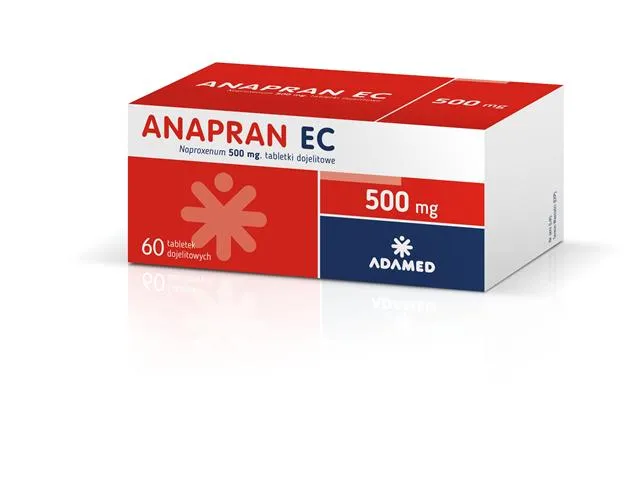
Table of Contents
Package leaflet: Information for the user
Anapran EC, 250 mg, enteric-coated tablets
Anapran EC, 500 mg, enteric-coated tablets
Naproxen
Please read all of this leaflet carefully before taking this medicine, because it contains
important information for you.
- Keep this leaflet. You may need to read it again.
- If you have any further questions, ask your doctor or pharmacist.
- This medicine has been prescribed for you only. Do not pass it on to others. It may harm them, even if their symptoms are the same as yours.
- If you experience any side effects, including any not listed in this leaflet, inform your doctor or pharmacist. See section 4.
Contents of the leaflet
- What Anapran EC is and what it is used for
- Important information before taking Anapran EC
- How to take Anapran EC
- Possible side effects
- How to store Anapran EC
- Contents of the pack and other information
1. What Anapran EC is and what it is used for
Anapran EC contains the active substance naproxen, which belongs to a group of medicines called non-steroidal anti-inflammatory drugs (NSAIDs). These medicines are used to reduce inflammation and pain in the joints and muscles.
Anapran EC is indicated for symptomatic treatment of rheumatoid arthritis, osteoarthritis, ankylosing spondylitis (neck and back pain and stiffness), acute musculoskeletal disorders (e.g. sprains and post-traumatic injuries), and painful menstruation (dysmenorrhoea), in patients over 16 years of age.
2. Important information before using Anapran EC
When not to use Anapran EC:
- if the patient is allergic to naproxen, sodium naproxen, or any of the other ingredients of this medicine (listed in section 6),
- if the patient is allergic to acetylsalicylic acid (aspirin), other NSAIDs (e.g. ibuprofen or diclofenac) or other painkillers, with symptoms such as asthma attacks, rhinitis, nasal polyps or urticaria,
- if the patient has or has had nasal polyps, frequent sneezing, runny nose, blocked or itchy nose,
- if the patient has asthma or allergies (such as hay fever) or has previously experienced facial swelling, lips, eyes or tongue,
- if the patient has or has ever had gastrointestinal disorders such as peptic ulcer or gastrointestinal bleeding,
- if gastrointestinal bleeding or perforation of the gastrointestinal tract wall has occurred after taking non-steroidal anti-inflammatory drugs,
- if the patient has severe liver, kidney or heart failure,
- if the patient is in the last three months of pregnancy. 1/8
Do not take Anapran EC if any of the above points apply to the patient. If there are any further doubts, consult a doctor or pharmacist before taking Anapran EC.
Warnings and precautions
If the patient has heart problems, has had a stroke or suspects being at risk of such conditions (e.g. if the patient has high blood pressure, diabetes, high cholesterol levels or is a smoker), discuss treatment options with a doctor or pharmacist.
Before starting to take Anapran EC, discuss this with a doctor or pharmacist if any of the following conditions apply to the patient:
- Asthma or allergy (such as hay fever) or swelling of the face, lips, eyes or tongue in the past.
- Feeling of weakness (possibly due to illness) or if the patient is elderly.
- Nasal polyps or frequent sneezing, runny nose, blocked or itchy nose (rhinitis).
- Kidney or liver function disorders.
- Blood clotting disorders.
- Blood vessel (arterial) disorders anywhere in the body.
- High levels of fats (lipids) in the blood (hyperlipidemia).
- Autoimmune disease, e.g. systemic lupus erythematosus (SLE, causing joint pain, rash and fever), ulcerative colitis or Crohn's disease (conditions causing intestinal inflammation, intestinal pain, diarrhea, vomiting and weight loss).
Taking medicines such as Anapran EC may be associated with a small increased risk of heart attack (myocardial infarction) or stroke. This risk increases with long-term use of higher doses. Do not use higher doses or longer treatment duration than recommended.
Serious skin reactions have been reported with the use of Anapran EC, including Stevens-Johnson syndrome, toxic epidermal necrolysis, and drug reaction with eosinophilia and systemic symptoms (DRESS syndrome). Treatment with Anapran EC should be discontinued and medical advice sought immediately if any of these symptoms occur (see section 4).
Naproxen may increase sensitivity to sunlight. Sunlight or sunlamps may cause sunburn, skin blisters (including cutaneous porphyria), rash, redness, itching or skin discoloration. If a reaction to sunlight occurs, consult a doctor.
If any of the above points apply to the patient or if there are any further doubts, consult a doctor or pharmacist before taking this medicine.
Children and adolescents
Anapran EC is not recommended for use in children under 16 years of age.
Anapran EC and other medicines
Tell your doctor or pharmacist about all medicines currently taken or recently taken, as well as any medicines planned for use, including those available without a prescription and herbal medicines. In particular, inform the doctor or pharmacist if the patient is taking:
- Other painkillers (such as acetylsalicylic acid, ibuprofen, diclofenac and paracetamol).
- Medicines used to prevent blood clots, such as: acetylsalicylic acid, warfarin, heparin or clopidogrel. 2/8
- Hydantoin group medicines (antiepileptic drugs) such as phenytoin.
- Sulfonamide group medicines such as hydrochlorothiazide, acetazolamide, indapamide, including sulfonamide antibiotics (medicines used to treat infections).
- Sulfonylurea derivatives (medicines used to treat diabetes) e.g. glimepiride and glipizide.
- Angiotensin-converting enzyme (ACE) inhibitors and other medicines used to treat high blood pressure, such as: cilazapril, enalapril or propranolol.
- Angiotensin II receptor antagonists, such as: candesartan, eprosartan or losartan.
- Diuretics (medicines used to treat high blood pressure) such as furosemide.
- Cardiac glycosides (medicines used to treat heart conditions) such as digoxin.
- Steroids (medicines used to treat edema and inflammation) such as hydrocortisone, prednisolone and dexamethasone.
- Quinolone antibiotics (medicines used to treat infections) such as ciprofloxacin or moxifloxacin.
- Certain medicines used to treat psychiatric disorders such as lithium or selective serotonin reuptake inhibitors (SSRIs) such as fluoxetine or citalopram.
- Probenecid (a medicine used to treat acute gout).
- Methotrexate (a medicine used to treat skin disorders, arthritis and cancer).
- Cyclosporine or tacrolimus (medicines used to treat skin disorders or after organ transplantation).
- Zidovudine (a medicine used to treat AIDS and HIV infection).
- Mifepristone (a medicine used to terminate pregnancy or induce labor in case of fetal death).
If any of the above points apply to the patient or if there are any further doubts, consult a doctor or pharmacist before taking this medicine.
Pregnancy, breastfeeding and effects on fertility
- Do not take naproxen during the last three months of pregnancy, as it may harm the unborn child or cause complications during delivery. It may cause kidney and heart problems in the unborn child. It may also increase the tendency to bleeding in both mother and child and may delay or prolong labor.
- During the first 6 months of pregnancy, naproxen should not be used unless a doctor considers it absolutely necessary. If treatment is required during this period or when trying to conceive, the lowest possible dose should be used for the shortest possible time.
- From the 20th week of pregnancy, Anapran EC may cause kidney function disorders in the unborn child if taken for longer than a few days, which may lead to reduced amniotic fluid surrounding the baby (oligohydramnios), or narrowing of a blood vessel (ductus arteriosus) in the baby's heart. If treatment is required for longer than a few days, the doctor may recommend additional monitoring.
- If the patient is breastfeeding (or plans to breastfeed soon), naproxen should not be used.
- If the patient is pregnant, suspects she may be pregnant, or is planning to have a baby, she should consult a doctor or pharmacist before using this medicine.
- Anapran EC may make it more difficult to become pregnant. Inform the doctor if the patient is planning pregnancy or has difficulty becoming pregnant.
Driving and operating machinery
Anapran EC may cause fatigue, drowsiness, dizziness, visual and balance disturbances, depressive states or sleep disorders. Consult a doctor if any of these symptoms occur, and do not drive or operate tools or machinery.
Anapran EC contains sodium
The medicine contains less than 1 mmol (23 mg) of sodium per tablet, meaning the medicine is considered "sodium-free".
3. How to take Anapran EC
This medicine should always be taken exactly as your doctor has told you. If you are unsure, consult your doctor or pharmacist.
While taking Anapran EC, your doctor will recommend regular check-ups to monitor for possible adverse effects and to confirm that you are receiving the appropriate dose. This is particularly important if you are elderly.
Recommended dose:
Adults
Degenerative joint disease and ankylosing spondylitis
The recommended daily dose is 500 mg to 1000 mg, divided into two doses taken every 12 hours. If the recommended dose is 1000 mg per day, you may take one 500 mg tablet twice daily, or two 500 mg tablets as a single dose (in the morning or evening).
In some patients, a higher initial dose of 750 mg to 1000 mg per day may be used to relieve pain. This applies to patients who:
- experience increased night pain or morning stiffness,
- have recently switched from high-dose treatment with another pain-relieving medicine,
- have degenerative joint disease where pain is the main symptom.
Musculoskeletal disorders (e.g. sprains and post-traumatic conditions) or painful menstruation
The initial dose is usually 500 mg per day, followed if necessary by 250 mg every 6 to 8 hours. The dose should not exceed 1250 mg per day after the first day of treatment.
Elderly patients and patients with impaired kidney or liver function
Your doctor will decide on the appropriate dose. It is usually lower than in other adult patients.
Use in children and adolescents
Due to the strength of the formulation, Anapran EC is not recommended for use in children under 16 years of age.
Method of administration:
Tablets should be swallowed whole with a small amount of water, during or after a meal. Do not crush or chew the tablets.
You should ensure that you drink enough fluids (stay well hydrated) while taking Anapran EC. This is particularly important for patients with impaired kidney function. While you are taking Anapran EC, your doctor may wish to monitor whether you are receiving the correct dose and whether you are experiencing any adverse effects. This is especially important for elderly patients.
If you take more Anapran EC than you should
If you accidentally take more than the recommended dose, contact your doctor immediately or go to the nearest hospital. Take the medicine pack with you.
4/8
If you forget to take Anapran EC
If you miss a dose, skip the missed dose and take the next dose at the usual time. Do not take a double dose to make up for a forgotten dose.
Stopping Anapran EC
If you have any further questions about the use of this medicine, consult your doctor or pharmacist.
4. Possible adverse effects
Like all medicines, this medicine can cause adverse effects, although not everyone will experience them.
Taking medicines such as Anapran EC may be associated with a small increased risk of
heart attack (myocardial infarction) or stroke.
Important adverse effects to be aware of:
You must stop taking Anapran EC and contact your doctor immediately if
any of the following adverse effects occur. The patient may require urgent medical attention:
Severe gastrointestinal disorders occur not very commonly (may affect up to 1 in
100 people) or rarely (may affect up to 1 in 1000 people); symptoms include:
- Bleeding from the stomach, seen as vomiting blood or dark, coffee-ground-like vomit.
- Bleeding from the rectum, seen as passing black, tarry stools or bloody diarrhoea.
- Ulcers or perforations of the stomach or intestines. Symptoms may include indigestion, stomach pain, fever, nausea or vomiting.
- Problems with the pancreas. Symptoms may include severe stomach pain radiating to the back.
- Worsening of ulcerative colitis or Crohn's disease, manifesting as pain, diarrhoea, vomiting and weight loss.
Allergic reactions occur rarely (may affect up to 1 in 1000 people); symptoms include:
- Sudden swelling of the throat, face, hands or feet.
- Difficulty breathing, feeling of tightness in the chest.
- Skin rash, blisters or itching.
Severe skin adverse effects; symptoms include:
- Severe rash developing rapidly, with blisters or peeling of the skin, possibly also blisters in the mouth, throat or eyes. Fever, headache, cough and general body tenderness may occur simultaneously. Frequency is unknown, i.e. frequency cannot be determined from available data.
- Blisters on the skin after exposure to sunlight (porphyria cutanea tarda), particularly on the arms, face and hands. Occur not very commonly (may affect up to 1 in 100 people).
- Widespread rash, high body temperature, elevated liver enzyme activity, blood disorders (eosinophilia), enlarged lymph nodes and involvement of other organs (drug reaction with eosinophilia and systemic symptoms, also known as DRESS syndrome). Frequency is unknown, i.e. frequency cannot be determined from available data.
- Characteristic skin allergic reaction called fixed drug eruption, which typically recurs in the same location(s) upon re-administration of the 5/8
medicine and may present as round or oval red patches and swelling
of the skin, blisters (urticaria), itching. Frequency is unknown, i.e.
frequency cannot be determined from available data.
Liver disorders occur rarely (may affect up to 1 in 1000 people); symptoms include:
- Yellowing of the skin or whites of the eyes (jaundice).
- Feeling tired, loss of appetite, nausea or vomiting, pale-coloured stools (hepatitis), and abnormalities visible in blood test results (including hepatitis).
Heart attack occurs rarely (may affect up to 1 in 1000 people); symptoms include:
- Chest pain, which may radiate to the neck, shoulders and down the left arm.
Stroke occurs rarely (may affect up to 1 in 1000 people); symptoms include:
- Muscle weakness and numbness. May occur only on one side of the body.
- Sudden change in smell, taste, hearing or vision, confusion.
Meningitis (frequency is unknown, i.e. frequency cannot be determined from available data); symptoms include:
- Fever, nausea or vomiting, neck stiffness, headache, sensitivity to bright light and confusion (more likely in people with immune disorders such as systemic lupus erythematosus).
If any of the above adverse effects occur, the medicine must be stopped immediately and a doctor should be contacted.
Other adverse effects:
Common (may affect up to 1 in 10 people):
- heartburn,
- diarrhoea,
- constipation,
- abdominal discomfort,
- inflammation of the mouth,
- indigestion,
- bruising,
- itching,
- sweating,
- headache,
- dizziness, drowsiness, feeling of lightheadedness,
- visual disturbances,
- ringing in the ears (tinnitus),
- nausea or vomiting.
Not very common (may affect up to 1 in 100 people):
- sensation of heart pounding (palpitations),
- shortness of breath, asthma,
- memory or concentration difficulties, drowsiness,
- difficulty falling asleep,
- hearing loss,
- increased skin sensitivity to sunlight,
- urticaria, skin rash, including redness of the skin,
- kidney function disorders.
Rare (may affect up to 1 in 1000 people):
6/8
- blood disorders such as anaemia or changes in white blood cell count,
- swelling of the hands, feet or legs (oedema). This may be accompanied by chest pain, fatigue, shortness of breath (heart failure),
- increased potassium levels in the blood,
- disorders affecting the way the heart pumps blood throughout the body. Symptoms may include fatigue, shortness of breath, feeling faint, generalized pain,
- slowing of the heart rate,
- high blood pressure,
- damage to blood vessels (vasculitis), symptoms may include fever, headache, fatigue, weight loss and pain,
- lung inflammation or pulmonary oedema,
- haematuria (blood in urine),
- changes in sleep patterns,
- depression,
- disorientation or seeing and hearing things that are not there (hallucinations),
- memory and concentration disorders.
Very rare (may affect up to 1 in 10,000 people):
- eye pain, visual disturbances, scarring of the eye surface,
- hearing disorders, hearing impairment,
- dizziness causing balance disturbances,
- urticaria, rash, blisters on the body and face,
- excessive thirst, fever, feeling of fatigue or general malaise,
- muscle pain, muscle weakness,
- systemic lupus erythematosus (SLE). Symptoms may include fever, rash, kidney problems, fatigue and joint pain,
- kidney function disorders.
Frequency unknown (frequency cannot be determined from available data):
- epileptic seizures or convulsions,
- optic neuritis, which causes pain and loss of sharpness or clarity of vision and other symptoms,
- tingling or numbness of hands and feet,
- difficulty becoming pregnant in women.
If any of the above symptoms worsen or if other adverse effects not listed in this leaflet occur, inform your doctor or pharmacist.
Reporting of adverse effects
If any adverse effects occur, including any adverse effects not listed in this leaflet, tell your doctor, pharmacist or nurse. Adverse effects can be reported directly to the Department of Monitoring Adverse Drug Reactions of the Office for Registration of Medicinal Products, Medical Devices and Biocidal Products:
Al. Jerozolimskie 181C, 02-222 Warsaw, tel.: 22 49-21-301, fax: 22 49-21-309, website:
https://smz.ezdrowie.gov.pl .
Adverse effects can also be reported to the marketing authorisation holder.
Reporting adverse effects helps provide more information on the safety of the medicine.
5. How to store Anapran EC
Keep the medicine out of sight and reach of children.
7/8
Store below 25°C. Keep in the original packaging to protect from light.
Do not use this medicine after the expiry date stated on the carton after: EXP. The expiry date refers to the last day of the specified month.
Medicines must not be disposed of via wastewater or household waste. Ask your pharmacist how to dispose of medicines no longer required. These measures will help protect the environment.
6. Contents of the pack and other information
What Anapran EC contains
- The active substance is naproxen. Each tablet contains 250 mg or 500 mg of naproxen respectively.
- The other ingredients are: povidone K 90, sodium croscarmellose, magnesium stearate contained in the tablet core; and in the tablet coating: polymethacrylic acid and ethyl acrylate copolymer (1:1) dispersion 30%, triethyl citrate, talc, simethicone emulsion.
What Anapran EC looks like and contents of the pack
Anapran EC, 250 mg, enteric-coated tablets:
White or almost white, round, biconvex, coated tablets with a diameter of approximately 10 mm.
Anapran EC, 500 mg, enteric-coated tablets:
White or almost white, round, biconvex, coated tablets with a diameter of approximately 13 mm.
Blister pack made of PVC/aluminum foil in a cardboard box. Each blister contains 10 enteric-coated tablets.
Pack size: Anapran EC, 250 mg contains 20, 30 or 60 enteric-coated tablets.
Pack size: Anapran EC, 500 mg contains 20 or 60 enteric-coated tablets.
Not all pack sizes may be marketed.
Marketing Authorisation Holder and Manufacturer
Marketing Authorisation Holder
Adamed Pharma S.A.
Pieńków, ul. M. Adamkiewicza 6A
05-152 Czosnów
Tel.: 22 732 77 00
Manufacturer
Adamed Pharma S.A.
Pieńków, ul. M. Adamkiewicza 6A
05-152 Czosnów
April 2025
8/8