Aminoplasmal hepa 10%
Poland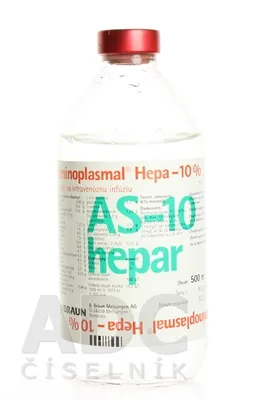
Table of Contents
- Package leaflet: Information for the user
- 1. What Aminoplasmal Hepa – 10% is and what it is used for
- 2. Important information before using Aminoplasmal Hepa – 10%
- 3. How to use Aminoplasmal Hepa – 10%
- 4. Possible adverse reactions
- 5. How to store Aminoplasmal Hepa – 10%
- 6. Contents of the package and other information
- Information intended exclusively for medical professionals:
Package leaflet: Information for the user
Aminoplasmal Hepa – 10%, solution for injection
Amino acids
Please read all of this leaflet carefully before using this medicine, because it contains
important information for the patient.
- Keep this leaflet, as you may need to read it again.
- If you have any further questions, please ask your doctor or pharmacist.
- If you experience any side effects, including any not listed in this leaflet, please tell your doctor or pharmacist. See section 4.
Table of contents
- What Aminoplasmal Hepa – 10% is and what it is used for
- Important information before using Aminoplasmal Hepa – 10%
- How to use Aminoplasmal Hepa – 10%
- Possible side effects
- How to store Aminoplasmal Hepa – 10%
- Contents of the pack and other information
1. What Aminoplasmal Hepa – 10% is and what it is used for
Aminoplasmal Hepa – 10% is a solution administered intravenously through a needle or catheter inserted into a vein (intravenous infusion).
The solution contains amino acids, which are essential for the body's growth and recovery.
This medicine is used in cases of severe liver disorders. It may help prevent or alleviate brain function disturbances associated with serious liver diseases.
In such conditions, patients may be unable to perform complex tasks and may also be drowsy, nearly or completely unconscious.
This medicine is given to patients who are unable to eat normally or to be fed through a tube inserted into the stomach. This solution may be used in adults, adolescents, and children above 2 years of age.
2. Important information before using Aminoplasmal Hepa – 10%
When not to use Aminoplasmal Hepa – 10%
- if the patient is allergic to the active substances or to any of the other ingredients of this medicine (listed in section 6);
- if the patient has a congenital disorder of protein and amino acid metabolism;
- if the patient has severe (i.e. life-threatening) circulatory disorders (shock);
- if the patient has inadequate oxygen supply (hypoxia);
- if acidic substances have accumulated in the patient's blood (metabolic acidosis);
- if the patient has severe kidney disease (severe renal failure) that is not adequately treated with artificial kidney or similar therapies;
- if the patient has poorly controlled heart failure with significant circulatory disturbance (decompensated heart failure);
- if fluid has accumulated in the patient's lungs (acute pulmonary edema);
- if the patient has disturbances in fluid or electrolyte balance.
Newborns, infants and young children under 2 years of age
The solution must not be administered to newborns, infants and children under 2 years of age, because the composition of the solution is not appropriately adapted to the special needs of this age group.
Children and adolescents
The safety and efficacy of Aminoplasmal Hepa – 10% in children have not yet been established.
Warnings and precautions
Before starting treatment with Aminoplasmal Hepa – 10%, discuss this with the doctor or pharmacist:
- if the patient has impaired kidney function, the doctor will carefully consider whether to use the medicine and then very cautiously adjust the daily dose according to the severity of the kidney dysfunction;
- if the patient has impaired heart function;
- if the patient has abnormally concentrated blood serum (high serum osmolality).
If there are disturbances in fluid or electrolyte balance, these should be corrected before administering this medicine. Examples of such disturbances include concurrent fluid and electrolyte deficiency (hypotonic dehydration), low sodium levels (hyponatremia), or low potassium levels (hypokalemia).
Before and during treatment with this medicine, the doctor will monitor blood electrolyte levels, blood glucose levels, fluid balance, acid-base balance, blood protein levels, and kidney function. For this purpose, blood and urine samples will be collected and analyzed.
Ongoing treatment for liver disease will be continued and will not be replaced by amino acid infusions.
Patients usually receive Aminoplasmal Hepa – 10% as part of parenteral nutrition, which also includes non-protein energy sources (carbohydrate solutions, fat emulsions), essential fatty acids, electrolytes, vitamins, fluids, and trace elements.
Aminoplasmal Hepa – 10% and other medicines
Inform the doctor or pharmacist about all medicines currently or recently taken, as well as any medicines planned for future use.
Pregnancy and breastfeeding
If the patient is pregnant or breastfeeding, suspects she might be pregnant, or is planning to have a baby, she should consult a doctor or pharmacist before using this medicine.
Pregnancy
If the patient is pregnant, she will receive this medicine only if the doctor considers it necessary for her recovery. There are no available data on the use of this medicine in pregnant women.
Breastfeeding
At therapeutic doses, Aminoplasmal Hepa – 10% is not expected to affect breastfed newborns/infants. Nevertheless, breastfeeding is not recommended for women who simultaneously require parenteral nutrition.
Driving and operating machinery
This medicine is usually administered to immobilized patients in a controlled setting (emergency treatment, treatment of acute episodes in hospital, or in a day unit). This excludes the possibility of driving or operating machinery.
Aminoplasmal Hepa – 10% contains sodium
This medicine contains between 0.3 and 2.3 mmol of sodium (the main component of table salt) per 1000 ml. The doctor will take this into account for patients who require dietary sodium restriction.
3. How to use Aminoplasmal Hepa – 10%
This medicine is administered by trained medical personnel.
Dosage
Adults
The doctor will carefully adjust the dose according to the patient's age, physical development, and underlying disease.
The usual dose is 8 to 15 ml per kg of body weight per day. The solution will be administered at a rate not exceeding 1 ml per kg of body weight per hour.
Duration of treatment
This medicine may be used for as long as the patient requires intravenous nutrition and as long as there is a risk of further deterioration in brain function.
Method of administration
This medicine will be given through a tube inserted into a vein (intravenous infusion).
Use of a higher than recommended dose of Aminoplasmal Hepa – 10%
This is unlikely, as the doctor determines the daily doses for the patient.
However, if the patient receives a higher than recommended dose of the solution or if the solution is administered too rapidly, nausea, vomiting, chills, or headache may occur.
There may also be an increase in acid levels in the blood (metabolic acidosis) or elevated ammonia levels (hyperammonemia), as well as loss of amino acids in the urine.
Additionally, fluid overload (overhydration), disturbances in mineral salt balance (electrolyte imbalances), and accumulation of fluid in the lungs (pulmonary edema) may occur.
In such cases, the infusion will be stopped and resumed later at a slower rate.
If you have any further questions about the use of this medicine, consult your doctor or pharmacist.
4. Possible adverse reactions
Like all medicines, this medicine can cause adverse reactions, although not everyone will experience them.
These adverse reactions are not specifically associated with Aminoplasmal Hepa – 10%, but rather with parenteral nutrition in general, particularly during the initial phase of treatment.
The following adverse reactions may be serious. If the patient experiences any of the following,
inform the doctor immediately, who will discontinue administration of this medicine:
Unknown (frequency cannot be estimated from available data)
- allergic reactions
Other adverse reactions
Not common (may occur in up to 1 in 100 people)
- vomiting, nausea
Reporting of adverse reactions
If any adverse reactions occur, including any adverse reactions not listed in this leaflet, inform a doctor or pharmacist.
Adverse reactions can be reported directly to the Department of Monitoring Adverse Drug Reactions at the Office for Registration of Medicinal Products, Medical Devices and Biocidal Products:
Al. Jerozolimskie 181C, 02-222 Warsaw
Tel.: +48 22 49 21 301
Fax: +48 22 49 21 309
Website: https://smz.ezdrowie.gov.pl
Adverse reactions can also be reported to the marketing authorization holder.
Reporting adverse reactions helps to provide more information on the safety of the medicine.
5. How to store Aminoplasmal Hepa – 10%
Keep the medicine out of the sight and reach of children.
Do not use this medicine after the expiry date stated on the bottle and the outer carton label.
The expiry date refers to the last day of the stated month.
Store the bottle in the outer packaging to protect it from light.
Do not store above 25°C.
Do not freeze.
After infusion administration, any remaining solution must never be stored for later use.
6. Contents of the package and other information
What Aminoplasmal Hepa – 10% contains
The active substances are amino acids.
The medicinal product contains:
per 1 ml per 500 ml per 1000 ml
Isoleucine 8.80 mg 4.40 g 8.80 g
Leucine 13.60 mg 6.80 g 13.60 g
Lysine acetate 10.60 mg 5.30 g 10.60 g
(corresponding to lysine) (7.51 mg) (3.75 g) (7.51 g)
Methionine 1.20 mg 0.60 g 1.20 g
Phenylalanine 1.60 mg 0.80 g 1.60 g
Threonine 4.60 mg 2.30 g 4.60 g
Tryptophan 1.50 mg 0.75 g 1.50 g
Valine 10.60 mg 5.30 g 10.60 g
Arginine 8.80 mg 4.40 g 8.80 g
Histidine 4.70 mg 2.35 g 4.70 g
Glycine 6.30 mg 3.15 g 6.30 g
Alanine 8.30 mg 4.15 g 8.30 g
Proline 7.10 mg 3.55 g 7.10 g
Aspartic acid 2.50 mg 1.25 g 2.50 g
Monohydrate asparagine 0.55 mg 0.27 g 0.55 g
(corresponding to asparagine) (0.48 mg) (0.24 g) (0.48 g)
Acetylcysteine 0.80 mg 0.40 g 0.80 g
(corresponding to cysteine) (0.59 mg) (0.29 g) (0.59 g)
Glutamic acid 5.70 mg 2.85 g 5.70 g
Ornithine hydrochloride 1.66 mg 0.83 g 1.66 g
(corresponding to ornithine) (1.30 mg) (0.65 g) (1.30 g)
Serine 3.70 mg 1.85 g 3.70 g
Acetyltyrosine 0.86 mg 0.43 g 0.86 g
(corresponding to tyrosine) (0.70 mg) (0.35 g) (0.70 g)
Other ingredients are sodium hydroxide or hydrochloric acid (for pH adjustment), disodium edetate and water for injections.
Electrolyte concentrations
Acetates 51 mmol/l
Chlorides 10 mmol/l
Amino acid content 100 g/l
Nitrogen content 15.3 g/l
Energy value 1675 kJ/l ≙ 400 kcal/l
Theoretical osmolarity 875 mOsm/l
pH 5.5 – 6.5
What Aminoplasmal Hepa – 10% looks like and contents of the pack
Aminoplasmal Hepa – 10% is a clear, colourless or slightly yellowish aqueous solution.
The product is supplied in 500 ml colourless glass bottles closed with elastomeric stoppers.
Not all pack sizes may be marketed.
Marketing Authorisation Holder and Manufacturer
B. Braun Melsungen AG
Carl-Braun-Straße 1
34212 Melsungen, Germany
Postal address:
34209 Melsungen, Germany
Tel: +49-5661-71-0
Fax: +49-5661-71-45 67
Information intended exclusively for medical professionals:
Instructions for handling the medicinal product
No special requirements for disposal.
Containers are intended for single use only. After administration, the container and any
remaining medicinal product must be discarded.
Use only if the solution is clear and colourless or slightly yellowish and the bottle and its closure
are undamaged.
Use only a sterile infusion set for the Aminoplasmal Hepa – 10% solution.
If, under conditions of total parenteral nutrition, it is necessary to add other nutritional components such as carbohydrates, fats, vitamins, electrolytes, and trace elements to this medicinal product, admixtures must be prepared under strictly aseptic conditions.
Thoroughly mix after adding any admixtures. Aminoplasmal Hepa – 10% may be mixed only with other nutritional components for which compatibility has been documented. Information on compatibility for various admixtures and the shelf life of such admixtures is available upon request from the manufacturer.
Special precautions during storage
Do not use the product if the solution is not transparent and colourless or slightly yellowish, or if the bottle or its closure is damaged.
Shelf life
Closed packaging
3 years
After first opening of the container
The medicinal product should be used immediately.
After addition of admixtures
From a microbiological point of view, admixed solutions should be administered immediately after preparation. If administration is not immediate, the responsibility for storage conditions and duration prior to use lies with the user and should normally not exceed 24 hours at 2°C–8°C, unless the admixture was prepared under controlled and validated aseptic conditions.
For detailed information on this medicinal product, see the Product Characteristics Summary.