Amantix
Poland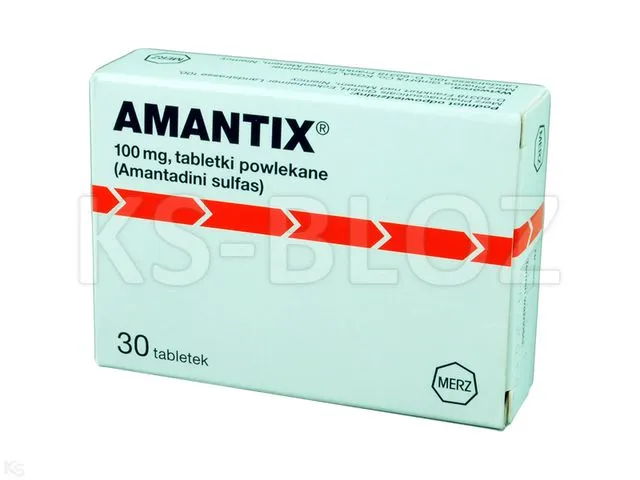
Table of Contents
Package leaflet: Information for the user
Warning! Keep the leaflet – the packaging information in a foreign language!
Amantix (PK-Merz)
100 mg, film-coated tablets
Amantadini sulfas
Amantix and PK-Merz are different trade names for the same medicinal product.
Please read this leaflet carefully before using the medicine, as it contains
important information for the patient.
- Keep this leaflet, so that you can read it again if necessary.
- If you have any doubts, consult your doctor or pharmacist.
- This medicine has been prescribed for a specific individual. Do not pass it on to others. This medicine may harm other people, even if their symptoms are the same.
- If any adverse reactions occur in the patient, including any adverse reactions not listed in this leaflet, inform your doctor or pharmacist. See section 4.
Table of contents of the leaflet:
- What Amantix is and what it is used for
- Important information before taking Amantix
- How to take Amantix
- Possible side effects
- How to store Amantix
- Contents of the pack and other information
1. What Amantix is and what it is used for
Amantix is a dopaminergic medicine, meaning it may increase the levels of certain chemical substances that transmit impulses in the nervous system, including the brain.
Amantix reduces the severity of symptoms of Parkinson's disease (an antiparkinsonian medicine).
Amantix tablets are used:
- in the treatment of symptoms of Parkinson's disease, such as rigidity, tremor, hypokinesia (reduced motor function), or akinesia (lack of movement);
- in the treatment of movement disorders resembling Parkinson's disease caused by certain medicines (neuroleptics and medicines with a similar mechanism of action) (extrapyramidal symptoms, such as early dyskinesia, uncontrollable urge to move (akathisia), and parkinsonism).
2. Important information before using Amantix
When not to use Amantix:
- if the patient is allergic to amantadine or any of the other ingredients of this medicine (listed in section 6);
- if the patient has severe, uncontrolled heart failure (NYHA class IV);
- if the patient has heart diseases such as cardiomyopathy or myocarditis;
- if the patient has conduction disorders of cardiac impulses (second- or third-degree atrioventricular block);
- if the patient has a slow heart rate (less than 55 beats per minute);
- if the patient has changes in the electrocardiogram (ECG), such as prolonged QT interval, visible U waves, or if there is a family history of congenital long QT syndrome;
- if the patient has severe heart rhythm disorders (ventricular arrhythmias, including a history of torsades de pointes);
- if the patient has low blood potassium or magnesium levels;
- if the patient is pregnant or breastfeeding;
- if the patient is taking medicines that prolong the QT interval (see section 2 – Amantix and other medicines).
Warnings and precautions
Before starting treatment with Amantix, discuss this with your doctor or pharmacist.
Particular caution is required when using Amantix in patients with:
- benign prostatic hyperplasia (enlarged prostate);
- increased intraocular pressure (narrow-angle glaucoma);
- renal impairment of varying severity (risk of drug accumulation due to reduced renal filtration) (see section 3);
- current or past states of agitation or confusion (disorientation);
- psychiatric disorders (history of delirium or exogenous psychoses);
- diarrhoea, vomiting, use of diuretics or insulin in acute conditions, kidney disease, or anorexia (risk of water-electrolyte imbalance);
- concurrent treatment with memantine (see section 2 – Amantix and other medicines).
Other important information regarding the use of Amantix
Before starting treatment and after 1 and 3 weeks of therapy, an ECG should be performed and the QT interval corrected using Bazett's formula (QTc) should be determined. An ECG should also be performed before any dose increase and 2 weeks after each dose increase. Subsequent follow-up ECGs should be performed at least once a year.
In patients with cardiac pacemakers, accurate determination of the QT interval duration is not possible; therefore, the decision to use Amantix should be made individually for each patient after consultation with a cardiologist.
In patients with impaired renal function, drug accumulation may occur due to reduced excretion by the kidneys. This may lead to symptoms associated with overdose. The doctor should carefully adjust the dose and measure and monitor the glomerular filtration rate (see section 3).
Particular caution is required when using Amantix in patients with organic brain syndrome or a history of seizures, due to the possible worsening of symptoms and the risk of seizures (see sections 3 and 4).
During treatment with Amantix, the doctor must regularly monitor patients prone to seizures, including those with a history of seizures and patients with cardiovascular diseases.
If palpitations, dizziness, or brief loss of consciousness (syncope) occur during treatment with Amantix, the use of Amantix should be discontinued immediately and the patient should consult a doctor to assess heart function (heart rhythm) via 24-hour monitoring. If the doctor does not detect any cardiac dysfunction, treatment with Amantix may be continued, taking into account contraindications and interactions (see section 4).
Patients treated simultaneously with neuroleptics (medicines used to treat psychiatric disorders) and Amantix are at risk of developing a life-threatening condition known as neuroleptic malignant syndrome if Amantix is abruptly discontinued. This syndrome is characterized by sudden high fever, muscle rigidity, and autonomic nervous system disturbances.
In patients with Parkinson's disease, clinical symptoms such as low blood pressure, drooling, sweating, elevated body temperature, fluid retention, and depression are often observed. When using Amantix in these patients, special consideration should be given to its adverse effects and interactions.
Patients experiencing difficulty urinating should contact their doctor.
If a patient experiences blurred vision or other visual disturbances, they should immediately consult an ophthalmologist.
Inform the doctor if the patient or their family members and/or caregivers notice an urge or uncontrollable desire to behave in an unusual way, or an inability to resist such impulses, or an urge or compulsion to act in a way that could be harmful to the patient or others. These are known as impulse control disorders, which may include behaviours such as compulsive gambling, binge eating or spending, abnormally increased sexual drive, or intensified sexual thoughts or feelings. The doctor may modify the dose or discontinue Amantix.
Amantadine should not be used for the prevention and treatment of influenza A virus infections due to the risk of overdose.
Children and adolescents
There is no data available on the use of this medicine in children and adolescents.
Elderly patients
In elderly patients, the dose should be selected carefully, especially in cases of agitation, confusion, or delirium (see section 3).
Amantix and other medicines
Inform your doctor about all medicines currently used, recently used, or planned for use.
Amantix must not be used concomitantly with other medicines that prolong the QT interval, such as:
- certain medicines used to treat irregular heart rhythms (antiarrhythmics of class IA, e.g. quinidine, disopyramide, procainamide, and class III, e.g. amiodarone, sotalol);
- certain medicines used to treat psychiatric disorders (antipsychotics, e.g. thioridazine, chlorpromazine, haloperidol, pimozide);
- certain medicines used to treat depression (tricyclic and tetracyclic antidepressants, e.g. amitriptyline);
- certain medicines used to treat allergies, e.g. hay fever (antihistamines, e.g. astemizole, terfenadine);
- certain medicines used to treat bacterial infections (macrolide antibiotics, e.g. erythromycin, clarithromycin, and gyrase inhibitors, e.g. sparfloxacin);
- certain medicines used to treat fungal infections (azole antifungals);
- other medicines such as budipine, halofantrine, co-trimoxazole, pentamidine, cisapride, or bepridil.
The above list may not be complete. Before using Amantix with another medicine, the doctor should check the possibility of interactions leading to QT prolongation.
Concomitant treatment with Amantix and other medicines used in Parkinson's disease is possible. To avoid adverse effects (e.g. psychotic reactions), it may be necessary to reduce the dose of one or both medicines.
Concomitant use of Amantix with any of the medicines or active substances listed below may lead to the following interactions:
Anticholinergics
Increased risk of anticholinergic adverse effects (confusion and hallucinations), e.g. trihexyphenidyl, benzatropine, scopolamine, biperiden, orphenadrine.
Indirectly acting sympathomimetics affecting the central nervous system
Enhanced central action of amantadine.
Levodopa (medicine used in Parkinson's disease)
Mutual enhancement of therapeutic effect (therefore, levodopa may be administered simultaneously with Amantix).
Memantine (medicine used in dementia)
Memantine may enhance the effects and adverse effects of Amantix (see section 2 – Warnings and precautions).
Other medicines
Concomitant use of diuretics containing triamterene in combination with hydrochlorothiazide may reduce the plasma clearance of amantadine, leading to toxic serum concentrations. Therefore, concomitant use of amantadine and such medicines should be avoided.
It should be emphasized that the interactions listed above may also apply to medicines previously used.
Use of Amantix with food, drink and alcohol
Alcoholic beverages should be avoided during treatment with Amantix, as this medicine reduces alcohol tolerance.
Pregnancy and breastfeeding
If the patient is pregnant or breastfeeding, suspects she may be pregnant, or plans to become pregnant, she should consult a doctor or pharmacist before using this medicine.
Amantix tablets are contraindicated during pregnancy and in women who are breastfeeding.
Driving and operating machinery
The effect of Amantix on concentration, alertness, and ocular accommodation (the eye's ability to adjust for viewing at different distances) cannot be ruled out, especially in combination with other medicines used to treat Parkinson's disease.
At the beginning of treatment, the ability to drive and operate machinery may be further impaired beyond the impairment caused by the disease itself.
The patient may be unable to react quickly and decisively in unexpected or sudden situations.
Driving vehicles and operating machinery or electrical devices should not be undertaken without consulting a doctor.
Bear in mind that alcohol may worsen the impairment of driving ability.
Amantix contains lactose monohydrate and sunset yellow (E 110)
Amantix contains lactose monohydrate. Patients with intolerance to certain sugars should consult their doctor before starting treatment with this medicine.
Amantix contains the colouring agent sunset yellow (E 110), which may cause allergic reactions.
3. How to use Amantix
This medicine should always be taken as directed by the physician. In case of doubt, consult
your doctor or pharmacist.
The following information refers to the dosage of Amantix unless otherwise advised by your
physician. Follow the instructions carefully; otherwise, Amantix may not work properly.
Duration of treatment
Tablets should be taken orally with a small amount of liquid, preferably in the morning and in the
afternoon.
The last daily dose should not be taken later than 4 p.m.
Do not discontinue taking the tablets without consulting your doctor. The duration of treatment is
determined by the doctor according to the patient's condition and individual response to therapy.
Dosage
Treatment of patients with parkinsonian syndromes and drug-induced movement disorders is
usually initiated gradually. The required dose and duration of treatment depend on the type and
severity of symptoms and are determined by the physician.
Treatment is initiated with 1 tablet of Amantix once daily for the first 4 to 7 days (corresponding
to 100 mg of amantadine sulfate per day). The daily dose is then increased by 100 mg at weekly
intervals until the maintenance dose is reached. The usual maintenance dose is 1 to 3 tablets
twice daily (corresponding to 200–600 mg of amantadine sulfate per day). The daily dose may be
divided into three divided doses, as determined by the physician.
In elderly patients, especially those with agitation, confusion, or symptoms of delirium, treatment
should be initiated with a lower dose.
If the patient is concurrently taking other anti-parkinsonian medications, the physician will
individually determine the appropriate dose of Amantix.
If the patient has previously been treated with amantadine in the form of an infusion solution, the
physician may use a higher initial dose.
The physician may use amantadine in the form of an infusion solution in cases of acute worsening
of Parkinson's disease symptoms (akinetic crisis).
Patients with renal function impairment:
The dosage of Amantix tablets must be adjusted according to renal clearance (a parameter
indicating kidney function). The appropriate dose is determined by the physician.
Use in children and adolescents
There is no data available on the use of this medicine in children and adolescents.
Taking more than the recommended dose of Amantix
If an overdose is taken, inform your doctor immediately or ask a family member to inform the
doctor and agree to be referred to hospital by the doctor if severe poisoning occurs, manifested by:
nausea, vomiting, tremors or convulsions, unsteady gait, blurred vision, lethargy, depression,
speech disturbances, cardiac dysfunction.
When Amantix is taken together with other drugs used in Parkinson's disease, states of confusion
with hallucinations, even coma, as well as muscle twitching, have been observed. There is no
known specific pharmacological treatment or antidote in case of Amantix overdose. The physician
will induce vomiting or perform gastric lavage.
Blood purification by dialysis (hemodialysis) is not recommended due to the low elimination of
amantadine during dialysis (approximately 5%).
In life-threatening poisoning, intensive therapy is required. Therapeutic measures should include:
fluid administration and acidification of urine to accelerate elimination of the toxic substance,
sedation if possible, administration of anticonvulsant and antiarrhythmic drugs (intravenous
lidocaine). No specific drug or antidote is known.
In the treatment of neurotoxic symptoms (as described above), intravenous physostigmine may be
tried at a dose of 1–2 mg every 2 hours in adults, and 2 x 0.5 mg with a 5–10 minute interval, up to
a maximum dose of 2 mg in children.
The physician will perform an ECG and carefully monitor conditions favoring the development of
cardiac arrhythmias, if necessary, e.g. electrolyte imbalance (potassium or magnesium deficiency
in blood) or bradycardia.
Missed dose of Amantix
Do not take a double dose to make up for a missed dose.
Continue taking the single dose prescribed by your doctor.
Stopping Amantix
Under no circumstances should treatment be stopped without consulting your doctor.
If the patient wishes to discontinue treatment, e.g. due to drug intolerance or worsening of disease
symptoms, they should inform the doctor. Do not abruptly stop treatment, as this may worsen
disease symptoms and cause withdrawal symptoms. In patients with Parkinson's disease, Amantix
should not be abruptly discontinued, as this may lead to severe movement disorders, sometimes
including inability to move.
4. Possible adverse reactions
Like all medicines, this medicine can cause adverse reactions, although not everyone will experience them.
Possible adverse reactions of Amantix:
Common (occurring in more than 1 in 100 people but less than 1 in 10 people):
- Sleep disturbances
- Anxiety and agitation
- Urinary retention in patients with benign prostatic hyperplasia (enlarged prostate)
- Delusional (paranoid) symptoms (disturbances in perception and behavior), accompanied by visual hallucinations, mainly occurring in elderly patients; these adverse reactions are more frequent in patients treated simultaneously with Amantix and other antiparkinsonian medicines (e.g. levodopa, bromocriptine) or memantine
- Livedo reticularis (reddish-blue, net-like skin patches), sometimes accompanied by swelling of the lower legs and ankles
- Nausea
- Dizziness
- Dry mouth
- Sudden drop in blood pressure when standing up quickly from a lying or sitting position. This may cause dizziness or feeling faint (orthostatic hypotension)
Uncommon (affecting less than 1 in 100 people):
- Blurred vision
Rare (occurring in more than 1 in 10,000 people but less than 1 in 1,000 people):
- Corneal damage, corneal edema, decreased visual acuity
Very rare (occurring in less than 1 in 10,000 people):
- Leukopenia (reduced number of white blood cells) and thrombocytopenia (reduced number of platelets)
- Cardiac disorders such as ventricular tachycardia, ventricular fibrillation, torsades de pointes, and QT interval prolongation; these disorders most commonly occur after exceeding the recommended doses or when amantadine is used concomitantly with other drugs having proarrhythmic effects, or in the presence of other risk factors for cardiac disorders (see section 2 "When not to take Amantix" and "Amantix with other medicines")
- Transient loss of vision
- Increased sensitivity to light
- Seizures (usually after exceeding the recommended dose)
- Muscle cramps
- Sensory disturbances in the limbs
Frequency not known (cannot be estimated from available data):
- Irresistible urge to behave in an unusual manner – strong impulse towards excessive gambling, disturbed or increased sexual drive, uncontrolled excessive spending or shopping, binge eating (consuming large amounts of food in a short time), or compulsive overeating (consuming more food than usual and more than needed to satisfy hunger)
If visual disturbances occur, such as loss of visual acuity or blurred vision, consult a doctor to rule out corneal edema (see section 2).
Reporting of adverse reactions
If any adverse reactions occur, including any adverse reactions not listed in this leaflet, inform your doctor or pharmacist. Adverse reactions can be reported directly to the Department of Monitoring Adverse Reactions of Medicinal Products at the Office for Registration of Medicinal Products, Medical Devices and Biocidal Products
Al. Jerozolimskie 181C, 02-222 Warsaw
Tel: +48 22 49 21 301
Fax: +48 22 49 21 309
Website: https://smz.ezdrowie.gov.pl
Reporting adverse reactions helps provide more information on the safety of this medicine.
5. How to store the medicine Amantix
Keep the medicine out of the sight and reach of children.
Do not use this medicine after the expiry date stated on the packaging. The expiry date refers to the last day of the stated month.
Store below 25°C.
Translation of some information on the immediate packaging:
Č. šarže:; EXP.: pozri vyrazené – batch number and expiry date: see embossing
Číslo šarže.; Použitelné do: víz vyraženo – batch number and expiry date: see embossing
Medicines should not be disposed of via wastewater or household waste. Ask your pharmacist how to dispose of medicines no longer required. Such practices help protect the environment.
6. Contents of the pack and other information
What Amantix contains
The active substance in Amantix is amantadine sulfate.
Each coated tablet contains 100 mg of amantadine sulfate.
The excipients are: monohydrate lactose, microcrystalline cellulose, potato starch, gelatin,
povidone K 25, talc, colloidal anhydrous silica, magnesium stearate, sodium carmellose,
butyl methacrylate copolymer, basic, sunset yellow (E 110), titanium dioxide (E 171).
What Amantix looks like and contents of the pack
Amantix is an orange-coloured, round, film-coated tablet with a dividing score on one side.
The score line is intended only to facilitate breaking the tablet for easier swallowing and does not ensure equal dosing.
The pack contains 30 or 100 film-coated tablets in a cardboard box.
For more detailed information, please contact the marketing authorisation holder or the parallel importer.
Marketing Authorisation Holder in the Czech Republic, the country of export:
Merz Pharmaceuticals GmbH
Eckenheimer Landstrasse 100
60318 Frankfurt am Main
Germany
Manufacturer:
Merz Pharma GmbH & Co. KGaA
Eckenheimer Landstrasse 100
60318 Frankfurt am Main
Germany
Parallel Importer:
Medezin Sp. z o.o.
Zbąszyńska 3
91-342 Łódź
Poland
Repackaged by:
Medezin Sp. z o.o.
Zbąszyńska 3
91-342 Łódź
Poland
CEFEA Sp. z o.o. Sp. komandytowa
Działkowa 56
02-234 Warsaw
Poland
SHIRAZ PRODUCTIONS Sp. z o.o.
Tymiankowa 24/28
95-054 Ksawerów
Poland
CANPOLAND SPÓŁKA AKCYJNA
Beskidzka 190
91-610 Łódź
Poland
Marketing Authorisation Number in the Czech Republic, the country of export: 27/219/93-C
Parallel Import Authorisation Number: 161/23