Alugastrin
Poland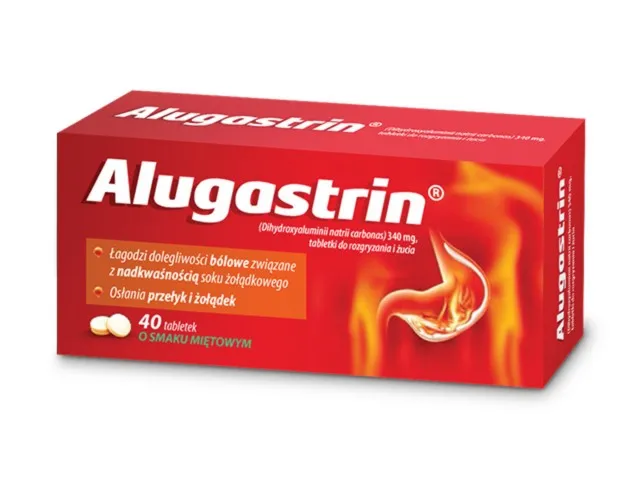
Table of Contents
Package leaflet: Information for the patient
Alugastrin, 340 mg, chewable tablets
(Dihydroxyaluminii natrii carbonas)
Please read this leaflet carefully before using the medicine, as it contains important information for the patient.
This medicine should always be used exactly as described in this patient leaflet or as directed by a doctor or pharmacist.
- Keep this leaflet, so that you can read it again if necessary.
- If you need advice or further information, please consult your pharmacist.
- If you experience any adverse reactions, including any possible adverse reactions not listed in this leaflet, inform your doctor or pharmacist. See section 4.
- If there is no improvement after 14 days in adults or after 7 days in children, or if your condition worsens, consult your doctor.
Table of contents
- What Alugastrin is and what it is used for
- Important information before taking Alugastrin
- How to take Alugastrin
- Possible side effects
- How to store Alugastrin
- Contents of the pack and other information
1. What Alugastrin is and what it is used for
Alugastrin is a medicine that neutralizes excess hydrochloric acid in gastric juice. It does not cause excessive alkalization of gastric juice or secondary stimulation of hydrochloric acid secretion. It provides protective action on the mucous membranes of the oesophagus, stomach and duodenum. It relieves pain symptoms associated with gastric hyperacidity.
Indicated for symptomatic treatment:
- in gastric hyperacidity;
- in episodic gastro-oesophageal reflux disease (e.g. heartburn, acid regurgitation, sour taste in the mouth);
- in mucosal damage of the stomach and duodenum caused by ulcerogenic factors (e.g. non-steroidal anti-inflammatory drugs - painkillers and anti-inflammatory medicines, commonly used for colds);
- in peptic ulcer disease of the stomach and duodenum.
If there is no improvement after 14 days in adults or after 7 days in children, or if your condition worsens, consult your doctor.
2. Important information before using Alugastrin
When not to use Alugastrin
- if the patient is allergic to sodium dihydroxyaluminium carbonate or any of the other ingredients of this medicine (listed in section 6);
- if the patient has severe renal insufficiency.
Warnings and precautions
Use with caution in patients prone to constipation.
In children under 6 years of age, may be used only after a physician has diagnosed the cause of symptoms.
Long-term use of high doses of the medicine may lead to hypophosphatemia (aluminium contained in the medicine binds phosphates in the small intestine, forming insoluble compounds).
Alugastrin and other medicines
Tell your doctor or pharmacist about all medicines the patient is currently taking or has recently taken, as well as any medicines the patient plans to take.
Alugastrin reduces gastrointestinal absorption of certain orally administered medicines, for example:
- H-receptor antagonists (medicines that reduce gastric acid secretion, used in the treatment of gastric and duodenal ulcer disease, e.g. ranitidine);
- phenytoin (an anticonvulsant and antiarrhythmic medicine used in the treatment of epilepsy);
- fluoroquinolones (medicines used to treat bacterial infections of the respiratory, urinary and genital systems, gastrointestinal tract, skin, soft tissues, bones and joints, e.g. ciprofloxacin);
- cardiac glycosides (medicines used in heart failure, e.g. digoxin);
- ketoconazole (a medicine used in fungal infections of the skin and nails);
- tetracyclines (a group of antibiotics used in bacterial infections of the respiratory and urogenital systems, Lyme disease, skin infections, e.g. doxycycline);
- salicylates (medicines with antipyretic, analgesic and anti-inflammatory effects, commonly used for colds);
- iron preparations (medicines used in iron deficiency anaemia);
- reduces the efficacy of sucralfate (a medicine used in the treatment of gastric and duodenal ulcer disease).
Intervals between administration of Alugastrin and other oral medicines should be observed as recommended by the physician.
Alugastrin with food and drink
It is advisable to take the medicine after meals or between meals.
Pregnancy, breastfeeding and fertility
Before using any medicine, consult a doctor or pharmacist.
During pregnancy (especially in the first trimester) and breastfeeding, the medicine may be used only if clearly necessary. Do not use long-term or in high doses.
Driving and operating machinery
Alugastrin has no effect on the ability to drive or operate machinery.
Alugastrin contains sodium
The medicine contains 57 - 114 mg of sodium per dose; this should be taken into account in patients with impaired renal function and in patients controlling sodium intake in their diet.
3. How to use Alugastrin
This medicine should always be taken exactly as described in this patient leaflet or as directed by a doctor or pharmacist. If in doubt, consult your doctor or pharmacist.
Recommended dose
Adults and children over 6 years of age: chew 1 or 2 tablets one hour after meals and before bedtime, or when symptoms occur. The maximum daily dose is 6 tablets.
Use of a higher than recommended dose of Alugastrin
If Alugastrin is taken in higher doses than recommended, diarrhoea, swelling of the feet and lower legs may occur.
Missed dose of Alugastrin
Do not take a double dose to make up for a missed dose.
If you have any further doubts concerning the use of this medicine, consult your doctor or pharmacist.
4. Possible adverse reactions
Like all medicines, this medicine can cause adverse reactions, although not everyone will experience them.
Common adverse reactions (occurring in 1 to 10 out of 100 patients):
chalky taste, mild constipation, stomach cramps.
Uncommon adverse reactions (occurring in 1 to 10 out of 1,000 patients):
nausea or vomiting, whitish discoloration of stool.
Rare adverse reactions (occurring in 1 to 10 out of 10,000 patients):
in case of long-term use or use of high doses:
persistent constipation, loss of appetite, unusual weight loss, muscle weakness, phosphate loss (bone pain, swelling of wrists or ankles).
Reporting of adverse reactions
If any adverse symptoms occur, including any adverse symptoms not listed in this leaflet, inform your doctor or pharmacist.
Adverse reactions can be reported directly to:
Department of Monitoring of Adverse Drug Reactions
Office for Registration of Medicinal Products, Medical Devices and Biocidal Products
Al. Jerozolimskie 181C
02-222 Warsaw
Phone: +48 22 49 21 301
Fax: +48 22 49 21 309
Website: https://smz.ezdrowie.gov.pl
Adverse reactions can also be reported to the marketing authorization holder.
By reporting adverse reactions, additional information on the safety of the medicine can be collected.
5. How to store Alugastrin
Store below 25°C. Keep in the original packaging to protect from moisture.
Keep the medicine out of the sight and reach of children.
Do not use this medicine after the expiry date stated on the blister and carton following EXP.
The expiry date refers to the last day of the stated month.
Medicines should not be disposed of via wastewater or household waste. Ask your pharmacist how to
dispose of medicines no longer required. These measures will help protect the environment.
6. Contents of the packaging and other information
What Alugastrin contains
- The active substance is sodium glycinate dihydroxy carbonate. Each tablet contains 340 mg of sodium glycinate dihydroxy carbonate.
- The other ingredients (excipients) are: mannitol, potato starch, sodium carmellose, magnesium stearate, mint-flavored flavoring agent, sodium saccharin.
What Alugastrin looks like and contents of the pack
The medicine is in the form of white, round tablets with a mint taste and odor, packed in blisters.
The outer packaging contains 10, 20, 40 or 60 tablets in blisters and the patient information leaflet.
Not all pack sizes may be marketed.
Marketing Authorization Holder
URGO Sp. z o.o.
Al. Jerozolimskie 142 B
02-305 Warsaw
tel/fax: 22 616 33 48 / 22 617 69 21
Manufacturer
SENSILAB Polska Spółka z ograniczoną odpowiedzialnością – Spółka komandytowo-akcyjna
ul. gen. Mariana Langiewicza 58
95-050 Konstantynów Łódzki
Coripharma ehf.
Reykjavíkurvegur 78,
Hafnarfjörður, IS-220,
Iceland
Detailed information about this medicinal product is available from the marketing authorization holder,
including for blind and partially sighted persons (audio version, CD), by calling:
22 616 33 48