Aescin
Poland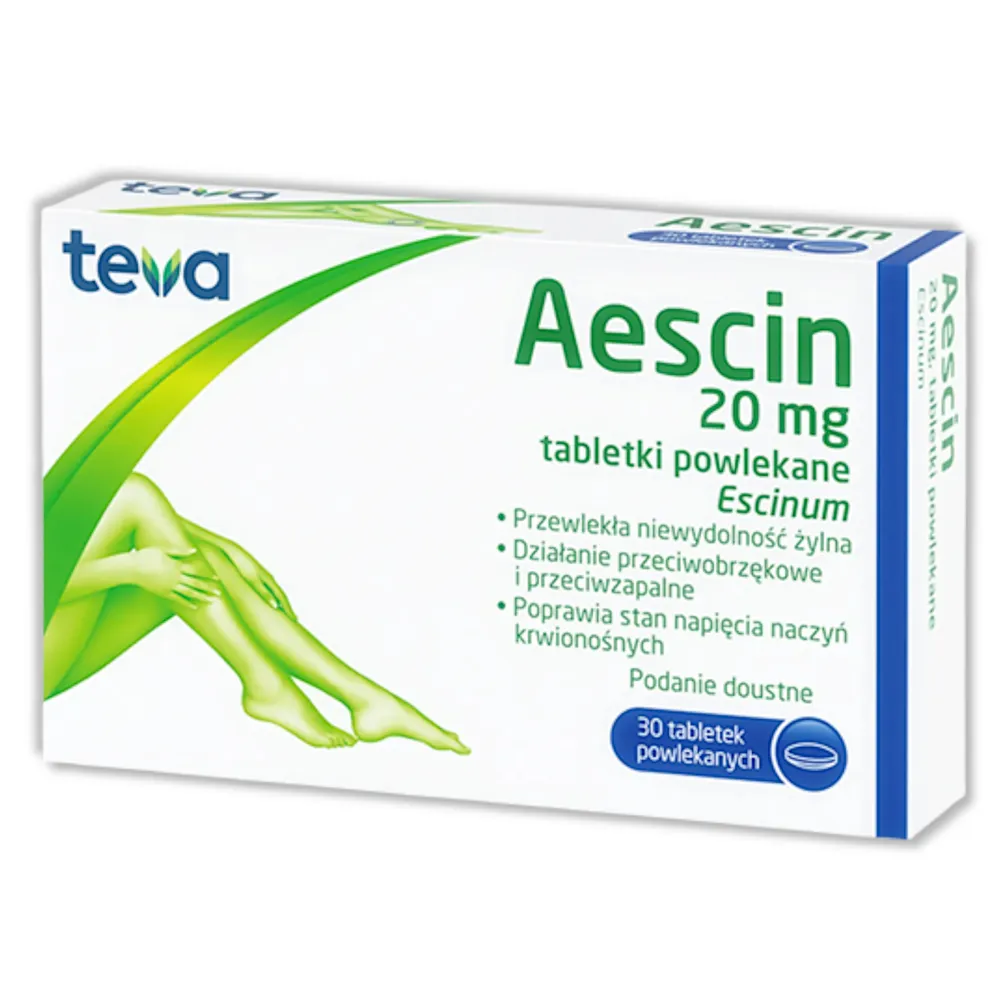
Table of Contents
Package leaflet: Information for the user
Warning! Keep this leaflet! The information on the immediate packaging is in a foreign language.
Aescin (Aescin Teva), 20 mg, enteric-coated tablets
Escinum
Aescin and Aescin Teva are different trade names for the same medicinal product.
Please read this leaflet carefully before using the medicine, as it contains
important information for the patient.
This medicine should always be used exactly as described in this patient leaflet or as directed by
the physician or pharmacist.
- Keep this leaflet, as you may need to read it again.
- If you need advice or further information, consult your pharmacist.
- If you experience any adverse reactions, including any possible adverse reactions not listed in this leaflet, inform your doctor or pharmacist. See section 4.
- If your condition does not improve or if you feel worse, contact your doctor.
Table of contents of the leaflet:
- What Aescin is and what it is used for
- Important information before taking Aescin
- How to take Aescin
- Possible side effects
- How to store Aescin
- Contents of the pack and other information
1. What Aescin is and what it is used for
- Treatment of chronic venous insufficiency, varicose veins of the lower limbs, and hemorrhoids.
- Treatment of phlebitis of the lower limbs.
- Prevention and treatment of postoperative and traumatic haematomas and oedema.
Aescin has anti-oedematous and anti-inflammatory effects and improves vascular tone. It reduces the permeability of blood vessel walls. It is effective in the treatment of postoperative and traumatic oedema.
Aescin promotes faster resorption of traumatic haematomas and reduces the likelihood of their occurrence in the postoperative period (especially after orthopaedic surgeries).
Moreover, by sealing the vascular endothelium, it improves venous and lymphatic circulation. The medicine is also used in the prevention of postoperative thrombophlebitis, as well as in the treatment of circulatory disorders of the limbs and varicose veins of the lower limbs.
If your condition does not improve or if you feel worse, contact your doctor.
2. Important information before using Aescin
When not to use Aescin:
- if the patient is allergic to the active substance or to any of the other ingredients of this medicine (listed in section 6)
- if the patient has severe renal insufficiency
- in women during pregnancy and breastfeeding.
Warnings and precautions
If any of the following symptoms occur after using Aescin, contact a doctor immediately:
- skin inflammation
- thrombophlebitis
- subcutaneous hardening (lumps under the skin)
- skin ulcers
- acute pain associated with skin disorders
- sudden swelling of one or both legs
- heart or kidney failure.
When using anticoagulant drugs concomitantly, blood coagulation parameters should be monitored frequently.
It is important to follow all other non-invasive measures recommended by the physician, such as leg bandaging, wearing compression stockings, cold water compresses.
Renal function should be monitored during treatment with Aescin.
This medicine should not be used in patients with rare hereditary galactose intolerance, Lapp-type lactase deficiency, or glucose-galactose malabsorption syndrome.
Note! The use of Aescin does not replace other preventive measures such as cold water compresses or wearing compression stockings.
Children and adolescents
The use of this medicine is not recommended in children and adolescents under 18 years of age due to insufficient data confirming safety in this age group.
Aescin and other medicines
Inform your doctor about all medicines you have recently taken, including those obtained without a prescription.
Aescin may enhance the effect of anticoagulant drugs. Some antibiotics – cephalosporins – may enhance the effect of the drug.
Concomitant administration of Aescin with aminoglycoside antibiotics should be avoided due to the possible increased nephrotoxic effect of aminoglycosides.
Pregnancy and breastfeeding
If the patient is pregnant or breastfeeding, suspects she may be pregnant, or is planning to become pregnant, she should consult a doctor or pharmacist before using this medicine.
Pregnancy
There are no clinical data on the use of alpha-aescin in pregnant women.
Animal studies do not show a direct or indirect harmful effect of alpha-aescin on pregnancy course and fetal development.
Breastfeeding
There are no clinical data on the use of alpha-aescin in women during breastfeeding.
Driving and operating machinery
Aescin does not affect the ability to drive or operate machinery.
The medicine contains monohydrate lactose
If the patient has previously been diagnosed with intolerance to certain sugars, the patient should consult a doctor before taking this medicine.
The medicine contains sunset yellow (E 110)
Due to the presence of sunset yellow (E 110), this medicine may cause allergic reactions.
The medicine contains sodium
This medicine contains less than 1 mmol (23 mg) of sodium per tablet, meaning the medicine is considered "sodium-free".
3. How to use Aescin
This medicine should always be used according to the instructions given by your doctor or pharmacist. If you have any doubts,
you should consult your doctor or pharmacist.
Aescin enteric-coated tablets are intended for oral use.
Use in children and adolescents:
The use of Aescin is not recommended in children and adolescents under 18 years of age.
Adults:
The usual dose of Aescin is 2 tablets taken 3 times daily, after meals, with a large amount of fluid.
For prophylactic use, treatment may be started at least 16 hours before a surgical procedure.
After 2-3 months of treatment, a maintenance dose of 40 mg (2 tablets) twice daily may be used.
When using contraceptive agents, a double dose of alpha-escin may be administered.
Elderly patients:
no dosage adjustment is necessary.
Missed dose of Aescin
Do not take a double dose to make up for a missed dose.
4. Possible side effects
Like all medicines, this medicine can cause side effects, although not everybody will get them.
The frequency of occurrence of side effects is defined as follows:
- very common – more than 1 in 10 patients
- common – 1 to 10 in 100 patients
- uncommon – 1 to 10 in 1,000 patients
- rare – 1 to 10 in 10,000 patients
- very rare – less than 1 in 10,000 patients
- unknown – frequency cannot be estimated from the available data.
Rare: allergic dermatitis (itching, rash, erythema, exanthema, urticaria).
Very rare: severe allergic reactions (in some cases with bleeding); tachycardia,
arterial hypertension; hypersensitivity reactions; genital tract hemorrhage.
Uncommon: dizziness, headache; nausea, vomiting, diarrhoea, gastric discomfort.
If any of the above reactions occur, particularly bleeding and initial signs of hypersensitivity (skin rash), the medicine should be discontinued and a doctor should be consulted immediately.
Reporting of side effects
If any adverse effects occur, including any not listed in this leaflet, inform your doctor or pharmacist.
Side effects can be reported directly to the Department of Monitoring Adverse Drug Reactions, Office for Registration of Medicinal Products, Medical Devices and Biocidal Products, Al. Jerozolimskie 181C, 02-222 Warsaw, tel.: +48 22 49 21 301, fax: +48 22 49 21 309; website: https://smz.ezdrowie.gov.pl.
Reporting of side effects helps to provide more information on the safety of the medicine.
5. How to store Aescin
Store below 25 °C.
Keep in the original packaging to protect from moisture.
Store in a place inaccessible and not visible to children.
Do not use this medicine after the expiry date stated on the packaging. The expiry date refers to the last day of the stated month.
Medicines must not be disposed of via wastewater or household waste. Ask your pharmacist how to dispose of medicines no longer required. Such measures help protect the environment.
6. Contents of the packaging and other information
What Aescin contains
- The active substance is alpha-aescin. Each tablet contains 20 mg of alpha-aescin ( Escinum ).
- The other ingredients are: lactose monohydrate, potato starch, povidone 25, talc, magnesium stearate. Coating: talc, titanium dioxide (E 171), povidone 25, polysorbate 80, copolymer of methacrylic acid and methyl methacrylate (1:1), 30% dispersion, sodium carmellose, orange yellow aluminium lake (E 110), simeticone emulsion 30%.
What Aescin looks like and contents of the pack
Enteric-coated tablets in Al/PVC blisters containing 30 tablets or 90 tablets per cardboard box.
For more detailed information, please contact the marketing authorisation holder or the parallel importer.
Marketing authorisation holder in the Czech Republic, country of export:
Teva Pharmaceuticals CR, s.r.o.
Radlická 3185/1c
150 00 Prague 5
Czech Republic
Manufacturer:
Teva Operations Poland Sp. z o.o.
ul. Mogilska 80, 31-546 Kraków
Poland
Parallel importer:
InPharm Sp. z o.o.
ul. Strumykowa 28/11
03-138 Warsaw
Repackaged in:
InPharm Sp. z o.o. Services sp. k.
ul. Chełmżyńska 249
04-458 Warsaw
Marketing authorisation number in the Czech Republic, country of export: 85/262/92-C
Parallel import authorisation number: 415/15