Adatam
Poland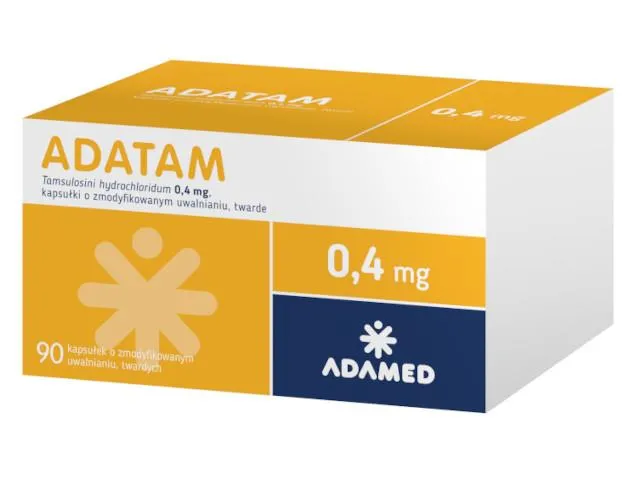
Table of Contents
Package leaflet: Information for the user
ADATAM, 0.4 mg, modified-release capsules, hard
Tamsulosini hydrochloridum
Please read all of this leaflet carefully before taking this medicine because it contains
important information for you.
- Keep this leaflet. You may need to read it again.
- If you have any further questions, ask your doctor or pharmacist.
- This medicine has been prescribed for you personally. Do not pass it on to others. It may harm them even if their symptoms are the same as yours.
- If you experience any side effects, including any not listed in this leaflet, tell your doctor or pharmacist. See section 4.
Contents of the leaflet
- What ADATAM is and what it is used for
- What you need to know before taking ADATAM
- How to take ADATAM
- Possible side effects
- How to store ADATAM
- Contents of the pack and other information
1. What ADATAM is and what it is used for
Tamsulosin is a substance that blocks alpha-1A adrenergic receptors.
ADATAM reduces the tone of the muscles of the prostate gland and urinary tract.
ADATAM is used in men to relieve symptoms of urinary disorders associated with an enlarged prostate gland (benign prostatic hyperplasia). The medicine reduces muscle tension, thereby facilitating urine flow through the urethra and urination.
2. Important information before taking ADATAM
When not to take ADATAM:
- if the patient is allergic to tamsulosin or to any of the other ingredients of this medicine (listed in section 6); symptoms may include facial and throat swelling (angioedema),
- if the patient has postural hypotension (a drop in blood pressure upon standing), which may cause dizziness, lightheadedness or fainting,
- if the patient has severe hepatic impairment.
Warnings and precautions
Before starting treatment with ADATAM, discuss with your doctor or pharmacist:
- if the patient experiences dizziness or lightheadedness, especially when standing up. This medicine may lower blood pressure, causing such symptoms. If symptoms of low blood pressure occur, the patient should sit or lie down until feeling better,
- if the patient has severe renal impairment. Administering the standard dose of ADATAM in patients with impaired kidney function may not provide the expected therapeutic effect,
- if the patient is scheduled for cataract surgery. During surgery, intraoperative floppy iris syndrome (IFIS) may occur – see section 4 "Possible side effects". The patient should inform the ophthalmologist that they are currently taking or have recently taken ADATAM. The ophthalmologist may take appropriate precautions regarding medications and surgical techniques. If preparing for cataract surgery or for treatment of increased intraocular pressure (glaucoma), the patient should consult their doctor whether ADATAM treatment should be postponed or temporarily discontinued.
Before initiating treatment with tamsulosin, the doctor should perform tests to exclude other conditions that may cause symptoms similar to those of benign prostatic hyperplasia.
Children and adolescents
This medicine should not be given to children and adolescents under 18 years of age, as it is not effective in this population.
ADATAM with other medicines
ADATAM may affect other medicines, and other medicines may affect the efficacy of ADATAM. ADATAM may interact with:
- diclofenac, a pain-relieving and anti-inflammatory medicine. This medicine may accelerate the elimination of tamsulosin from the body, thereby shortening its duration of action,
- warfarin, a medicine used to prevent blood clots. This medicine may accelerate the elimination of tamsulosin from the body, thereby shortening its duration of action,
- other alpha-adrenergic receptor blockers. Combining these with tamsulosin may lower blood pressure and cause dizziness or lightheadedness,
- ketoconazole, a medicine used to treat fungal skin infections. This medicine may enhance the effect of tamsulosin.
You should tell your doctor or pharmacist about all medicines the patient is currently taking or has recently taken, as well as any medicines the patient plans to take.
Taking ADATAM with food and drink
Take the medicine after breakfast or after the first meal of the day, with a glass of water.
Pregnancy, breastfeeding and fertility
ADATAM is not intended for use in women.
In men, abnormal ejaculation (ejaculation disorders) has been reported. This means that semen is not expelled from the body through the urethra, but enters the urinary bladder (retrograde ejaculation), or the volume of ejaculate is reduced or absent (anejaculation). These symptoms are not harmful to the patient.
Driving and operating machinery
There are no data confirming the effect of this medicine on the ability to drive or operate machinery. However, it should be noted that ADATAM may cause dizziness or lightheadedness; therefore, driving and operating machinery should only be undertaken when the patient does not experience such symptoms and feels well.
ADATAM contains sodium
This medicine contains less than 1 mmol (23 mg) of sodium per tablet, meaning the medicine is considered "sodium-free".
3. How to take ADATAM
This medicine should always be taken as directed by a doctor or pharmacist. If in doubt,
consult a doctor or pharmacist.
The recommended dose is one capsule once daily after breakfast or after the first meal of the day.
The capsule should be taken whole, with a glass of water, while standing or sitting (not
in a lying position). Capsules must not be broken or crushed, as this may affect
the effectiveness of the medicine.
In patients with mild or moderate renal impairment or liver disease,
there is no need to adjust the dosage.
Taking more than the recommended dose of ADATAM
If more than the recommended dose of ADATAM is taken, sudden lowering of blood pressure may occur.
Symptoms may include: dizziness, weakness, vomiting,
diarrhea, and fainting. The person should lie down to reduce the effects of low blood pressure, and then
contact a doctor. The doctor may administer medications to stabilize blood pressure and fluid levels, and
may recommend monitoring of vital functions. If removal of unabsorbed tamsulosin from the stomach is necessary, the doctor
may perform gastric lavage and administer laxatives.
Missing a dose of ADATAM
Do not take a double dose to make up for a missed dose. Take the next dose at the usual time.
Stopping treatment with ADATAM
If treatment is stopped too early, symptoms of the disease may return. Therefore, the medicine should be taken for as long as the doctor has instructed, even if symptoms have subsided. If a patient plans to discontinue treatment, this should always be discussed with a doctor.
If there are any further doubts regarding the use of this medicine, consult a doctor or pharmacist.
4. Possible adverse reactions
Like all medicines, this medicine can cause adverse reactions, although not everyone will experience them.
Serious adverse reactions are rare. You should seek immediate medical advice if the patient experiences:
- severe allergic reaction manifesting as swelling of the face or throat (angioedema). Tamsulosin must not be administered again (see section 2 "When not to take ADATAM").
Common adverse reactions (may occur in up to 1 in 10 patients)
- dizziness, particularly when sitting down or standing up,
- abnormal ejaculation (ejaculation disorders). This means that semen does not exit the body through the urethra but instead flows backward into the bladder (retrograde ejaculation),
or the volume of ejaculate is reduced or ejaculation cannot be achieved (inability to achieve ejaculation). These symptoms are not dangerous for the patient.
Uncommon adverse reactions (may occur in up to 1 in 100 patients)
- headache,
- sensation of rapid or irregular heartbeat (palpitations),
- low blood pressure upon standing, which may lead to dizziness, lightheadedness or fainting (orthostatic hypotension),
- swelling or irritation of nasal mucosa (rhinitis),
- constipation,
- diarrhoea,
- nausea,
- vomiting,
- rash,
- urticaria,
- weakness (asthenia),
- itching.
Rare adverse reactions (may occur in up to 1 in 1,000 patients)
- fainting.
Very rare adverse reactions (may occur in up to 1 in 10,000 patients)
- painful penile erection (priapism),
- severe illness characterized by blister formation on the skin, around the mouth, eyes and genital organs (Stevens-Johnson syndrome).
Adverse reactions with unknown frequency (frequency cannot be estimated from available data)
- blurred vision,
- visual disturbances,
- nosebleeds,
- dry mouth,
- severe skin rashes (erythema multiforme, exfoliative dermatitis),
- irregular heart rhythm (atrial fibrillation), irregular heartbeat (arrhythmia), rapid heartbeat (tachycardia), difficulty breathing (dyspnoea).
During eye surgery due to lens opacity (cataract) or increased intraocular pressure (glaucoma), a condition known as intraoperative floppy iris syndrome (IFIS) may occur: the pupil may dilate poorly and the iris (the coloured circular part of the eye) may become floppy. For additional information, see section 2 "Warnings and precautions".
Reporting of adverse reactions
If any adverse reactions occur, including any adverse reactions not listed in this leaflet, inform a doctor or pharmacist. Adverse reactions can be reported directly to the Department for Monitoring Adverse Drug Reactions at the Office for Registration of Medicinal Products, Medical Devices and Biocidal Products,
Al. Jerozolimskie 181C, 02-222 Warsaw
Tel.: +48 22 49 21 301
Fax: +48 22 49 21 309
Website: https://smz.ezdrowie.gov.pl
Adverse reactions can also be reported to the marketing authorization holder.
Reporting adverse reactions helps to improve the safety information available for this medicine.
5. How to store ADATAM
Keep this medicine out of sight and reach of children.
Do not use this medicine after the expiry date stated on the carton and blister after:
"Expiry date" or "EXP". The expiry date refers to the last day of the stated month.
Keep the medicine in its original packaging.
Medicines should not be disposed of via wastewater or household waste. Ask your pharmacist how to dispose of medicines no longer required. This will help protect the environment.
6. Contents of the pack and other information
What Adatam contains
The active substance is tamsulosin hydrochloride 0.4 mg.
The other ingredients are:
Capsule core: microcrystalline cellulose, methacrylic acid-ethyl acrylate copolymer (1:1) 30% dispersion, polysorbate 80, sodium lauryl sulfate, triethyl citrate, talc.
Capsule shell: gelatin, indigo carmine (E 132), titanium dioxide (E 171), yellow iron oxide (E 172), red iron oxide (E 172), black iron oxide (E 172).
7. What Adatam looks like and contents of the pack
Orange-olive coloured capsules (measuring 19.3 mm x 6.4 mm). The capsules contain white or almost white pellets.
Adatam modified-release capsules are available in packs containing 30, 60 or 90 capsules.
Not all pack sizes may be marketed.
Marketing Authorisation Holder and Manufacturer
Marketing Authorisation Holder
Adamed Pharma S.A.
Pieńków, ul. M. Adamkiewicza 6A
05-152 Czosnów
Poland
Manufacturer
Adamed Pharma S.A.
Pieńków, ul. M. Adamkiewicza 6A
05-152 Czosnów
Poland
A.Menarini Manufacturing and Logistics and Services S.r.l.
Via Campo di Pile
67100 L’Aquila, Italy
Menarini - von Heyden GmbH
Leipziger Str. 7-13
01097 Dresden, Germany
Quinta-Analytica s.r.o.
Pražská 1486/18c
102 00 Prague 10, Czech Republic
Synthon Hispania S.L.
Castello, 1, Poligono las Salinas
08830 Sant Boi de Llobregat, Spain
Synthon BV
Microweg 22
6545 CM Nijmegen, Netherlands
HGA Biomed Kft.
Nagygat u. 1.
7400 Kaposvár, Hungary