Actusept
Poland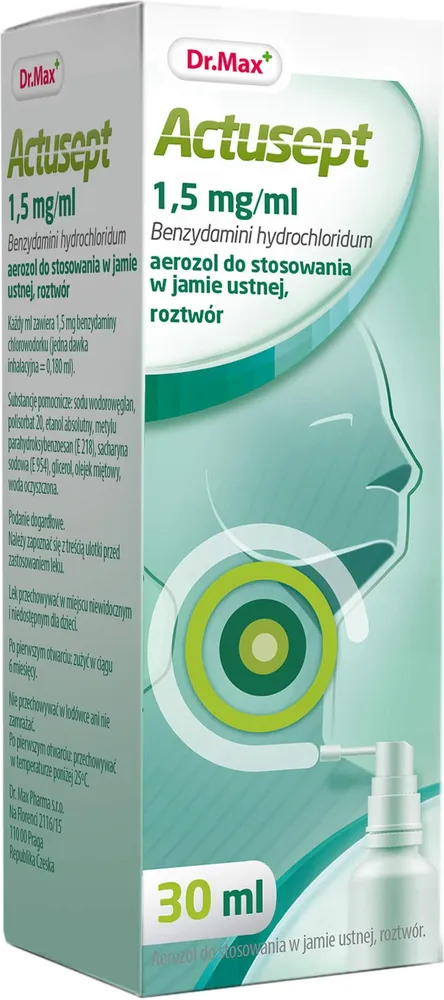
Table of Contents
Patient Information Leaflet
Actusept, 1.5 mg/ml, oral spray, solution
Benzydamini hydrochloridum
Please read all of this leaflet carefully before using this medicine, because it contains
important information for you.
This medicine should always be used exactly as described in this patient leaflet or as directed by
your doctor or pharmacist.
- Keep this leaflet so that you can read it again if necessary.
- If you need advice or further information, please consult your pharmacist.
- If you experience any adverse reactions, including any possible adverse reactions not listed in this leaflet, inform your doctor or pharmacist. See section 4.
- If there is no improvement after 3 days or if your condition worsens, contact your doctor.
Table of Contents
- What Actusept is and what it is used for
- Before you use Actusept
- How to use Actusept
- Possible side effects
- How to store Actusept
- Contents of the pack and other information
1. What Actusept is and what it is used for
Actusept contains benzydamine, which belongs to a group of medicines called non-steroidal anti-inflammatory drugs (NSAIDs). The medicine exerts local anti-inflammatory and analgesic effects and produces local anaesthesia of the oral mucosa.
Actusept is used for the local treatment of inflammatory symptoms in the mouth and throat associated with pain (e.g. oral ulceration, sore throat, inflammation of the oral mucosa and gums). On medical advice, it may also be used to relieve post-traumatic pain following procedures in the mouth or throat (e.g. after tonsillectomy or dental procedures), or following the use of a nasogastric tube.
If there is no improvement after 3 days or if your condition worsens, contact your doctor.
2. Important information before using Actusept
When not to use Actusept
- if the patient is allergic to benzydamine or any of the other ingredients of this medicine (listed in section 6).
Warnings and precautions
Before starting to use Actusept, consult a doctor or pharmacist:
- if the patient is allergic to acetylsalicylic acid or other non-steroidal anti-inflammatory drugs (NSAIDs), as this may increase the risk of hypersensitivity reactions to benzydamine;
- if the patient currently has or has ever had bronchial asthma or allergies, which may lead to an increased risk of bronchospasm.
Gingivitis may be a symptom of dental disease. A dentist should be consulted if treatment is ineffective.
Avoid contact of the medicine with the eyes.
Actusept and other medicines
Inform the doctor about all medicines currently used or recently used, as well as any medicines the patient intends to take.
No interactions have been demonstrated so far between other medicines and Actusept, or between Actusept and other medicines.
Pregnancy, breastfeeding and fertility
If the patient is pregnant or breastfeeding, suspects she may be pregnant, or is planning to have a baby, she should consult a doctor or pharmacist before using this medicine.
Actusept should not be used during pregnancy unless absolutely necessary and recommended by a doctor. If use is necessary, the lowest possible dose should be used for the shortest possible duration.
Driving and operating machinery
This medicine has no effect or has a negligible effect on the ability to drive and operate machinery.
Actusept contains methyl parahydroxybenzoate (E 218), ethanol (alcohol) and sodium
Methyl parahydroxybenzoate (E 218)
This medicine may cause allergic reactions (including delayed-type reactions).
Ethanol
This medicine contains 14.58 mg of alcohol (ethanol) per spray. The amount of alcohol in one spray of this medicine is equivalent to less than 1 ml of beer or 1 ml of wine. The small amount of alcohol in this medicine will not cause noticeable effects.
Sodium
The medicine contains less than 1 mmol (23 mg) of sodium per spray, meaning the medicine is considered "sodium-free".
3. How to use Actusept
This medicine should always be used exactly as described in this patient information leaflet or as directed by a doctor or pharmacist. If in doubt, consult your doctor or pharmacist.
Recommended dose
Adults and adolescents aged above 12 years
4 to 8 sprays, 2 to 6 times daily; no more frequently than every 1.5 to 3 hours.
Children aged 6 to 12 years
4 sprays, 2 to 6 times daily; no more frequently than every 1.5 to 3 hours.
Children under 6 years of age
1 spray per 4 kg body weight, up to a maximum of 4 sprays, 2 to 6 times daily; no more frequently than every 1.5 to 3 hours.
Do not use in children who are unable to hold their breath for the duration of the spraying.
Elderly people
Dosage is the same as for other adults.
Method of administration
Use after eating and drinking.
How to use the aerosol
- When using the aerosol, hold the bottle vertically.
- Before first use, the aerosol must be primed. Turn the spray nozzle away from the face. Press firmly on the white actuator until a mist appears from the end of the spray nozzle. The aerosol is now ready for use.
- Direct the spray nozzle towards the affected area in the mouth or throat and press the actuator again. One press of the actuator delivers one spray.
- After administering the required number of sprays, wipe the end of the spray nozzle with a single-use tissue. This helps maintain the nozzle's patency.
- Never insert anything into the spray nozzle tip if it becomes blocked.
- Hold your breath while administering the dose.
Duration of treatment:
Contact your doctor if symptoms worsen or do not improve after 3 days, or if fever develops. Do not use Actusept for longer than 7 days without consulting a doctor.
Overdose of Actusept
If more than the recommended dose has been taken, or if a large amount of the medicine has been accidentally swallowed, contact your doctor or pharmacist immediately.
Missed dose of Actusept
Do not use a double dose to make up for a missed dose.
If you have any further doubts about the use of this medicine, consult your doctor or pharmacist.
4. Possible adverse reactions
Like all medicines, this medicine can cause adverse reactions, although not everyone will experience them.
Uncommon (may affect up to 1 in 100 patients):
- numbness or tingling in the mouth
- light sensitivity (phototoxic reaction)
Very rare (may affect up to 1 in 10,000 patients):
- breathing or swallowing difficulties (bronchospasm or laryngospasm)
Frequency not known (frequency cannot be determined from available data):
- allergic reactions (hypersensitivity)
- severe allergic reactions (anaphylactic shock), the symptoms of which may include difficulty breathing, chest pain or chest tightness and (or) dizziness/fainting, severe skin itching or raised lumps on the skin, swelling of the face, lips, tongue and (or) throat, which may be life-threatening.
Reporting of adverse reactions
If any adverse reactions occur, including any adverse reactions not listed in this leaflet, inform your doctor, pharmacist or nurse. Adverse reactions can be reported directly to the Department of Monitoring Adverse Drug Reactions of the Office for Registration of Medicinal Products, Medical Devices and Biocidal Products, Al. Jerozolimskie 181C, 02-222 Warsaw, phone: +48 22 49 21 301, fax: +48 22 49 21 309, website: https://smz.ezdrowie.gov.pl
Adverse reactions can also be reported to the marketing authorization holder.
Reporting adverse reactions helps to provide more information on the safety of the medicine.
5. How to store Actusept
Keep the medicine out of the sight and reach of children.
Do not use this medicine after the expiry date stated on the label and the outer carton after: "Expiry date (EXP)". The expiry date refers to the last day of the stated month.
Do not store in a refrigerator or freeze.
After first opening, store below 25°C.
Medicines must not be disposed of via wastewater or household waste. Ask your pharmacist how to dispose of medicines you no longer use. This will help protect the environment.
6. Contents of the package and other information
What Actusept contains
- The active substance is benzidamine hydrochloride. One millilitre of Actusept oral aerosol solution contains 1.5 mg of benzidamine hydrochloride. One spray (0.18 ml) of the aerosol contains 270 micrograms of benzidamine hydrochloride.
- The excipients are: sodium hydrogen carbonate, polysorbate 20, absolute ethanol, methyl parahydroxybenzoate (E 218), sodium saccharin (E 954), glycerol, peppermint oil, purified water.
What Actusept looks like and contents of the pack
Actusept is a colourless, clear, transparent liquid with a mint odour, contained in an amber glass bottle (type III) with a pump spray cap (applicator made of PP, tube made of LDPE/PP), packed in a cardboard box.
Pack size: 30 ml
Marketing Authorisation Holder
Dr. Max Pharma s.r.o.
Na Florenci 2116/15
110 00 Prague
Czech Republic
Tel.: (+420) 516 770 199
Manufacturer/Importer
Medis International a.s., výrobní závod Bolatice
Průmyslová 961/16
747 23 Bolatice
Czech Republic
Dr. Max Pharma s.r.o.
Na Florenci 2116/15
Nové Město
110 00 Prague 1
Czech Republic
This medicinal product is authorised in the European Economic Area under the following names:
Czech Republic: Larymed
Poland: Actusept
Romania: Zotrina 1.5 mg/ml bucofaringian spray, solution
Slovakia: Larynox