Aciclovir jelfa
Poland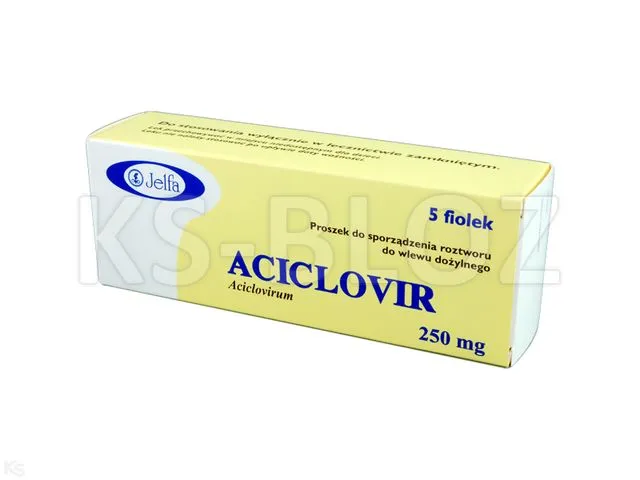
Table of Contents
- Package leaflet: Information for the user
- 1. What Aciclovir Jelfa is and what it is used for
- 2. Important information before using the medicine Aciclovir Jelfa
- 3. How to use Aciclovir Jelfa
- 4. Possible adverse reactions
- 5. How to store Aciclovir Jelfa
- 6. Contents of the package and other information
- Information intended exclusively for medical professionals
Package leaflet: Information for the user
ACICLOVIR JELFA, 250 mg, powder for solution for infusion
Aciclovirum
Please read all of this leaflet carefully before using this medicine, as it contains
important information for you.
- Keep this leaflet, as you may need to read it again.
- If you have any questions, please consult your doctor, pharmacist, or nurse.
- If you experience any adverse reactions, including any not listed in this leaflet, inform your doctor, pharmacist, or nurse. See section 4.
Contents of the leaflet
- What Aciclovir Jelfa is and what it is used for
- Important information before using Aciclovir Jelfa
- How to use Aciclovir Jelfa
- Possible side effects
- How to store Aciclovir Jelfa
- Contents of the package and other information
1. What Aciclovir Jelfa is and what it is used for
Aciclovir Jelfa is an antiviral medicine. It is used in infections caused by viruses of the Herpesviridae family (herpesviruses).
In humans, the most common causative agents are the following herpesviruses: herpes simplex virus types I and II (Herpes simplex, HSV), varicella-zoster virus (Varicella zoster, VZV), cytomegalovirus (CMV), and Epstein-Barr virus (EBV).
Acyclovir shows the highest clinical efficacy in the treatment of herpes simplex virus type I (Herpes simplex, HSV-I) infections, somewhat lower efficacy against type II (HSV-II), and even lower efficacy against Varicella zoster (VZV) virus infections.
It shows minimal antiviral activity, usually without clinical significance, against cytomegalovirus (CMV) and Epstein-Barr virus (EBV).
Indications for Aciclovir Jelfa
Herpes simplex skin and mucous membrane infections (types I and II) and their recurrences in immunocompromised patients.
Varicella-zoster virus infections (chickenpox and shingles) in immunocompromised patients.
Herpes simplex meningitis and encephalitis in patients over 6 months of age.
Treatment of severe initial episodes of genital herpes (Herpes genitalis).
2. Important information before using the medicine Aciclovir Jelfa
When not to use Aciclovir Jelfa
If the patient is allergic to aciclovir or valaciclovir.
Warnings and precautions
Before starting treatment with Aciclovir Jelfa, discuss this with your doctor.
Exercise particular caution when using Aciclovir Jelfa in dehydrated patients, those receiving high doses of aciclovir, patients with a history of kidney disease, or those receiving other nephrotoxic (kidney-damaging) drugs simultaneously. These conditions increase the risk of kidney damage caused by aciclovir.
The medicine must not be administered as a rapid intravenous injection, as this may lead to kidney damage due to increased risk of aciclovir crystallization in the renal tubules. This may result in acute renal failure.
Aciclovir solutions must be administered only by slow intravenous infusion at the appropriate concentration (see: Preparation of Aciclovir Jelfa solution).
Solutions of higher concentration may cause phlebitis and kidney damage.
Aciclovir solutions must not be used topically, intramuscularly, subcutaneously, orally, or in the eyes (these are highly alkaline solutions, pH 10.5–12).
If the solution comes into contact with skin or mucous membranes, wash thoroughly with soap and water.
If the solution gets into the eye, rinse immediately with large amounts of water, preferably running water.
Intravenous administration of aciclovir requires maintaining adequate hydration of the patient.
Adequate hydration to prevent precipitation of drug crystals in urine is indicated by a daily urine output (diuresis) of at least 500 ml per 1 g of administered drug. It is recommended to administer fluids in an amount of no less than 1 litre per 1 g of aciclovir per day.
Intravenous infusion of aciclovir may cause central nervous system disturbances. Caution is advised when administering aciclovir to patients who previously experienced neurological disturbances after aciclovir administration.
Increased risk of such disturbances also exists in patients with renal or hepatic impairment, significant electrolyte imbalances, severe hypoxia, and in those receiving concomitant intravenous methotrexate or interferon.
It should be noted that reduced activity of the viral enzyme thymidine kinase leads to decreased efficacy of aciclovir. Such cases have been observed during intravenous use of aciclovir in patients with severe immunodeficiency, including after bone marrow transplantation.
The correlation between in vitro antiviral activity of the drug and clinical efficacy has not been established.
Use of Aciclovir Jelfa in patients with renal impairment
Due to the risk of drug accumulation, dosage adjustments are essential in patients with renal impairment, based on creatinine clearance (estimated glomerular filtration rate) (see section 3: Specific patient groups).
Aciclovir Jelfa and other medicines
Inform your doctor about all medicines currently or recently taken, as well as any medicines the patient plans to use.
No clinically significant interactions have been reported.
Aciclovir is primarily excreted unchanged in urine via active tubular secretion. Any concomitantly administered drugs competing for this mechanism may increase aciclovir plasma concentrations.
Probenecid and cimetidine increase the area under the curve (AUC) of aciclovir through this mechanism and reduce renal clearance. However, dosage adjustment is not necessary due to the wide therapeutic index of aciclovir.
Caution is advised when administering Aciclovir Jelfa by infusion together with drugs that compete for renal excretion, due to the potential for increased plasma concentrations of one or both drugs or their metabolites. When administered concomitantly, it has been demonstrated that systemic exposure to aciclovir and mycophenolic acid (an inactive metabolite of the immunosuppressive drug administered to transplant patients) increases [increased area under the curve (AUC)].
Caution (with monitoring of renal function) is also advised when administering Aciclovir Jelfa intravenously together with drugs affecting kidney function (cyclosporine, tacrolimus).
Pregnancy and breastfeeding
If the patient is pregnant or breastfeeding, suspects she may be pregnant, or is planning to become pregnant, she should consult her doctor before using this medicine.
Limited data are available on the use of aciclovir in pregnant women.
Aciclovir may be used during pregnancy only if, in the opinion of the physician, the expected benefit to the pregnant woman outweighs the potential risk to the fetus.
Consult your doctor before taking any medicine.
After oral administration, aciclovir has been detected in human milk, sometimes at concentrations higher than those in serum. The potential risks to the breastfed infant have not been established.
If treatment with aciclovir is necessary, breastfeeding should be discontinued.
Driving and operating machinery
In patients treated with intravenous aciclovir, numerous central nervous system disturbances have been reported (see section 4), including seizures, agitation, and disturbances of consciousness. Such symptoms impair psychomotor performance and make driving and operating machinery inadvisable.
3. How to use Aciclovir Jelfa
This medicinal product is intended for use only in a hospital setting.
This medicine should always be used as directed by the physician. In case of doubt, consult your doctor.
Treatment should be initiated as early as possible after the onset of symptoms and diagnosis.
The dosing recommendations below apply to adults and children with normal renal function
(see also Special patient groups).
Herpes simplex skin and mucous membrane infections in immunocompromised patients
The medicine is administered by continuous intravenous infusion lasting no less than 1 hour.
Treatment lasts 7 days.
Adults: 15 mg/kg body weight per day in divided doses (5 mg/kg body weight of aciclovir every 8 hours).
Children aged over 6 months up to 12 years: 750 mg/m^2 body surface area per day in divided doses (250 mg/m^2 body surface area every 8 hours).
Clinically severe genital herpes infections (Herpes genitalis)
Adults and children over 6 months of age: Treatment lasts 5 days.
Dosage, method, and frequency of administration are the same as for herpes simplex skin and mucous membrane infections in immunocompromised patients (see above).
Varicella-zoster virus infections in immunocompromised patients
The medicine is administered by continuous intravenous infusion lasting no less than 1 hour.
Treatment lasts 7 days.
Adults: 10 mg/kg body weight every 8 hours.
Children aged over 6 months up to 12 years: 500 mg/m^2 body surface area every 8 hours.
Herpes simplex encephalitis and meningitis
The medicine is administered by continuous intravenous infusion lasting no less than 1 hour. Treatment lasts 10 days.
Adults: 10 mg/kg body weight every 8 hours.
Children aged over 6 months up to 12 years: 500 mg/m^2 body surface area every 8 hours.
Special patient groups
Patients with renal impairment
Dosage or dosing intervals should be adjusted according to creatinine clearance as recommended in the table below.
| Creatinine clearance (ml/min/1.73m2) | % of recommended dose | Dosing interval (hours) |
| > 50 | 100% | 8 |
| 25–50 | 100% | 12 |
| 10–25 | 100% | 24 |
| 0–10 | 50% | 24 |
Warning: During acyclovir treatment, creatinine clearance or its serum concentration should be monitored continuously.
Patients undergoing hemodialysis
Acyclovir concentrations decrease during dialysis. An appropriate dose adjustment should be made after each dialysis session.
Patients undergoing peritoneal dialysis
Dose adjustment is not necessary if appropriate dosing intervals are maintained.
Elderly patients
Renal function may be reduced to varying degrees in elderly patients. The drug should be administered following an assessment of renal status. Dosage should be modified according to recommendations for patients with renal impairment (see table above).
Obese patients
In obese patients receiving intravenous acyclovir dosed according to actual body weight, increased plasma concentrations may occur. Therefore, dose reduction should be considered in obese patients, especially in those with impaired renal function or elderly patients.
Warning: the dose should never exceed 500 mg/m² every 8 hours.
If the effect of the medication seems too strong or too weak, consult a physician.
Administration of a higher than recommended dose of Aciclovir Jelfa
Symptoms of overdose have been reported following rapid intravenous injection or excessive dosing, as well as in patients with disturbed water-electrolyte balance.
Increased blood urea nitrogen and serum creatinine levels, and renal function disorders have been observed. Significant disturbances in consciousness, seizures, and coma may occur.
Acyclovir crystallization in renal tubules may occur when tubular concentration exceeds 2.5 mg/mL.
It is recommended to administer fluids in sufficient volume to ensure a diuresis exceeding 500 mL per 1 g of drug administered by infusion.
Six-hour hemodialysis may reduce serum acyclovir concentration by 60%.
In cases of renal failure and anuria, the patient requires hemodialysis until renal function returns.
4. Possible adverse reactions
Like all medicines, this medicine can cause adverse reactions, although not everyone will experience them.
The frequencies of adverse reactions presented below are only approximate. In most cases, there were no available data enabling estimation of the frequency of occurrence of adverse reactions, which may also vary depending on the indication for treatment.
Common (may occur in up to 1 in 10 people):
- phlebitis, nausea, vomiting, transient increase in liver enzyme activity in the blood, itching, urticaria, rash (including photosensitivity);
- increased levels of urea and creatinine.
Sudden increases in serum urea and creatinine concentrations have occasionally been observed in patients receiving intravenous acyclovir. This is believed to be related to peak plasma concentrations of the drug and the patient's hydration status. To avoid this, the medicine should not be administered as a rapid intravenous injection, but exclusively as a slow intravenous infusion lasting more than one hour.
Uncommon (may occur in up to 1 in 100 people):
- decreased haematological parameters (anaemia, thrombocytopenia, leukopenia).
Very rare (may occur in up to 1 in 10,000 people):
- anaphylactic reactions (severe allergic reactions causing breathing difficulties or dizziness);
- headache, dizziness, agitation, disorientation, tremors, ataxia, dysarthria, hallucinations, psychotic symptoms, seizures, somnolence, encephalopathy (brain damage), coma. The above adverse reactions are usually transient and generally observed in patients with impaired renal function or other predisposing factors (see section 2: Warnings and precautions).
- dyspnoea, diarrhoea, abdominal pain, transient increase in bilirubin levels, jaundice, hepatitis, angioedema;
- renal function disorders, acute renal failure. Adequate hydration of the patient should be maintained. Renal impairment usually resolves quickly after fluid supplementation and/or dose reduction or discontinuation of the medicine. However, in exceptional cases, acute renal failure may occur.
- fatigue, fever, local inflammatory reactions. Following accidental extravasation of acyclovir infusion solution, severe local inflammatory reactions have been observed, sometimes leading to skin damage.
Reporting of adverse reactions
If any adverse reactions occur, including any adverse reactions not listed in this leaflet, inform your doctor, pharmacist, or nurse. Adverse reactions can be reported directly to the Department of Monitoring Adverse Drug Reactions of the Office for Registration of Medicinal Products, Medical Devices and Biocidal Products:
Al. Jerozolimskie 181C
02-222 Warsaw
Tel.: +48 22 49 21 301
Fax: +48 22 49 21 309
Website: https://smz.ezdrowie.gov.pl
Adverse reactions can also be reported to the marketing authorisation holder.
Reporting adverse reactions helps to provide more information on the safety of the medicine.
5. How to store Aciclovir Jelfa
Keep this medicine out of sight and reach of children.
Do not use this medicine after the expiry date stated on the packaging.
The expiry date refers to the last day of the stated month.
Store below 25°C.
The prepared solution may be stored for 24 hours at a temperature below 25°C.
Medicines must not be disposed of via wastewater or household waste. Ask your pharmacist
how to dispose of medicines no longer in use. This will help protect the environment.
6. Contents of the package and other information
What Aciclovir Jelfa contains
The active substance is aciclovir in the form of aciclovir sodium.
Each vial contains 250 mg of aciclovir in the form of aciclovir sodium.
What Aciclovir Jelfa looks like and contents of the pack
Powder for solution for infusion (lyophilisate).
Aciclovir Jelfa is a white or almost white solid or partially fragmented mass (lyophilisate).
Pack size: 5 glass vials in a cardboard box.
Marketing Authorisation Holder
Bausch Health Ireland Limited
3013 Lake Drive
Citywest Business Campus
Dublin 24, D24PPT3
Ireland
Tel: +48 17 865 51 00
Manufacturer
Przedsiębiorstwo Farmaceutyczne Jelfa SA
ul. Wincentego Pola 21, 58-500 Jelenia Góra
Information intended exclusively for medical professionals
Preparation of the medicinal product solution Aciclovir Jelfa
Add 10 mL of water for injections or 10 mL of 0.9% sodium chloride solution for injections to the vial containing the lyophilisate.
The resulting solution contains 25 mg of acyclovir per 1 mL.
Do not use solvents containing benzyl alcohol or parahydroxybenzoates (precipitation may occur).
After dissolving the dry substance in the vial, inspect the solution carefully for particulate matter or discoloration before combining with infusion fluids.
The prepared solution may be stored for 24 hours at a temperature below 25°C.
Sodium acyclovir solution has a pH of 10.5–12, which may cause reactions with metal (e.g. syringe components).
The appropriate dose of acyclovir should be added to an infusion fluid so that the drug concentration does not exceed 7 mg/mL.
In adults weighing 70 kg, the recommended single dose should be administered in a volume of 60–150 mL.
In children, the volume of infusion fluid should be adjusted according to age and body weight.
The original acyclovir solution may be added to the following intravenous infusion fluids:
- 0.45% or 0.9% sodium chloride solution;
- 0.45% sodium chloride with 2.5% glucose solution;
- compound sodium lactate solution (Hartmann's solution).
The solution must be prepared under aseptic conditions immediately before administration. If cloudiness or crystallization occurs (before or during infusion), the solution must be discarded. The prepared solution should be administered by slow intravenous infusion at a constant rate over a period of not less than 1 hour.
Warning!
Do not administer the medicinal product by rapid intravenous injection or at concentrations higher than recommended. Intramuscular or subcutaneous injection may cause local tissue irritation (the pH of sodium acyclovir solution is approximately 11).
Pharmaceutical incompatibilities
The lyophilisate must not be reconstituted with solutions containing bacteriostatic parahydroxybenzoates or benzyl alcohol.