Acatar allergy
Poland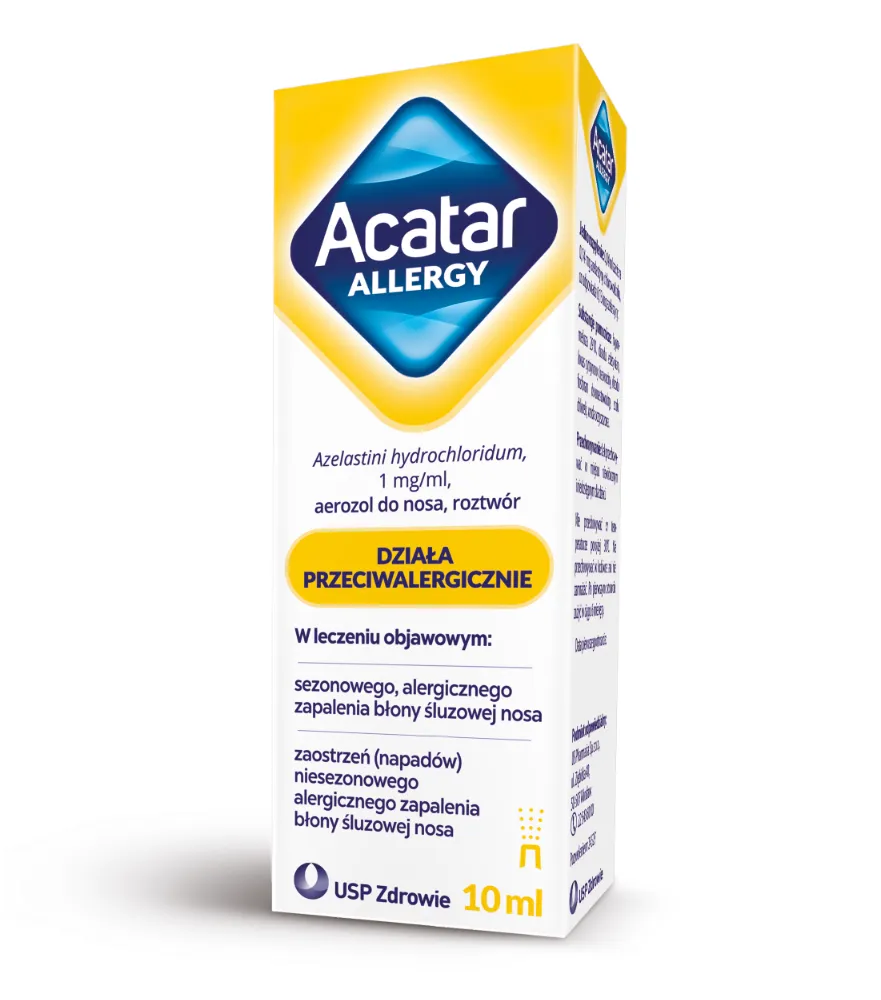
Table of Contents
Package leaflet: Information for the patient
Acatar Allergy, 1 mg/ml, nasal spray, solution
Azelastini hydrochloridum
Please read this leaflet carefully before using the medicine, as it contains important information for the patient.
This medicine should always be used exactly as described in this patient leaflet or as directed by a doctor, pharmacist, or nurse.
- Keep this leaflet, as you may need to read it again.
- If you need advice or further information, consult your pharmacist.
- If you experience any adverse reactions, including any possible adverse reactions not listed in this leaflet, inform your doctor, pharmacist, or nurse. See section 4.
- If there is no improvement after 3 days or if your condition worsens, contact your doctor.
Contents of the leaflet
- What Acatar Allergy is and what it is used for
- Important information before using Acatar Allergy
- How to use Acatar Allergy
- Possible side effects
- How to store Acatar Allergy
- Contents of the pack and other information
1. What Acatar Allergy is and what it is used for
Acatar Allergy contains azelastine, which belongs to a group of medicines that work by preventing the action of histamine (antihistamines) and other substances produced by the body during an allergic reaction, which usually cause watery nasal discharge, sneezing, itching, or nasal congestion in patients.
The indications for use of Acatar Allergy are:
- Symptomatic treatment of seasonal allergic rhinitis (hay fever);
- Symptomatic treatment of perennial (non-seasonal) allergic rhinitis.
Acatar Allergy nasal spray is intended for use in adults, adolescents, and children aged 6 years and above.
The onset of action occurs within 15 minutes after administration and lasts for approximately 12 hours.
Allergic rhinitis may be considered chronic when symptoms persist for more than 4 days per week and longer than 4 weeks.
If there is no improvement after 3 days or if your condition worsens, consult your doctor.
2. Important information before using Acatar Allergy
When not to use Acatar Allergy:
- if the patient is allergic to azelastine hydrochloride or any of the other ingredients of this medicine (listed in section 6).
- in children under 6 years of age. page 1 of 5
Warnings and precautions
Before starting treatment with Acatar Allergy, discuss this with your doctor or pharmacist.
Patients with hepatic and/or renal impairment
There is insufficient data on the use of Acatar Allergy in these patient groups.
Elderly patients
There is insufficient data on the use of this medicine in elderly patients.
Acatar Allergy and other medicines
Tell your doctor or pharmacist about all medicines the patient is currently using, has recently used, or plans to use.
No cases of interactions with other medicines have been reported.
Pregnancy and breastfeeding
If the patient is pregnant or breastfeeding, suspects she may be pregnant, or is planning to have a baby, she should consult her doctor or pharmacist before using this medicine.
Pregnancy
Despite the lack of data indicating harmful effects of azelastine on the unborn child, use of this medicine is not recommended during the first trimester of pregnancy.
Breastfeeding
Due to insufficient data on safety, Acatar Allergy nasal spray should not be used during breastfeeding.
Driving and operating machinery
Very rarely, fatigue, exhaustion, tiredness, dizziness, or weakness may occur, which may be caused by the disease itself or by the use of Acatar Allergy. In such cases, driving vehicles or operating machinery should be avoided. Be aware that drinking alcohol or taking other medicines may worsen these effects.
3. How to use Acatar Allergy
This medicine should always be used exactly as described in this patient information leaflet or as directed by a doctor or pharmacist. If in doubt, consult your doctor or pharmacist.
Adults, adolescents, and children aged above 6 years:
The recommended dose is one spray into each nostril twice daily (0.56 mg of azelastine hydrochloride per day).
How to use the nasal spray
- Blow your nose.
- Before first use, remove the plastic protective cap from the nozzle (Figure 1).
- Remove the protective cover (Figure 2).
- Before first use, prime the pump by pressing it several times until a fine mist is produced (3–4 times) (Figure 3).
- Administer one spray into each nostril keeping your head upright. Do not tilt your head backward (Figure 4).
- Wipe the pump tip and replace the protective cover.
page 2 of 5

If Acatar Allergy has not been used for 6 or more days, the pump must be re-primed by pressing and releasing it several times until a fine mist appears.
Duration of treatment
Consult your doctor or pharmacist if symptoms worsen or persist for more than 3 days without significant improvement despite using Acatar Allergy nasal spray.
This medicine may be used until symptoms resolve. The longest duration of observation in clinical trials with azelastine hydrochloride nasal spray was 12 months in adults and 6 months in children. The duration of treatment depends on the type, duration, and course of symptoms and should be determined by the physician. Acatar Allergy nasal spray may only be used in patients diagnosed by a physician with seasonal or perennial allergic rhinitis and according to the physician's instructions.
Acatar Allergy should not be used for longer than 4 weeks without medical supervision.
Use in children and adolescents
Acatar Allergy nasal spray should not be used in children under 6 years of age due to lack of data on safety and efficacy.
Use of more than the recommended dose of Acatar Allergy
If too much Acatar Allergy has been sprayed, contact your doctor or pharmacist.
There have been no reported cases of azelastine hydrochloride overdose in humans. However, after overdose or accidental oral ingestion, adverse effects on the central nervous system may occur (such as drowsiness, confusion, coma, tachycardia (rapid heartbeat), hypotension), similar to those observed in animal studies. In such cases, symptomatic treatment should be administered.
There is no known specific antidote for azelastine.
Missed dose of Acatar Allergy
Do not use a double dose to make up for a missed dose.
If you forget to use the medicine, use it as soon as you remember, then take the next dose 12 hours later, if necessary.
Stopping Acatar Allergy treatment
Do not stop treatment abruptly.
If you have any further questions about the use of this medicine, consult your doctor or pharmacist.
4. Possible adverse reactions
Like all medicines, this medicine can cause adverse reactions, although not everyone experiences them.
page 3 of 5
Common (may occur in fewer than 1 in 10 people): bitter taste in the mouth due to improper administration of the medicine (with the head tilted backwards, see section 3), which may sometimes cause nausea.
Uncommon (may occur in fewer than 1 in 100 people): irritation of the inflamed nasal mucosa (e.g. tingling, burning, itching), sneezing, and nosebleeds.
Rare (may occur in fewer than 1 in 1,000 people): nausea.
Very rare (may occur in fewer than 1 in 10,000 people): hypersensitivity, fatigue (tiredness, exhaustion), dizziness or weakness, which may also be caused by the underlying disease, rash, itching, urticaria.
If any of the adverse reactions listed above occur, inform your doctor.
In case of the first signs of hypersensitivity reactions, discontinue use of Acatar Allergy immediately. The doctor will then assess the severity of symptoms and decide whether further action is necessary.
Management of adverse reactions
Usually, the adverse reactions listed above are transient. Therefore, no specific action is required.
If a bitter taste in the mouth occurs after using Acatar Allergy, drink a non-alcoholic beverage (such as juice or milk) to neutralize it.
If any of the adverse reactions worsen or if any adverse reactions not listed in this leaflet occur, inform your doctor or pharmacist.
Reporting of adverse reactions
If any adverse reactions occur, including those not listed in this leaflet, inform your doctor or pharmacist.
Adverse reactions can also be reported directly to the Department of Monitoring Adverse Reactions of Medicinal Products, Office for Registration of Medicinal Products, Medical Devices and Biocidal Products, Al. Jerozolimskie 181C, 02-222 Warsaw;
tel: +48 22 492 13 01; fax: +48 22 492 13 09;
Website: https://smz.ezdrowie.gov.pl .
Adverse reactions can also be reported to the marketing authorization holder.
By reporting adverse reactions, more information on the safety of this medicine can be collected.
5. How to store Acatar Allergy
Keep this medicine out of sight and reach of children.
Do not use this medicine after the expiry date stated on the bottle and carton label after EXP. The expiry date refers to the last day of the stated month.
Store in the original packaging.
Do not store in a refrigerator or freeze.
Do not store at temperatures above 25°C.
Do not use more than 6 months after first opening.
Medicines should not be disposed of via wastewater or household waste. Ask your pharmacist how to dispose of medicines no longer in use. This will help protect the environment.
page 4 of 5
6. Contents of the pack and other information
What Acatar Allergy contains
- The active substance is azelastine hydrochloride 1 mg/ml. One application (0.14 ml) contains 0.14 mg of azelastine hydrochloride, equivalent to 0.13 mg of azelastine.
- Other ingredients are: hypromellose 2910, disodium edetate, citric acid, disodium phosphate dodecahydrate, sodium chloride, and purified water.
What Acatar Allergy looks like and contents of the pack
Acatar Allergy is a clear, colourless solution.
Acatar Allergy nasal spray is a multi-dose, plastic bottle (made of high-density polyethylene) equipped with a spray pump. Each bottle contains 10 ml of solution.
Marketing Authorisation Holder and Manufacturer
Marketing Authorisation Holder:
US Pharmacia Sp. z o.o.,
Ziębicka Street 40,
50-507 Wrocław, Poland
Manufacturers:
SAG Manufaturing, S.L.U
Ctra. N-I, Km 36, San Agustín de Guadalix
28750 Madrid, Spain
Galenicum Health, S.L.U
Sant Gabriel, 50, Esplugues de Llobregat
08950 Barcelona, Spain
For further information, contact:
USP Zdrowie Sp. z o.o., Poleczki Street 35, 02-822 Warsaw, Poland
Tel. +48 (22) 543 60 00
page 5 of 5