Yomesan
Italy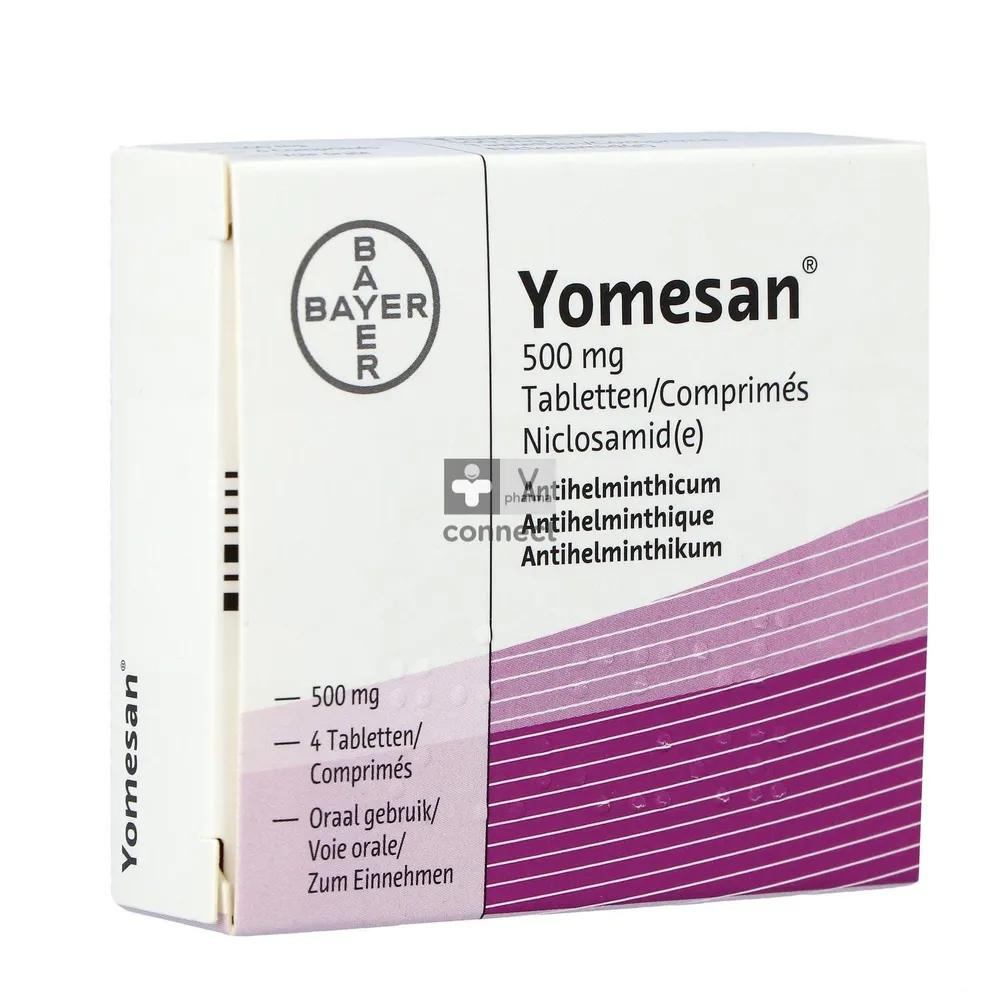
Table of Contents
Package leaflet: Information for the patient
Yomesan 500 mg chewable tablets
niclosamide
Please read this leaflet carefully before taking this medicine because it contains important information for you.
- Keep this leaflet. You may need to read it again.
- If you have any questions, ask your doctor or pharmacist.
- This medicine has been prescribed for you only. Do not give it to other people, even if their symptoms are the same as yours, as it could be harmful.
- If you experience any side effect, including those not listed in this leaflet, tell your doctor or pharmacist. See section 4.
Contents of this leaflet:
- What Yomesan is and what it is used for
- What you need to know before taking Yomesan
- How to take Yomesan
- Possible side effects
- How to store Yomesan
- Contents of the pack and other information
1. What Yomesan is and what it is used for
Yomesan contains the active substance niclosamide, an antiparasitic agent belonging to the group of
anthelmintic, anticestodal medicines, derivatives of salicylic acid.
This medicinal product is used for the treatment of the following tapeworm infestations in adults and children:
- infestations caused by Taenia saginata (beef tapeworm),
- infestations caused by Taenia solium (pork tapeworm),
- infestations caused by Diphyllobothrium latum (fish tapeworm),
- infestations caused by Hymenolepis nana (dwarf tapeworm).
2. What you need to know before taking Yomesan
Do not take Yomesan
- if you are allergic to niclosamide or to any of the other ingredients of this medicine (listed in section 6).
Warnings and precautions
Talk to your doctor or pharmacist before taking Yomesan.
Yomesan eliminates the tapeworm present in the intestine.
Yomesan is not effective in cases of cysticercosis and echinococcosis, diseases caused by larvae of Taenia solium and
other parasites (E. multiocularis or E. granulosus) that localize and develop outside the intestine.
The absence of scolices (the "head" of the tapeworm, by which it attaches to the intestinal wall) in the faeces does not
indicate that Yomesan has not worked. After contact with the medicine, the parasites are damaged and may become
unrecognizable.
If rapid expulsion of the entire body (strobila) of the tapeworm is desired, a strong saline purgative (e.g. sodium sulfate or magnesium sulfate) may be administered 2 hours after taking the full daily dose of Yomesan (or, in the case of the dwarf tapeworm, Hymenolepis nana, after the last dose of treatment), to facilitate elimination of the parasite in liquid faeces. The scolex may not be found in the faeces despite the use of a drastic purgative: in this case, the tapeworm will be expelled in fragments over the following days.
If the purgative is not taken, segments (proglottids) of the tapeworm may be found in the faeces for about 2 more days after completion of Yomesan treatment. After this period, neither proglottids nor eggs should be detectable. If re-infected with Taenia saginata or Taenia solium, no scolices or eggs will appear in the faeces before 3 months.
Only in the case of infection with the dwarf tapeworm (Hymenolepis nana) is a 14-day observation period necessary, because any surviving scolices regenerate very rapidly and form sexually mature parasites, which begin producing eggs in the faeces again as early as 10 days after treatment.
Yomesan is lethal only to the adult parasite but not to the eggs; in case of infestation with Taenia solium (pork tapeworm), it is essential to take the drastic purgative to prevent the development of cysticercosis, i.e. an infestation caused by the larval form of the parasite due to ingestion of eggs, especially if adequate hygiene measures are not observed.
Indeed, the purgative serves to eliminate as quickly as possible the terminal segments (proglottids) containing mature eggs, before these are digested and release the eggs into the intestine.
Other medicines and Yomesan
Inform your doctor or pharmacist if you are taking, have recently taken, or might take any other medicines, including those not requiring a prescription.
Yomesan and alcohol
During treatment, it is advisable to avoid alcoholic beverages because the medicine is soluble in alcohol, which may increase its absorption.
Pregnancy and breastfeeding
If you are pregnant, suspect you may be pregnant, are planning a pregnancy, or are breastfeeding, consult your doctor or pharmacist before taking this medicine.
Pregnancy
Animal studies do not indicate any direct or indirect adverse effects on reproductive toxicity.
As a precautionary measure, use this medicine during pregnancy, especially during the first trimester, only when strictly necessary.
Breastfeeding
It is not known whether niclosamide is excreted in human milk. If you are breastfeeding, your doctor will prescribe Yomesan only after evaluating the risk-benefit ratio.
Driving and using machines
Yomesan may impair the ability to drive or use machinery due to central nervous system reactions. See section 4.
Yomesan chewable tablets contain less than 1 mmol (23 mg) of sodium per maximum daily dose, i.e. essentially "sodium-free".
3. How to take Yomesan
Take this medicine exactly as directed by your doctor or pharmacist. If you have any doubts,
consult your doctor or pharmacist.
Dosage
The recommended doses are:
| Parasite | Age group | Daily dose Day 1 Days 2–7 | |
| Taenia saginata Taenia solium Diphyllobothrium latum | Adults and children over 6 years | 4 tablets | |
| Children from 2 to 6 years | 2 tablets | ||
| Children under 2 years | 1 tablet | ||
| Hymenolepis nana | Adults and children over 6 years | 4 tablets | 2 tablets/day |
| Children from 2 to 6 years | 2 tablets | 1 tablet/day | |
| Children under 2 years | 1 tablet | 1/2 tablet/day | |
Administration methods
Oral use.
The entire daily dose should be taken immediately after breakfast in the morning.
The chewable tablets, which have a pleasant taste, must be chewed until reduced to a homogeneous paste and then swallowed with a small amount of water.
The tablets may also be crushed in water and then ingested.
The elimination of intestinal mucus, abundantly produced during infections with tapeworm, can be facilitated by taking acidic fruit juices, which allow easier access of the active ingredient to the tapeworm located beneath the mucus.
In case of constipation, it is necessary to normalize intestinal peristalsis (intestinal muscle contraction) before taking Yomesan. No other dietary measures are required.
Special populations
Use in patients with impaired hepatic (liver) or renal function
Niclosamide is not appreciably absorbed from the gastrointestinal tract and does not interfere with liver or kidney function. Therefore, dosage adjustments are not necessary in patients with impaired hepatic or renal function.
Use in children
For younger children, the tablets should be appropriately reduced to a homogeneous paste before administration with a small amount of water.
If you take more Yomesan than you should
Cases of overdose have not been reported.
If you accidentally take an excessive dose of Yomesan, inform your doctor immediately or go to the nearest hospital.
If you have any doubts about the use of this medicine, consult your doctor or pharmacist.
4. Possible side effects
Like all medicines, this medicine can cause side effects, although not everyone will experience them.
The adverse reactions listed below come from spontaneous reports, therefore their frequency cannot be determined.
Immune system disorders
- allergic reaction, for example erythema (redness of the skin), pruritus, rash (skin eruption),
- anaphylactic reaction (severe allergic reaction),
- anaphylactic shock (sudden drop in blood pressure due to severe allergic reaction).
Nervous system disorders
- dizziness.
Vascular disorders
- cyanosis (bluish discoloration of the skin due to reduced oxygen in the blood).
Gastrointestinal disorders
- nausea,
- vomiting,
- gastrointestinal and abdominal pain,
- retching,
- diarrhoea.
Skin and subcutaneous tissue disorders
- skin rash,
- pruritus,
- hyperhidrosis (excessive sweating).
General disorders and administration site conditions
- feeling unwell (fatigue).
Following the instructions contained in this leaflet reduces the risk of side effects.
Reporting of side effects
If you experience any side effect, including those not listed in this leaflet, talk to your doctor or pharmacist. You can also report side effects directly via the national reporting system at www.aifa.gov.it/content/segnalazioni-reazioni-avverse. By reporting side effects, you can help provide more information on the safety of this medicine.
5. How to store Yomesan
Keep in the original packaging.
Do not use this medicine after the expiry date stated on the carton. The expiry date refers to the last day of that month.
Keep this medicine out of the sight and reach of children.
Do not dispose of any medicine via wastewater or household waste. Ask your pharmacist how to dispose of medicines you no longer use. This will help protect the environment.
6. Package contents and other information
What Yomesan contains
- The active substance is: niclosamide. Each tablet contains 500 mg of niclosamide.
- The other components are: sodium saccharin, vanillin, sodium lauryl sulfate, polyvinylpyrrolidone, corn starch, talc, magnesium stearate.
Description of the appearance of Yomesan and contents
Yomesan is available as yellowish-grey, round, chewable tablets, marked "FE" on one side and the Bayer cross on the other.
Pack contents: 4 tablets of 500 mg.
Marketing Authorization Holder
Bayer AG
Leverkusen - Germany
Manufacturer
Bayer AG
Leverkusen - Germany