Voltadvance
Italy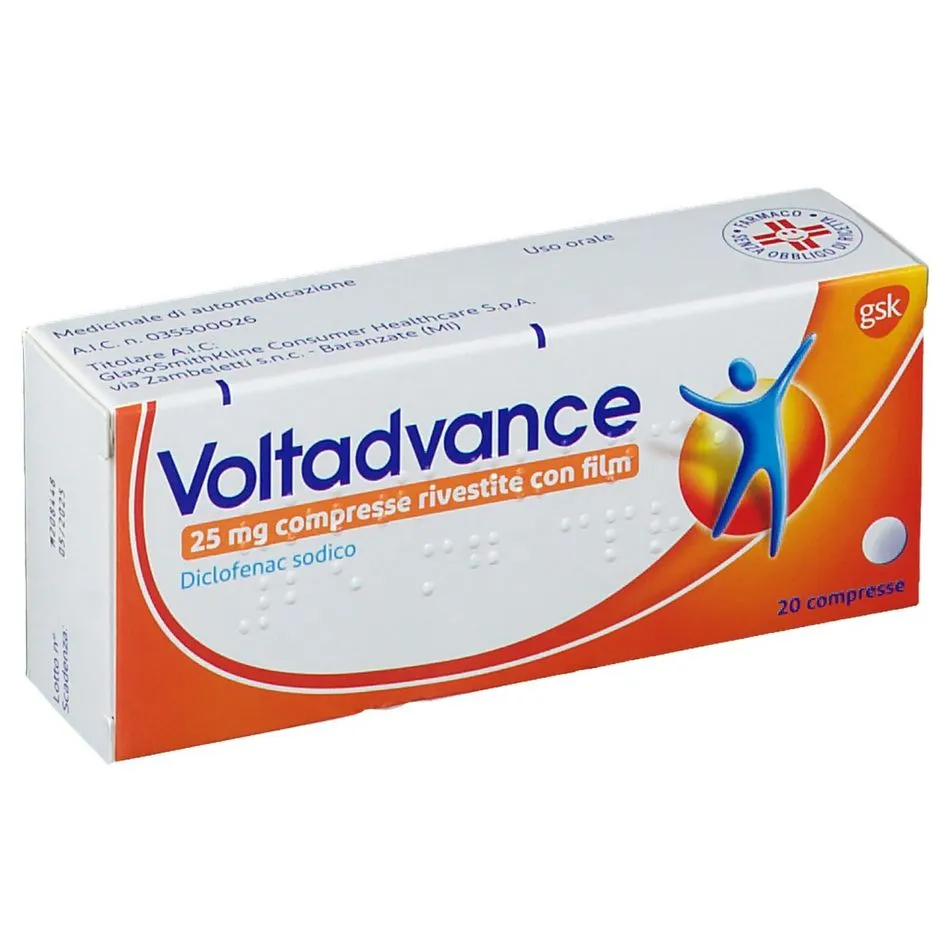
Table of Contents
- Patient Information Leaflet
- Voltadvance 25 mg film-coated tablets, 25 mg powder for oral solution
- 1. What Voltadvance is and what it is used for
- 2. What you need to know before taking Voltadvance
- 3. How to take Voltadvance
- 4. Possible side effects
- 5. How to store Voltadvance
- 6. Package contents and other information
Patient Information Leaflet
Voltadvance 25 mg film-coated tablets, 25 mg powder for oral solution
diclofenac sodium
Read this entire leaflet carefully before taking this medicine because it contains important information for you.
Always take this medicine exactly as described in this leaflet or as your doctor or pharmacist has instructed you.
- Keep this leaflet. You may need to read it again.
- If you need more information or advice, consult your pharmacist.
- If you experience any side effects, including those not listed in this leaflet, contact your doctor or pharmacist. See section 4.
- Contact your doctor if you do not notice any improvement or if your symptoms worsen after 2–3 days of treatment.
Contents of this leaflet:
- What Voltadvance is and what it is used for
- What you need to know before taking Voltadvance
- How to take Voltadvance
- Possible side effects
- How to store Voltadvance
- Contents of the pack and other information
1. What Voltadvance is and what it is used for
Voltadvance contains the active substance sodium diclofenac, which belongs to a class of medicines known as non-steroidal anti-inflammatory drugs (NSAIDs). Voltadvance works by reducing pain and inflammation.
Voltadvance is indicated for the treatment of various types of pain, such as:
- joint pain
- back pain (lumbago)
- muscle pain, including torticollis
- headache
- toothache
- menstrual pain
Consult your doctor if you do not feel better or feel worse after 2–3 days of treatment.
2. What you need to know before taking Voltadvance
Do not take Voltadvance
- if you are allergic to sodium diclofenac, acetylsalicylic acid, or any other non-steroidal anti-inflammatory drug (NSAID), or to any of the other ingredients of this medicine (listed in section 6)
- if you currently have a stomach or intestinal ulcer, bleeding, or perforation
- if you have previously experienced stomach or intestinal bleeding (haemorrhage) or perforation following treatment with NSAIDs
- if you have had recurrent bleeding or ulcers (two or more distinct episodes of proven ulceration or bleeding)
- if you have severe liver or kidney failure
- if you suffer from established heart disease and/or cerebrovascular disease, e.g., you have had a heart attack, stroke, mini-stroke (TIA), or obstruction of blood vessels supplying the heart or brain, or have undergone surgery to remove or prevent such obstructions
- if you suffer from or have suffered from circulatory problems (peripheral arterial disease)
- if you suspect you are allergic to sodium diclofenac, acetylsalicylic acid, ibuprofen, or any other NSAID or any other component of this medicine. Signs of hypersensitivity include swelling of the face, lips, tongue, and/or throat with difficulty swallowing (angioedema), breathing problems (difficulty breathing, asthma), chest pain, acute rhinitis (runny nose), skin rashes (urticaria), or any other type of allergic reaction.
- if you have a blood cell production disorder
- if you are taking high doses of medicines that increase urine production (diuretics) (see “Other medicines and Voltadvance”)
- if your stools are dark or contain blood
- if you are breastfeeding (see section “Pregnancy, breastfeeding and fertility”)
- if you are in the last three months of pregnancy (see section “Pregnancy, breastfeeding and fertility”)
- if you are under 14 years of age.
Warnings and precautions
Talk to your doctor or pharmacist before taking Voltadvance.
Before taking Voltadvance, ensure your doctor is aware if you:
- have asthma
- have seasonal allergic rhinitis, swelling of the nasal mucosa (e.g., nasal polyps)
- have chronic obstructive pulmonary disease or chronic respiratory tract infections
- have liver or kidney problems, except in cases of severe liver or kidney failure, as you must not take Voltadvance in these cases (see section 2 “Do not take Voltadvance”). If in doubt, consult your doctor.
- have hepatic porphyria
- have ulcerative colitis or Crohn’s disease, as these conditions may worsen
- are using medicines that increase urine production (diuretics) or other medicines that may affect kidney function
- have reduced body fluid volume (e.g., before or after major surgery)
- are undergoing or have recently undergone major surgery
- have blood clotting disorders (coagulation defects)
- have or have had heart problems
- smoke
- have diabetes
- have angina, blood clots, high blood pressure, high cholesterol, or high triglycerides
- experience signs or symptoms of heart or blood vessel problems such as chest pain, shortness of breath, weakness, or speech difficulties—contact your doctor immediately
- have stomach or intestinal problems, except in cases where you must not take Voltadvance (see section “Do not take Voltadvance”)
- are taking medicines that may increase the risk of bleeding, ulceration, and perforation, such as acetylsalicylic acid (e.g., aspirin) and other NSAIDs, corticosteroids taken orally, by injection, or rectally (e.g., cortisone), blood-thinning medicines (anticoagulants and antiplatelets), selective serotonin reuptake inhibitors (antidepressants) (see section “Other medicines and Voltadvance”).
- Inform your doctor if you have recently undergone or are about to undergo stomach or intestinal surgery before receiving/taking/using Voltadvance, as Voltadvance may sometimes impair wound healing in the intestine after surgery.
- If you have ever developed a severe skin rash or skin peeling, skin eruptions with blisters and/or mouth ulcers after taking Voltadvance or other pain-relieving medicines.
In these cases, your doctor will monitor you closely and periodically reassess the need for treatment with Voltadvance. Additionally, your doctor may perform regular tests (such as monitoring kidney or liver function) to evaluate your condition during treatment with Voltadvance.
Stop treatment and inform your doctor if, during treatment with Voltadvance, you develop:
- gastrointestinal bleeding or ulceration
- skin reactions, as very rare but potentially fatal skin reactions have been reported (see section 4.8)
- mucosal lesions or any other sign of allergic reaction
- fluid retention and swelling due to fluid accumulation (oedema)
- signs and symptoms of liver problems or if liver function tests are abnormal (visible in blood tests)
- unusual stomach or intestinal symptoms
- worsening headache, as prolonged use of pain-relieving medicines may in some cases worsen headaches
- symptoms of an infection (e.g., headache, fever) or notice worsening of an existing infection, as Voltadvance may mask signs and symptoms of infection.
In such cases, your doctor will evaluate whether to continue or discontinue treatment with Voltadvance.
Other important information:
- During treatment with NSAIDs, including diclofenac, gastrointestinal bleeding, ulceration, or perforation may occur, which can be fatal. The risk of gastrointestinal bleeding is higher with high NSAID doses and in patients who have had ulcers, especially if complicated by bleeding or perforation. You should take the lowest effective dose of diclofenac to reduce the risk of gastrointestinal toxicity, and your doctor may also prescribe protective medicines (e.g., misoprostol or proton pump inhibitors) to protect the gastrointestinal mucosa.
- Medicines such as Voltadvance may be associated with a small increased risk of heart attack (myocardial infarction) or stroke. Any such risk is more likely with high doses or prolonged treatment.
- Adverse effects can be minimised by using the lowest effective dose for the shortest necessary duration (see section 3 “How to take Voltadvance”).
- Avoid using diclofenac during treatment with other NSAIDs taken orally, by injection, or rectally, including selective cyclooxygenase-2 inhibitors, as this increases the likelihood of adverse effects.
Children and adolescents
Voltadvance is contraindicated in children and adolescents under 14 years of age.
Elderly patients
Elderly patients have a higher likelihood of experiencing adverse reactions, particularly gastrointestinal bleeding or perforation, which are generally more severe and may be fatal.
If you are elderly, you should take the lowest dosage of Voltadvance.
As a precaution, your doctor may monitor your kidney function and prescribe medicines that protect the gastrointestinal mucosa, such as misoprostol or proton pump inhibitors.
Inform your doctor of any unusual stomach or intestinal symptoms.
Other medicines and Voltadvance
Inform your doctor or pharmacist if you are taking, have recently taken, or might take any other medicines.
Inform your doctor if you are using any of the following medicines before taking Voltadvance:
- lithium (a medicine for mood disorders)
- digoxin (a heart medicine)
- methotrexate (a medicine for cancer)
- phenytoin (a medicine for epilepsy)
- diuretics, including potassium-sparing diuretics, and blood pressure-lowering medicines (ACE inhibitors, beta-blockers, and angiotensin II antagonists), particularly if you have kidney problems
- anti-inflammatory medicines (NSAIDs and corticosteroids)
- blood-thinning medicines (anticoagulants or antiplatelets)
- serotonin reuptake inhibitors (medicines for depression)
- medicines for diabetes
- cyclosporine, interferon alpha (immunosuppressants used to modify the body’s immune system response)
- antibacterial medicines of the quinolone class
- colestipol and cholestyramine (cholesterol-lowering medicines)
- sulfinpyrazone (used for gout) and voriconazole (used for fungal infections)
- intrauterine devices, as their effectiveness may be reduced
- medicines that increase potassium levels in the blood (potassium-sparing diuretics, cyclosporine, tacrolimus, or trimethoprim), as your doctor may need to perform frequent blood tests.
Pregnancy, breastfeeding and fertility
If you are pregnant, think you may be pregnant, are planning a pregnancy, or are breastfeeding, consult your doctor or pharmacist before taking this medicine.
Conception, first and second trimesters of pregnancy
Diclofenac should not be used during the first and second trimesters of pregnancy except when strictly necessary and under medical advice. Your doctor will assess whether the benefits clearly outweigh the risks to the fetus.
If you are trying to conceive or are in the first or second trimester of pregnancy and need to use diclofenac, take the lowest dose for the shortest possible time.
Third trimester of pregnancy
Do not take Voltadvance during the last three months (third trimester) of pregnancy, as it may harm the fetus or cause problems during delivery. It may cause kidney and heart problems in the fetus. It may affect your and your baby’s tendency to bleed and delay or prolong labour beyond the expected duration. If treatment is required during this period or during attempts to conceive, the lowest possible dose should be used for the shortest possible time. From week 20 of pregnancy, Voltadvance may cause kidney problems in the fetus if taken for more than a few days, thereby reducing the levels of amniotic fluid surrounding the baby (oligohydramnios) or narrowing the blood vessel (ductus arteriosus) in the baby’s heart. If treatment is needed for more than a few days, your doctor may recommend additional monitoring.
Breastfeeding
Diclofenac passes into breast milk in small amounts; therefore, Voltadvance is contraindicated during breastfeeding.
Fertility
As with other NSAIDs, Voltadvance is not recommended for women who are trying to conceive, as this medicine may impair female fertility. Your doctor will assess whether treatment with Voltadvance should be discontinued if you experience difficulty conceiving or require fertility testing.
Driving and using machines
Avoid driving or operating machinery if you experience or have previously experienced vision disturbances, dizziness, vertigo, drowsiness, or other central nervous system disorders with diclofenac use.
Important information about certain excipients:
Voltadvance 25 mg film-coated tablets contain less than 1 mmol (23 mg) of sodium per dose, i.e., essentially ‘sodium-free’.
Voltadvance 25 mg oral powder for solution contains less than 1 mmol (23 mg) of sodium per dose, i.e., essentially ‘sodium-free’.
Voltadvance 25 mg oral powder for solution contains anise flavour, which in turn contains limonene and linalool. Limonene and linalool may cause allergic reactions.
Voltadvance 25 mg oral powder for solution contains mint flavour, which in turn contains limonene, linalool, and eugenol. Limonene, linalool, and eugenol may cause allergic reactions.
3. How to take Voltadvance
Take this medicine exactly as directed by your doctor or pharmacist. If you have
any doubts, consult your doctor or pharmacist.
Use in adults and adolescents over 14 years of age
1-3 coated tablets or sachets per day, with meals, including 2 taken together in a single dose.
The maximum daily dose is 75 mg.
Take Voltadvance preferably with food.
Voltadvance tablets should be swallowed whole with a little water or other liquid.
Voltadvance sachets should be dissolved in a glass of water before taking.
Be careful not to exceed the recommended doses without medical advice. If you are elderly, you should
use the lowest possible dose among those listed above.
Do not use for more than 3 days.
Consult your doctor if you do not feel better or if you feel worse after 2-3 days of treatment.
Use in children and adolescents under 14 years of age
Voltadvance must not be used in children and adolescents under 14 years of age.
Use in the elderly
In elderly patients, a reduced dose of diclofenac may be necessary. If you are elderly, use the lowest possible
dose among those listed above.
Use in patients with kidney problems
Voltadvance must not be used in patients with severe renal impairment.
The medicine should be used with caution in patients with mild to moderate renal impairment.
Use in patients with liver problems
Voltadvance must not be used in patients with severe hepatic impairment.
The medicine should be used with caution in patients with mild to moderate hepatic impairment.
If you take more Voltadvance than you should
If you accidentally take too much Voltadvance, contact your doctor immediately
or go to the nearest hospital.
If you take an excessive dose of diclofenac, you may experience
- vomiting
- bleeding from the stomach or intestine
- diarrhoea
- dizziness
- ringing or buzzing in the ears
- seizures.
In more severe cases, serious damage to the kidneys and liver may also occur.
Your doctor will treat acute poisoning caused by non-steroidal anti-inflammatory drugs, including diclofenac,
according to the symptoms presented.
If you forget to take Voltadvance
Do not take a double dose to make up for the forgotten dose.
If you have any doubts about how to use this medicine, consult your doctor or pharmacist.
4. Possible side effects
Like all medicines, this medicine can cause side effects, although not everybody gets them.
If any of these effects occur during treatment with Voltadvance, it is recommended to
discontinue the medicine and consult your doctor.
Side effects can be minimized by using the lowest effective dose for the shortest duration necessary.
Some side effects may be serious.
Stop taking Voltadvance and contact your doctor immediately if you notice:
- Mild cramps and abdominal tenderness occurring shortly after starting treatment with Voltadvance, followed by rectal bleeding or bloody diarrhoea usually within 24 hours of the onset of abdominal pain (frequency not known, cannot be estimated from available data).
- Chest pain, which may be a sign of a potentially serious allergic reaction called Kounis syndrome.
- A severe skin allergic reaction that may include widespread red and/or dark patches, skin swelling, blisters, and itching (generalized fixed drug eruption).
Common side effects (may affect up to 1 in 10 people)
- Headache, dizziness, vertigo
- Nausea, vomiting
- Diarrhoea, passing gas (flatulence)
- Digestive problems (dyspepsia), abdominal pain
- Loss or reduction of appetite (anorexia)
- Changes in liver function tests (increased transaminases)
- Skin rash
Uncommon side effects (may affect up to 1 in 100 people)
These effects occurred after long-term treatment and with a high dose (150 mg daily).
- Heart attack
- Heart problems (heart failure)
- Awareness of your heartbeat (palpitations)
- Chest pain
Rare side effects (may affect up to 1 in 1,000 people)
- Allergic reactions, severe allergic reactions even after first use of the medicine (anaphylactic and anaphylactoid reactions), including hypotension and collapse (shock)
- Somnolence
- Asthma, difficulty breathing (dyspnoea)
- Inflammation of the stomach (gastritis), bleeding from the stomach or intestine, vomiting blood (haematemesis), stomach or intestinal ulcer with or without bleeding and perforation (with possible inflammation of the peritoneum called peritonitis), gastrointestinal narrowing (stenosis)
- Diarrhoea accompanied by bleeding, dark stools with blood (melena)
- Dryness of the mouth and mucous membranes
- Inflammation of the liver (hepatitis), yellowing of the skin, mucous membranes and eyes (jaundice), liver disorders
- Urticaria
- Swelling due to fluid accumulation (oedema)
Very rare side effects (may affect up to 1 in 10,000 people)
- Abnormal blood test results or reduced platelet count (thrombocytopenia), reduced white blood cell count (leucopenia, agranulocytosis), or anaemia (including haemolytic and aplastic anaemia)
- Abnormal urine test results or presence of blood in urine (haematuria) or presence of protein in urine (proteinuria)
- Swelling of the skin and mucous membranes (angioedema), including facial oedema
- Disorientation, depression, insomnia, nightmares, irritability, severe mental disturbances (psychotic reactions)
- Worsening of memory, seizures, anxiety, tremors
- Altered sensation in limbs or other body parts (paraesthesiae)
- Altered taste
- Inflammation of the membranes covering the brain and spinal cord (aseptic meningitis), damage to blood vessels in the brain (cerebrovascular events)
- Vision disorders, blurred vision, double vision (diplopia)
- Ringing or buzzing in the ears (tinnitus), worsening of hearing
- High blood pressure (hypertension)
- Inflammation of blood vessels (vasculitis)
- Pneumonia
- Inflammation of the colon (colitis), including colitis with bleeding, worsening of ulcerative colitis or Crohn's disease
- Constipation (stipsis)
- Inflammation of the mouth mucosa (stomatitis), including stomatitis with ulcers
- Inflammation of the tongue (glossitis)
- Problems with the oesophagus, narrowing of the intestine (intestinal diaphragm disease)
- Inflammation of the pancreas (pancreatitis)
- A very severe and sudden form of hepatitis (fulminant hepatitis), liver necrosis, impaired liver function (liver failure)
- Various skin reactions ranging from mild to potentially fatal (bullous eruptions, eczema, erythema, erythema multiforme, Stevens-Johnson syndrome, toxic epidermal necrolysis (Lyell's syndrome), exfoliative dermatitis)
- Appearance of red-brown spots on the skin (purpura), Henoch-Schönlein purpura, pruritus
- Hair loss
- Appearance of spots or redness on the skin after exposure to sunlight or sunlamps
- Impaired kidney function (acute renal failure), nephrotic syndrome, interstitial nephritis, renal papillary necrosis
Side effects with unknown frequency (frequency cannot be estimated from available data):
- Sudden, oppressive chest pain that may be a symptom of a serious allergic reaction (Kounis syndrome)
- A skin allergic reaction, which may include round or oval red or swollen patches on the skin, skin rash with blisters and itching (fixed drug eruption). Darkening of the skin in affected areas may also occur, which could persist after healing. A fixed drug eruption usually recurs at the same site (or sites) if the medicine is taken again.
Medicines such as Voltadvance may be associated with a small increased risk of heart attack (myocardial infarction) or stroke (see section "Warnings and precautions").
Reporting of side effects
If you experience any side effect, including those not listed in this leaflet, talk to your doctor or pharmacist. You can also report side effects directly via the national reporting system at https://www.aifa.gov.it/content/segnalazioni-reazioni-avverse.
Reporting side effects can help provide more information on the safety of this medicine.
5. How to store Voltadvance
Keep this medicine out of the sight and reach of children.
This medicine does not require any special storage conditions.
Do not use this medicine after the expiry date stated on the packaging after "Expiry".
The expiry date refers to the last day of that month.
Do not dispose of any medicine via wastewater or household waste. Ask your pharmacist how to dispose of
medicines no longer in use. This will help protect the environment.
6. Package contents and other information
What Voltadvance contains
Voltadvance 25 mg film-coated tablets
- The active substance is diclofenac sodium. Each film-coated tablet contains 25 mg of diclofenac sodium.
- The other components are potassium bicarbonate, mannitol, sodium lauryl sulfate, crospovidone, magnesium stearate, glycerol dibehenate, Clear Opadry (hypromellose, polyethylene glycol).
Voltadvance 25 mg powder for oral solution
- The active substance is diclofenac sodium. Each sachet contains 25 mg of diclofenac sodium.
- The other components are potassium bicarbonate, mannitol, acesulfame potassium, glycerol dibehenate, mint flavour (containing limonene, linalool and eugenol), aniseed flavour (containing limonene and linalool).
Description of the appearance of Voltadvance and contents of the pack
Voltadvance 25 mg film-coated tablets
Each pack contains 10, 20 or 30 film-coated tablets for oral use, in blister packs.
Voltadvance 25 mg powder for oral solution
Each pack contains 10 or 20 sachets of powder for oral solution.
Marketing Authorization Holder
Haleon Italy S.r.l. - Via Monte Rosa 91 - 20149 Milan, Italy
Manufacturer
Film-coated tablets
Doppel Farmaceutici S.r.l.
Via Volturno 48
Rozzano (MI), Italy
Powder for oral solution
Haleon Alcala, S.A.
Ctra. de Ajalvir, Km. 2.500,
Alcalá de Henares,
28806 Madrid, Spain