Visudyne
Italy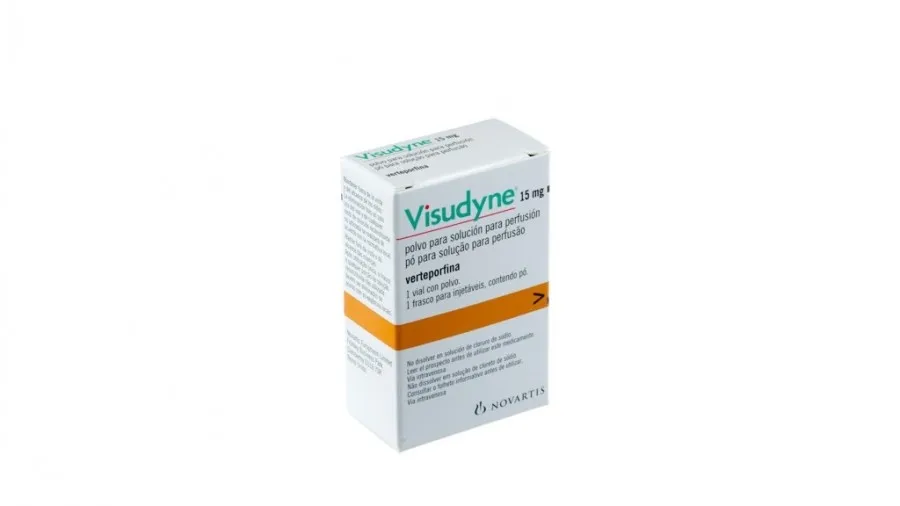
Table of Contents
- Package leaflet: Information for the user
- Visudyne 15 mg powder for solution for infusion
- 1. What Visudyne is and what it is used for
- 2. What you should know before using Visudyne
- 3. How Visudyne is used
- 4. Possible side effects
- 5. How to store Visudyne
- 6. Package contents and other information
- The following information is intended for healthcare professionals only:
Package leaflet: Information for the user
Visudyne 15 mg powder for solution for infusion
verteporfin
Please read this leaflet carefully before you start using this medicine because it contains important information for you.
- Keep this leaflet. You may need to read it again.
- If you have any questions, ask your doctor, pharmacist or nurse.
- This medicine has been prescribed for you only. Do not give it to other people, even if they have the same symptoms as you, because it could be harmful.
- If you experience any side effects, including those not listed in this leaflet, tell your doctor, pharmacist or nurse. See section 4.
Contents of this leaflet:
- What Visudyne is and what it is used for
- What you need to know before using Visudyne
- How Visudyne is used
- Possible side effects
- How to store Visudyne
- Contents of the pack and other information
1. What Visudyne is and what it is used for
What Visudyne is
Visudyne contains the active substance verteporfin, which is activated by laser light in a treatment
called photodynamic therapy. When you receive a Visudyne infusion, it circulates throughout your body
via the blood vessels, including those in the back of the eye. When laser light is directed into the eye,
Visudyne becomes activated.
What Visudyne is used for
Visudyne is indicated for the treatment of the wet form of age-related macular degeneration and
pathological myopia.
These conditions cause a decline in vision. The visual loss is due to the growth of new blood vessels
(choroidal neovascularization) that damage the retina (the light-sensitive layer lining the back of the eye).
There are two types of choroidal neovascularization: classic and occult.
Visudyne is indicated for the treatment of predominantly classic forms of choroidal neovascularization
in adults with age-related macular degeneration, and also for the treatment of all types of choroidal
neovascularization in adults with pathological myopia.
2. What you should know before using Visudyne
Do not use Visudyne
- if you are allergic to verteporfin or to any of the other ingredients of this medicine (listed in section 6).
- if you have porphyria (a rare disease that may increase light sensitivity).
- if you have any severe liver problems. If any of the above conditions apply to you, inform your doctor. You must not take Visudyne.
Warnings and precautions
Talk to your doctor, pharmacist, or nurse before using Visudyne.
- If you experience any problems or symptoms related to the infusion during or after treatment, such as chest pain, sweating, dizziness, skin rash, shortness of breath, flushing, irregular heartbeat, or seizures, contact your doctor or healthcare provider immediately, as it may be necessary to stop the infusion and treat your condition urgently. Infusion-related problems may also include sudden loss of consciousness.
- If you have any liver problems or a blocked bile duct, inform your doctor before starting treatment with Visudyne.
- If Visudyne leaks out of the vein during infusion, and especially if the affected area is exposed to light, this may cause pain, swelling, blistering, and skin discoloration in the affected area. If this occurs, the infusion must be stopped and the skin cooled with ice and completely protected from light until the discoloration resolves. You may need to take a pain reliever.
- After receiving Visudyne, you will be sensitive to light for 48 hours following the infusion. During this time, avoid direct sunlight, intense artificial light such as tanning lamps, halogen lamps, high-intensity operating room or dental office lights, or light emitted by medical devices such as pulse oximeters (used to measure blood oxygen levels). If you need to go outdoors during the first 48 hours after treatment, protect your skin and eyes by wearing protective clothing and dark sunglasses. Sunscreens do not provide adequate protection. Normal indoor lighting does not pose a risk.
- Do not stay in the dark, as exposure to indoor lighting will help your body eliminate Visudyne more quickly.
- If you develop any eye problems after treatment, such as vision loss, discuss this with your doctor.
Other medicines and Visudyne
Inform your doctor, nurse, or pharmacist if you are taking, have recently taken, or might take any other medicines.
Inform your doctor or pharmacist if you are taking any of the following medicines, as they may increase light sensitivity:
- tetracyclines or sulfonamides (used to treat bacterial infections),
- phenothiazines (used to treat psychiatric disorders or nausea and vomiting),
- sulfonylureas (used to treat diabetes),
- medicines used to lower blood sugar levels,
- thiazide diuretics (used to reduce high blood pressure),
- griseofulvin (used to treat fungal infections),
- calcium channel blockers (used to treat high blood pressure, angina, and abnormal heart rhythms),
- antioxidants such as beta-carotene or medicines that can remove or inactivate free radicals (such as dimethyl sulfoxide (DMSO), formate, mannitol, and alcohol),
- vasodilators (used to widen blood vessels by relaxing smooth muscle),
- or if you are about to undergo radiotherapy.
Pregnancy and breastfeeding
- Experience with the use of Visudyne in pregnant women is very limited. It is important to inform your doctor if you are pregnant, think you may be pregnant, or are planning a pregnancy. You should only use Visudyne if your doctor considers it absolutely necessary.
- Verteporfin passes into breast milk in small amounts. Inform your doctor if you are breastfeeding; he or she will decide whether you should continue taking Visudyne. It is recommended that, if you have received Visudyne, you do not breastfeed for 48 hours after administration.
Ask your doctor or pharmacist for advice before taking any medicine.
Driving and using machines
After treatment with Visudyne, you may experience visual disturbances, such as abnormal or reduced vision, which may be temporary. If this occurs, do not drive or operate tools or machinery until your vision has improved.
Visudyne contains small amounts of butylated hydroxytoluene (E321)
This excipient is irritating to the eyes, skin, and mucous membranes. If you come into direct contact with Visudyne, you must thoroughly wash the affected area with plenty of water.
3. How Visudyne is used
Treatment with Visudyne is a two-step process
- First, your doctor or pharmacist will prepare the Visudyne solution for infusion. The administration will be performed by the doctor or healthcare professional as an intravenous infusion (into a vein).
- The second step is the activation of Visudyne in the eye, which occurs 15 minutes after the start of the infusion. The doctor will place a special contact lens in your eye and treat it using a specific laser. It takes 83 seconds to deliver the required dose of activating light to Visudyne. During this time, you must follow the doctor's instructions and keep your eye still.
If necessary, Visudyne treatment may be repeated every 3 months, up to 4 times per year.
Use in children
Visudyne is a treatment intended only for adults and is not indicated for use in children.
If you use more Visudyne than you should
An overdose of Visudyne may prolong the time during which you are light-sensitive, and you may need to follow the instructions in section 2 regarding protection for a period longer than 48 hours. Your doctor will inform you.
An overdose of Visudyne combined with light treatment in the eye may cause a severe decrease in vision.
If you have any doubts about how to use this medicine, consult your doctor or pharmacist.
4. Possible side effects
Like all medicines, this medicine can cause side effects, although not everybody gets them.
Some side effects can be serious:
Common (may affect up to 1 in 10 people)
- Eye disorders: severe decrease in vision (loss of 4 or more lines within 7 days of treatment), visual disturbances such as blurred, hazy or fuzzy vision, light flashes, visual loss, and changes in the visual field of the treated eye such as dark or grey shadows, blind spots or black spots.
- General disorders: hypersensitivity (allergic reactions), syncope (fainting), headache, sensation of emptiness in the head, breathing difficulties.
Uncommon (may affect up to 1 in 100 people)
- Eye disorders: bleeding of the retina or vitreous (the transparent gel-like substance filling the eyeball behind the lens), swelling or fluid retention in the retina, and retinal detachment in the treated eye.
- Infusion site reactions: as with other types of injection, some patients have experienced bleeding at the infusion site, skin discoloration, and hypersensitivity. If this occurs, there will be increased sensitivity to light in that area of skin until the green discoloration disappears.
- General disorders: skin rash, urticaria, pruritus.
Rare (may affect up to 1 in 1,000 people)
- Eye disorders: lack of blood circulation in the retina or choroid (the vascular layer of the eye) in the treated eye.
- General disorders: feeling unwell.
Not known (frequency cannot be estimated from the available data)
- Eye disorders: rupture in the pigmented layer of the retina, swelling or fluid accumulation in the macula.
- General disorders: vasovagal reactions (fainting), sweating, flushing, changes in blood pressure have been reported. In rare cases, vasovagal and hypersensitivity reactions may be serious and could potentially include seizures.
- Heart attack has been reported, particularly in patients with a history of heart disease, sometimes within 48 hours after Visudyne treatment. In case of suspected heart attack, contact your doctor immediately.
- Localized death of skin tissue (necrosis).
If any of these symptoms occur, inform your doctor immediately.
Other side effects:
Common (may affect up to 1 in 10 people)
- Infusion site reactions: as with other types of injection, some patients may experience pain, swelling, inflammation, and exudation at the infusion site.
- General disorders: feeling of sickness (nausea), sunburn-like reactions, fatigue, infusion-related reaction, mainly manifested as back or chest pain, and increased cholesterol levels.
Uncommon (may affect up to 1 in 100 people)
- General disorders: pain, increased blood pressure, increased sensitivity, and fever.
Not known (frequency cannot be estimated from the available data)
- Infusion site reactions: as with other types of injection, some patients have developed blisters.
- General disorders: changes in heart rate. A reaction at the infusion site that may spread to other areas, including but not limited to the pelvis, scapulae, or chest.
Reporting of side effects
If you experience any side effect, including those not listed in this leaflet, talk to your doctor, pharmacist, or nurse. You can also report side effects directly via the national reporting system listed in Annex V. By reporting side effects, you can help provide more information on the safety of this medicine.
5. How to store Visudyne
Keep this medicine out of the sight and reach of children.
Do not use this medicine after the expiry date stated on the carton and vial after 'Exp.'/'EXP'. The expiry date refers to the last day of that month.
Do not store above 25°C. Keep the vial in the outer packaging to protect the medicine from light.
The chemical and physical stability of the reconstituted medicine has been demonstrated at 25°C for up to 4 hours. From a microbiological standpoint, the medicine should be used immediately. If not used immediately, the user is responsible for the storage time and conditions of the reconstituted medicine prior to use. Normally, the reconstituted medicine, protected from light and stored at a temperature not exceeding 25°C, should not be kept for longer than 4 hours.
6. Package contents and other information
What Visudyne contains
- The active substance is verteporfin. Each vial contains 15 mg of verteporfin. After reconstitution, 1 ml contains 2 mg of verteporfin. 7.5 ml of reconstituted solution contain 15 mg of verteporfin.
- The other components are dimyristoyl phosphatidylcholine, egg phosphatidylglycerol, ascorbyl palmitate, butylated hydroxytoluene (E321), and monohydrate lactose.
Description of the appearance of Visudyne and contents of the pack
Visudyne is supplied as a dark green to black powder in a clear glass vial.
Before use, the powder is reconstituted with water to form a dark green opaque solution.
Visudyne is supplied in a pack containing 1 vial of powder.
Marketing Authorization Holder
CHEPLAPHARM Arzneimittel GmbH
Ziegelhof 24
17489 Greifswald
Germany
Manufacturer
Delpharm Huningue S.A.S.
26 rue de la Chapelle
68330 Huningue
France
CHEPLAPHARM Arzneimittel GmbH
Ziegelhof 23-24
17489 Greifswald
Germany
Further information
More detailed information on this medicinal product is available on the website of the European Medicines Agency: http://www.ema.europa.eu
The following information is intended for healthcare professionals only:
Reconstitute Visudyne with 7.0 ml of water for injections to obtain 7.5 ml of a 2.0 mg/ml solution.
After reconstitution, the Visudyne solution is opaque and dark green in color.
The solution should be inspected visually before administration to detect any particulate matter or discoloration.
For a dose of 6 mg/m² of body surface area (recommended dose for treatment), dilute the required amount of Visudyne solution in 50 mg/ml (5%) glucose solution for infusion to a final volume of 30 ml.
Do not use sodium chloride solution.
Use of a standard in-line filter with a hydrophilic membrane (e.g., polyethersulfone) having a pore size of at least 1.2 μm is recommended.
For storage conditions, see section 5 of this leaflet.
After use, the vial and any remaining reconstituted solution must be discarded.
In case of spillage, collect the spilled material and wipe up residues with a damp cloth.
Avoid contact with eyes and skin. Use of rubber gloves and eye protection is recommended.
Any unused medicine and waste material resulting from this medicine should be disposed of in accordance with local regulations.