Vicks cough sedative
Italy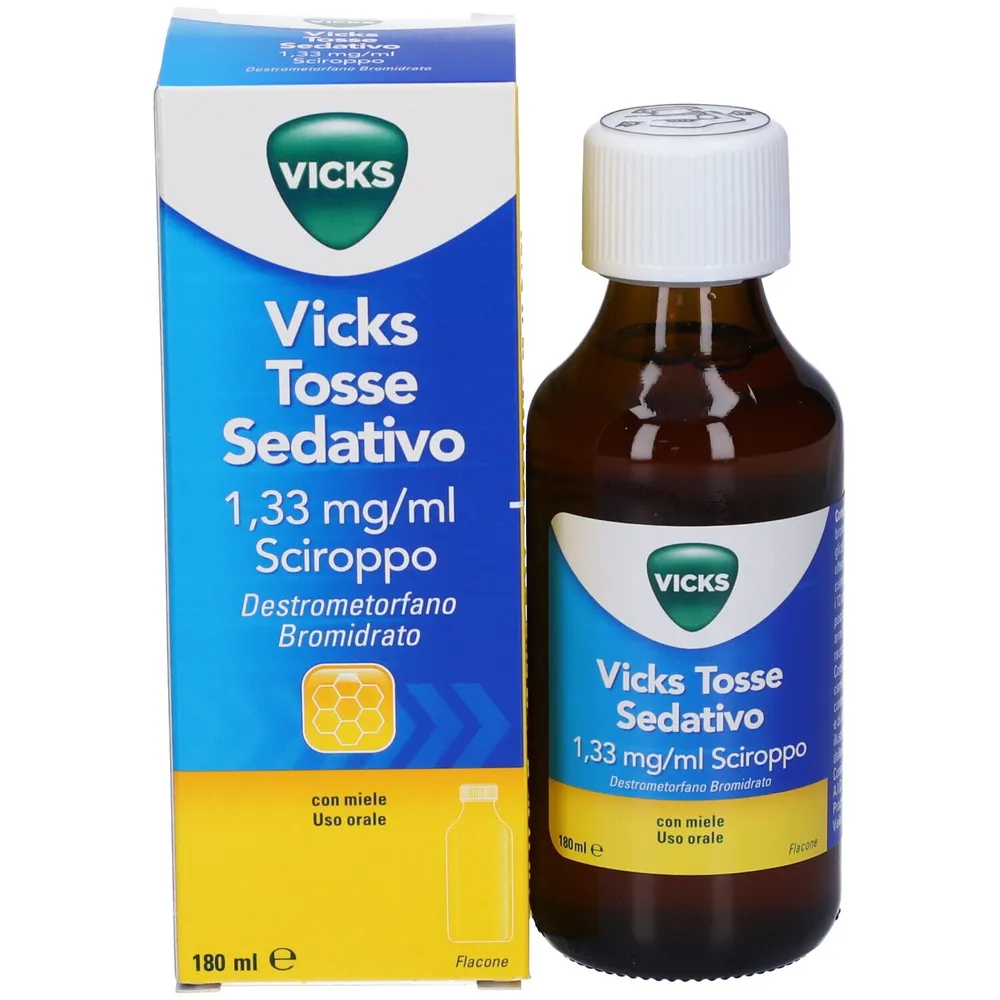
Table of Contents
- Patient Information Leaflet
- Vicks Cough Suppressant
- 1. What Vicks Cough Suppressant is and what it is used for
- 2. What you need to know before taking Vicks Cough Suppressant
- 3. How to take Vicks Cough Suppressant
- 4. Possible side effects
- 5. How to store Vicks Cough Suppressant
- 6. Package contents and other information
Patient Information Leaflet
Vicks Cough Suppressant
1.33 mg/ml syrup
dextromethorphan hydrobromide
Please read all of this leaflet carefully before taking this medicine because it contains
important information for you.
Always use this medicine exactly as described in this leaflet or as your doctor or
pharmacist has instructed.
- Keep this leaflet. You may need to read it again.
- If you need further information or advice, consult your pharmacist.
- If you experience any of the side effects, including those not listed in this leaflet, consult your doctor or pharmacist. See section 4.
- Consult your doctor if you do not notice any improvement or if your symptoms worsen after 5–7 days.
Contents of this leaflet:
- What Vicks Cough Suppressant is and what it is used for
- What you need to know before taking Vicks Cough Suppressant
- How to take Vicks Cough Suppressant
- Possible side effects
- How to store Vicks Cough Suppressant
- Contents of the pack and other information
1. What Vicks Cough Suppressant is and what it is used for
Vicks Cough Suppressant contains dextromethorphan bromide, a substance that helps relieve
dry cough.
Consult your doctor if you do not feel better or if you feel worse after 5–7 days.
2. What you need to know before taking Vicks Cough Suppressant
This medicine may lead to dependence. Therefore, treatment should be short-term only.
Do not take Vicks Cough Suppressant
- if you are allergic to the active substance or to any of the other ingredients of this medicine (listed in section 6);
- during and within two weeks after treatment with medicines used for depression, called monoamine oxidase inhibitors (MAOIs);
- if you suffer from asthma, chronic obstructive pulmonary disease (COPD – chronic lung disease), pneumonia, breathing difficulties or respiratory depression;
- if you have cardiovascular diseases or suffer from high blood pressure;
- if you suffer from hyperthyroidism (increased thyroid function);
- if you have diabetes;
- if you suffer from increased pressure inside the eye (glaucoma);
- if you have urinary disorders caused by prostate enlargement or other obstructions of genital organs or urinary tract;
- if you have obstructions of the esophagus, stomach or intestine;
- if you have severe liver disease;
- if you suffer from epilepsy;
- if you are pregnant, especially during the first trimester (see section “Pregnancy, breastfeeding and fertility”);
- if you are breastfeeding (see section “Pregnancy, breastfeeding and fertility”); Do not give Vicks Cough Suppressant to children under 12 years of age.
Talk to your doctor or pharmacist before taking Vicks Cough Suppressant:
If you are taking medicines such as certain antidepressants or antipsychotics: Vicks Cough Suppressant
may interact with these medicines and cause changes in mental status (e.g.
agitation, hallucinations, coma) and other effects such as body temperature above 38°C, increased
heart rate, unstable blood pressure, exaggerated reflexes, muscle rigidity,
lack of coordination and/or gastrointestinal symptoms (e.g. nausea, vomiting, diarrhoea).
Warnings and precautions
Consult your doctor or pharmacist before taking Vicks Cough Suppressant.
Exercise particular caution and seek medical advice before taking Vicks Cough Suppressant if:
- your kidney or liver function is impaired (especially if severely compromised);
- you have persistent, irritating cough with significant mucus (phlegm) production or accompanied by fever, rash, headache, nausea and vomiting;
- you have reduced capacity to metabolize certain drugs, leading to increased toxicity.
Exercise particular caution with prolonged use of this medicine, as tolerance, dependence and physical and psychological addiction may occur (see section “Possible side effects”). Consult your doctor if you do not obtain noticeable improvement after a short period of treatment (5–7 days), if the condition recurs repeatedly, or if you have noticed any recent change in its characteristics.
Other medicines and Vicks Cough Suppressant
Inform your doctor or pharmacist if you are taking, have recently taken or might take
any other medicine.
Do not take this medicine during and within two weeks after treatment with certain medicines
used for depression called monoamine oxidase inhibitors (MAOIs). See also section
“Do not take Vicks Cough Suppressant”.
In particular, inform your doctor if you are taking or have recently taken:
- medicines for depression such as fluoxetine, paroxetine, sertraline and bupropion (see section 2 “Do not take Vicks Cough Suppressant”);
- medicine used to treat severe pain or to reduce withdrawal symptoms in cases of dependence (methadone);
- medicines for psychiatric disorders (haloperidol, thioridazine, perphenazine);
- medicines for heart rhythm disorders (amiodarone, quinidine, propafenone);
- medicines for heart rhythm abnormalities (flecainide);
- medicines to reduce calcium levels in the blood and to treat dysfunction due to reduced secretion of the hormone regulating these levels (hyperparathyroidism), such as cinacalcet;
- medicines used to prevent fungal (mould) growth (terbinafine);
- antibacterial medicines such as linezolid;
- anti-obesity medicines such as sibutramine;
- hypnotic, sedative or anxiolytic* medicines. *Concomitant use of Vicks Cough Suppressant and sedative medicines such as benzodiazepines or related drugs increases the risk of drowsiness, breathing difficulties (respiratory depression) and coma, potentially endangering the patient's life. For this reason, concomitant use should only be considered when no alternative treatment options are available. However, if your doctor prescribes Vicks Cough Suppressant together with sedative medicines, the dose and duration of concomitant treatment must be limited by the doctor. Inform your doctor about all sedative medicines you are taking and follow your doctor's instructions carefully. It may be helpful to inform friends or relatives to watch for the signs and symptoms listed above. Contact your doctor if you experience these symptoms.
Vicks Cough Suppressant with drinks and alcohol
Avoid consuming alcohol while taking Vicks Cough Suppressant.
Be cautious with grapefruit juice as it may increase the absorption of the medicine, thereby increasing its toxicity and reducing its effectiveness.
Pregnancy, breastfeeding and fertility
If you are pregnant, suspect you may be pregnant, planning to become pregnant, or are breastfeeding, consult your doctor or pharmacist before taking this medicine.
Pregnancy
Do not use Vicks Cough Suppressant during the first trimester of pregnancy. In later months, take this medicine only if clearly needed and under medical supervision.
Breastfeeding
Do not use Vicks Cough Suppressant while breastfeeding, as it is unknown whether the drug passes into breast milk.
Driving and using machines
Vicks Cough Suppressant may impair your ability to drive or operate machinery due to drowsiness that may occur during treatment, especially when taken together with alcohol or other medicines that may slow reaction times.
Vicks Cough Suppressant contains
- sucrose and invert sugar (honey): if your doctor has diagnosed you with an intolerance to certain sugars, contact him before taking this medicine. This medicine contains approximately 5.55 g of sucrose (sugar) and 0.570 g of invert sugar (honey) per 15 ml dose of syrup. This should be taken into account in people with diabetes mellitus or those on low-calorie diets.
- ethanol (alcohol): this medicine contains 5 vol % ethanol (alcohol), e.g. up to 592 mg per 15 ml dose, equivalent to less than 15 ml of beer or 6 ml of wine per 15 ml dose of syrup. The small amount of alcohol in this medicine is unlikely to have any significant effect.
- sodium: this medicine contains 28.2 mg of sodium (main component of table salt) per 15 ml dose. This corresponds to 1.40% of the maximum daily dietary intake recommended for an adult;
- propylene glycol: this medicine contains 850.50 mg of propylene glycol per 15 ml of syrup. If you are pregnant or breastfeeding, do not take this medicine unless otherwise recommended by your doctor. Your doctor may perform additional monitoring during treatment. If you suffer from liver or kidney disease, do not take this medicine unless otherwise recommended by your doctor. Your doctor may perform additional monitoring during treatment.
- sodium benzoate: this medicine contains 15 mg of sodium benzoate per 15 ml dose of syrup.
- honey: honey is a source of phenylalanine. It may be harmful to you if you have phenylketonuria, a rare genetic disorder causing accumulation of phenylalanine because the body cannot eliminate it.
3. How to take Vicks Cough Suppressant
Use this medicine exactly as stated in this leaflet or as instructed by your doctor or pharmacist. If you have any doubts, consult your doctor or pharmacist.
Adults and adolescents over 12 years
The recommended dose is 15 ml of syrup.
This dose may be repeated every 6 hours, up to 4 times a day.
Do not exceed the recommended dose.
Use the graduated dosing cup supplied with the package.
Do not take Vicks Cough Suppressant for more than 5–7 days.
If no noticeable improvement occurs after a short period of treatment, consult your doctor.
Children under 12 years
Dextromethorphan must not be used.
If you take more Vicks Cough Suppressant than you should
In case of accidental ingestion or incorrect use of the medicine, contact your doctor or go to the nearest hospital immediately.
If you take more Vicks Cough Suppressant than recommended, the following symptoms may occur: nausea and vomiting, involuntary muscle contractions, agitation, confusion, drowsiness, cognitive disturbances, involuntary and rapid eye movements, cardiac disorders (increased heart rate), coordination problems, psychosis with visual hallucinations and hyperexcitability.
Additional symptoms in case of massive overdose may include: coma, severe breathing difficulties, and seizures.
In extreme cases, difficulty urinating and breathing may occur.
Seek immediate medical attention at a doctor’s office or hospital if any of the above symptoms occur.
4. Possible side effects
Like all medicines, this medicine can cause side effects, although not everyone experiences them.
Possible side effects include:
Common (may affect up to 1 in 10 people)
- dizziness
- nausea;
- vomiting;
- gastrointestinal disturbances of the stomach and intestine;
- loss of appetite;
- fatigue. Rare (may affect up to 1 in 1,000 people)
- skin rashes;
- drowsiness. Very rare (may affect up to 1 in 10,000 people)
- Hallucinations. Not known (frequency cannot be estimated from the available data)
- hypersensitivity reactions, including anaphylactic reaction;
- swelling of the face, hands and feet, eyes, lips, larynx and/or tongue (angioedema);
- urticaria;
- pruritus;
- rash;
- erythema;
- diabetes mellitus;
- psychosis;
- very high fever (hyperpyrexia).
Reporting of side effects
If you experience any side effect, including those not listed in this leaflet, consult your doctor or pharmacist.
You can also report side effects directly via the national reporting system at: https://www.aifa.gov.it/content/segnalazioni-reazioni-avverse.
By reporting side effects, you can help provide more information on the safety of this medicine.
5. How to store Vicks Cough Suppressant
Keep this medicine out of the sight and reach of children.
Store below 25°C.
Do not use this medicine after the expiry date stated on the packaging after "Exp.".
The expiry date refers to the last day of that month.
Do not dispose of any medicine via wastewater or household waste. Ask your pharmacist how to
discard medicines no longer in use. This will help protect the environment.
6. Package contents and other information
What Vicks Cough Suppressant contains
- The active substance is dextromethorphan hydrobromide. 1 ml of product contains 1.33 mg (0.133% w/v) of dextromethorphan hydrobromide.
- The other components are: sucrose, sodium saccharin, propylene glycol, ethanol 96 percent, sodium croscarmellose, sodium citrate, citric acid, honey flavour (containing honey), verbena flavour, sodium benzoate, macrogol, menthyl isopropylidene glycerol, macrogol stearate type I, purified water.
Description of the appearance of Vicks Cough Suppressant and package contents
Vicks Cough Suppressant is available in opaque glass bottles of 120 ml and 180 ml with child-resistant safety cap and a graduated dosing cup made of polypropylene.
Marketing Authorization Holder and Manufacturer
Marketing Authorization Holder
Procter & Gamble S.r.l. - Viale Giorgio Ribotta, 11 - 00144 Rome, Italy
Manufacturer
Procter & Gamble Manufacturing GmbH, Procter-&-Gamble Strasse 1, 64521 Gross-Gerau, Germany.